Paddle Boards
The Best Touring Paddle Boards (November 2026)
Every other board page on this site ranks on width, because width is what gets a beginner standing. This one ranks on length, because length is what gets you somewhere.
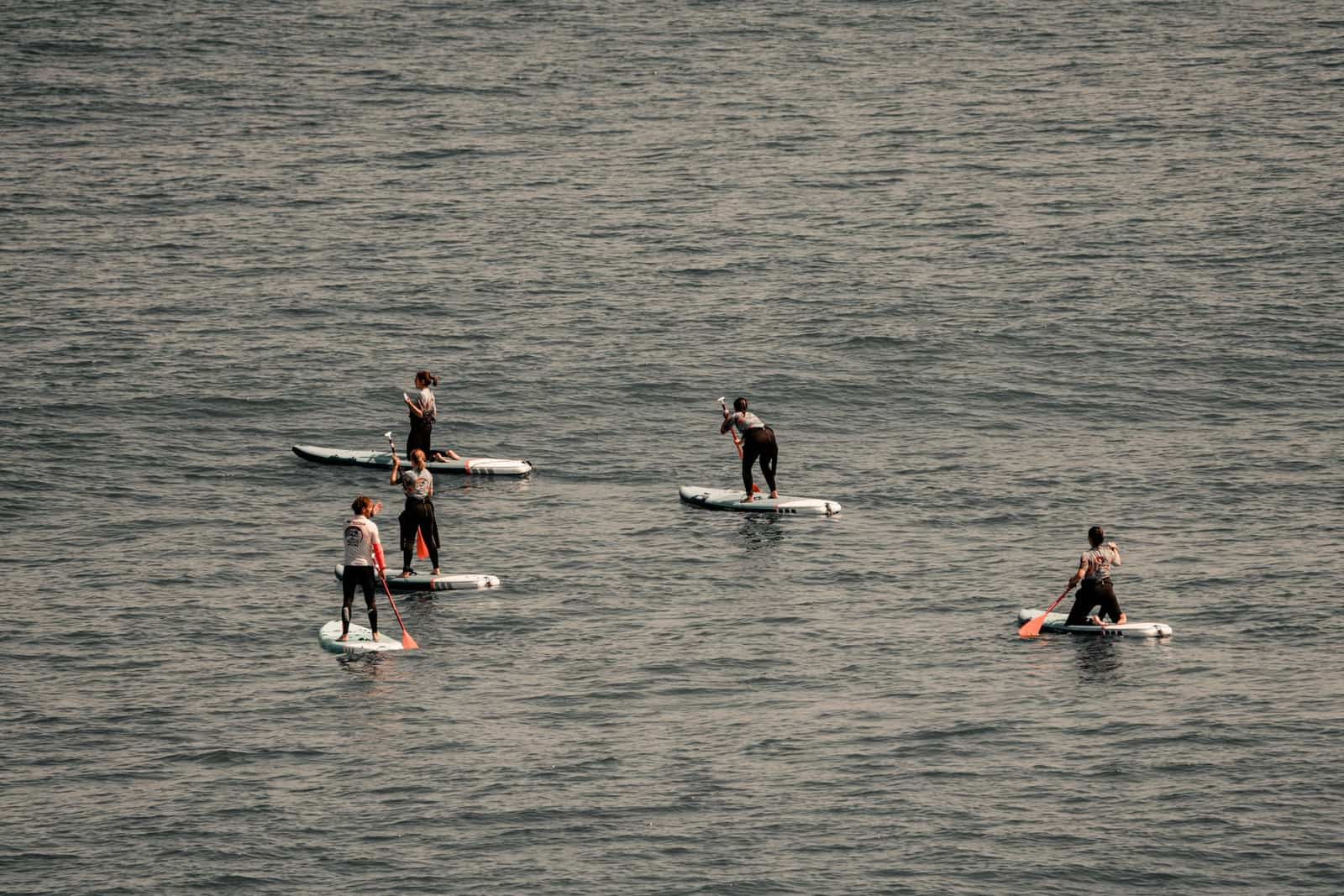
We have not paddled these, and we are not going to pretend we have. Here is what we did instead. Links to Amazon earn us a commission at no extra cost to you, and commission never decides a pick — how this site is funded.
| # | Product | Best for | The spec it turns on | Price |
|---|---|---|---|---|
| 1 | 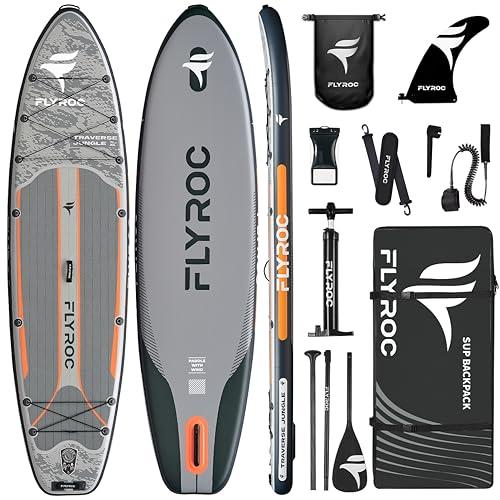 Flyroc 11 ft 6 in x 35 in Inflatable Paddle BoardTop pickA foot more waterline than the all-around boards with no narrowing to pay for it, and the highest rated capacity of any board here bar one. The published 18 lb is the figure to treat with some caution. | Distance without giving up width | 138 x 35 x 6 in, 18 lb board weight, 450 lb rated capacity, 15 D-rings | |
| 2 | 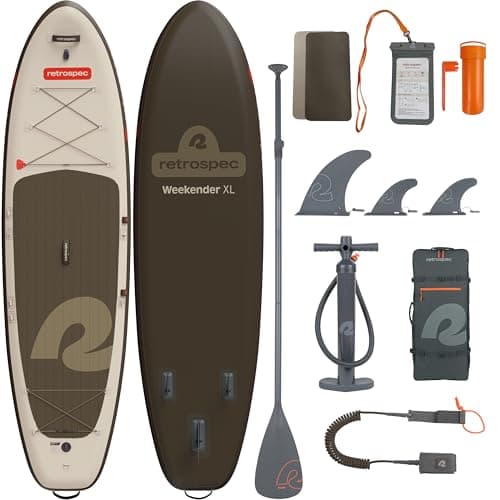 Retrospec Weekender XL Inflatable Paddle Board, 11 ftEight inches of drop-stitch instead of the usual six, which is where the stiffness to carry two people comes from. 400 lb recommended is the highest limit here that still belongs to a board one person can carry. | Two adults who want one board, not a raft | 11 ft x 35 in x 8 in inflated, 31 lb with fins, 400 lb recommended weight limit, 3 removable tracking fins, 12-15 PSI, 11 D-rings | |
| 3 | 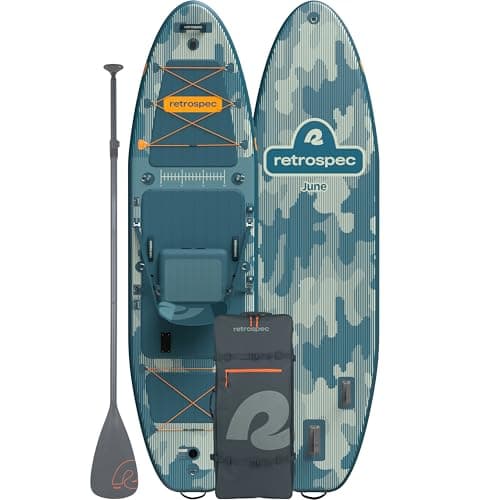 Retrospec June Inflatable Fishing Paddle Board, 11 ft 6 inThe removable seat is what makes this useful to a beginner who is not a fisherman: a board you can sit on is a board you keep using when your legs give out or the wind gets up. | Fishing, or paddling seated | 138 x 35 x 6 in, 24.5 lb board weight, 320 lb rated capacity, removable seat and rod holders | |
| 4 | 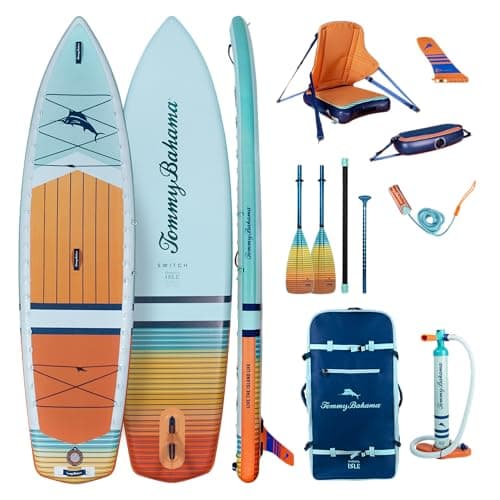 ISLE & Tommy Bahama Switch Inflatable Hybrid Kayak-SUP, 11 ft 6 inThe purpose-built version of the thing people improvise with a clip-on seat: a board designed from the start to be paddled standing or sitting, with the seat and a convertible paddle in the box. It costs several times what the improvised version does. | Someone who genuinely wants both, and will pay for it | 11.6 x 35.5 x 6 in inflated, 425 lb maximum; ships as a 2-in-1 bundle with seat, paddle, pump and travel bag | |
| 5 | 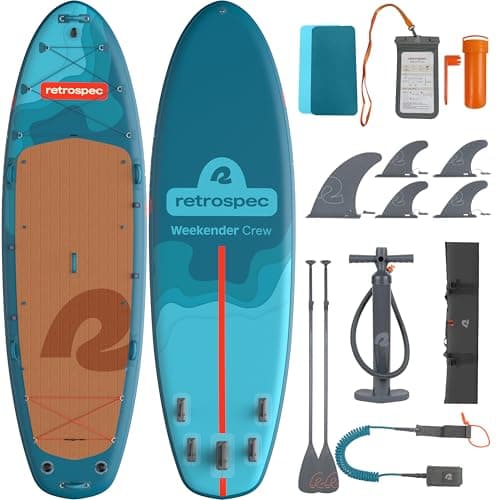 Retrospec Weekender Crew Multi-Person Inflatable Paddle Board, 12 ftThe only board here actually designed for more than one paddler: five fins instead of three, more grab handles, and two paddles in the box. The capacity figure is the catch, because the maker and the listing do not agree on it. | A household that wants everyone on one board | 12 ft, about 36 lb, five slide-in fins, ships with a pair of 3-piece 63-84 in paddles and a dual-action pump; Retrospec states up to 500 lb and 2 to 3 paddlers, the Amazon listing states 400 lb for the 12 ft size |
With that said, the reason this page exists is that length is the most under-explained specification in paddle boarding and the one that changes the most about how a day on the water feels. Our other ten board pages rank on width, volume, weight and price, because those decide whether a beginner can stand up. Once you can stand up, the question changes to how far you can go before you are bored or tired, and that is a length question.
What length actually buys you
A longer board has more waterline, and more waterline means the board tracks straighter and carries its speed further between strokes. Practically, a 10 ft 6 in all-around board wanders slightly with every stroke and needs a correction every few strokes; an 11 ft 6 in board holds its line and lets you fall into a rhythm. Over twenty minutes that is a mild preference. Over two hours it is the difference between a paddle and a workout you did not sign up for.
Length also helps in wind, which is the thing that most often ruins a flat-water outing. A short board pivots around its center and gets pushed broadside; a long one resists that. Neither is immune, and our first time on the water page is blunt about why you check the forecast rather than the board.
What length costs is turning and storage. An 11 ft 6 in board does not spin on the spot the way a 10 ft board does, which matters on a twisty river -- the river roundup is the page for that. And when deflated, a longer board makes a bigger, heavier roll, which is the one place the inflatable advantage narrows.
How we judged these
- **Published length first.** Anything under 11 ft is not on this page. That is the whole premise and it is the one specification every listing here publishes honestly.
- **Then width, because distance is no good if you cannot stand.** Every board here is 35 in or wider, which is unusual for a long board and is why these particular long boards suit a first or second season. A 30 in touring board is faster and will put a beginner in the water.
- **Then rated capacity through the volume arithmetic,** because a long board that is overloaded sits low and stops gliding, which defeats the point of buying length.
- **Then board weight.** A long board is carried further from the car than a short one, for the simple reason that distance paddlers launch where there is room. 18 lb and 36 lb are very different propositions.
- **Then stiffness, named per board.** A long inflatable flexes in the middle under load, and flex is lost energy. Where a maker publishes a thickness or a construction detail that addresses it, we say so.
The five, side by side
| Board | Length | Width | Board weight | Rated capacity |
|---|---|---|---|---|
| Flyroc 11 ft 6 in | 11 ft 6 in | 35 in | 18 lb | 450 lb |
| Retrospec Weekender XL | 11 ft | 35 in | 31 lb | 400 lb |
| Retrospec June 11 ft 6 in | 11 ft 6 in | 35 in | 24.5 lb | 320 lb |
| ISLE Switch hybrid | 11 ft 6 in | 35.5 in | Not published | 425 lb |
| Retrospec Weekender Crew | 12 ft | Not published | 36 lb | Up to 500 lb |
The Flyroc's 18 lb against the Weekender XL's 31 lb is the most consequential pair of numbers in that table, and it is worth being careful about: the Flyroc's 18 lb figure appears in its dimensions block rather than in a headline specification, which makes it the softer of the two claims. The FEATH-R-LITE's 18.9 lb is the firmest low weight we have found on any board, and it is a 9 ft 10 in board, not a tourer.
Two cells read 'not published' and they stay that way. ISLE does not publish a board weight for the Switch on its listing and Retrospec does not publish a width for the Crew, so this page does not print either. Our sizing page explains why we would rather leave a gap than fill one.
Check the volume against yourself before the length
Length is why you are on this page, but capacity is still what rules a board in or out. A 200 lb paddler on a board rated 320 lb is fine; the same paddler with a dog and a cooler is not, and an overloaded long board sits deep and loses exactly the glide you bought it for.
| Your weight | Loaded weight | Minimum volume | Comfortable volume | Width |
|---|---|---|---|---|
| 120 lb | 135 lb | 135 L | 159 L | 32 in |
| 140 lb | 155 lb | 155 L | 183 L | 32 in |
| 160 lb | 175 lb | 175 L | 206 L | 33 in |
| 180 lb | 195 lb | 195 L | 230 L | 33 in |
| 200 lb | 215 lb | 215 L | 254 L | 34 in |
| 220 lb | 235 lb | 235 L | 277 L | 34 in |
| 250 lb | 265 lb | 264 L | 313 L | 35 in |
| 280 lb | 295 lb | 294 L | 348 L | 35 in |
Our weight limits page covers what actually happens as you approach a board's rating, and it is not a cliff -- it is a gradual loss of freeboard and glide, which on a distance board you feel sooner than on a short one.
Stiffness is the specification that separates these
On a 10 ft board, flex is a minor annoyance. On an 11 or 12 ft board it is the main engineering problem, because the longer the span between your feet and the ends, the more the board can hinge in the middle under load. A board that hinges absorbs the energy you are putting into the paddle, which is why two boards of identical length can feel completely different to paddle.
The Retrospec Weekender XL is the only board here with a published 8 in drop-stitch core rather than the usual 6 in, and that is the single most direct answer to the flex problem on this page. It is also the heaviest solo board here at 31 lb, which is not a coincidence -- stiffness is bought with material. Inflation pressure matters at least as much: 12 to 15 PSI is the Weekender XL's published range and a board at 8 PSI is a different board from the same board at 15. Our pumps page explains why a gauge is not optional on a long board.
The two that are not really distance boards
Two picks here earn their place on length but are bought for another reason, and it would be dishonest to rank them without saying so. The Retrospec June is a fishing board -- 11 ft 6 in of it, which is why it is here, but its 320 lb rating is the lowest on the page and its value is the sit-down setup covered on our fishing page. The ISLE Switch is a kayak-SUP hybrid, and the reason to want 11 ft 6 in of it is that you can sit down and paddle it like a boat when your legs have had enough, which on a long day is a real feature. Using a board as a kayak is a whole page on that idea.
The Weekender Crew is the other outlier: 12 ft, the longest here, published for two to three paddlers and up to 500 lb. It is on this page because length is the premise, but nobody buys a 12 ft multi-person board to cover distance alone -- two people on one board is the page that covers what it is actually for.
What a long board needs that a short one does not
- **A paddle set properly, every time.** Distance magnifies a badly sized paddle into a shoulder injury. What length paddle you need is arithmetic, not preference.
- **A pump with a gauge.** A long board at low pressure flexes, and flex over two hours is fatigue. Pumps and pressure covers the gauge question.
- **A leash, without exception.** On a long board in wind, a board that gets away from you leaves faster than you can swim. SUP leashes covers coiled against straight and ankle against calf.
- **Water and a way to carry it.** A 20 litre dry bag strapped under the front bungee is the normal answer, and distance is the case where it stops being optional.
- **A worn life jacket.** Federal rules treat a paddle board as a vessel outside a designated swimming area, which our life jacket rules page sets out properly.
What you can ignore
- **Fin count.** Three removable fins versus five changes tracking marginally and is not a reason to choose a board. More fins is not more speed.
- **Claimed 'military grade' PVC.** It is a marketing phrase with no published standard behind it, and every board in this bracket uses it.
- **Included paddle quality.** Assume it is a starter paddle on every board here, because it is, and budget accordingly.
- **Bungee D-ring count.** You need four at the front. Everything beyond that is decoration until you are camping off the board.
- **'Touring' in the product name.** As the callout at the top says, at this price it almost always describes length rather than hull shape.
Boards we left off, and why
Every board under 11 ft, which is most of what we cover -- those are on best for beginners and best inflatable, and for a first season on a small lake they remain the better advice. Narrow touring boards in the 28 to 32 in range are the genuine omission: they are faster than anything here and they will put a first-year paddler in the water repeatedly, which is a bad trade for the buyer this site is written for. And hard displacement tourers are absent because we could not verify enough of them in stock to rank honestly.
Questions people actually ask
What is a touring paddle board?
What size paddle board is best for long distance?
Is a longer paddle board harder to control?
Are inflatable boards stiff enough for touring length?
How much does a touring paddle board weigh?
Do I need a longer paddle for a longer board?
Is a touring board worth it for a beginner?
Where these numbers came from
Every figure on this page traces to one of these. Where a number could not be sourced, the page says so rather than estimating it.
- Thurso Surf — What Size Paddle Board Is Right for You (manufacturer, states the weight-in-kg x 2 volume rule and the 32 in beginner width band)
- ISLE Paddle Boards — Paddle Board Size & Weight Chart (manufacturer, published per-model capacities)
- Retrospec — Weekender XL 11 ft inflatable paddle board (manufacturer specification table: 11 ft x 35 in x 8 in inflated, 31 lb with fins, 400 lb recommended weight limit, 3 removable tracking fins, 12-15 PSI, 11 D-rings), read 2026-10-17
- Retrospec — Weekender Crew multi-person inflatable paddle board (manufacturer: 12 ft, about 36 lb, up to 500 lb, 2 to 3 paddlers, five slide-in fins, a pair of 3-piece 63-84 in paddles and a dual-action pump included), read 2026-10-17
- Flyroc 11 ft 6 in x 35 in Inflatable Paddle Board — manufacturer specification as published on the Amazon listing, read 2026-09-02
- Retrospec Weekender XL Inflatable Paddle Board, 11 ft — manufacturer specification as published on the Amazon listing, read 2026-09-02
- Retrospec June Inflatable Fishing Paddle Board, 11 ft 6 in — manufacturer specification as published on the Amazon listing, read 2026-09-02
- ISLE & Tommy Bahama Switch Inflatable Hybrid Kayak-SUP, 11 ft 6 in — manufacturer specification as published on the Amazon listing, read 2026-09-02
- Retrospec Weekender Crew Multi-Person Inflatable Paddle Board, 12 ft — manufacturer specification as published on the Amazon listing, read 2026-09-02
Read next
Best Inflatable
The Best Inflatable Paddle Boards
Inflatable SUPs ranked on width, thickness, capacity and packed weight, with every figure read off the listing.
Top pick
Roc Inflatable Stand Up Paddle Board, 10 ft 6 in x 33 in
The default first inflatable board
#ad · how this is funded · price as of November 25, 2026
Lightest to Carry
The Lightest Paddle Boards, and What a Board Really Weighs
Published board weights run 12.2 to 24.5 lb across the boards we cover — and three of seven publish nothing at all. The lightest boards, and what light costs you.
Top pick
FEATH-R-LITE Inflatable Stand Up Paddle Board, 10 ft 6 in x 31.5 in
The lightest board to carry to the water
#ad · how this is funded · price as of November 25, 2026

What Size Paddle Board Do I Need?
A volume and width calculator that shows its working, and ends in an actual board rather than a chart.
Top pick
Roc Inflatable Stand Up Paddle Board, 10 ft 6 in x 33 in
The default first inflatable board
#ad · how this is funded · price as of November 25, 2026
Flyroc 11'6" x 35": Distance Without Giving Up Width
138 x 35 x 6 in, 450 lb rated and a published 18 lb. A foot more waterline with no narrowing — and two listing figures we would treat carefully.
Top pick
Flyroc 11 ft 6 in x 35 in Inflatable Paddle Board
Distance without giving up width
#ad · how this is funded · price as of November 25, 2026
Can Two People Ride One Paddle Board?
Two adults need about 400 lb rated and 35 in of width. Why most beginner boards cannot do it, and the three that can.
Top pick
Retrospec Weekender XL Inflatable Paddle Board, 11 ft
Two adults who want one board, not a raft
#ad · how this is funded · price as of November 25, 2026
Can You Use a Paddle Board Like a Kayak?
A seat and a convertible paddle turn a board into a sit-down craft. The two parts, the boards they fit, and the three things you give up.
Top pick
Pelican Sit-on-Top Kayak or SUP Seat
A Pelican or Lifetime sit-on-top, or a paddle board
#ad · how this is funded · price as of November 25, 2026