Paddle Boards
The Best Budget Paddle Boards
The entry tier of this category is better than it has any right to be, and every board in it gives something up. Here is what each one gives up, so you can pick the compromise that does not matter to you.

We have not paddled these, and we are not going to pretend we have. Here is what we did instead. Links to Amazon earn us a commission at no extra cost to you, and commission never decides a pick — how this site is funded.
| # | Product | Best for | The spec it turns on | Price |
|---|---|---|---|---|
| 1 | 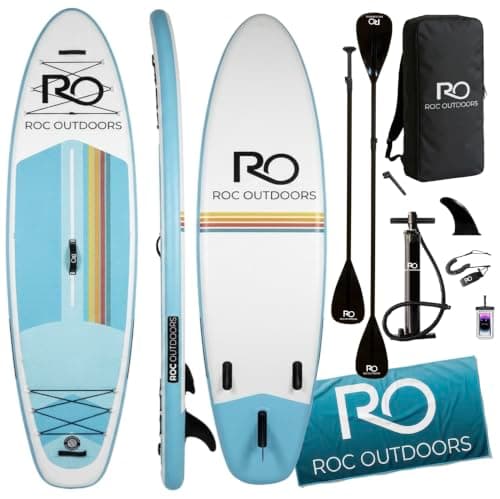 Roc Inflatable Stand Up Paddle Board, 10 ft 6 in x 33 inTop pick10 ft 6 in by 33 in is the shape the whole beginner category converged on, and this is the cheapest version of it that publishes a 350 lb rating. | The default first inflatable board | 126 x 33 x 6 in, 350 lb rated capacity, PVC drop-stitch, full accessory kit | |
| 2 | 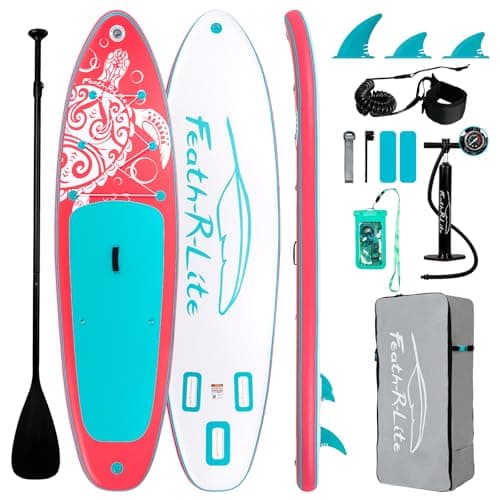 FEATH-R-LITE Inflatable Stand Up Paddle Board, 10 ft 6 in x 31.5 inEighteen and a half pounds is a genuinely low number for a drop-stitch board, and it is the spec that decides whether the board gets carried past the first parking lot. | The lightest board to carry to the water | 118.1 x 31.5 x 5.91 in, 18.9 lb board weight, 330 lb rated capacity | |
| 3 | 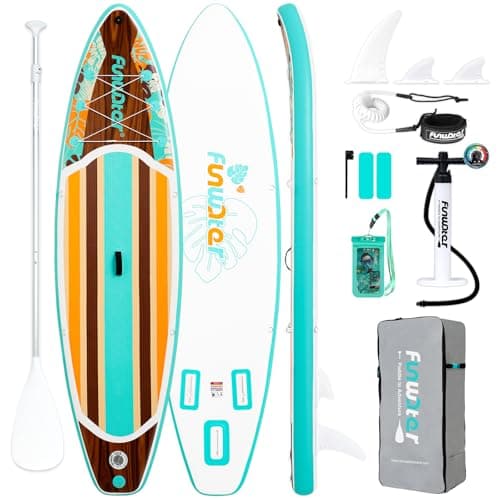 FunWater Inflatable Stand Up Paddle Board, 10 ft 6 in x 35 inThirty-five inches of width in a 10 ft 6 in board is the closest thing to a raft that still paddles like a board, and for a genuinely nervous beginner that is the right trade. | Maximum stability in a standard length | 126 x 35.1 x 6 in, 330 lb rated capacity, PVC drop-stitch |
Budget boards are the reason this category exists. A decade ago a paddle board was a serious purchase; now an entry inflatable with a pump, a paddle and a bag costs roughly what a good bicycle helmet does, and it is a real board. The catch is that the entry tier competes on price, and something has to give to get there. What gives is different on each board, and the listing tells you what.
How we judged these boards
- **The three specs first, no exceptions.** 32 to 34 in wide, 6 in thick, and a published rated capacity of at least your loaded weight divided by 0.65. A budget board that fails any of those is not a bargain; it is a board you will replace.
- **Then the compromise, named.** Every entry board saves money somewhere — an unpublished spec, a narrower deck, a heavier hull, a paddle you will replace. We say exactly where, per board.
- **Then the kit.** At this price the pump, paddle, leash, fin and bag are usually included, and their quality varies. A complete kit is worth something; a kit paddle is worth less than it looks.
- **Never the price itself.** Prices move constantly in this tier and we do not print them. The buy button shows what is live, or says to check.
What cheap does not cost you
This is worth stating because people assume the opposite. A well-specified entry board and a well-specified mid-tier board are, for a flat-water beginner, almost indistinguishable on the water.
- **Construction is largely the same.** PVC drop-stitch at 6 in is the standard, and it is what the entry tier uses. Premium boards add layers and better seams, which matter in year four, not year one.
- **Shape is the same.** 10 ft 6 in by 33 in is what the whole beginner category converged on, and the cheap boards use it.
- **Stability is the same at the same width.** A 33 in budget board and a 33 in premium board are equally hard to fall off.
What cheap does cost you
- **Published information.** The single most consistent thing the entry tier withholds is board weight. Two of the three boards here do not print one. That is a real cost when you are the one carrying it.
- **The paddle.** Entry kits ship with a heavy adjustable aluminum paddle. It works. It is the first thing every owner replaces, and it is the biggest upgrade available at any price.
- **The pump.** Single-stroke hand pumps that take a long time to reach 15 psi. Usable, slow.
- **Longevity you cannot see.** Seams, valves and the deck pad glue are where cheap shows up, and it shows up in season three, not on the listing.
The compromise, board by board
| Board | Width | Rated | Board weight | The compromise |
|---|---|---|---|---|
| Roc 10 ft 6 in | 33 in | 350 lb | not published | Weight unknown; starter paddle and pump |
| FEATH-R-LITE | 31.5 in | 330 lb | 18.9 lb | Half an inch under the beginner width floor; 118 in, not a true 10 ft 6 in |
| FunWater 10 ft 6 in | 35.1 in | 330 lb | not published | Slow and wide; weight unknown |
Read the last column as the decision. If you carry the board a long way, the FEATH-R-LITE's published weight is the compromise you want and its width is the one you accept — as long as you are under about 180 lb. If you are nervous about standing, the FunWater's width is worth its slowness. If neither applies, the Roc is the default for a reason.
Top pick — The default first inflatable board
Roc Inflatable Stand Up Paddle Board, 10 ft 6 in x 33 in
10 ft 6 in by 33 in is the shape the whole beginner category converged on, and this is the cheapest version of it that publishes a 350 lb rating.
What the listing publishes
126 x 33 x 6 in, 350 lb rated capacity, PVC drop-stitch, full accessory kit
Usable at the 65 percent rule: 228 lb (range 210–245 lb), which leaves about 208 lb of paddler after a 20 lb day kit. Why 65 percent.
33 in of width is the number that decides whether you stand up on day one. Our width guidance puts 32 to 33 in as the beginner band for an adult between 150 and 200 lb, and this sits in it.
350 lb rated capacity means about 227 lb of loaded paddler at 65 percent. Applying the displacement arithmetic instead, a 195 lb loaded paddler wants roughly 195 L of volume -- this hull's 126 x 33 x 6 in envelope is comfortably past that.
Six inches of thickness is what makes a modern inflatable stiff. Four-inch boards flex under an adult in the middle and that flex is what people mistake for the board being unstable.
What it does well
- 33 in wide -- the width that gets a first-timer standing rather than kneeling
- 350 lb rating covers an adult with a child or a dog on board
- Ships with pump, paddle, leash and bag, so the listing price is close to the total
What it costs you
- The included paddle and pump are starter parts you will eventually replace
- 10 ft 6 in is a compromise length -- not fast, not especially maneuverable
- The listing does not publish a board weight
Skip this if you already know you want to cover distance. A 10 ft 6 in all-around board is a cruiser and an 11 ft 6 in touring shape is the honest answer for mileage.
#ad · how this is funded · price as of October 9, 2026
Pick 2 — The lightest board to carry to the water
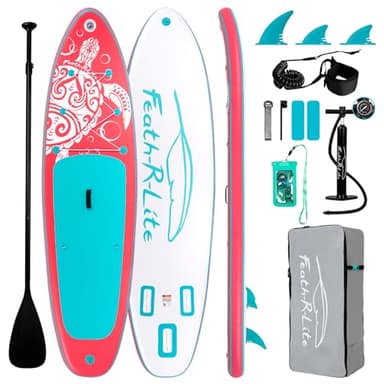
FEATH-R-LITE Inflatable Stand Up Paddle Board, 10 ft 6 in x 31.5 in
Eighteen and a half pounds is a genuinely low number for a drop-stitch board, and it is the spec that decides whether the board gets carried past the first parking lot.
What the listing publishes
118.1 x 31.5 x 5.91 in, 18.9 lb board weight, 330 lb rated capacity
Usable at the 65 percent rule: 215 lb (range 198–231 lb), which leaves about 195 lb of paddler after a 20 lb day kit. Why 65 percent.
330 lb rated is about 215 lb of loaded paddler at 65 percent, which covers most adults with gear.
31.5 in of width is just under our 32 in beginner recommendation. For a paddler under about 150 lb that is fine; for a 200 lb paddler it is the reason to look at the 33 in boards instead.
At 118 in this is closer to a 9 ft 10 in board than a true 10 ft 6 in, despite how the category is marketed. Shorter is more maneuverable and less directionally stable, and the listing's own dimensions are the place to check that rather than the product name.
What it does well
- 18.9 lb published board weight is at the light end of the class
- Rated to 330 lb, so an adult with a day kit has real headroom
- Shorter hull is easier to turn and easier to pack
What it costs you
- 31.5 in is narrower than our 32 in beginner floor for an average adult
- 118 in is shorter than the 10 ft 6 in the category name implies
- Less glide per stroke than a longer board
Skip this if you are over about 180 lb. Half an inch of width sounds trivial and it is the difference between standing and kneeling for a heavier paddler.
#ad · how this is funded · price as of October 9, 2026
Pick 3 — Maximum stability in a standard length
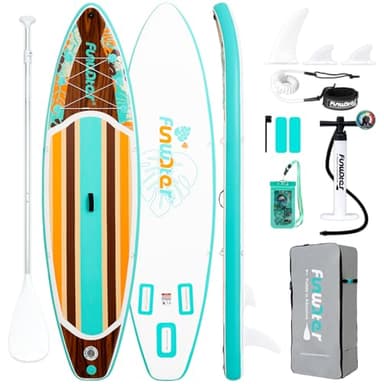
FunWater Inflatable Stand Up Paddle Board, 10 ft 6 in x 35 in
Thirty-five inches of width in a 10 ft 6 in board is the closest thing to a raft that still paddles like a board, and for a genuinely nervous beginner that is the right trade.
What the listing publishes
126 x 35.1 x 6 in, 330 lb rated capacity, PVC drop-stitch
Usable at the 65 percent rule: 215 lb (range 198–231 lb), which leaves about 195 lb of paddler after a 20 lb day kit. Why 65 percent.
35.1 in is above our beginner recommendation for every weight band on the site. Extra width is slower and it is not a mistake -- speed is not the thing standing between a first-timer and a good afternoon.
330 lb rated is about 215 lb of loaded paddler at 65 percent, the same as the FEATH-R-LITE, in a board three and a half inches wider.
Wide boards are harder to reach past when you paddle, so a wide board pushes you toward a slightly longer paddle. Our formula puts a 5 ft 8 in paddler on a 77 in SUP paddle regardless of board, but the reach penalty is real and worth knowing about.
What it does well
- 35.1 in wide -- as stable as an inflatable board gets at this length
- 330 lb rating with room for a child or a dog on the nose
- Full accessory kit included
What it costs you
- Wide is slow, and you will notice against a 31 in board
- Harder to reach the water past the rail, which tires your shoulders
- The listing does not publish a board weight
Skip this if you are reasonably confident on your feet already. Width you do not need is drag you pay for on every stroke.
#ad · how this is funded · price as of October 9, 2026
Check your own number before any of them
The upgrade to make first
If there is money left after the board, it goes on the paddle, and it is not close. The kit paddle is heavy aluminum, the paddle is the thing your hands are on for the entire outing, and a stroke repeats roughly a thousand times an hour. Swapping it changes the board more than any other purchase. What a SUP paddle actually needs to do.
Where budget boards genuinely fail
- **Under a heavy paddler.** The entry tier tops out around 350 lb rated, which is about 227 lb loaded. Above that, the budget class runs out and the boards with real headroom cost more.
- **On open water in wind.** A cheap board and an expensive one catch the same wind. The difference is that the expensive one is stiffer and tracks better. On a big lake with a breeze, that is where you feel the money.
- **In year three.** If the board is still being used regularly after two seasons, seams and valves are where it will show its price. By then you know whether you want a better one.
What we would spend the difference on
The gap between an entry board and a mid-tier one is real money, and if you have it, it is worth asking whether the board is where it should go. For a first season, it usually is not.
- **A life jacket you will keep on.** Legally required, not in any board kit, and the only piece of gear that is ever load-bearing. A paddling-cut vest that does not fight the stroke is worth every dollar it costs over a generic one. What the rules say.
- **A better paddle.** The upgrade that changes the board most, at any price.
- **A pressure gauge you trust.** Most kit pumps have one. If yours reads like a suggestion, a separate gauge is cheap and it ends the is-this-board-soft question permanently.
- **Then, and only then, a better board**, in year two, when you know what your first board got wrong for you.
The used-board question
Buy inflatables new. The parts of an inflatable board that fail are seams, valves and the interior of the drop-stitch chamber, and none of them can be inspected in a driveway. A used hard board is a reasonable purchase; a used inflatable is a gamble on the part you cannot see, and the entry tier is cheap enough that the gamble is not worth taking. Rent or buy, and the used market covers the general case.
The one spec worth paying up for
If you are going to leave the entry tier for exactly one reason, make it a published board weight. It is the spec the entry tier withholds most consistently, it is the one that decides whether the board gets carried past the first parking lot, and a maker that prints it is a maker willing to be measured. Two of the three boards here do not. The FEATH-R-LITE does, at 18.9 lb, and that single printed number is most of why it is on this page.
What you can ignore
- **Brand names.** The entry tier is a small number of factories under a large number of labels. Judge the spec table, not the logo. How to read a listing.
- **Accessory count.** Every kit has a pump, a paddle, a leash, a fin and a bag. Extra items are usually a phone pouch and a repair patch. Not a differentiator.
- **Star ratings.** They pool across sizes and repurposed listings. The published width, thickness and rating are the claims you can check.
- **Warehouse-club boards priced below these.** Sometimes a real bargain, and usually with the spec table missing. The Costco question.
Questions people actually ask
Are cheap paddle boards any good?
What is the best cheap paddle board for beginners?
What should I check on a budget paddle board?
Is the paddle that comes with a cheap board any good?
How long does a budget inflatable paddle board last?
Should I buy a budget paddle board or wait and buy a better one?
Where these numbers came from
Every figure on this page traces to one of these. Where a number could not be sourced, the page says so rather than estimating it.
- Thurso Surf — What Size Paddle Board Is Right for You (manufacturer, states the weight-in-kg x 2 volume rule and the 32 in beginner width band)
- Eddyline Kayaks — Maximum weight capacity versus ideal capacity for various styles of kayaks (manufacturer, states the 60-70% ideal-capacity band)
- Roc Inflatable Stand Up Paddle Board 10 ft 6 in — manufacturer specification as published on the Amazon listing, read 2026-09-02
- FEATH-R-LITE Inflatable Stand Up Paddle Board — manufacturer specification as published on the Amazon listing, read 2026-09-02
- FunWater Inflatable Stand Up Paddle Board — manufacturer specification as published on the Amazon listing, read 2026-09-02
Read next
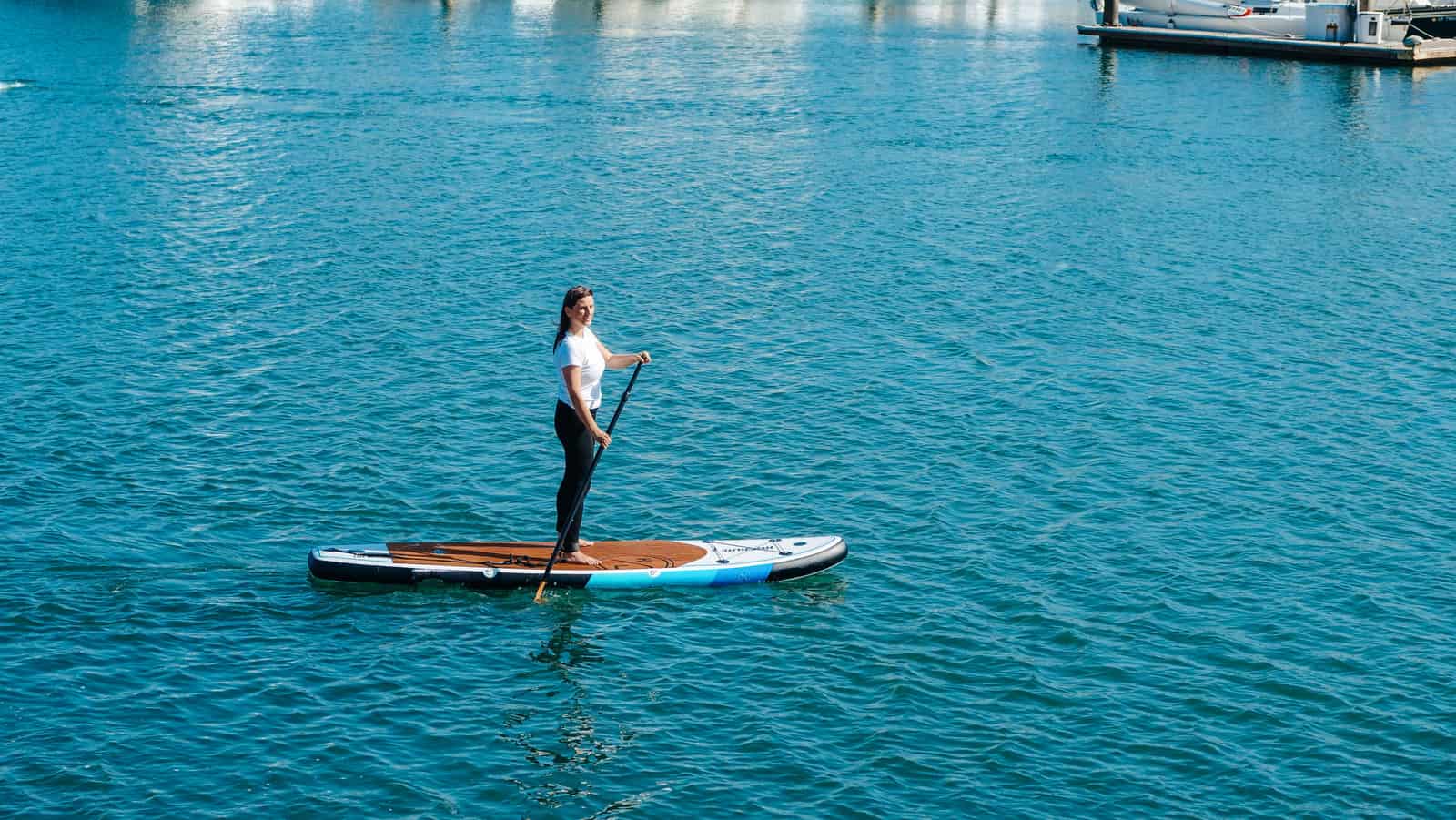
Best First Board
The Best Paddle Boards for Beginners
Five beginner boards ranked on published width and usable capacity, with the displacement arithmetic run on each one.
Top pick
Roc Inflatable Stand Up Paddle Board, 10 ft 6 in x 33 in
The default first inflatable board
#ad · how this is funded · price as of October 9, 2026

Best Budget Kayak
The Best Budget Kayaks
Budget kayaks with the specific compromise each one makes, named. Capacity is usually the one that catches people.
Top pick
Intex Explorer K2 Inflatable Kayak, 2-person (oars and pump included)
Two people, no roof rack, small budget
#ad · how this is funded · price as of October 9, 2026
Buying a Paddle Board on Amazon
How to read an Amazon board listing: the three specs that decide it, the two that are usually missing, and what the review count is not telling you.
Top pick
Roc Inflatable Stand Up Paddle Board, 10 ft 6 in x 33 in
The default first inflatable board
#ad · how this is funded · price as of October 9, 2026
Roc 10'6" Inflatable Paddle Board: What the Specs Say
33 inches wide, 6 inches thick, rated to 350 lb — the numbers behind the most-recommended first board there is.
Top pick
Roc Inflatable Stand Up Paddle Board, 10 ft 6 in x 33 in
The default first inflatable board
#ad · how this is funded · price as of October 9, 2026

What a First Setup Actually Costs
Every line item in a first setup, including the ones that surprise people — with live prices rather than stale numbers.
Top pick
Perception Tribe 11.5 Sit-on-Top Kayak
The all-round first sit-on-top
#ad · how this is funded · price as of October 9, 2026