Gear & Getting There
The Best SUP Paddles for a First Board
Your hands are on the paddle for every second of every outing, and it is the one item in the box that was chosen to hit a price. Here is what a better one needs to do, and how much better it needs to be.

We have not paddled these, and we are not going to pretend we have. Here is what we did instead. Links to Amazon earn us a commission at no extra cost to you, and commission never decides a pick — how this site is funded.
| # | Product | Best for | The spec it turns on | Price |
|---|---|---|---|---|
| 1 | 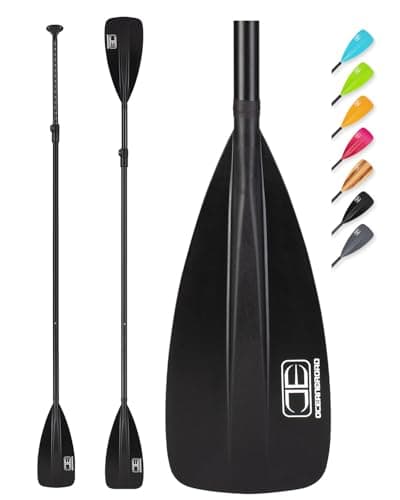 OCEANBROAD Adjustable SUP Paddle, aluminum shaftTop pickThe paddle in an inflatable board's accessory kit is the weakest part of the package, and this is the cheapest honest replacement. | Replacing the paddle that came in the box | Adjustable aluminum shaft, 3 lb, converts between SUP and kayak use | |
| 2 | 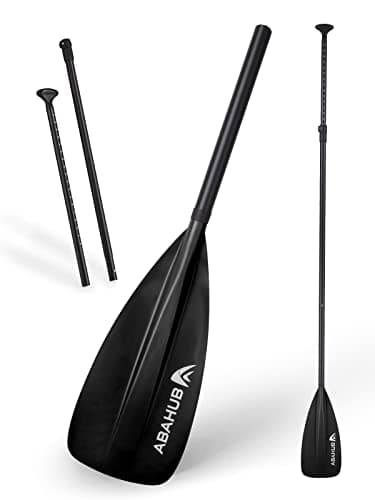 Abahub 3/4-Piece Adjustable SUP Paddle, 68-84 inA 68 to 84 in adjustment range covers every paddler from about 4 ft 11 in to 6 ft 3 in on our height-plus-nine rule, which is most families in one paddle. | A household where several people share one board | Adjustable 68 to 84 in, aluminum shaft, nylon blade, three- or four-piece |
Every inflatable board we cover ships with a paddle, and every one of those paddles was chosen to make the package price work. They are heavy, they flex, and they are the reason a lot of first-season paddlers think their shoulders are the problem. This page is about the upgrade — what it needs to do, how to size it, and where the money genuinely goes.
How we judged these paddles
- **Adjustment range that covers you.** A SUP paddle is sized to your height, and a first paddle should be adjustable so you can find the number that works. We wanted a published range that spans most adults.
- **Published weight.** A stroke repeats roughly a thousand times an hour. Half a pound is not half a pound; it is half a pound lifted a thousand times. A paddle that publishes its weight is one that is willing to be judged on it.
- **Shaft and blade material, honestly described.** Aluminum and nylon is the entry tier and it is fine. Fiberglass is lighter and stiffer. Carbon is lighter still and costs several times more. We say which tier each pick is in.
- **Whether it floats and whether it breaks down.** A paddle that sinks is gone. A paddle in three pieces fits in the board bag.
Length first, because it is arithmetic
The manufacturers' own guidance converges on a simple rule, and it is the one we use everywhere on this site.
That is why adjustability matters on a first paddle. The rule gets you close; a couple of outings tell you whether you want an inch more or less, and a fixed-length paddle cut to the wrong number is a fixed mistake. Once you know your number, a fixed paddle at that length is stiffer and lighter for the same money — but that is a second-paddle purchase.
Why weight is the spec that matters most
On the board, weight is a carry. On the paddle, weight is a repetition. A relaxed flat-water cadence is somewhere around 40 to 60 strokes a minute, which is 2,400 to 3,600 lifts an hour. Every ounce on the blade end is multiplied by that.
| Tier | Typical weight | Feel | Honest note |
|---|---|---|---|
| Aluminum shaft, nylon blade | around 2.5 to 3 lb | Heavy, flexes under a hard stroke, cold in hand | The kit paddle and the cheapest upgrade. Fine for a season |
| Fiberglass shaft, nylon or fiberglass blade | around 1.5 to 2 lb | Noticeably lighter, stiffer, warmer | The tier most people should end up in |
| Carbon shaft and blade | around 1 to 1.5 lb | Very light, very stiff | A second-paddle purchase. Costs several times more |
Both picks on this page are in the first tier, and that is a deliberate, honest choice: they are the paddles that replace a kit paddle at a price that does not compete with the board. The OCEANBROAD publishes 3 lb, which is heavy — and it is a stiffer, better-shaped 3 lb than what came in the box. If you paddle every week, the fiberglass tier is where you go next.
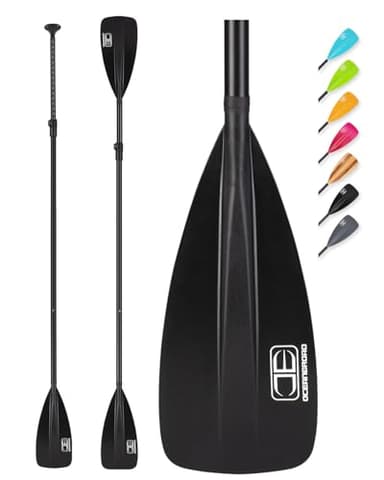
Top pick — Replacing the paddle that came in the box
OCEANBROAD Adjustable SUP Paddle, aluminum shaft
The paddle in an inflatable board's accessory kit is the weakest part of the package, and this is the cheapest honest replacement.
What the listing publishes
Adjustable aluminum shaft, 3 lb, converts between SUP and kayak use
Adjustable is what you want on a SUP paddle. Our rule puts an all-around paddle at your height plus 8 to 10 in, and an adjustable shaft lets you find your own number inside that band instead of guessing once.
3 lb is heavy for a SUP paddle -- carbon paddles are around half that -- and it is what you accept at this price. You lift a SUP paddle more often than a kayak paddle, so weight compounds.
The kayak-blade conversion is genuinely useful on an inflatable that you sometimes sit down on, and useless if you only ever stand.
What it does well
- Adjustable, so you can dial in your height-plus-9-inches rather than guess
- Converts to a kayak paddle, which suits sit-down boards
- Cheap enough to buy purely as an upgrade over a kit paddle
What it costs you
- 3 lb is heavy, and you notice it in the second hour
- Aluminum shaft is cold and flexes under a hard stroke
- Adjustable clamps are the part that eventually wears out
Skip this if the paddle in your board's kit is already adjustable and fits. Swapping aluminum for aluminum buys you very little.
#ad · how this is funded · price as of October 9, 2026
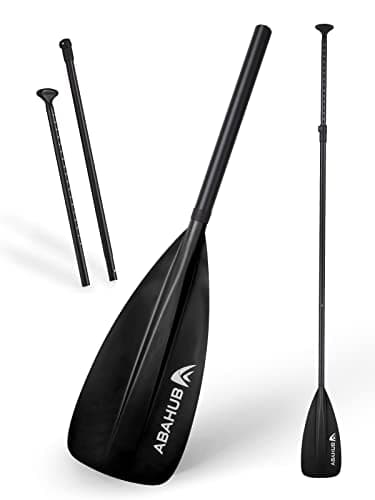
Pick 2 — A household where several people share one board
Abahub 3/4-Piece Adjustable SUP Paddle, 68-84 in
A 68 to 84 in adjustment range covers every paddler from about 4 ft 11 in to 6 ft 3 in on our height-plus-nine rule, which is most families in one paddle.
What the listing publishes
Adjustable 68 to 84 in, aluminum shaft, nylon blade, three- or four-piece
68 to 84 in is the useful spec. At height plus 9 in, that range covers paddlers from 59 in to 75 in tall -- so one paddle genuinely does fit a household rather than nearly fitting it.
Three-piece breaks down for storage; four-piece breaks down further. Either is enough to fit a board bag, which is where a SUP paddle should live.
Nylon blades are the durable, unexciting choice. They will bounce off rocks and gravel launches that would chip a composite blade.
What it does well
- 68 to 84 in covers nearly every adult and older child in one paddle
- Breaks down to fit the board bag
- Nylon blade shrugs off gravel launches
What it costs you
- Aluminum and nylon is the heavy, flexible end of the market
- Shared paddles get readjusted constantly, and clamps wear
- No carbon option in this family if you later want light
Skip this if the board is yours alone. A fixed-length paddle cut to your own number is stiffer and lighter for the same money.
#ad · how this is funded · price as of October 9, 2026
The blade, briefly
- **Size.** A smaller blade moves less water per stroke and is easier on the shoulders over distance. A larger blade accelerates harder. For a first paddle, medium is right and most adjustable paddles ship medium.
- **Angle.** SUP blades are angled forward from the shaft, typically around 10 degrees, so the blade stays vertical through the power phase. Hold it with the angle pointing away from you. Almost every first-timer holds it backward.
- **Shape.** A teardrop is the all-around default. Anything more exotic is a preference you will not have until your second season.
Adjustable, or fixed?
Adjustable for a first paddle, and for any paddle that more than one person will use. Fixed once you know your number and the paddle is yours alone. The trade is that an adjustable clamp is a joint, and a joint is where flex and eventual wear live.
- **A two-piece adjustable** is the simplest: one clamp, minimal flex, packs reasonably.
- **A three-piece** breaks down small enough for the board bag. Two joints, a little more flex.
- **A household paddle** — the Abahub's 68 to 84 in range covers roughly 4 ft 11 in to 6 ft 3 in on the height-plus-nine rule — gets readjusted constantly, and that is exactly the use that wears a clamp fastest. Fair trade for a family; a poor one for a solo paddler.
Does it float?
Most aluminum-shaft paddles do not, or not for long. Most fiberglass and carbon paddles do. This matters more than it sounds: a dropped paddle on a windy day drifts away faster than you can paddle a board with your hands, and a sunk paddle is simply gone. If the listing does not say it floats, assume it does not, and either buy a paddle float or keep the leash on the paddle rather than the board when the water is deep.
How to hold it, because most people do not
A paddle sized perfectly and held wrong is still the wrong paddle, and the two mistakes below account for most sore shoulders in a first season.
- **The blade angle faces away from you.** SUP blades are bent forward from the shaft by around ten degrees. The angled face points toward the nose of the board, so the blade is vertical in the water during the power phase. Held backward it scoops, and you work twice as hard to go the same distance.
- **Top hand on the grip, bottom hand on the shaft, elbows soft.** The bottom hand sits low enough that your forearms are roughly parallel when the paddle is vertical. Too high and you are paddling with your arms; the stroke should come from rotating your torso.
- **Reach forward, plant, pull to your feet, out.** The stroke ends at your feet. Pulling past them turns forward motion into lift and steers the board.
- **Switch sides every few strokes.** A board turns away from the paddling side. Alternating is how you go straight without a corrective stroke.
When to upgrade again
The picks on this page are the honest first upgrade: they replace a kit paddle with a better-shaped, stiffer paddle in the same material tier at a price that does not compete with the board. They are not the last paddle you will want, and the signal that it is time for the next one is specific.
- **You paddle most weeks.** At that point a fiberglass shaft, roughly a pound lighter, is felt on every stroke of every outing, and it pays for itself in shoulders.
- **You know your length.** Once the adjustable has told you your number, a fixed-length paddle at that number is stiffer and lighter for the same money, because it has no clamp.
- **You have started to cover distance.** Touring is where a smaller, lighter blade on a stiff shaft stops being a luxury.
Until one of those is true, the paddle on this page is the right paddle, and the money is better spent on the life jacket you will actually keep on.
What you can ignore
- **Kayak-conversion blades.** Some SUP paddles ship with a second blade that turns them into a kayak paddle. The OCEANBROAD does this. It is a genuine feature if you own an inflatable kayak too, and irrelevant if you do not.
- **Grip shape.** T-grip versus palm grip is a preference. Neither is better.
- **Branded paddles matched to the board.** A paddle does not care what board it pushes. Buy on weight, range and price.
- **Carbon, in year one.** It is the right paddle for someone who already knows they will paddle every week. Nobody knows that in week one.
For kayak paddles, which are sized and shaped completely differently, the beginner kayak paddle roundup is the page. And for everything else that belongs in a first setup, the accessories that actually earn a place.
Questions people actually ask
What length SUP paddle do I need?
Is the paddle that comes with a paddle board good enough?
How much does a SUP paddle weigh?
Should a beginner get an adjustable or fixed SUP paddle?
Do SUP paddles float?
Can I use a SUP paddle for a kayak?
Where these numbers came from
Every figure on this page traces to one of these. Where a number could not be sourced, the page says so rather than estimating it.
- NIXY Sports — What Size SUP Paddle Do I Need (manufacturer, the height-plus-8-to-10-inches rule)
- Aqua-Bound — Kayak Paddle Sizing Guide (manufacturer, the size-longer and size-shorter adjustment rules)
- OCEANBROAD Adjustable SUP Paddle — manufacturer specification as published on the Amazon listing, read 2026-09-02
- Abahub 3/4-Piece Adjustable SUP Paddle 68-84 in — manufacturer specification as published on the Amazon listing, read 2026-09-02
Read next
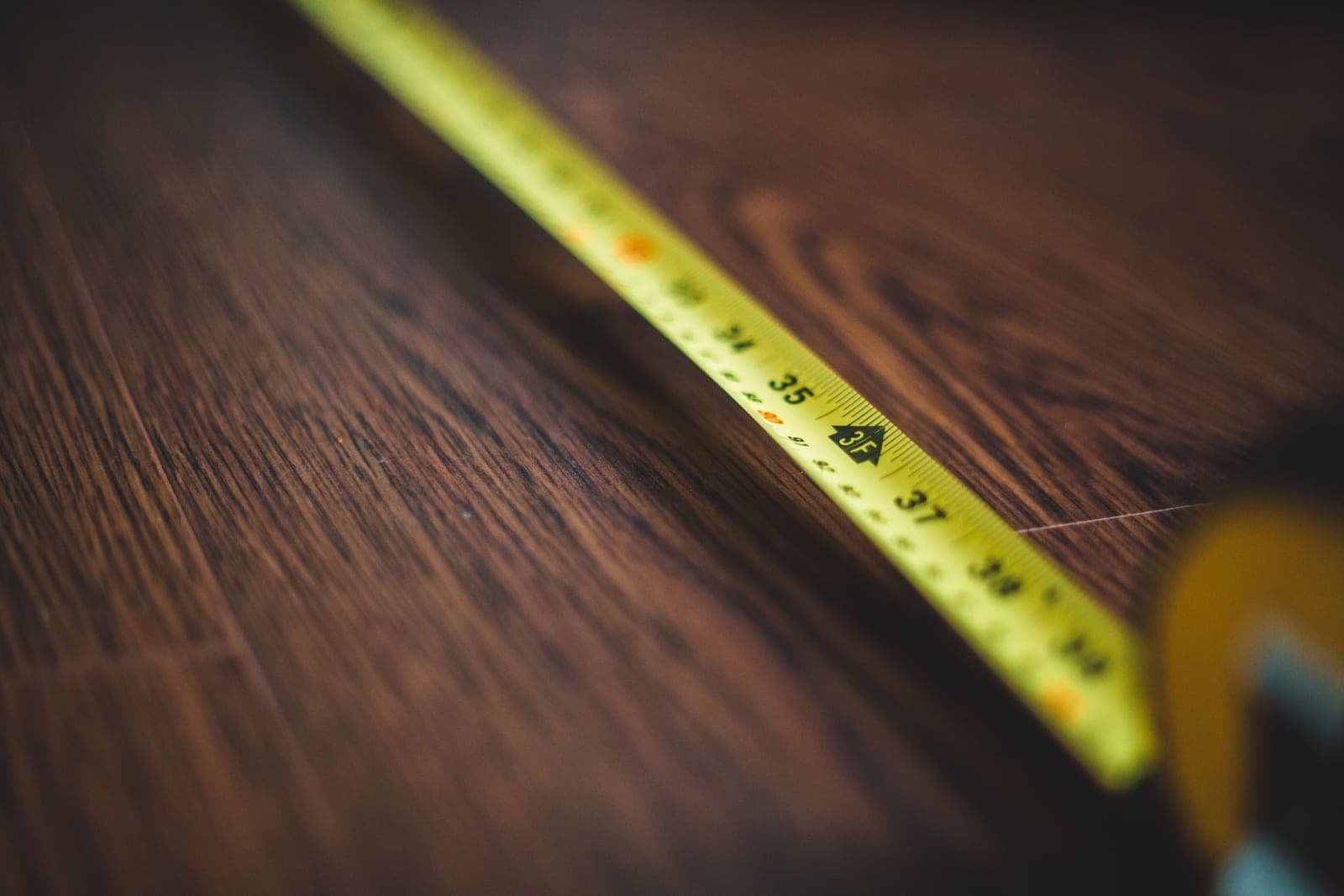
What Length Paddle Do You Need?
A paddle length calculator fitted to a manufacturer's published chart, with the derivation shown.
Top pick
Bending Branches Whisper Kayak Paddle, 230 cm
The first paddle worth keeping
#ad · how this is funded · price as of October 9, 2026
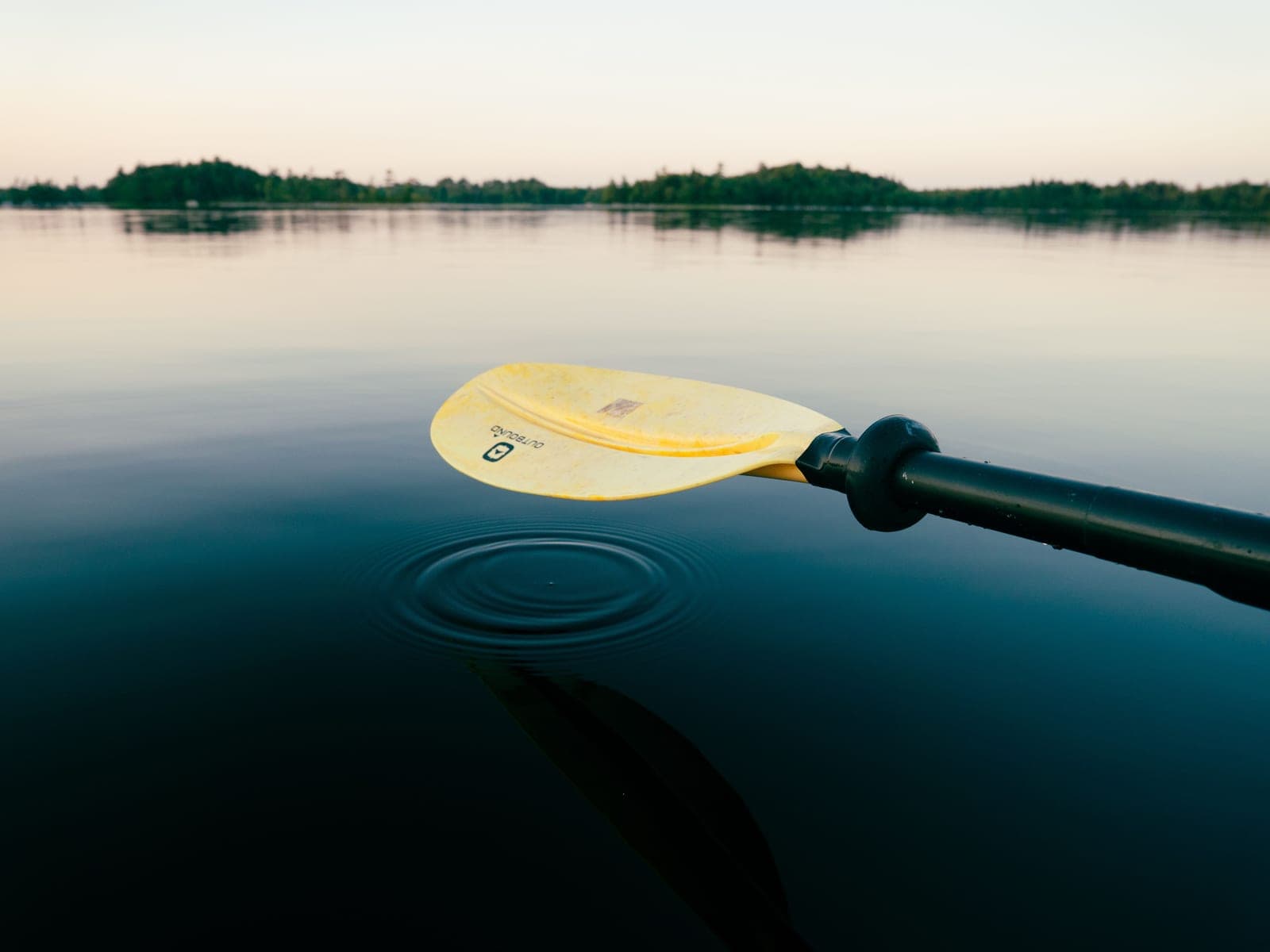
Best First Paddle
The Best Kayak Paddles for Beginners
Paddles at each common length, chosen by the size you actually need rather than by price bracket.
Top pick
Bending Branches Whisper Kayak Paddle, 230 cm
The first paddle worth keeping
#ad · how this is funded · price as of October 9, 2026

Best Budget Board
The Best Budget Paddle Boards
The entry-tier boards where the compromise is one you can live with — a missing spec, a narrower deck, a starter paddle — named per board so you choose the right one.
Top pick
Roc Inflatable Stand Up Paddle Board, 10 ft 6 in x 33 in
The default first inflatable board
#ad · how this is funded · price as of October 9, 2026

Best First Board
The Best Paddle Boards for Beginners
Five beginner boards ranked on published width and usable capacity, with the displacement arithmetic run on each one.
Top pick
Roc Inflatable Stand Up Paddle Board, 10 ft 6 in x 33 in
The default first inflatable board
#ad · how this is funded · price as of October 9, 2026
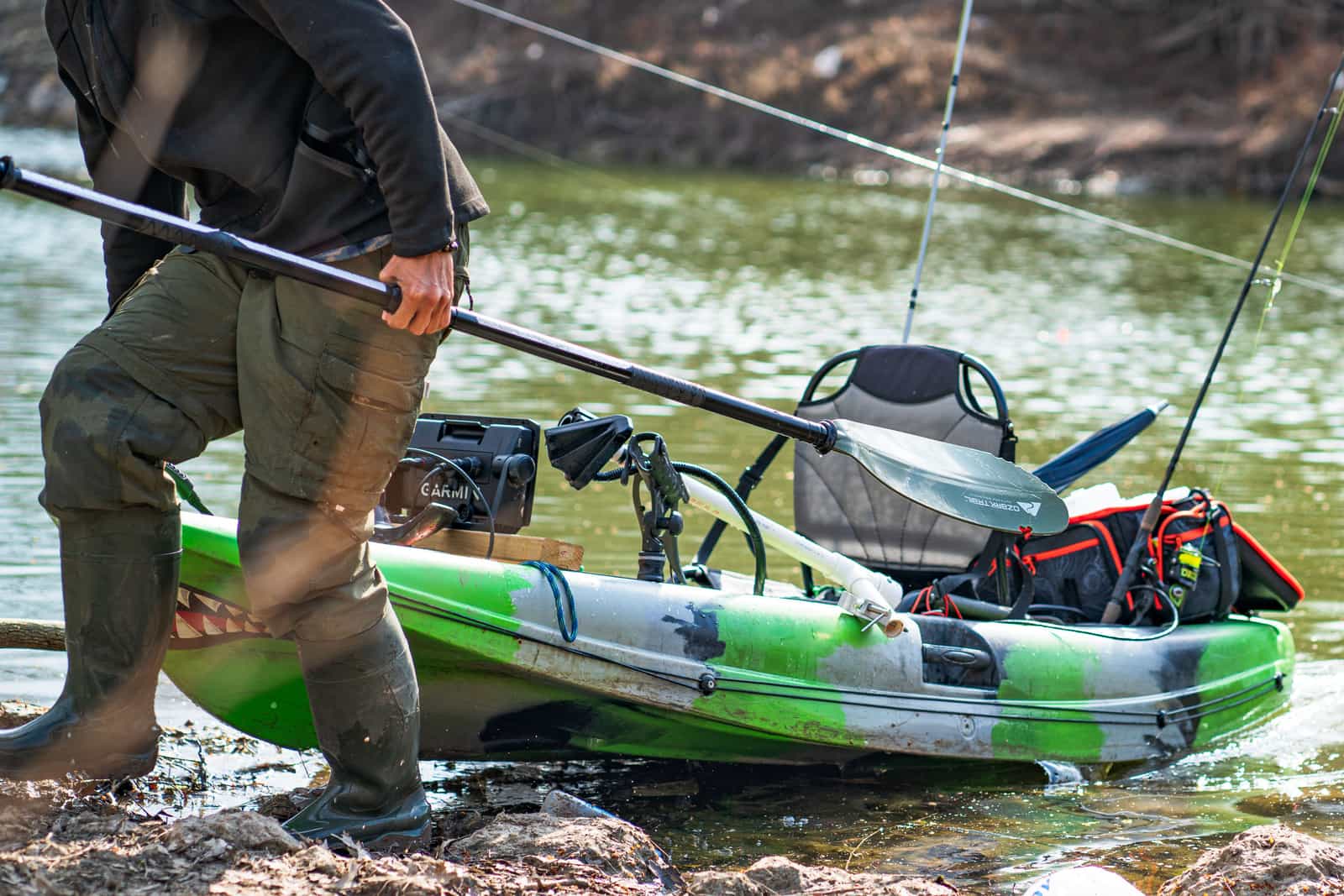
Best First Accessory
Kayak Accessories: What Actually Earns a Place
Five accessories that change every outing, ranked by how much they improve it per dollar — and the ones you can safely skip for a season.
Top pick
Bending Branches Whisper Kayak Paddle, 230 cm
The first paddle worth keeping
#ad · how this is funded · price as of October 9, 2026