Kayaks
Sit-On-Top vs Sit-In Kayak
This gets sold as a preference. It is closer to a decision about water temperature and about what you would do if you ended up in it.

We have not paddled these, and we are not going to pretend we have. Here is what we did instead. Links to Amazon earn us a commission at no extra cost to you, and commission never decides a pick — how this site is funded.
| # | Product | Best for | The spec it turns on | Price |
|---|---|---|---|---|
| 1 | 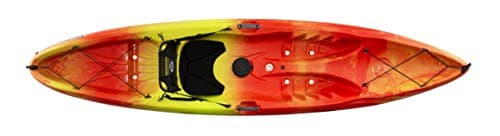 Perception Tribe 11.5 Sit-on-Top KayakTop pickThe combination almost nothing else manages: 350 lb of rating, a 30 in beam and enough waterline to hold a line, in a hull a first-timer can climb back onto from the water. | The all-round first sit-on-top | 137 in long, 30.25 in beam, 52 lb hull, 350 lb rated capacity | |
| 2 | 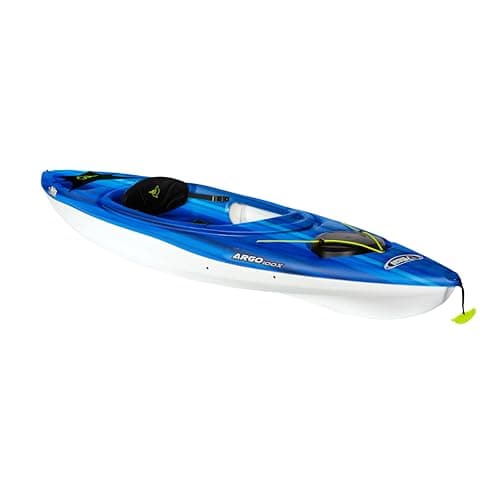 Pelican Argo 100X Sit-In Kayak, 10 ftThirty-six pounds is the number that matters here: it is the only 10-footer on this page one average adult can get off a car roof without a second person or a bad decision. | The lightest sit-inside to carry alone | 120 in long, 28 in beam, 36 lb hull, 275 lb rated capacity | |
| 3 | 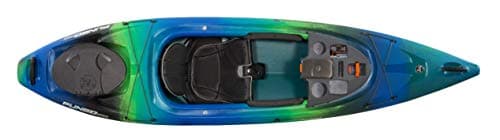 Wilderness Systems Pungo 105 Recreational Kayak, 10 ft 6 inThe only hull here that will still feel right in year three, because the seat and the waterline were designed for people who paddle for three hours rather than forty minutes. | The boat you keep after your first season | 126 in long, 30 in beam, 47 lb hull, 300 lb rated capacity |
The two designs solve the same problem in opposite ways, and the marketing for each mostly lists its own advantages. Here is the version that names the trade in both directions.
| Sit-on-top | Sit-inside | |
|---|---|---|
| Getting back on after a swim | Straightforward — climb onto the open deck | Hard. A swamped cockpit needs pumping first |
| Staying dry | You will get wet. Always | Legs stay dry unless it is rough |
| Warmth | Fully exposed | Legs out of the wind — a big difference in spring |
| Storage | Open deck with tie-downs. Nothing stays dry | Enclosed hull, often with a sealed hatch |
| Stability | Usually wider, so more stable | Lower center of gravity, often narrower |
| Feeling enclosed | None. Fine for anxious paddlers | Some people dislike it, and that is worth taking seriously |
| Self-draining | Yes, through scupper holes | No. Water in the cockpit stays there |
| Weight | Usually heavier for a given length | Usually lighter |
The remounting argument is the important one
Everything else on that table is comfort. This one is safety, and it is where the comparison is genuinely one-sided.
If you end up in the water off a sit-on-top, you swim to the boat, get your chest over the deck, and roll yourself on. It is awkward and it works, and a first-timer can do it with no instruction.
If you end up in the water off a sit-inside, the cockpit fills. A swamped kayak floats low, is unstable, and holds a lot of water — you have to get back in and pump it out, in that order, from the water, and that is a skill rather than an instinct. In deep water with nobody nearby it is a genuinely difficult situation.
The warmth argument runs the other way
A sit-inside puts your legs inside the hull and out of the wind. In July that is a mild inconvenience and in April it is the difference between a three-hour paddle and forty minutes.
This is why the honest framing is water temperature rather than preference. In warm water, the sit-on-top's easier remount is a small advantage and its exposure is a benefit. In cold water the exposure is a real cost — and, awkwardly, cold water is also when an unplanned swim is most dangerous. Both designs get harder in spring; they just get harder in different ways.
The claustrophobia question, taken seriously
Some people dislike sitting inside a boat with their legs under a deck. That is worth taking at face value rather than talking someone out of. Modern recreational sit-insides have very large cockpit openings — the Old Town Vapor 10's oversized cockpit exists specifically for this — and you are not attached to the boat in any way, so you exit by simply sliding out.
If that reassurance does not help, buy a sit-on-top. A boat you are uneasy in is a boat you do not use.
Which to buy
- **Warm water, summer paddling, likely to swim, kids aboard:** sit-on-top.
- **Cool water, spring and fall, want to stay dry, want dry storage:** sit-inside.
- **Nervous about being enclosed:** sit-on-top, and do not overthink it.
- **Open water, paddling alone:** sit-on-top, for the remount.
- **Small ponds and sheltered creeks:** either. The remount argument mostly evaporates in water you can stand up in.
- **Fishing:** sit-on-top, almost always. Open deck, easy access to gear, and often a pontoon hull you can stand on.
One of each, plus the one we would keep
Top pick — The all-round first sit-on-top
Perception Tribe 11.5 Sit-on-Top Kayak
The combination almost nothing else manages: 350 lb of rating, a 30 in beam and enough waterline to hold a line, in a hull a first-timer can climb back onto from the water.
What the listing publishes
137 in long, 30.25 in beam, 52 lb hull, 350 lb rated capacity
Usable at the 65 percent rule: 228 lb (range 210–245 lb), which leaves about 208 lb of paddler after a 20 lb day kit. Why 65 percent.
350 lb rated is about 228 lb usable at 65 percent and 208 lb of paddler after a day kit -- the most headroom of any single boat here, and enough that a 200 lb adult is inside the comfortable band rather than at the edge of it.
Sit-on-top means the deck is open and self-draining. The reason that matters to a beginner is not comfort, it is that remounting from deep water is a maneuver you can actually perform, where a flooded sit-inside cockpit is not.
52 lb is the price. This is at the top of what one person carries any distance, and the reason a cart appears in our cost totals for this boat and not for the Argo.
What it does well
- 350 lb rated capacity gives real headroom for larger adults or a child up front
- Open self-draining deck is the forgiving choice for a first summer
- 137 in of hull tracks far better than the 9 and 10 ft boats here
What it costs you
- 52 lb is a two-person lift onto a roof for most people
- You will get wet. Sit-on-tops always do, and that is a season decision not a design flaw
- 11 ft 5 in needs more storage length than the 10 ft boats
Skip this if you paddle in cold water or a cold shoulder season. An open deck in 55-degree water is a different and less pleasant sport, and a sit-inside is the right answer there.
#ad · how this is funded · price as of October 18, 2026
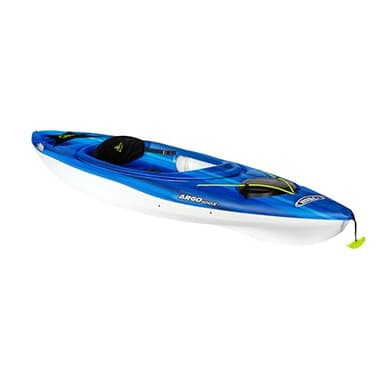
Pick 2 — The lightest sit-inside to carry alone
Pelican Argo 100X Sit-In Kayak, 10 ft
Thirty-six pounds is the number that matters here: it is the only 10-footer on this page one average adult can get off a car roof without a second person or a bad decision.
What the listing publishes
120 in long, 28 in beam, 36 lb hull, 275 lb rated capacity
Usable at the 65 percent rule: 179 lb (range 165–193 lb), which leaves about 159 lb of paddler after a 20 lb day kit. Why 65 percent.
A 275 lb rating sounds generous until you apply the 60 to 70 percent band Eddyline publishes for usable capacity. At 65 percent that is 179 lb of paddler, gear, clothing and PFD -- so a 160 lb paddler is comfortable and a 200 lb paddler is at the rating's edge before they pack anything.
The 28 in beam is the narrowest here, and narrow is the trade you make for a hull this light. It is stable enough for flat water and it will feel twitchier than a 30 in boat for the first hour.
Sit-inside means your legs are in a cockpit and out of the wind, which is why this is the shoulder-season pick rather than the July one.
What it does well
- 36 lb is genuinely one-person liftable, which decides how often the boat actually gets used
- Sit-inside cockpit keeps your legs dry and out of the wind on cool mornings
- 10 ft turns easily on a small lake and fits diagonally in most garages
What it costs you
- 28 in is the narrowest beam here and feels it on day one
- 275 lb rating is the lowest of the adult sit-insides on this page
- A cockpit is harder to get back into after a capsize than a sit-on-top deck
Skip this if you weigh over about 200 lb, or you expect to swim off the boat on hot days -- a sit-on-top is easier to remount and this hull's usable capacity runs out early.
#ad · how this is funded · price as of October 18, 2026
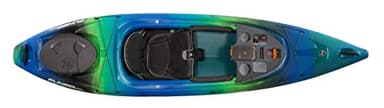
Pick 3 — The boat you keep after your first season
Wilderness Systems Pungo 105 Recreational Kayak, 10 ft 6 in
The only hull here that will still feel right in year three, because the seat and the waterline were designed for people who paddle for three hours rather than forty minutes.
What the listing publishes
126 in long, 30 in beam, 47 lb hull, 300 lb rated capacity
Usable at the 65 percent rule: 195 lb (range 180–210 lb), which leaves about 175 lb of paddler after a 20 lb day kit. Why 65 percent.
126 in of waterline with a defined keel line is why this tracks straight where a 9 ft 5 in flat-bottom does not. Distance stops being a fight, which is the difference between a boat you use twice and one you use twenty times.
300 lb rated is about 195 lb usable and 175 lb of paddler after a day kit. That is less headroom than the Flash despite being the better boat -- the rating is not the quality signal, and this is the clearest example of it on the site.
47 lb is the practical ceiling for a one-person carry from a driveway to a launch. Past this you are into cart territory, and a cart is a real cost that belongs in the total.
What it does well
- 126 in waterline plus a keel line means it holds a course without constant correction
- The seat is the reason people keep these boats -- it is a chair, not a molded dent
- 30 in beam is stable enough that a nervous first-timer relaxes inside ten minutes
What it costs you
- 47 lb is a real carry and gets old across a long parking lot
- 300 lb rating is mid-pack, so a heavier paddler runs out of room before the boat runs out of quality
- Costs more than every other sit-inside here, usually by a wide margin
Skip this if this is a once-or-twice-a-summer boat. Nothing about a better seat and a truer waterline is worth paying for if the hull spends eleven months against a garage wall.
#ad · how this is funded · price as of October 18, 2026
Questions people actually ask
Is a sit-on-top or sit-in kayak better for beginners?
Do you get wet in a sit-on-top kayak?
Are sit-in kayaks more stable?
Can you get back into a sit-in kayak in deep water?
Which is warmer, a sit-on-top or a sit-in kayak?
Which is better for fishing?
Where these numbers came from
Every figure on this page traces to one of these. Where a number could not be sourced, the page says so rather than estimating it.
- Eddyline Kayaks — Maximum weight capacity versus ideal capacity for various styles of kayaks (manufacturer, states the 60-70% ideal-capacity band)
- U.S. Coast Guard — Life Jacket Wear / Wearing Your Life Jacket (federal carriage and under-13 wear requirements)
- Perception Tribe 11.5 Sit-on-Top Kayak — manufacturer specification as published on the Amazon listing, read 2026-09-02
- Pelican Argo 100X Sit-In Kayak — manufacturer specification as published on the Amazon listing, read 2026-09-02
- Old Town Vapor 10 Solo Sit-Inside Kayak — manufacturer specification as published on the Amazon listing, read 2026-09-02
Read next

Best for Seniors
The Best Kayaks for Seniors
Cockpit size, hull weight and remount ease are the specs that matter for an older paddler. Which boats publish good numbers on all three.
Top pick
Old Town Vapor 10 Solo Sit-Inside Kayak, 10 ft
A first boat with a large, easy-entry cockpit
#ad · how this is funded · price as of October 18, 2026
Wilderness Systems Pungo 105: What the Specs Say
126 in of waterline, a 30 in beam, 47 lb and 300 lb rated — the numbers behind the boat people keep after their first season.
Top pick
Wilderness Systems Pungo 105 Recreational Kayak, 10 ft 6 in
The boat you keep after your first season
#ad · how this is funded · price as of October 18, 2026
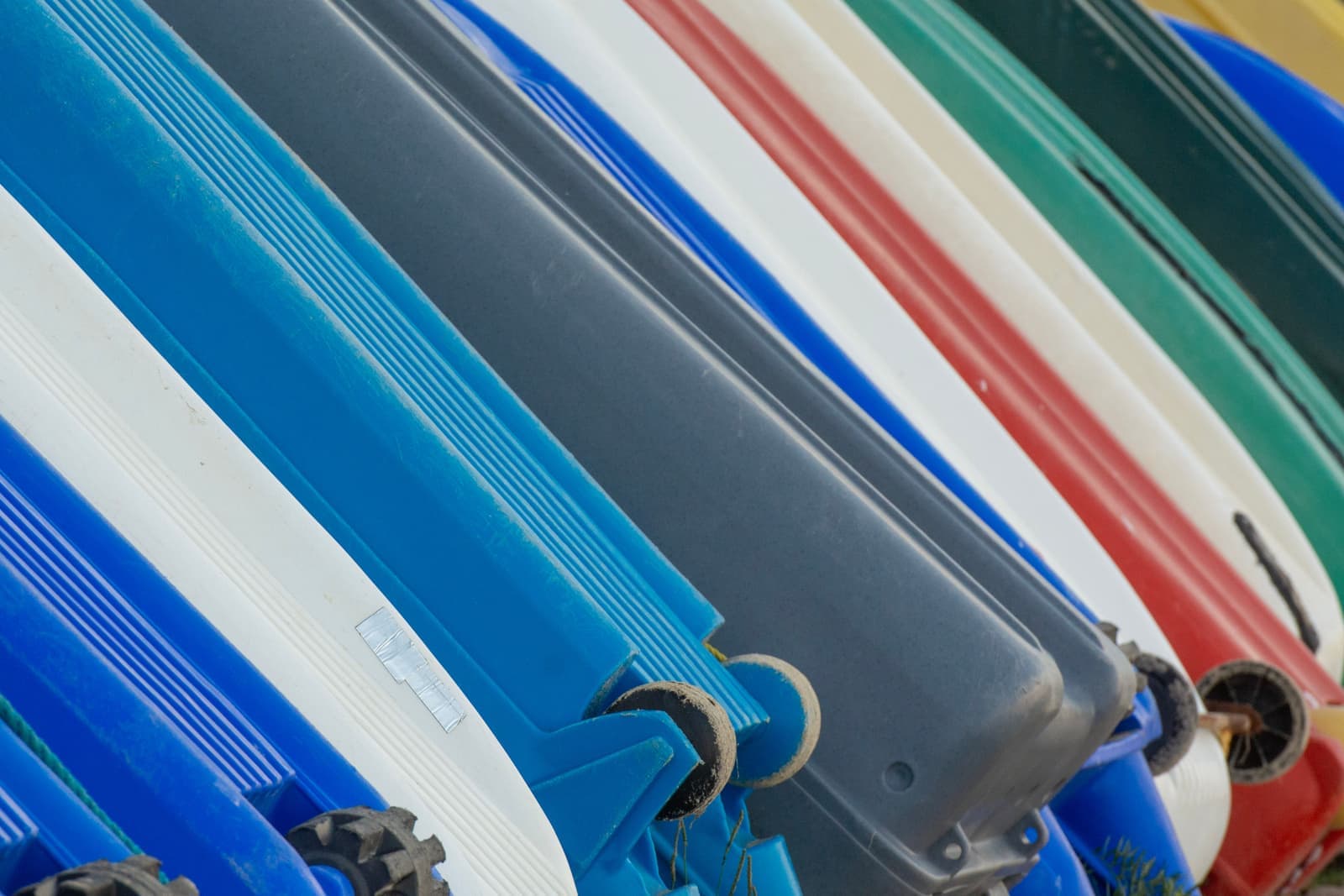
Kayak Hull Types: What Each Shape Does on the Water
Flat, shallow-V, rounded and pontoon hulls — what each shape actually does, and which one belongs under a beginner.
Top pick
Perception Tribe 11.5 Sit-on-Top Kayak
The all-round first sit-on-top
#ad · how this is funded · price as of October 18, 2026

Best First Kayak
The Best Kayaks for Beginners
Beginner kayaks ranked on width, carry weight and usable capacity — with the 65 percent arithmetic run on every one.
Top pick
Perception Tribe 11.5 Sit-on-Top Kayak
The all-round first sit-on-top
#ad · how this is funded · price as of October 18, 2026

Your First Time on the Water
What a first outing is actually like, the checklist that matters, and the three mistakes beginners reliably make.
Top pick
Onyx MoveVent Dynamic Paddle Vest
The PFD you will actually keep on
#ad · how this is funded · price as of October 18, 2026

Best for Lakes
The Best Kayaks for Lakes
Lake paddling rewards waterline length. The boats that hold a line when the wind gets up, with the numbers.
Top pick
Perception Tribe 11.5 Sit-on-Top Kayak
The all-round first sit-on-top
#ad · how this is funded · price as of October 18, 2026