Paddle Boards
The Best Paddle Boards for Kids
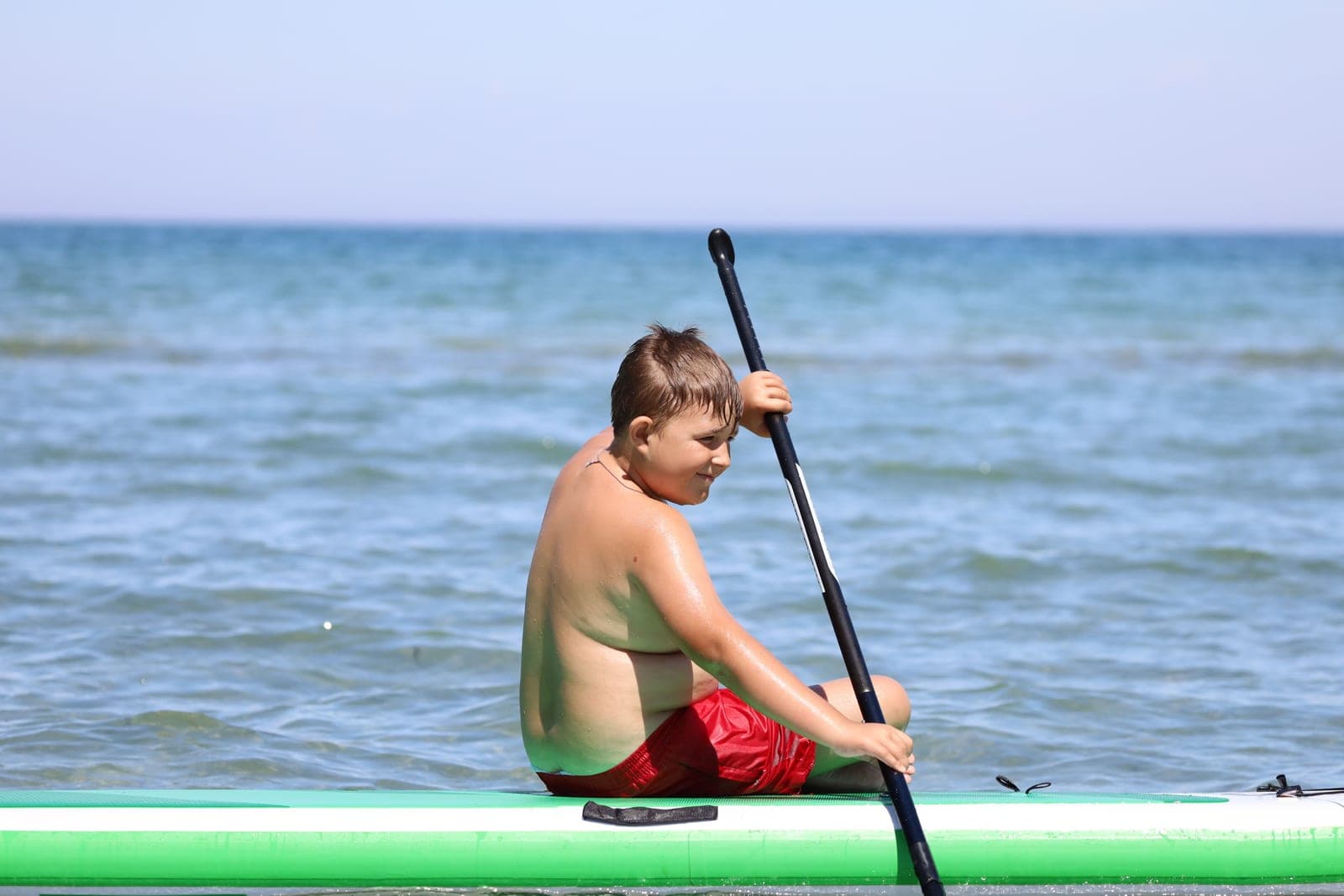
A child's board is not a small adult board. It is sized so they can carry it, reach past the rail to paddle it, and get back on it themselves.
We have not paddled these, and we are not going to pretend we have. Here is what we did instead. Links to Amazon earn us a commission at no extra cost to you, and commission never decides a pick — how this site is funded.
| # | Product | Best for | The spec it turns on | Price |
|---|---|---|---|---|
| 1 | 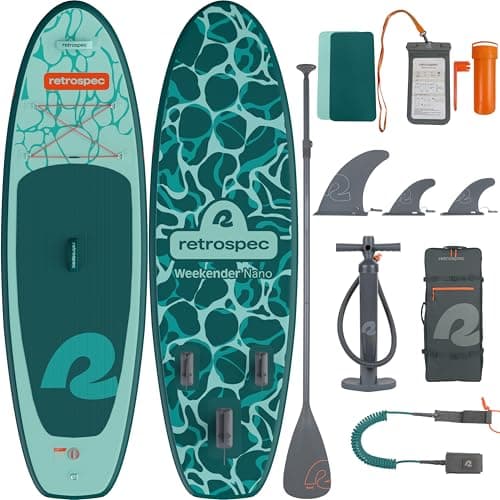 Retrospec Weekender-Nano Inflatable Paddle Board, 8 ftTop pickTwelve pounds and eight and a half feet: sized so a child can carry, inflate and drag their own board, which is the entire difference between their board and yours. | A child's own board | 102 x 28 x 5 in, 12.2 lb board weight, 140 lb rated capacity | |
| 2 | 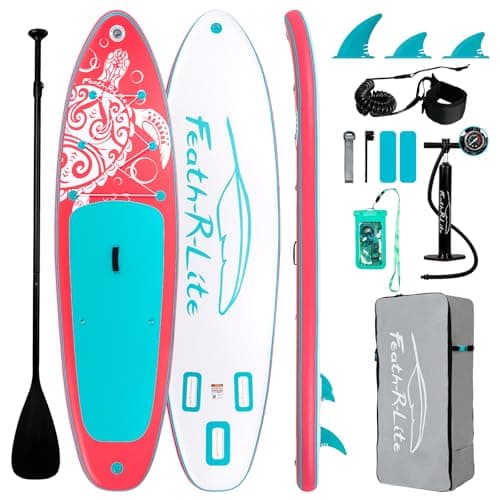 FEATH-R-LITE Inflatable Stand Up Paddle Board, 10 ft 6 in x 31.5 inEighteen and a half pounds is a genuinely low number for a drop-stitch board, and it is the spec that decides whether the board gets carried past the first parking lot. | The lightest board to carry to the water | 118.1 x 31.5 x 5.91 in, 18.9 lb board weight, 330 lb rated capacity |
Buying for a child gets sold on age brackets, which are the wrong unit. Two nine-year-olds can be 55 and 95 pounds, and the board that works for one is wrong for the other. Weight and reach are the specs. Age is a proxy for them and a poor one.
The three specs that decide it
Board weight: can they carry it themselves?
This is the spec nobody lists first and it is the one that determines whether it is their board or your board that they sit on. A 12 lb board is one a seven-year-old drags across grass on their own. A 20 lb adult board is one you carry for them, every time, which changes the whole character of the outing.
Width: narrow enough to reach past
This one runs opposite to the adult rule and it surprises people. We tell adults to go wider for stability. A child on a 33 inch board cannot reach past the rail to get the paddle blade vertically into the water, so they end up sweeping the paddle out to the side and turning in circles. A 28 to 30 inch board is narrower, less stable in the abstract, and much easier for a small person to actually paddle.
That works because stability scales with the load. A 60 lb child on a 28 inch board sits far higher in the water than a 180 lb adult on the same board, so they get the stability without the width.
Capacity: apply the same 65 percent rule
A 140 lb rated board is about 91 lb of usable load — that is the child, their PFD and whatever they insist on bringing. It is a real ceiling and children reach it faster than parents expect.
Top pick — A child's own board
Retrospec Weekender-Nano Inflatable Paddle Board, 8 ft
Twelve pounds and eight and a half feet: sized so a child can carry, inflate and drag their own board, which is the entire difference between their board and yours.
What the listing publishes
102 x 28 x 5 in, 12.2 lb board weight, 140 lb rated capacity
Usable at the 65 percent rule: 91 lb (range 84–98 lb), which leaves about 71 lb of paddler after a 20 lb day kit. Why 65 percent.
140 lb rated is about 91 lb of loaded child at 65 percent, so this covers most children up to roughly eleven or twelve.
28 in of width is narrow by our adult standard and correct here -- children weigh less, so they need less width for the same margin, and a narrower board is one they can actually reach past to paddle.
12.2 lb is the spec that makes it theirs. A child who cannot lift their own board is a passenger on a family outing rather than a participant in one.
What it does well
- 12.2 lb -- genuinely child-portable
- 28 in width is proportionate to a child's weight and reach
- 8 ft 6 in turns quickly, which is what children actually want to do
What it costs you
- 140 lb rated, so a teenager will outgrow it
- 5 in thickness is less stiff than a 6 in adult board
- Too small to be useful to an adult afterwards
Skip this if your child is already near 90 lb dressed. Buy a narrow adult board instead -- it will last them into their teens and this will not.
#ad · how this is funded · price as of October 18, 2026
Pick 2 — The lightest board to carry to the water
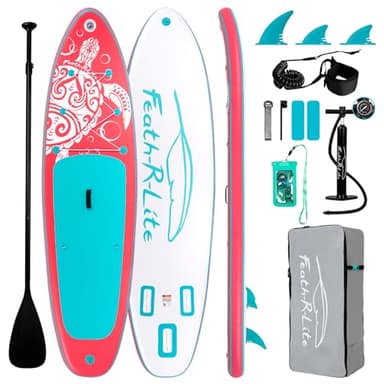
FEATH-R-LITE Inflatable Stand Up Paddle Board, 10 ft 6 in x 31.5 in
Eighteen and a half pounds is a genuinely low number for a drop-stitch board, and it is the spec that decides whether the board gets carried past the first parking lot.
What the listing publishes
118.1 x 31.5 x 5.91 in, 18.9 lb board weight, 330 lb rated capacity
Usable at the 65 percent rule: 215 lb (range 198–231 lb), which leaves about 195 lb of paddler after a 20 lb day kit. Why 65 percent.
330 lb rated is about 215 lb of loaded paddler at 65 percent, which covers most adults with gear.
31.5 in of width is just under our 32 in beginner recommendation. For a paddler under about 150 lb that is fine; for a 200 lb paddler it is the reason to look at the 33 in boards instead.
At 118 in this is closer to a 9 ft 10 in board than a true 10 ft 6 in, despite how the category is marketed. Shorter is more maneuverable and less directionally stable, and the listing's own dimensions are the place to check that rather than the product name.
What it does well
- 18.9 lb published board weight is at the light end of the class
- Rated to 330 lb, so an adult with a day kit has real headroom
- Shorter hull is easier to turn and easier to pack
What it costs you
- 31.5 in is narrower than our 32 in beginner floor for an average adult
- 118 in is shorter than the 10 ft 6 in the category name implies
- Less glide per stroke than a longer board
Skip this if you are over about 180 lb. Half an inch of width sounds trivial and it is the difference between standing and kneeling for a heavier paddler.
#ad · how this is funded · price as of October 18, 2026
When to skip the kids' board entirely
Around 90 lb, a dedicated kids' board stops being the right purchase. The child is at the capacity ceiling, they have the reach for a narrow adult board, and a kids' board bought at that point gets one summer of use.
The better buy is a narrow adult board — 31 inches rather than 33 — which they will still be paddling at sixteen. The FEATH-R-LITE at 31.5 inches and 18.9 lb is the one we would point at: light enough that a teenager carries it themselves, narrow enough to reach past, and rated to 330 lb so it never becomes the limiting factor.
| Child's weight | Board | Why |
|---|---|---|
| Under 60 lb | 8 ft, 28 in, ~140 lb rated | They can carry it and reach past it. Capacity is not the constraint yet |
| 60 to 90 lb | 8 ft to 9 ft, 28 to 30 in | Still reach-limited. Watch the capacity ceiling — 140 lb rated is 91 lb usable |
| Over 90 lb | A narrow adult board, 31 in | Kids' boards are out of capacity. A 31 in adult board lasts to adulthood |
| Sharing with an adult | 34 in+, 400 lb+ rated | Two bodies is a capacity problem before it is a stability one |
The safety part, which is not optional
Federal law requires children under 13 to wear an approved life jacket while a vessel is under way, and a paddle board outside a designated swimming or surfing area is a vessel. This is not the general carriage requirement that applies to adults — for a child it is a wear requirement. The rules and the source.
- **A properly fitted child PFD**, not an adult one on the tightest setting. A vest that slides up over the ears in the water is worse than useless.
- **A leash, and a conversation about it.** The board is the biggest floating thing nearby and staying attached to it is the plan.
- **Shallow, sheltered water for the first several outings.** Water you can stand up in changes every mistake from an incident into a laugh.
- **A whistle on the PFD.** Cheap, and children are much better at using one than at shouting.
Questions people actually ask
What size paddle board should I get for a child?
What age can a child use a paddle board?
Can a child ride on an adult's paddle board?
Do kids need a life jacket on a paddle board?
Is a kids' paddle board worth buying if they will outgrow it?
Where these numbers came from
Every figure on this page traces to one of these. Where a number could not be sourced, the page says so rather than estimating it.
- U.S. Coast Guard — Life Jacket Wear / Wearing Your Life Jacket (federal carriage and under-13 wear requirements)
- Thurso Surf — What Size Paddle Board Is Right for You (manufacturer, states the weight-in-kg x 2 volume rule and the 32 in beginner width band)
- Retrospec Weekender-Nano 8 ft Inflatable Paddleboard — manufacturer specification as published on the Amazon listing, read 2026-09-02
- FEATH-R-LITE Inflatable Stand Up Paddle Board — manufacturer specification as published on the Amazon listing, read 2026-09-02
Read next
Retrospec Weekender-Nano: The Board a Child Can Actually Carry
12.2 lb, 8 ft 6 in and 28 in wide, with paddle, pump and backpack in the box. Rated 140 lb, which is the number that decides how many seasons you get.
Top pick
Retrospec Weekender-Nano Inflatable Paddle Board, 8 ft
A child's own board
#ad · how this is funded · price as of October 18, 2026
Best Kids' Life Jacket
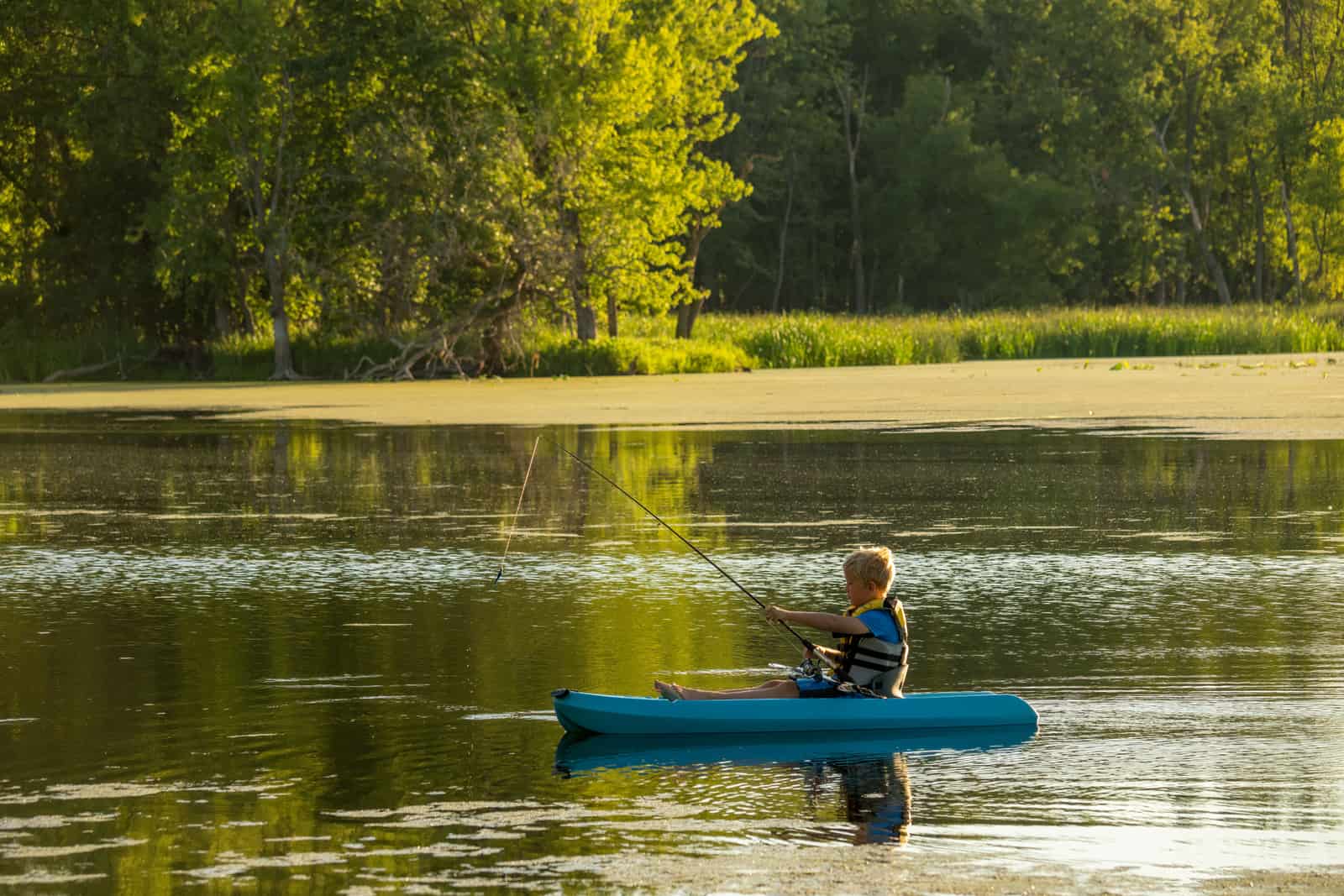
The Best Life Jackets for Kids Who Paddle
Fitted by weight on the label, never by age. The approved vest for each weight band, the features that matter at each size, and the mistakes that make a vest unsafe.
Top pick
Onyx Youth Life Jacket, 55-88 lb
A child paddling their own kayak or board
#ad · how this is funded · price as of October 18, 2026

Best Kids' Kayak
The Best Kayaks for Kids
Hull weight decides whether it is their boat. Rated capacity decides how long it lasts. Both are on the listing — here is how to read them for a child.
Top pick
Lifetime Youth Wave Kayak, 6 ft (paddle included)
A first boat for a child aged five and up
#ad · how this is funded · price as of October 18, 2026

What Size Paddle Board Do I Need?
A volume and width calculator that shows its working, and ends in an actual board rather than a chart.
Top pick
Roc Inflatable Stand Up Paddle Board, 10 ft 6 in x 33 in
The default first inflatable board
#ad · how this is funded · price as of October 18, 2026
Life Jacket Rules for Paddlers
The federal PFD requirement, the under-13 wear rule, and why your state matters — sourced, not paraphrased.
Top pick
Onyx MoveVent Dynamic Paddle Vest
The PFD you will actually keep on
#ad · how this is funded · price as of October 18, 2026
Best First Kayak
The Best Kayaks for Beginners
Beginner kayaks ranked on width, carry weight and usable capacity — with the 65 percent arithmetic run on every one.
Top pick
Perception Tribe 11.5 Sit-on-Top Kayak
The all-round first sit-on-top
#ad · how this is funded · price as of October 18, 2026