Paddle Boards
The Lightest Paddle Boards, and What a Board Really Weighs
Board weight is the specification that decides how far from the car you are willing to park, which is another way of saying it decides how often you go. It is also the specification most listings quietly leave out.
We have not paddled these, and we are not going to pretend we have. Here is what we did instead. Links to Amazon earn us a commission at no extra cost to you, and commission never decides a pick — how this site is funded.
| # | Product | Best for | The spec it turns on | Price |
|---|---|---|---|---|
| 1 | 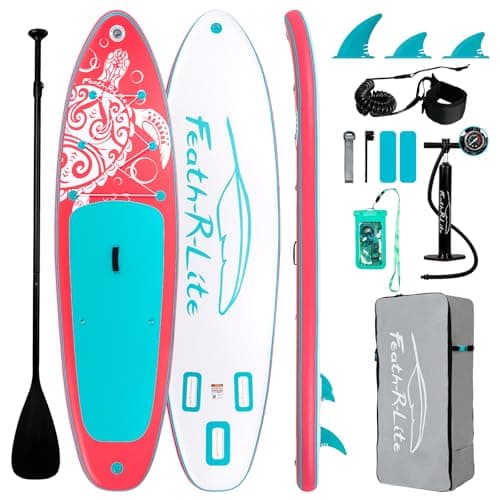 FEATH-R-LITE Inflatable Stand Up Paddle Board, 10 ft 6 in x 31.5 inTop pickEighteen and a half pounds is a genuinely low number for a drop-stitch board, and it is the spec that decides whether the board gets carried past the first parking lot. | The lightest board to carry to the water | 118.1 x 31.5 x 5.91 in, 18.9 lb board weight, 330 lb rated capacity | |
| 2 | 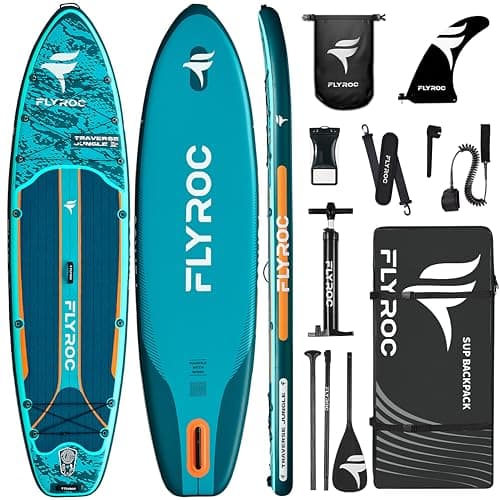 Flyroc 11 ft 6 in x 35 in Inflatable Paddle BoardA foot more waterline than the all-around boards with no narrowing to pay for it, and the highest rated capacity of any board here bar one. The published 18 lb is the figure to treat with some caution. | Distance without giving up width | 138 x 35 x 6 in, 18 lb board weight, 450 lb rated capacity, 15 D-rings | |
| 3 | 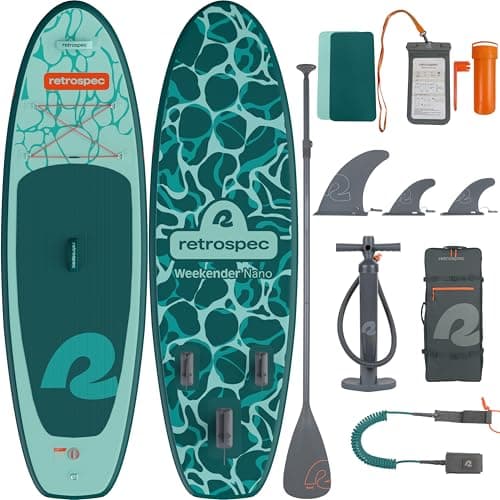 Retrospec Weekender-Nano Inflatable Paddle Board, 8 ftTwelve pounds and eight and a half feet: sized so a child can carry, inflate and drag their own board, which is the entire difference between their board and yours. | A child's own board | 102 x 28 x 5 in, 12.2 lb board weight, 140 lb rated capacity | |
| 4 | 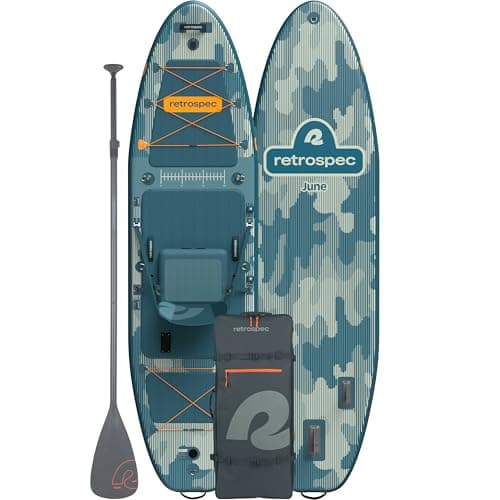 Retrospec June Inflatable Fishing Paddle Board, 11 ft 6 inThe removable seat is what makes this useful to a beginner who is not a fisherman: a board you can sit on is a board you keep using when your legs give out or the wind gets up. | Fishing, or paddling seated | 138 x 35 x 6 in, 24.5 lb board weight, 320 lb rated capacity, removable seat and rod holders |
Ask how much a paddle board weighs and the honest answer is that it depends on whether the maker chose to tell you. Across the boards we cover, the published figures run from 12.2 lb for a child's board to 24.5 lb for a fishing platform, and the full-size adult boards cluster tightly between 18 and 20 lb. That is the answer to the question. The more useful page is the one about why the number matters and why so many listings omit it.
Board weight is the least glamorous specification in this category and the best predictor of whether a board gets used. Nobody abandons paddle boarding because their board was two inches too narrow. People abandon it because the walk from the parking lot to the water is four hundred yards and the bag is awkward.
How we judged these boards
- **A published weight, or no ranking.** We rank on figures the maker prints. A board that does not publish a weight cannot be compared on weight, and we will not estimate one from a photograph or a shipping figure.
- **Weight in proportion to size.** Twelve pounds for an 8 ft kids' board and 20 lb for an 11 ft 6 in adult board are both good numbers. Comparing them directly is meaningless, so we group by what the board is for.
- **What the lightness costs.** Light usually means narrower, shorter, thinner or lower-rated. Where that trade exists we name it rather than presenting weight as a free win.
- **Whether the rated capacity still works.** A board you can carry and cannot float on is not a lighter board, it is a smaller one.
How much does a paddle board weigh?
| Board | Published weight | Size | Rated capacity |
|---|---|---|---|
| Retrospec Weekender-Nano | 12.2 lb | 102 × 28 × 5 in (kids) | 140 lb |
| Flyroc 11 ft 6 in | 18 lb | 138 × 35 × 6 in | 450 lb |
| FEATH-R-LITE 10 ft 6 in | 18.9 lb | 118.1 × 31.5 × 5.91 in | 330 lb |
| Retrospec June 11 ft 6 in | 24.5 lb | 138 × 35 × 6 in | 320 lb |
| Roc 10 ft 6 in | not published | 10 ft 6 in × 33 in | 350 lb |
| FunWater 10 ft 6 in | not published | 10 ft 6 in × 35 in | 330 lb |
| SereneLife XL | not published | 35 in wide | 485 lb |
Three of the seven boards we cover do not publish a weight at all, including two of the most popular boards in the category. We have left those rows blank rather than filling them, because a guessed weight in a spec table is worse than an admitted gap — it looks like information and is not.
The number you carry is not the number on the listing
A published board weight is the board. What goes on your back is the board, the pump, the paddle, the fin, the leash and the bag they all live in — and the pump in particular is not a trivial object. So treat the published figure as a floor rather than a total, and expect the loaded backpack to be meaningfully heavier than the spec sheet suggests.
This matters most when comparing an inflatable to a hard board. A hard board is heavier as an object but it is the whole object: there is nothing else to carry and nothing to inflate. An inflatable is lighter and comes with a bag of accessories and twenty minutes of work. The full comparison, and what a first setup weighs across both craft.
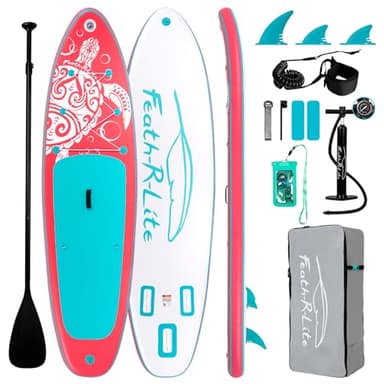
Top pick — The lightest board to carry to the water
FEATH-R-LITE Inflatable Stand Up Paddle Board, 10 ft 6 in x 31.5 in
Eighteen and a half pounds is a genuinely low number for a drop-stitch board, and it is the spec that decides whether the board gets carried past the first parking lot.
What the listing publishes
118.1 x 31.5 x 5.91 in, 18.9 lb board weight, 330 lb rated capacity
Usable at the 65 percent rule: 215 lb (range 198–231 lb), which leaves about 195 lb of paddler after a 20 lb day kit. Why 65 percent.
330 lb rated is about 215 lb of loaded paddler at 65 percent, which covers most adults with gear.
31.5 in of width is just under our 32 in beginner recommendation. For a paddler under about 150 lb that is fine; for a 200 lb paddler it is the reason to look at the 33 in boards instead.
At 118 in this is closer to a 9 ft 10 in board than a true 10 ft 6 in, despite how the category is marketed. Shorter is more maneuverable and less directionally stable, and the listing's own dimensions are the place to check that rather than the product name.
What it does well
- 18.9 lb published board weight is at the light end of the class
- Rated to 330 lb, so an adult with a day kit has real headroom
- Shorter hull is easier to turn and easier to pack
What it costs you
- 31.5 in is narrower than our 32 in beginner floor for an average adult
- 118 in is shorter than the 10 ft 6 in the category name implies
- Less glide per stroke than a longer board
Skip this if you are over about 180 lb. Half an inch of width sounds trivial and it is the difference between standing and kneeling for a heavier paddler.
#ad · how this is funded · price as of October 9, 2026
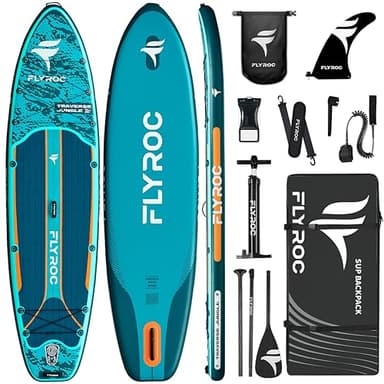
Pick 2 — Distance without giving up width
Flyroc 11 ft 6 in x 35 in Inflatable Paddle Board
A foot more waterline than the all-around boards with no narrowing to pay for it, and the highest rated capacity of any board here bar one. The published 18 lb is the figure to treat with some caution.
What the listing publishes
138 x 35 x 6 in, 18 lb board weight, 450 lb rated capacity, 15 D-rings
Usable at the 65 percent rule: 293 lb (range 270–315 lb), which leaves about 273 lb of paddler after a 20 lb day kit. Why 65 percent.
138 in of length is the reason this tracks. Every extra inch of waterline is distance covered per stroke, and the difference between a 10 ft 6 in and an 11 ft 6 in board over a mile is not subtle.
450 lb rated is about 292 lb of loaded paddler at 65 percent, which is genuine headroom rather than a marketing number. The listing's own 'up to 3 adults' framing is still optimistic — three adults is past 450 lb before anyone brings a bag.
18 lb for 138 x 35 in is light enough to be worth questioning. It is the figure the listing publishes and the only source for it, and the board's own feature text does not repeat it. Treat it as indicative rather than something to plan a long carry around.
Flyroc publish military-grade PVC with drop-stitch construction and a dual-layer sidewall, which is the right spec language for this class. What they do not publish is a maximum pressure, and pressure is what decides how stiff an inflatable actually gets.
What it does well
- 11 ft 6 in tracks straight and covers real distance
- 35 in of width means the extra length costs you no stability
- 450 lb rated, about 292 lb usable — real room for a passenger or gear
- 15 D-rings plus front and rear bungee, so a seat or a cooler both have somewhere to go
What it costs you
- 'Up to 3 adults' is not supported by 450 lb once you do the arithmetic
- The 18 lb board weight appears only in the listing's dimensions block
- No published maximum pressure, so stiffness is not a spec you can check
- 11 ft 6 in is a big object to turn on a small pond
Skip this if your water is a small pond or a tight creek. Length is only an advantage where there is room to use it, and a 10 ft 6 in board turns in half the space.
#ad · how this is funded · price as of October 9, 2026
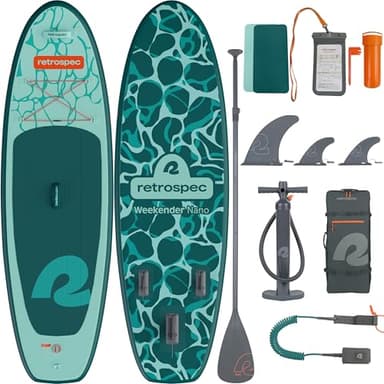
Pick 3 — A child's own board
Retrospec Weekender-Nano Inflatable Paddle Board, 8 ft
Twelve pounds and eight and a half feet: sized so a child can carry, inflate and drag their own board, which is the entire difference between their board and yours.
What the listing publishes
102 x 28 x 5 in, 12.2 lb board weight, 140 lb rated capacity
Usable at the 65 percent rule: 91 lb (range 84–98 lb), which leaves about 71 lb of paddler after a 20 lb day kit. Why 65 percent.
140 lb rated is about 91 lb of loaded child at 65 percent, so this covers most children up to roughly eleven or twelve.
28 in of width is narrow by our adult standard and correct here -- children weigh less, so they need less width for the same margin, and a narrower board is one they can actually reach past to paddle.
12.2 lb is the spec that makes it theirs. A child who cannot lift their own board is a passenger on a family outing rather than a participant in one.
What it does well
- 12.2 lb -- genuinely child-portable
- 28 in width is proportionate to a child's weight and reach
- 8 ft 6 in turns quickly, which is what children actually want to do
What it costs you
- 140 lb rated, so a teenager will outgrow it
- 5 in thickness is less stiff than a 6 in adult board
- Too small to be useful to an adult afterwards
Skip this if your child is already near 90 lb dressed. Buy a narrow adult board instead -- it will last them into their teens and this will not.
#ad · how this is funded · price as of October 9, 2026
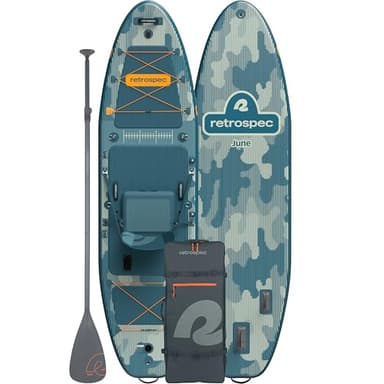
Pick 4 — Fishing, or paddling seated
Retrospec June Inflatable Fishing Paddle Board, 11 ft 6 in
The removable seat is what makes this useful to a beginner who is not a fisherman: a board you can sit on is a board you keep using when your legs give out or the wind gets up.
What the listing publishes
138 x 35 x 6 in, 24.5 lb board weight, 320 lb rated capacity, removable seat and rod holders
Usable at the 65 percent rule: 208 lb (range 192–224 lb), which leaves about 188 lb of paddler after a 20 lb day kit. Why 65 percent.
320 lb rated is about 208 lb of loaded paddler at 65 percent, which is enough for an adult plus tackle but not an adult plus a passenger.
Sitting down on a board converts it into a slow, very stable kayak. For a nervous first-timer that is a genuinely useful fallback rather than a gimmick, and most all-around boards do not offer it.
24.5 lb is heavy for an inflatable board and light for what it does. Rod holders, mounting points and a seat all cost weight.
What it does well
- Removable seat turns it into a stable sit-down craft when standing stops being fun
- 35 in wide and 11 ft 6 in long, so it is settled enough to fish from
- 320 lb rating covers an adult and a reasonable amount of tackle
What it costs you
- 24.5 lb is the heaviest board here
- Rod holders and mounts are clutter if you never fish
- Costs more than a plain all-around board of the same dimensions
Skip this if you only want to stand up and paddle. You are paying for hardware you will not use and carrying five extra pounds of it.
#ad · how this is funded · price as of October 9, 2026
Five pounds is more than it sounds
The reason to think in proportions rather than absolute pounds is that the carry is repeated. One trip, five pounds is nothing. Twenty trips a season with a four hundred yard walk each way, and it is the difference between a board that lives in the car and one that lives in the garage.
What lightness actually costs
There is no free weight saving. Every board that is lighter than its peers gave something up to get there, and the honest question is whether the thing it gave up matters to you.
- **Width.** The FEATH-R-LITE is the lightest adult board here at 18.9 lb and it is 31.5 in wide, which is under the 32 in we recommend for a first board. For a lighter paddler that is fine; for a 200 lb beginner it is the reason to look at a 33 in board and accept the extra weight.
- **Length.** Its listed dimensions make it 118 in — closer to 9 ft 10 in than the 10 ft 6 in the name suggests. Shorter is lighter and also less directionally stable. The dimensions tell you this and the product name does not.
- **Thickness.** Five inches of drop-stitch is lighter than six and less rigid under load. On a child's board that is the right call; on an adult board carrying 200 lb it is not.
- **Rated capacity.** The 12.2 lb Weekender-Nano is the lightest board on this page by a wide margin and it is rated 140 lb, which is about 91 lb of loaded child. Lightness and capacity pull against each other and there is no board that wins both.
The exception worth knowing about
Long boards are usually the heavy ones, because there is simply more of them. The Flyroc 11 ft 6 in is the counter-example on this page: 138 inches of board at a published 18 lb, slightly under the much shorter FEATH-R-LITE, with 35 inches of width rather than 31.5. That is either good engineering or an optimistic spec sheet — the figure appears only in the listing dimensions and its feature text never repeats it, so we would not plan a long carry around it.
If the carry is your constraint but you do not want a small board to solve it, that combination is the one to look at. A foot of extra waterline is the difference between correcting your line constantly and gliding, and here it costs almost nothing in weight. Why length is what makes a board track.
When a lighter board is the wrong answer
Two cases. The first is a heavier paddler: chasing a low board weight into a narrow, thin, lower-rated board is how a beginner ends up on a board that flexes in the middle and feels unstable, and the fix for that is more board, not less. Boards chosen for capacity first.
The second is a short carry. If you paddle from a dock, a cabin or a car park twenty yards from the water, board weight is close to irrelevant and you should spend the decision on width, length and capacity instead. The whole case for a light board is the walk; no walk, no case.
What you can ignore
- **"Ultralight" in a product name.** It is not a defined term and it appears on boards that publish no weight at all. Check the dimensions block.
- **Shipping weight.** It includes the box, the pump and everything else, so it is not the board and cannot be compared across listings.
- **Backpack straps as a substitute for a light board.** Good straps make a heavy bag carryable and do not make it light. They are worth having and they are not the specification.
- **Wheeled bags, mostly.** Useful on tarmac, useless on sand and grass, and the wheels add weight you carry the rest of the time. What is actually worth buying.
Questions people actually ask
How much does a paddle board weigh?
How much does an inflatable paddle board weigh compared to a hard board?
Is a lighter paddle board better?
What is the lightest inflatable paddle board?
Why do some paddle boards not list their weight?
How heavy is too heavy for one person to carry?
Does board weight affect how a paddle board performs?
Where these numbers came from
Every figure on this page traces to one of these. Where a number could not be sourced, the page says so rather than estimating it.
- Eddyline Kayaks — Maximum weight capacity versus ideal capacity for various styles of kayaks (manufacturer, states the 60-70% ideal-capacity band)
- FEATH-R-LITE Inflatable Stand Up Paddle Board, 10 ft 6 in — manufacturer specification as published on the Amazon listing, read 2026-09-20
- Flyroc 11'6 x 35 in Inflatable Stand Up Paddle Board — manufacturer specification as published on the Amazon listing, read 2026-10-04
- Retrospec Weekender-Nano Inflatable Paddle Board, 8 ft — manufacturer specification as published on the Amazon listing, read 2026-09-20
- Retrospec June Inflatable Fishing Paddle Board, 11 ft 6 in — manufacturer specification as published on the Amazon listing, read 2026-09-20
Read next
Retrospec Weekender-Nano: The Board a Child Can Actually Carry
12.2 lb, 8 ft 6 in and 28 in wide, with paddle, pump and backpack in the box. Rated 140 lb, which is the number that decides how many seasons you get.
Top pick
Retrospec Weekender-Nano Inflatable Paddle Board, 8 ft
A child's own board
#ad · how this is funded · price as of October 9, 2026

What Size Paddle Board Do I Need?
A volume and width calculator that shows its working, and ends in an actual board rather than a chart.
Top pick
Roc Inflatable Stand Up Paddle Board, 10 ft 6 in x 33 in
The default first inflatable board
#ad · how this is funded · price as of October 9, 2026
Best First Board
The Best Paddle Boards for Beginners
Five beginner boards ranked on published width and usable capacity, with the displacement arithmetic run on each one.
Top pick
Roc Inflatable Stand Up Paddle Board, 10 ft 6 in x 33 in
The default first inflatable board
#ad · how this is funded · price as of October 9, 2026

Inflatable vs Hard Paddle Board
Hard boards are better boards. Inflatables are better first boards. Here is exactly where each one wins.
Top pick
Roc Inflatable Stand Up Paddle Board, 10 ft 6 in x 33 in
The default first inflatable board
#ad · how this is funded · price as of October 9, 2026

Paddle Board Weight Limits, Explained
Rated capacity is not usable capacity. The 65 percent rule, where it comes from, and what happens when you ignore it.
Top pick
SereneLife XL Extra-Wide Inflatable Paddle Board, 35 in
A heavier paddler, or a board that carries the family
#ad · how this is funded · price as of October 9, 2026
What a Beginner Setup Really Weighs
Carry weight is the least-researched spec and the best predictor of whether a boat gets used. The numbers.
Top pick
Pelican Argo 100X Sit-In Kayak, 10 ft
The lightest sit-inside to carry alone
#ad · how this is funded · price as of October 9, 2026