Kayaks
The Best Kayaks for Seniors
The boat does not know how old you are. It knows how much it weighs, how big the cockpit is and how it behaves when you lean. Those three specs are the whole decision, and they are all printed on the listing.

We have not paddled these, and we are not going to pretend we have. Here is what we did instead. Links to Amazon earn us a commission at no extra cost to you, and commission never decides a pick — how this site is funded.
| # | Product | Best for | The spec it turns on | Price |
|---|---|---|---|---|
| 1 | 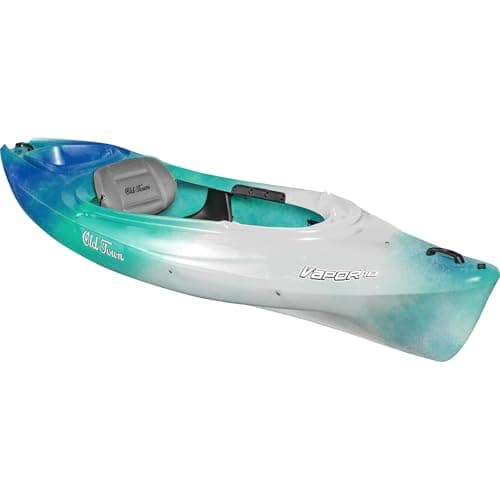 Old Town Vapor 10 Solo Sit-Inside Kayak, 10 ftTop pickThe large cockpit is the point. A sit-inside is intimidating to get into for exactly one reason -- the hole is small -- and this one is not. | A first boat with a large, easy-entry cockpit | 10 ft, 325 lb rated capacity | |
| 2 | 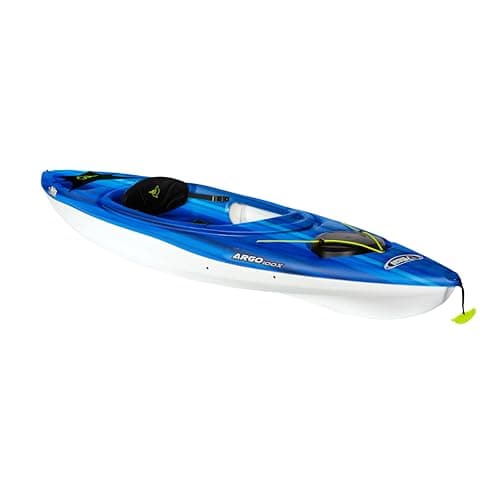 Pelican Argo 100X Sit-In Kayak, 10 ftThirty-six pounds is the number that matters here: it is the only 10-footer on this page one average adult can get off a car roof without a second person or a bad decision. | The lightest sit-inside to carry alone | 120 in long, 28 in beam, 36 lb hull, 275 lb rated capacity | |
| 3 | 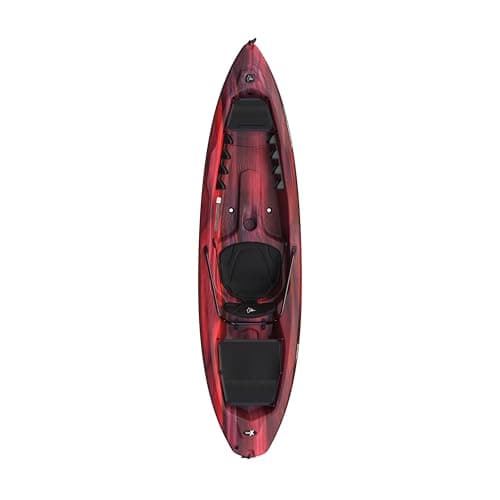 Pelican Seek 100X Sit-on-Top Kayak, 10 ftNine pounds lighter and seventeen inches shorter than the Tribe, for eight pounds less usable capacity. That trade is the whole reason to pick this one. | A sit-on-top that still fits a small car | 120 in long, 30 in beam, 43.1 lb hull, 300 lb rated capacity | |
| 4 | 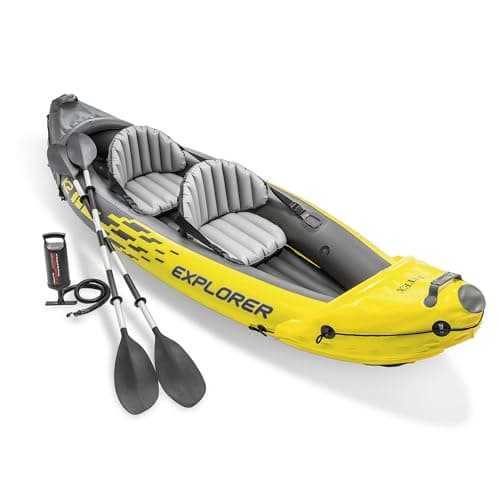 Intex Explorer K2 Inflatable Kayak, 2-person (oars and pump included)Bought as a tandem it disappoints; bought as a very roomy solo boat with 400 lb of rating and no rack requirement, it is the most useful inflatable here. | Two people, no roof rack, small budget | 123 in long, 36 in beam, 35 lb packed, 400 lb rated capacity, two oars and a pump included |
Most of what is written about kayaks for older paddlers is either patronizing or generic. The honest version is that age changes which specs are binding, not whether you can paddle. Knees decide how you get in. Shoulders decide what you can lift. Confidence decides how wide a hull you want under you. All three are numbers on a spec sheet, and this page is about reading them.
How we judged these boats
Three published specs in a specific order, and then one thing the spec sheet cannot tell you.
- **Cockpit size, or an open deck.** Getting into a sit-inside is a matter of lowering yourself through a hole while the boat moves. A large cockpit makes that a step; a small one makes it a maneuver. An open sit-on-top deck removes the question entirely.
- **Hull weight, published.** The number that decides whether the boat goes on the car and comes off it without help. We treat about 45 lb as the one-person ceiling and lower is better. A listing that does not publish a weight gets marked down for it.
- **Beam and hull shape.** 30 inches or wider with a flat or multi-chine bottom gives the settled, initial stability that lets you relax in the first ten minutes.
- **And then: what happens if you go in.** Remounting a sit-on-top from deep water is a maneuver most people can perform. Remounting a swamped sit-inside is a skill that takes practice and upper-body strength. This is the one that does not appear on any listing.
The entry problem, honestly
Nobody who sells kayaks talks about this, and it is the thing that stops older paddlers using the boat they bought. A recreational sit-inside cockpit is typically a hole you sit on the rim of and then slide your legs into, keeping your weight low while the hull moves under you. With good knees that is thirty seconds. With bad ones it is the reason the boat stays on the garage wall.
- **A large cockpit** — the Vapor 10 is the clearest example here — changes this from a slide to a step. You sit down into it the way you sit into a low chair.
- **A sit-on-top** has no cockpit at all. You sit on the deck, swing your legs across, done. It is the most forgiving entry there is, and the reason we list one for anyone with stiff hips.
- **A dock makes everything worse.** Entering from a dock means a drop into a moving boat. A gently shelving beach, where you can sit in the boat in six inches of water and push off, is the entry to look for. Choose your launch as carefully as your boat.
Hull weight, and the carry nobody plans for
A 10 ft recreational kayak weighs between about 36 and 52 lb depending on the model, and every one of those pounds has to get from a car roof to the water and back. That is a lift over your head at both ends of every trip, and it is the single biggest reason kayaks get used less than their owners intended.
| Boat | Hull weight | Type | Rated capacity |
|---|---|---|---|
| Pelican Argo 100X | 36 lb | Sit-inside | 275 lb |
| Pelican Seek 100X | 43.1 lb | Sit-on-top | 300 lb |
| Old Town Vapor 10 | not published | Sit-inside, large cockpit | 325 lb |
| Intex Explorer K2 | 35 lb packed | Inflatable | 400 lb |
The Vapor's unpublished weight is a genuine mark against it for this specific buyer. It is a boat you would choose for its cockpit and then have to weigh yourself in the store, which is exactly the spec you most need printed. We rank it first anyway because the cockpit is that decisive, but go in knowing it.
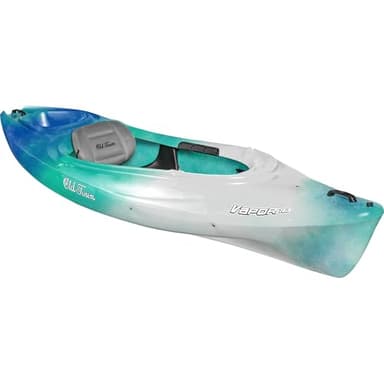
Top pick — A first boat with a large, easy-entry cockpit
Old Town Vapor 10 Solo Sit-Inside Kayak, 10 ft
The large cockpit is the point. A sit-inside is intimidating to get into for exactly one reason -- the hole is small -- and this one is not.
What the listing publishes
10 ft, 325 lb rated capacity
Usable at the 65 percent rule: 211 lb (range 195–227 lb), which leaves about 191 lb of paddler after a 20 lb day kit. Why 65 percent.
325 lb rated is about 211 lb usable at 65 percent, which puts most adults comfortably inside it rather than at its edge.
The listing publishes a length and a capacity but not a hull weight or a beam. We are not going to fill those in from memory: check the current spec sheet on the manufacturer's own page before you buy if carry weight is the thing deciding it for you.
Old Town has been making this hull family for a long time, which matters for a first boat only in that parts and seats are easy to find.
What it does well
- A large cockpit opening removes the single most common reason beginners avoid sit-insides
- 325 lb rating suits most adults with real headroom left over
- 10 ft is the length that turns easily and still tracks acceptably
What it costs you
- The listing does not publish a hull weight, so you cannot plan the carry from it
- Sit-inside cockpits are still harder to remount than an open deck after a swim
- Usually the priciest of the 10 ft sit-insides here
Skip this if carry weight is your deciding factor and you need a published number before you commit -- the Argo publishes 36 lb and this listing publishes nothing.
#ad · how this is funded · price as of October 9, 2026
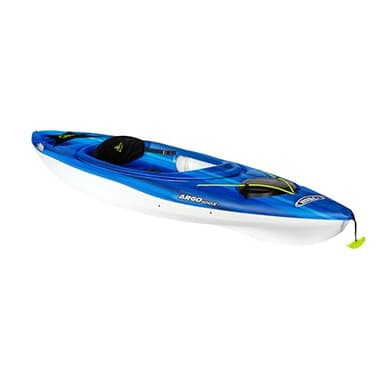
Pick 2 — The lightest sit-inside to carry alone
Pelican Argo 100X Sit-In Kayak, 10 ft
Thirty-six pounds is the number that matters here: it is the only 10-footer on this page one average adult can get off a car roof without a second person or a bad decision.
What the listing publishes
120 in long, 28 in beam, 36 lb hull, 275 lb rated capacity
Usable at the 65 percent rule: 179 lb (range 165–193 lb), which leaves about 159 lb of paddler after a 20 lb day kit. Why 65 percent.
A 275 lb rating sounds generous until you apply the 60 to 70 percent band Eddyline publishes for usable capacity. At 65 percent that is 179 lb of paddler, gear, clothing and PFD -- so a 160 lb paddler is comfortable and a 200 lb paddler is at the rating's edge before they pack anything.
The 28 in beam is the narrowest here, and narrow is the trade you make for a hull this light. It is stable enough for flat water and it will feel twitchier than a 30 in boat for the first hour.
Sit-inside means your legs are in a cockpit and out of the wind, which is why this is the shoulder-season pick rather than the July one.
What it does well
- 36 lb is genuinely one-person liftable, which decides how often the boat actually gets used
- Sit-inside cockpit keeps your legs dry and out of the wind on cool mornings
- 10 ft turns easily on a small lake and fits diagonally in most garages
What it costs you
- 28 in is the narrowest beam here and feels it on day one
- 275 lb rating is the lowest of the adult sit-insides on this page
- A cockpit is harder to get back into after a capsize than a sit-on-top deck
Skip this if you weigh over about 200 lb, or you expect to swim off the boat on hot days -- a sit-on-top is easier to remount and this hull's usable capacity runs out early.
#ad · how this is funded · price as of October 9, 2026
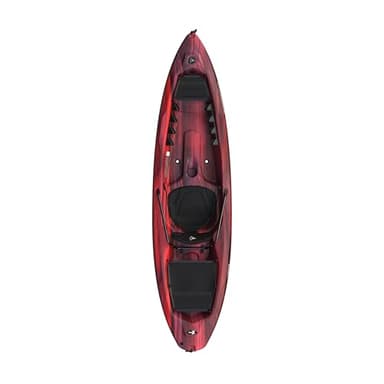
Pick 3 — A sit-on-top that still fits a small car
Pelican Seek 100X Sit-on-Top Kayak, 10 ft
Nine pounds lighter and seventeen inches shorter than the Tribe, for eight pounds less usable capacity. That trade is the whole reason to pick this one.
What the listing publishes
120 in long, 30 in beam, 43.1 lb hull, 300 lb rated capacity
Usable at the 65 percent rule: 195 lb (range 180–210 lb), which leaves about 175 lb of paddler after a 20 lb day kit. Why 65 percent.
300 lb rated is about 195 lb usable and 175 lb of paddler after gear -- enough for most adults, and 33 lb less headroom than the Tribe.
43 lb and 10 ft is the point where a sit-on-top becomes a one-person, one-trip job. Ten feet also fits inside a lot of vehicles that 11 ft 5 in does not.
The twin-arch hull section trades a little flat-water stillness for a hull that leans predictably rather than suddenly, which is a genuinely nicer feel once you are past the first hour.
What it does well
- 43 lb keeps this a one-person carry, unusual for a sit-on-top
- 30 in beam at only 10 ft means stability without the storage problem
- Self-draining deck with the same easy remount as any sit-on-top
What it costs you
- 300 lb rating is 50 lb short of the Tribe's
- 10 ft of hull wanders more than 11 ft 5 in on open water
- Same cold-water objection as every sit-on-top
Skip this if you and a child will regularly be on it together. The usable capacity does not cover two people once you subtract gear, and the Tribe or a tandem does.
#ad · how this is funded · price as of October 9, 2026
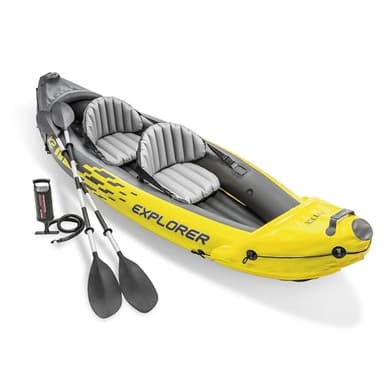
Pick 4 — Two people, no roof rack, small budget
Intex Explorer K2 Inflatable Kayak, 2-person (oars and pump included)
Bought as a tandem it disappoints; bought as a very roomy solo boat with 400 lb of rating and no rack requirement, it is the most useful inflatable here.
What the listing publishes
123 in long, 36 in beam, 35 lb packed, 400 lb rated capacity, two oars and a pump included
Usable at the 65 percent rule: 260 lb (range 240–280 lb), which leaves about 240 lb of paddler after a 20 lb day kit. Why 65 percent.
400 lb rated is about 260 lb usable at 65 percent. Two adults and gear will exceed that more often than not, which is why we recommend it as a spacious single rather than a genuine two-seater.
As a solo it is transformative: 260 lb of usable capacity against the Challenger K1's 143 lb, for nine extra pounds in the bag.
36 in of beam is wider than every hard-shell on this site. Inflatables are wide because air is what makes them stiff, and the side effect is a very forgiving platform.
What it does well
- 400 lb rated capacity -- 260 lb usable, which covers almost any solo adult with gear
- 36 in beam is the most stable platform on this site
- 35 lb in a bag: no rack, no straps, no garage
What it costs you
- Genuinely tight as a two-adult tandem once you apply the usable-capacity rule
- The included oars are oars, not proper kayak paddles -- budget to replace them
- Vinyl construction wallows in wind like every boat in this class
Skip this if you want a true two-adult tandem. Buy a hard-shell tandem with 500 lb or more of rating, or accept this as the roomiest solo inflatable in the price class.
#ad · how this is funded · price as of October 9, 2026
The capacity arithmetic still applies
Rated capacity is not usable capacity, and older paddlers are no exception. A hull loaded near its printed maximum sits low and handles badly, which is the opposite of what a nervous paddler needs.
Sit-on-top or sit-inside, for this buyer specifically
The general answer is on the full comparison page. For an older paddler the trade tilts a specific way.
- **Sit-on-top wins on entry and on remounting.** Both are strength-and-flexibility problems and an open deck removes most of each.
- **Sit-inside wins on warmth.** Cold water is harder on older bodies and an enclosed cockpit keeps the lower half dry. In a cool climate or a cool season that matters more.
- **The tiebreaker is the water temperature where you paddle.** Warm water, sit-on-top. Cold water, a large-cockpit sit-inside, and stay close to shore.
Getting out, which is the half nobody mentions
Every entry has an exit, and the exit is harder. You are stiffer than when you got in, the boat is still moving, and you are going from seated-low to standing on something uneven. The same rules apply in reverse: a shelving beach where you can run the bow aground and step out into six inches of water is the exit to plan for, and a dock is the one to avoid.
- **Ground the bow first.** Paddle straight at the shore until the hull stops. Now the boat is not moving and the water beside you is shallow.
- **Sit on the rim, then swing.** On a sit-inside, get your weight onto the cockpit rim behind you, then bring both legs out to one side. On a sit-on-top, swing both legs to one side and stand.
- **Use the paddle as a brace.** Laid across the cockpit rim and the shore, it turns into a handrail. This is the single most useful trick for stiff knees and it costs nothing.
- **Accept wet feet.** The alternative is a dry exit from a dock, which is the exit most likely to end in the water.
What you can ignore
- **Anything marketed as a senior kayak.** There is no such category. There are boats with large cockpits, low weights and wide beams, and this page is those boats.
- **Rudders and skegs.** Useful on long open crossings and irrelevant on the protected water where this paddling should happen.
- **Speed.** A 10 ft recreational hull is not fast and does not need to be. Waterline that tracks straight matters; waterline that goes fast does not.
- **Storage hatches.** A day kit lives behind the seat or in a dry bag. A sealed hatch is a nice-to-have, not a reason to accept a heavier boat.
The safety part, which is not optional here
Older paddlers are over-represented in paddlecraft fatalities and the reasons are specific: cold water, paddling alone, and a life jacket stowed rather than worn because it was uncomfortable to paddle in.
One more thing that is worth saying plainly: a kayak cart is not an admission of anything. It turns a 45 lb carry across a parking lot into a walk, and it is the accessory most likely to be the difference between a boat that gets used and one that does not. The accessories that actually earn a place.
Questions people actually ask
What is the easiest kayak for a senior to get in and out of?
How heavy a kayak can one older person handle?
Is a sit-on-top or sit-in kayak better for seniors?
Are inflatable kayaks good for older paddlers?
What width kayak is most stable for a beginner senior?
Should a senior kayak alone?
Where these numbers came from
Every figure on this page traces to one of these. Where a number could not be sourced, the page says so rather than estimating it.
- Eddyline Kayaks — Maximum weight capacity versus ideal capacity for various styles of kayaks (manufacturer, states the 60-70% ideal-capacity band)
- U.S. Coast Guard — Life Jacket Wear / Wearing Your Life Jacket (federal carriage and under-13 wear requirements)
- Old Town Vapor 10 Solo Sit-Inside Kayak — manufacturer specification as published on the Amazon listing, read 2026-09-02
- Pelican Argo 100X Sit-In Kayak — manufacturer specification as published on the Amazon listing, read 2026-09-02
- Pelican Seek 100X Sit-on-Top Kayak — manufacturer specification as published on the Amazon listing, read 2026-09-02
- Intex Explorer K2 Inflatable Kayak — manufacturer specification as published on the Amazon listing, read 2026-09-02
Read next
Lightest to Carry
The Best Lightweight Kayaks
Ranked on published hull weight, because the carry is what decides whether a kayak leaves the garage. What each pound saved costs in capacity.
Top pick
Pelican Argo 100X Sit-In Kayak, 10 ft
The lightest sit-inside to carry alone
#ad · how this is funded · price as of October 9, 2026

Sit-On-Top vs Sit-In Kayak
Water temperature and remounting decide this, not preference. The honest comparison, with picks for each.
Top pick
Perception Tribe 11.5 Sit-on-Top Kayak
The all-round first sit-on-top
#ad · how this is funded · price as of October 9, 2026

Best First Kayak
The Best Kayaks for Beginners
Beginner kayaks ranked on width, carry weight and usable capacity — with the 65 percent arithmetic run on every one.
Top pick
Perception Tribe 11.5 Sit-on-Top Kayak
The all-round first sit-on-top
#ad · how this is funded · price as of October 9, 2026
Getting Your Kayak to the Water
Four ways to move a kayak, including one that needs no roof bars and one that removes the problem entirely.
Top pick
Attwood Universal Rack-Free Car-Top Kayak Carrier Kit
A car with no roof bars at all
#ad · how this is funded · price as of October 9, 2026
Best Life Jacket
The Best Life Jackets for Paddling
Approved vests compared on cut and comfort — the variables that decide whether it stays on.
Top pick
Onyx MoveVent Dynamic Paddle Vest
The PFD you will actually keep on
#ad · how this is funded · price as of October 9, 2026
Kayak Weight Capacity, Explained
The 65 percent rule, where it comes from, what happens when you ignore it, and how to size around it.
Top pick
Perception Tribe 11.5 Sit-on-Top Kayak
The all-round first sit-on-top
#ad · how this is funded · price as of October 9, 2026