Choosing Your First
Paddle Board or Kayak?
The fork in the road for almost every first-time buyer. We earn the same commission whichever you choose, so nothing on this page is steering you.
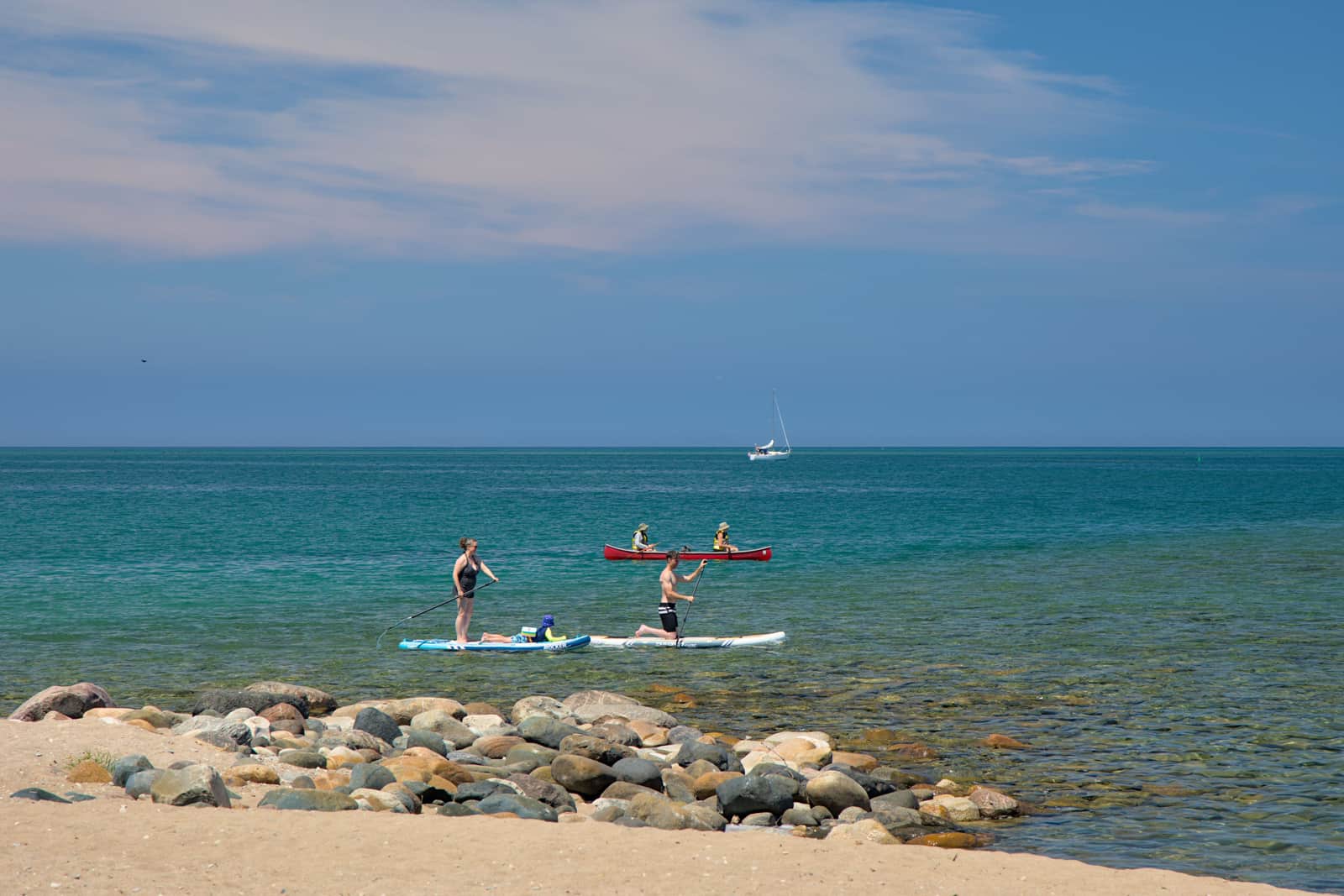
We have not paddled these, and we are not going to pretend we have. Here is what we did instead. Links to Amazon earn us a commission at no extra cost to you, and commission never decides a pick — how this site is funded.
| # | Product | Best for | The spec it turns on | Price |
|---|---|---|---|---|
| 1 | 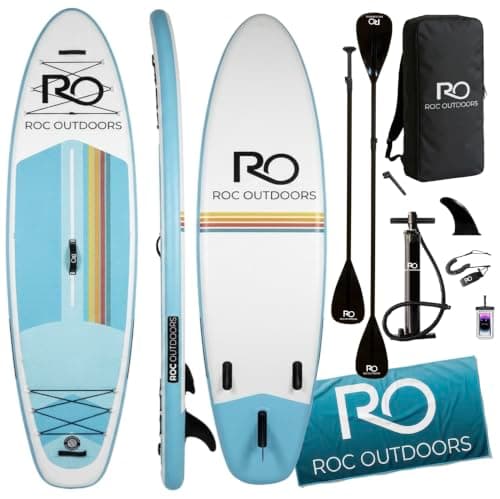 Roc Inflatable Stand Up Paddle Board, 10 ft 6 in x 33 inTop pick10 ft 6 in by 33 in is the shape the whole beginner category converged on, and this is the cheapest version of it that publishes a 350 lb rating. | The default first inflatable board | 126 x 33 x 6 in, 350 lb rated capacity, PVC drop-stitch, full accessory kit | |
| 2 | 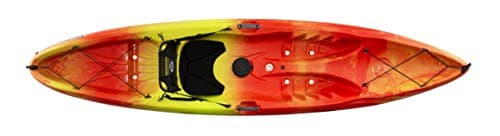 Perception Tribe 11.5 Sit-on-Top KayakThe combination almost nothing else manages: 350 lb of rating, a 30 in beam and enough waterline to hold a line, in a hull a first-timer can climb back onto from the water. | The all-round first sit-on-top | 137 in long, 30.25 in beam, 52 lb hull, 350 lb rated capacity |
Worth putting the conflict of interest on the table before the argument: this site earns an affiliate commission on both. The rates are comparable and nothing about our income depends on which of these you buy, which is the only reason a page like this is worth reading.
| Paddle board | Kayak | |
|---|---|---|
| Storage | Rolls into a rucksack-sized bag | 10 to 12 ft of wall, unless inflatable |
| Transport | Car boot | Roof bars and straps, unless inflatable |
| Physical effort | Higher — legs and core work continuously | Lower — you are seated and it is arms and torso |
| Staying dry | Wet feet and ankles, always | Dry in a sit-inside; wet legs in a sit-on-top |
| Carrying things | Very little. A dry bag under a bungee | A lot. Hatches, tank wells, tie-downs |
| Wind | Poor. You are a sail standing up | Much better. You sit low |
| Distance | Slower and more tiring | Faster and far less tiring |
| Cool weather | Exposed and unpleasant | A sit-inside is genuinely comfortable |
| Learning curve | An hour to stand, a season to be good | Ten minutes to be adequate |
| Setup time | 8 to 12 minutes to inflate | None, for a hard-shell |
| What comes in the box | Usually everything but the PFD | Usually just the hull |
The wind difference is bigger than the table suggests
This is the practical difference that shapes how many days a year each is enjoyable, and it is underweighted almost everywhere.
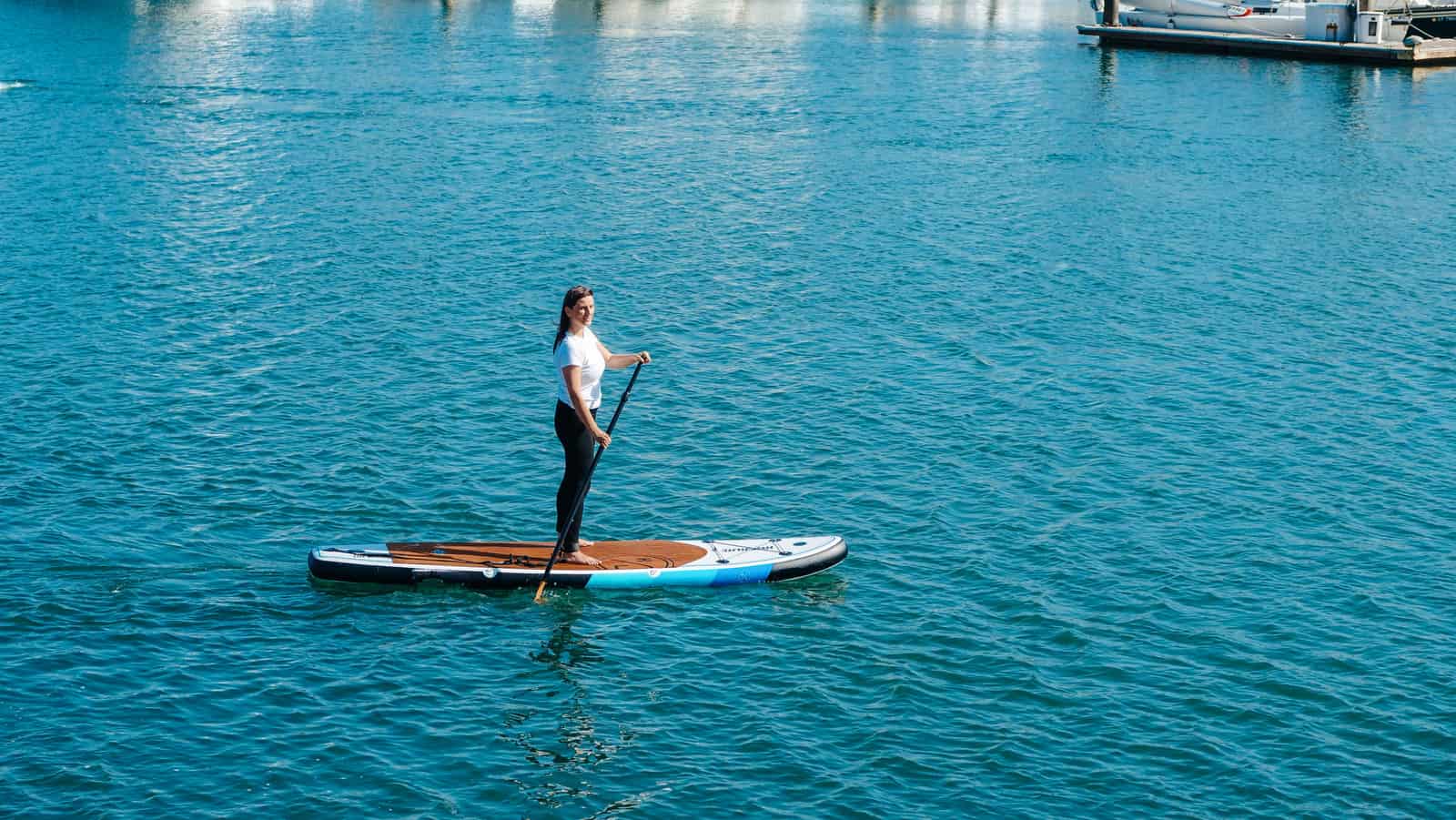
Standing on a board puts roughly five and a half feet of you above the water, perpendicular to the wind. You are the sail. At 12 mph a board becomes hard work; at 15 it becomes an argument you lose. A kayak puts you sitting at deck level with most of your body below the gunwale line, and the same 15 mph is merely a bit choppy.
In practice that is the difference between a craft that is pleasant on calm days and one that is pleasant on most days.
The storage difference goes the other way, and it is decisive
An inflatable board is a bag in a cupboard. A hard-shell kayak is ten to twelve feet of object that has to live somewhere permanently, plus roof bars, plus straps, plus a loading routine at both ends of every trip.
For a lot of people that settles it before any of the on-water arguments get a hearing, and it should — a boat you cannot store is a boat you do not use. The honest caveat is that an inflatable kayak collapses this difference entirely, which is why it is an underrated answer to exactly this problem.
The effort difference is real and often misread
Paddle boarding is harder work. Standing engages your legs and core for the entire session, and a first hour on a board is genuinely tiring in a way that a first hour in a kayak is not.
Whether that is a drawback depends entirely on what you want. If the goal is exercise, it is the feature. If the goal is being on the water for three hours with a picnic, it is not.
Choose a board if
- **Storage is genuinely tight** and an inflatable kayak is not appealing.
- **You want the simplest possible kit** — one bag with everything but the life jacket in it.
- **Exercise is part of the point.** Standing works far more of you than sitting does.
- **You paddle warm, sheltered water** where wind is not a routine factor.
- **You want to swim mid-session**, which is trivially easy off a board.
- **You might do yoga or take photographs** from it, which are activities a kayak does not offer.
Choose a kayak if
- **You want to carry things.** Hatches and tank wells versus one dry bag under a bungee is not a close comparison.
- **You want to stay dry**, particularly in spring and fall.
- **Your water is open and windy.** Sitting low beats standing up, every time.
- **You want to cover distance.** A kayak is meaningfully faster for the same effort.
- **You want to fish** with any seriousness.
- **Anyone in the household has balance or mobility concerns.** Sitting down is the accessible option.
The honest split
If we had to generalize: boards are easier to own and kayaks are easier to use. Which of those matters more depends on whether your obstacle is your garage or your water.
One more consideration that decides a surprising number of cases: a kayak is much easier to share with someone who does not have your balance or fitness. A nervous partner or a grandparent gets into a sit-on-top kayak and has a nice afternoon. The same person on a board has a frustrating one.
Where to go next
- **Leaning board:** work out your board size, then the beginner picks.
- **Leaning boat:** understand hull shapes first, then the beginner picks.
- **Still undecided:** what a first setup costs for both, side by side. The totals are closer than you would think.
One of each, to start from
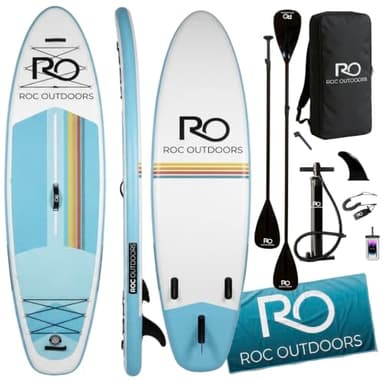
Top pick — The default first inflatable board
Roc Inflatable Stand Up Paddle Board, 10 ft 6 in x 33 in
10 ft 6 in by 33 in is the shape the whole beginner category converged on, and this is the cheapest version of it that publishes a 350 lb rating.
What the listing publishes
126 x 33 x 6 in, 350 lb rated capacity, PVC drop-stitch, full accessory kit
Usable at the 65 percent rule: 228 lb (range 210–245 lb), which leaves about 208 lb of paddler after a 20 lb day kit. Why 65 percent.
33 in of width is the number that decides whether you stand up on day one. Our width guidance puts 32 to 33 in as the beginner band for an adult between 150 and 200 lb, and this sits in it.
350 lb rated capacity means about 227 lb of loaded paddler at 65 percent. Applying the displacement arithmetic instead, a 195 lb loaded paddler wants roughly 195 L of volume -- this hull's 126 x 33 x 6 in envelope is comfortably past that.
Six inches of thickness is what makes a modern inflatable stiff. Four-inch boards flex under an adult in the middle and that flex is what people mistake for the board being unstable.
What it does well
- 33 in wide -- the width that gets a first-timer standing rather than kneeling
- 350 lb rating covers an adult with a child or a dog on board
- Ships with pump, paddle, leash and bag, so the listing price is close to the total
What it costs you
- The included paddle and pump are starter parts you will eventually replace
- 10 ft 6 in is a compromise length -- not fast, not especially maneuverable
- The listing does not publish a board weight
Skip this if you already know you want to cover distance. A 10 ft 6 in all-around board is a cruiser and an 11 ft 6 in touring shape is the honest answer for mileage.
#ad · how this is funded · price as of October 18, 2026
Pick 2 — The all-round first sit-on-top
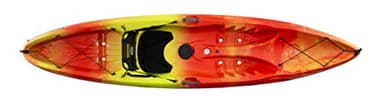
Perception Tribe 11.5 Sit-on-Top Kayak
The combination almost nothing else manages: 350 lb of rating, a 30 in beam and enough waterline to hold a line, in a hull a first-timer can climb back onto from the water.
What the listing publishes
137 in long, 30.25 in beam, 52 lb hull, 350 lb rated capacity
Usable at the 65 percent rule: 228 lb (range 210–245 lb), which leaves about 208 lb of paddler after a 20 lb day kit. Why 65 percent.
350 lb rated is about 228 lb usable at 65 percent and 208 lb of paddler after a day kit -- the most headroom of any single boat here, and enough that a 200 lb adult is inside the comfortable band rather than at the edge of it.
Sit-on-top means the deck is open and self-draining. The reason that matters to a beginner is not comfort, it is that remounting from deep water is a maneuver you can actually perform, where a flooded sit-inside cockpit is not.
52 lb is the price. This is at the top of what one person carries any distance, and the reason a cart appears in our cost totals for this boat and not for the Argo.
What it does well
- 350 lb rated capacity gives real headroom for larger adults or a child up front
- Open self-draining deck is the forgiving choice for a first summer
- 137 in of hull tracks far better than the 9 and 10 ft boats here
What it costs you
- 52 lb is a two-person lift onto a roof for most people
- You will get wet. Sit-on-tops always do, and that is a season decision not a design flaw
- 11 ft 5 in needs more storage length than the 10 ft boats
Skip this if you paddle in cold water or a cold shoulder season. An open deck in 55-degree water is a different and less pleasant sport, and a sit-inside is the right answer there.
#ad · how this is funded · price as of October 18, 2026
Questions people actually ask
Is a paddle board or kayak better for beginners?
Is paddle boarding harder than kayaking?
Which is safer, a paddle board or a kayak?
Can you sit down on a paddle board?
Which is better for fishing, a paddle board or a kayak?
Which is cheaper, a paddle board or a kayak?
Where these numbers came from
Every figure on this page traces to one of these. Where a number could not be sourced, the page says so rather than estimating it.
- Thurso Surf — What Size Paddle Board Is Right for You (manufacturer, states the weight-in-kg x 2 volume rule and the 32 in beginner width band)
- Eddyline Kayaks — Maximum weight capacity versus ideal capacity for various styles of kayaks (manufacturer, states the 60-70% ideal-capacity band)
- U.S. Coast Guard — Life Jacket Wear / Wearing Your Life Jacket (federal carriage and under-13 wear requirements)
- Roc Inflatable Stand Up Paddle Board 10'6" — manufacturer specification as published on the Amazon listing, read 2026-09-02
- Perception Tribe 11.5 Sit-on-Top Kayak — manufacturer specification as published on the Amazon listing, read 2026-09-02
Read next

Paddle Board vs Canoe
A canoe carries a family and a week of gear. A board carries you. Which one fits, and why most people asking are really asking something else.
Top pick
Roc Inflatable Stand Up Paddle Board, 10 ft 6 in x 33 in
The default first inflatable board
#ad · how this is funded · price as of October 18, 2026
Best First Board
The Best Paddle Boards for Beginners
Five beginner boards ranked on published width and usable capacity, with the displacement arithmetic run on each one.
Top pick
Roc Inflatable Stand Up Paddle Board, 10 ft 6 in x 33 in
The default first inflatable board
#ad · how this is funded · price as of October 18, 2026
Best First Kayak
The Best Kayaks for Beginners
Beginner kayaks ranked on width, carry weight and usable capacity — with the 65 percent arithmetic run on every one.
Top pick
Perception Tribe 11.5 Sit-on-Top Kayak
The all-round first sit-on-top
#ad · how this is funded · price as of October 18, 2026

What a First Setup Actually Costs
Every line item in a first setup, including the ones that surprise people — with live prices rather than stale numbers.
Top pick
Perception Tribe 11.5 Sit-on-Top Kayak
The all-round first sit-on-top
#ad · how this is funded · price as of October 18, 2026

What Size Paddle Board Do I Need?
A volume and width calculator that shows its working, and ends in an actual board rather than a chart.
Top pick
Roc Inflatable Stand Up Paddle Board, 10 ft 6 in x 33 in
The default first inflatable board
#ad · how this is funded · price as of October 18, 2026
What Size Kayak Do I Need?
Capacity, length and width worked out properly — including the 65 percent rule that changes which boats you should be looking at.
Top pick
Perception Tribe 11.5 Sit-on-Top Kayak
The all-round first sit-on-top
#ad · how this is funded · price as of October 18, 2026