Kayaks
The Best Kayaks for Kids
The difference between a child's own boat and a boat they sit in is whether they can carry it. That is a published number, and it matters more than any feature a kids' kayak advertises.
We have not paddled these, and we are not going to pretend we have. Here is what we did instead. Links to Amazon earn us a commission at no extra cost to you, and commission never decides a pick — how this site is funded.
| # | Product | Best for | The spec it turns on | Price |
|---|---|---|---|---|
| 1 | 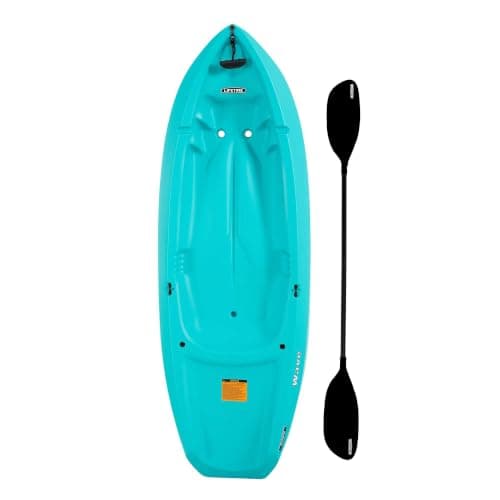 Lifetime Youth Wave Kayak, 6 ft (paddle included)Top pickEighteen pounds is the spec that matters: a child can drag this to the water themselves, which is the difference between their boat and your boat that they sit in. | A first boat for a child aged five and up | 72 in long, 18 lb hull, 130 lb rated capacity, youth paddle included | |
| 2 | 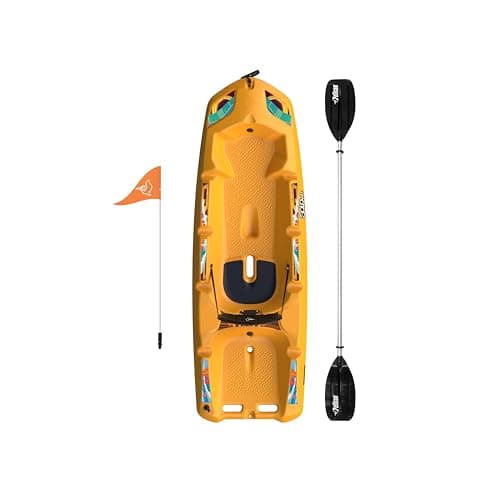 Pelican Solo EVO DLX Kids Sit-on-Top Kayak (paddle included)The same six feet as every kids' boat, with a twin-tunnel hull underneath so it leans and recovers instead of simply tipping, and a stern platform a child can climb back onto unaided. | A child's boat with a real hull under it | 72 in long, 24.5 in beam, 20.8 lb hull, paddle and seat cushion included | |
| 3 | 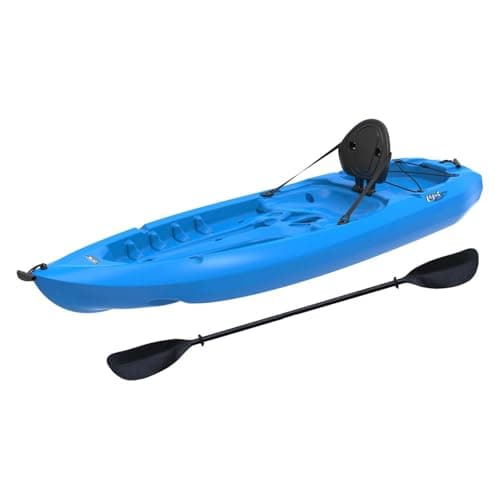 Lifetime Lotus Sit-on-Top Kayak, 8 ft (paddle included)Eight feet, thirty inches wide, a paddle in the box. It is not a good boat and it is an honest one -- this is a pond and a cabin dock, not a lake crossing. | The cheapest complete way onto flat water | 96 in long, 30 in beam, 39 lb hull, 250 lb rated capacity, paddle included | |
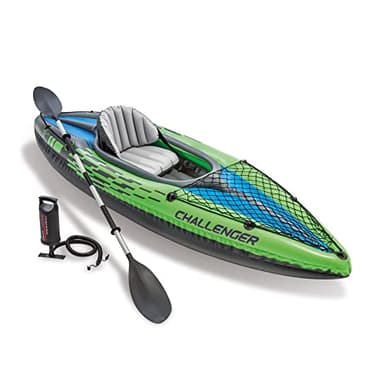
| 4 | 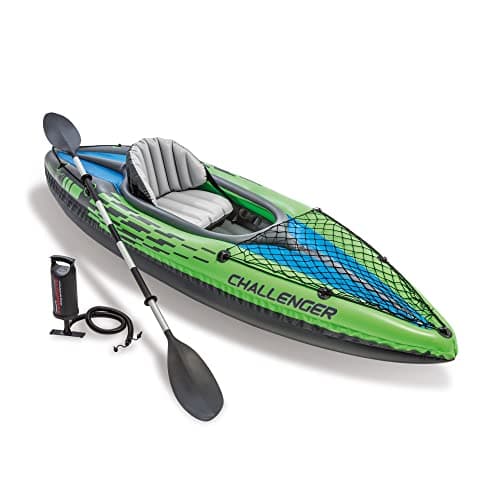 Intex Challenger K1 Inflatable Kayak (paddle and pump included)The honest answer to 'I have an apartment and a sedan'. It is a real boat on flat water and it is not a hard-shell substitute, and it is worth being clear about which of those you are buying. | No car rack, no garage, no storage | 108 in long, 30 in beam, 26 lb packed, 220 lb rated capacity, paddle and pump in the box |
Kids' kayaks are sold on color and on the word kids, and the two specifications that actually decide whether a child uses the boat are printed in the small type. One is the hull weight. The other is the rated capacity, which sets an expiry date. Everything else is downstream of those two numbers.
How we judged these boats
- **Hull weight the child can move.** A rough rule that works: if the boat weighs more than about a quarter of the child's body weight, they cannot drag it across sand alone, and it becomes your boat that they ride in. The 18 to 21 lb boats here pass that test for most children from about age six.
- **Rated capacity that fits them today, with a little room.** Run through the same 65 percent rule as any adult boat. A 130 lb rating is about 85 lb of child in a life jacket. That is a real ceiling and it arrives sooner than parents expect.
- **A sit-on-top, always.** Children go in the water on purpose. An open deck that self-drains and can be climbed back onto from the water is the only sensible design for a child's first boat.
- **Width proportionate to a child, not to an adult.** A 24 in beam is narrow by adult standards and correct for a 60 lb paddler — they need less width for the same stability margin, and a narrower hull is one they can reach past to paddle.
The expiry-date arithmetic
This is what makes a kids' kayak different from every other boat on this site: it is bought knowing it will be outgrown. The question is when, and the rating tells you.
That is why the honest recommendation for an older child is often not a kids' boat at all. The Lifetime Lotus is an 8 ft adult sit-on-top rated to 250 lb, which covers a child through their teens — the trade is 39 lb of hull that a ten-year-old cannot carry alone. Whether that matters depends entirely on whether you are at the water with them.
| Boat | Length | Hull weight | Rated | Child it fits, roughly |
|---|---|---|---|---|
| Lifetime Youth Wave | 72 in | 18 lb | 130 lb | up to about 80 lb |
| Pelican Solo EVO DLX | 72 in | 20.8 lb | not published | see note below |
| Lifetime Lotus | 96 in | 39 lb | 250 lb | up to about 157 lb |
| Intex Challenger K1 | 108 in | 26 lb packed | 220 lb | up to about 138 lb |
The Pelican is the exception in that table and it is worth saying why rather than quietly leaving the cell blank. Its listing publishes a length, a width and a hull weight but no rated capacity, so there is no number to run the 65 percent arithmetic against. We will not estimate one. Judge it on the specs it does publish — 72 in, 24.5 in wide, 20.8 lb — and treat the missing rating as a real mark against it if sizing by the numbers is how you want to buy.
Why six feet is the number
Every purpose-built kids' kayak is about six feet long, and it is not an accident. A six-foot hull turns almost on the spot, which is what children actually want to do with a boat, and it is short enough that a small paddler can reach the water on both sides with a youth paddle.
The cost is speed. A six-foot boat cannot keep up with a ten-foot one, at all, and a child paddling flat out while an adult drifts alongside is a real dynamic on family outings. Plan around it: the adult sets the pace, the child sets the route, and nobody is going anywhere far.
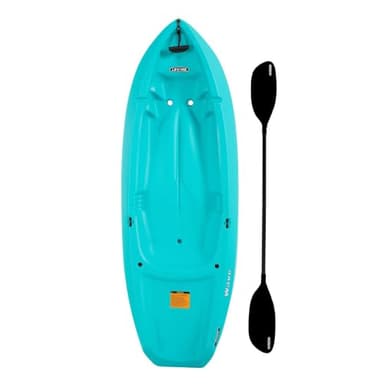
Top pick — A first boat for a child aged five and up
Lifetime Youth Wave Kayak, 6 ft (paddle included)
Eighteen pounds is the spec that matters: a child can drag this to the water themselves, which is the difference between their boat and your boat that they sit in.
What the listing publishes
72 in long, 18 lb hull, 130 lb rated capacity, youth paddle included
Usable at the 65 percent rule: 85 lb (range 78–91 lb), which leaves about 65 lb of paddler after a 20 lb day kit. Why 65 percent.
130 lb rated is about 85 lb usable at 65 percent, so this covers a child up to roughly eight stone in a PFD. Past that they need an adult boat and the jump is abrupt.
Molded swim-up steps on the back are the feature. Children fall off, and getting back on unaided is what keeps a fall funny instead of frightening.
6 ft and flat-bottomed is very stable and very slow, which is exactly right. A child's first boat should not go anywhere fast.
What it does well
- 18 lb -- a child can move it without help, which is most of the point
- Swim-up steps let them remount unaided after a fall
- Paddle is included and correctly sized for a child
What it costs you
- 130 lb rated means they will outgrow it, often in two or three seasons
- 6 ft is slow, so they cannot keep up with an adult boat
- No storage of any kind
Skip this if your child is already over about 85 lb in a PFD, or you want one boat that lasts to their teens -- this is not that boat and nothing at 6 ft is.
#ad · how this is funded · price as of October 9, 2026
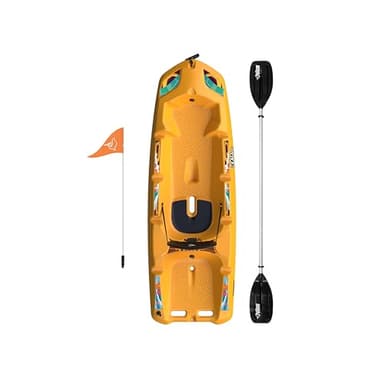
Pick 2 — A child's boat with a real hull under it
Pelican Solo EVO DLX Kids Sit-on-Top Kayak (paddle included)
The same six feet as every kids' boat, with a twin-tunnel hull underneath so it leans and recovers instead of simply tipping, and a stern platform a child can climb back onto unaided.
What the listing publishes
72 in long, 24.5 in beam, 20.8 lb hull, paddle and seat cushion included
The twin tunnels are two V-shaped channels molded into the bottom. They give a child's hull something a flat slab does not: it warns before it goes over, which is how balance gets learned.
The swim-up deck is the spec parents should read twice. It is a flat stern platform with a handle, and it is the difference between a child who can get back on alone and one who needs lifting every time.
20.8 lb is a shade under three pounds heavier than the Wave and still inside what a seven-year-old drags across grass unaided.
What it does well
- Twin-tunnel hull warns before it tips rather than just tipping
- Swim-up stern platform means a child remounts without help
- 20.8 lb is still a child-portable weight, and a paddle and seat cushion are in the box
What it costs you
- The listing does not publish a rated capacity, so you cannot run the usable-load arithmetic on it
- Costs more than the Lifetime Wave for a hull the child outgrows just as fast
- 6 ft, so the same speed mismatch with adult boats
Skip this if you want the cheapest possible way to find out whether your child likes this, or you want a published capacity to size against. Try the Lifetime Wave first and buy properly if it takes.
#ad · how this is funded · price as of October 9, 2026
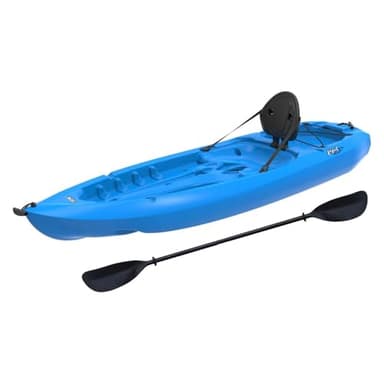
Pick 3 — The cheapest complete way onto flat water
Lifetime Lotus Sit-on-Top Kayak, 8 ft (paddle included)
Eight feet, thirty inches wide, a paddle in the box. It is not a good boat and it is an honest one -- this is a pond and a cabin dock, not a lake crossing.
What the listing publishes
96 in long, 30 in beam, 39 lb hull, 250 lb rated capacity, paddle included
Usable at the 65 percent rule: 163 lb (range 150–175 lb), which leaves about 143 lb of paddler after a 20 lb day kit. Why 65 percent.
250 lb rated is about 163 lb usable at 65 percent and 143 lb of paddler after gear. Read that number twice before you buy: a 180 lb adult is over it before they pick up the paddle.
The included paddle is the reason this is the cheapest genuine way onto the water, and it is also a paddle you will replace. Budget for that in year two, not year one.
Eight feet with a 30 in beam is very stable at rest and effectively unsteerable in wind. On a pond that is fine. On anything with fetch it is not.
What it does well
- Cheapest complete package here -- hull and paddle in one box
- 30 in beam on an 8 ft hull is extremely stable sitting still
- 39 lb and 8 ft: one person, one trip, fits in a lot of car interiors
What it costs you
- 250 lb rating means about 143 lb of paddler once gear is subtracted
- 8 ft is slow and blows around in any real wind
- The included paddle is a starter part, not a keeper
Skip this if you weigh more than about 145 lb dressed and carrying gear, or your water is anything larger than a small pond. Both are hard limits here, not preferences.
#ad · how this is funded · price as of October 9, 2026
Pick 4 — No car rack, no garage, no storage
Intex Challenger K1 Inflatable Kayak (paddle and pump included)
The honest answer to 'I have an apartment and a sedan'. It is a real boat on flat water and it is not a hard-shell substitute, and it is worth being clear about which of those you are buying.
What the listing publishes
108 in long, 30 in beam, 26 lb packed, 220 lb rated capacity, paddle and pump in the box
Usable at the 65 percent rule: 143 lb (range 132–154 lb), which leaves about 123 lb of paddler after a 20 lb day kit. Why 65 percent.
220 lb rated is about 143 lb usable at 65 percent and roughly 123 lb of paddler once a PFD, paddle and water are subtracted. That is the single most important number on this listing and it rules out most adult men.
26 lb packed into a bag is what you are actually paying for. No roof bars, no straps, no cart, no garage wall -- the entire transport problem this site spends a page on simply does not exist.
Vinyl over a drop-stitch floor is not the same construction as a drop-stitch inflatable board. Expect fifteen minutes of setup, expect it to be soft, and do not expect it to hold a line in wind.
What it does well
- 26 lb in a bag removes the roof rack, the straps and the storage problem in one purchase
- Paddle and pump are included, so the number on the listing is close to the total
- 30 in beam and a wide flat floor is very stable at rest
What it costs you
- 220 lb rated is about 123 lb of paddler after gear -- read that before anything else
- Fifteen minutes of pumping at each end of every trip
- Soft hull, so it wallows in wind and tracks poorly
Skip this if you weigh over about 125 lb dressed and carrying gear. The capacity arithmetic is unambiguous and the Excursion Pro or the Explorer K2 are the honest upgrades.
#ad · how this is funded · price as of October 9, 2026
The swim-up steps, and other details that matter
- **Molded steps or handholds on the hull.** The Youth Wave has a swim-up step at the stern. Children fall off kids' kayaks constantly and enjoy it; the question is whether they can get back on without you. A step changes that.
- **A youth paddle in the box.** An adult paddle is too long and too heavy for a child and makes the whole thing miserable. Both of the six-footers here ship with one.
- **Molded footwells at several positions.** Children grow during a season. Footwells at more than one distance from the seat keep the boat fitting.
- **Bright color.** Not for the child — for you. A bright hull is easy to spot from shore.
The inflatable question for a teenager
For a child too big for a six-footer and too small to carry a 39 lb hull, an entry inflatable is a genuine answer. The Challenger K1 is 26 lb in a bag, rated to 220 lb, and a twelve-year-old can carry it and inflate it themselves. The trade is that vinyl inflatables wallow in wind and need fifteen minutes of pumping. For a cabin dock or a small pond, that is a fair deal.
The tandem alternative
For a child under about six, or any child who is not yet a confident swimmer, the honest answer is often not their own boat at all. A tandem kayak with the child in the front seat and an adult behind puts them on the water, gives them a paddle to hold, and keeps them within reach. They get most of the experience and none of the risk of drifting off.
The Perception Rambler 13.5 is rated 550 lb and has real room in the bow for a small paddler and a dry bag. It is also a boat the family keeps when the child outgrows a kids' kayak, which a six-footer is not. The tandem roundup covers the trade in full. The short version is that a tandem is the better first purchase if the child is small, and a kids' boat is the better second one.
Teaching them, in the right order
- **Falling off first.** Before anything else, have them capsize on purpose in waist-deep water and climb back on. A child who has done this is not frightened when it happens by accident, and it will.
- **Then the paddle, on land.** Grip, blade angle and the forward stroke, standing on grass. Five minutes.
- **Then straight lines, close to shore.** Paddling straight is the skill. Turning takes care of itself on a six-foot boat.
- **Then let them lead.** A child who chooses the route is a participant. A child who follows your boat is a passenger with a paddle.
Keep the first outings short. Thirty minutes is plenty, and end them before the child wants to. A kid who is asked to stop while still enjoying it wants to go again. One who was kept out until cold and tired does not.
Storage, which is the parent's problem
A six-foot kids' boat is the easiest hull on this site to store and the one most likely to end up in the wrong place. It fits on a garage wall, under a deck, or standing on end in a corner, and it is light enough that a child will leave it wherever they got out of it. Two rules: out of direct sun, because a small hull with thin walls fades and goes brittle faster than a thick adult one, and off the ground, so it does not become a home for whatever lives in the yard. Storing a board or a boat covers the eleven months it is not in use.
What you can ignore
- **Character licensing and graphics.** They add nothing to the hull and often add to the price.
- **Storage.** A child's day kit is a water bottle and a snack, and they go in your boat.
- **Fishing features on a kids' boat.** A rod holder on a six-foot hull is a place to lose a rod.
- **Anything that promises the boat will last to adulthood.** Nothing at six feet does. Buy for the child you have and expect to buy again.
The safety part, which is the law for children
The other rule is proximity. A child's kayak is a shoreline toy, not a crossing boat, and an adult within a few boat lengths at all times is the entire safety plan. What a first outing should look like applies doubly here.
Questions people actually ask
What age can a child have their own kayak?
What size kayak is best for a kid?
How long will a kids' kayak last before they outgrow it?
Do kids need a sit-on-top or sit-in kayak?
Is an inflatable kayak good for a teenager?
Does a child need to wear a life jacket in a kayak?
Where these numbers came from
Every figure on this page traces to one of these. Where a number could not be sourced, the page says so rather than estimating it.
- Eddyline Kayaks — Maximum weight capacity versus ideal capacity for various styles of kayaks (manufacturer, states the 60-70% ideal-capacity band)
- U.S. Coast Guard — Life Jacket Wear / Wearing Your Life Jacket (federal carriage and under-13 wear requirements)
- Lifetime Youth Wave Kayak 6 ft, paddle included — manufacturer specification as published on the Amazon listing, read 2026-09-02
- Pelican Solo EVO DLX Kids Sit-on-Top Kayak — manufacturer specification as published on the Amazon listing, read 2026-09-02
- Lifetime Lotus Sit-on-Top Kayak 8 ft — manufacturer specification as published on the Amazon listing, read 2026-09-02
- Intex Challenger K1 Inflatable Kayak — manufacturer specification as published on the Amazon listing, read 2026-09-02
Read next
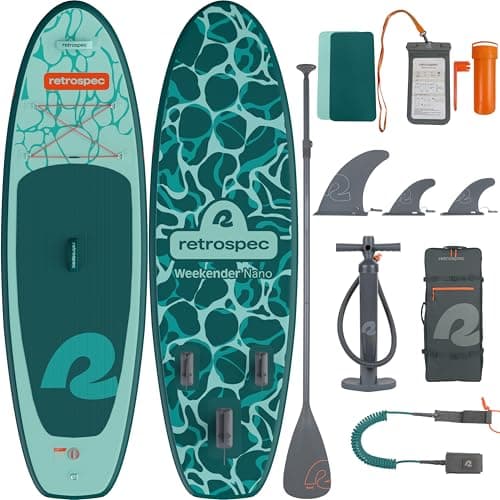
Retrospec Weekender-Nano: The Board a Child Can Actually Carry
12.2 lb, 8 ft 6 in and 28 in wide, with paddle, pump and backpack in the box. Rated 140 lb, which is the number that decides how many seasons you get.
Top pick
Retrospec Weekender-Nano Inflatable Paddle Board, 8 ft
A child's own board
#ad · how this is funded · price as of October 9, 2026
Best Kids' Life Jacket
The Best Life Jackets for Kids Who Paddle
Fitted by weight on the label, never by age. The approved vest for each weight band, the features that matter at each size, and the mistakes that make a vest unsafe.
Top pick
Onyx Youth Life Jacket, 55-88 lb
A child paddling their own kayak or board
#ad · how this is funded · price as of October 9, 2026
Best for Kids
The Best Paddle Boards for Kids
Kids' boards sized on weight and reach, plus the point at which a narrow adult board becomes the better buy.
Top pick
Retrospec Weekender-Nano Inflatable Paddle Board, 8 ft
A child's own board
#ad · how this is funded · price as of October 9, 2026
Life Jacket Rules for Paddlers
The federal PFD requirement, the under-13 wear rule, and why your state matters — sourced, not paraphrased.
Top pick
Onyx MoveVent Dynamic Paddle Vest
The PFD you will actually keep on
#ad · how this is funded · price as of October 9, 2026
Best Tandem
The Best Tandem Kayaks
Tandem kayaks with the usable-capacity arithmetic done — a 500 lb tandem covers less than most buyers assume.
Top pick
Perception Rambler 13.5 Tandem Sit-on-Top Kayak
Two adults plus a child or a dog
#ad · how this is funded · price as of October 9, 2026
Kayak Weight Capacity, Explained
The 65 percent rule, where it comes from, what happens when you ignore it, and how to size around it.
Top pick
Perception Tribe 11.5 Sit-on-Top Kayak
The all-round first sit-on-top
#ad · how this is funded · price as of October 9, 2026