Gear & Getting There
The Best Paddle Board Leashes
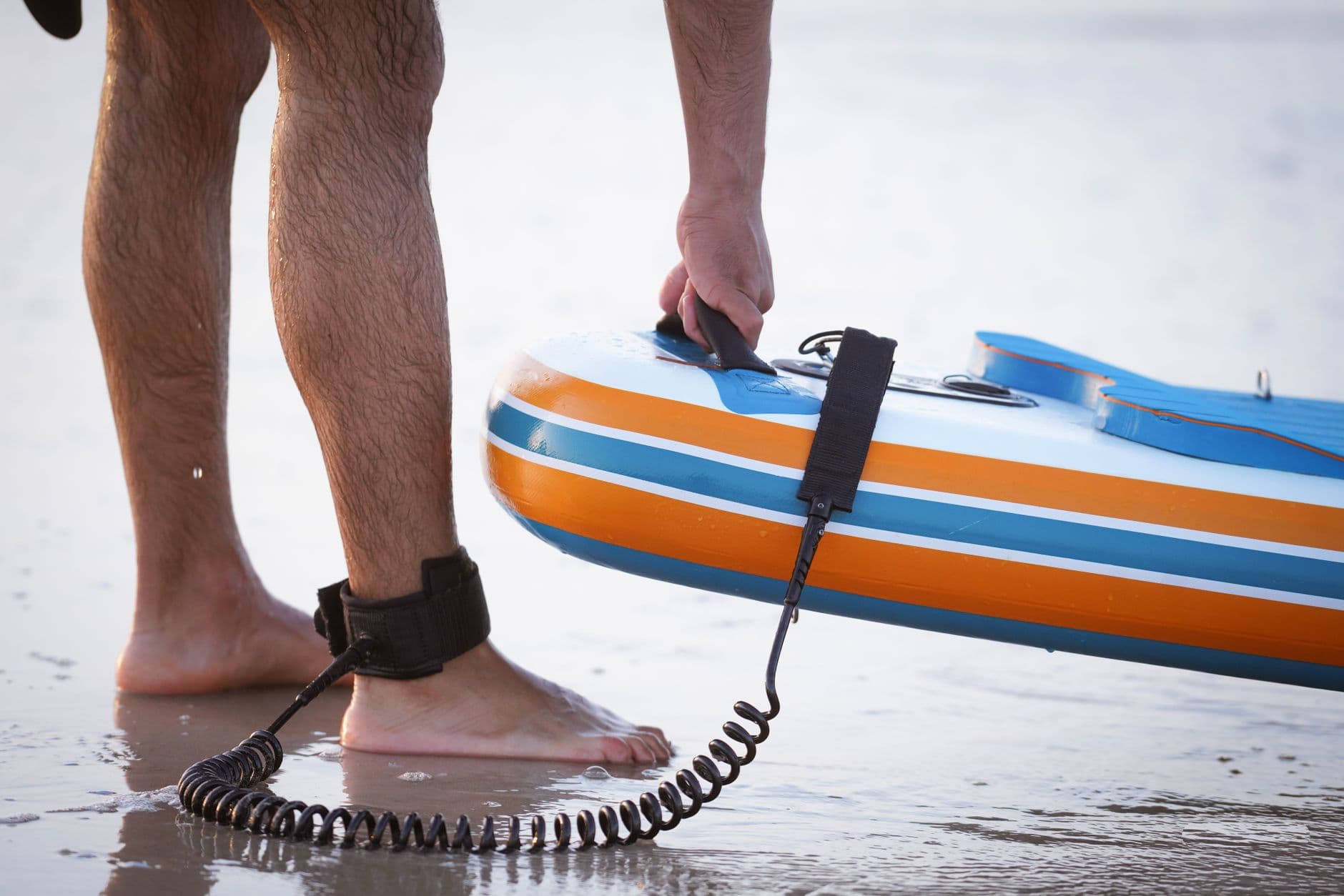
The leash is the cheapest piece of safety equipment you will ever buy for a board, and the only one where buying the wrong type is worse than owning none at all. Which kind you need is decided by the water, not by the board.
We have not paddled these, and we are not going to pretend we have. Here is what we did instead. Links to Amazon earn us a commission at no extra cost to you, and commission never decides a pick — how this site is funded.
| # | Product | Best for | The spec it turns on | Price |
|---|---|---|---|---|
| 1 | 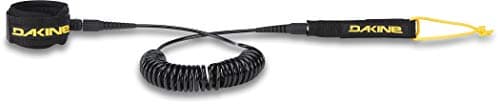 Dakine SUP Coiled Ankle Leash, 10 ft x 3/16 inTop pickThe straight-coil-straight layout is the detail worth paying for: the coil sits above the water where it cannot drag, and the straight sections at each end take the load instead of the coil. | Flat water, and the default if you buy one leash | 10 ft x 3/16 in urethane Dura-Cord, straight-coil-straight construction, molded neoprene cuff, Posi-Lock hook and loop closure, 0.45 lb | |
| 2 | 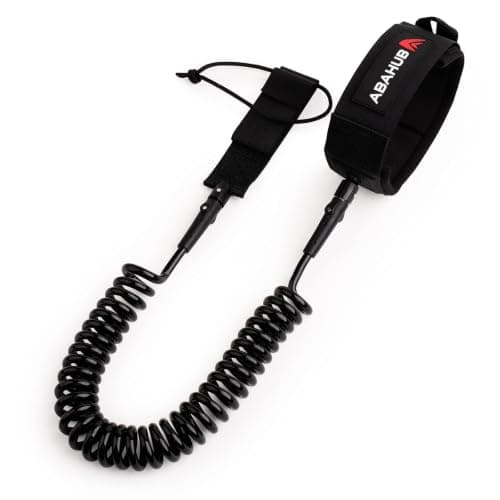 Abahub Coil SUP Leash, 10 ftIt has the three things that matter on a flat-water leash: a thick cord, two swivels and a rail saver. Buying up from here gets you better construction, not a different function. | Replacing the leash that came in the box, cheaply | 10 ft coiled, 7 mm TPU cord, double anti-corrosive steel swivels, 2.4 in neoprene ankle cuff with quick-release pull tab, triple-wrap nylon rail saver, key pocket, 0.7 lb | |
| 3 | 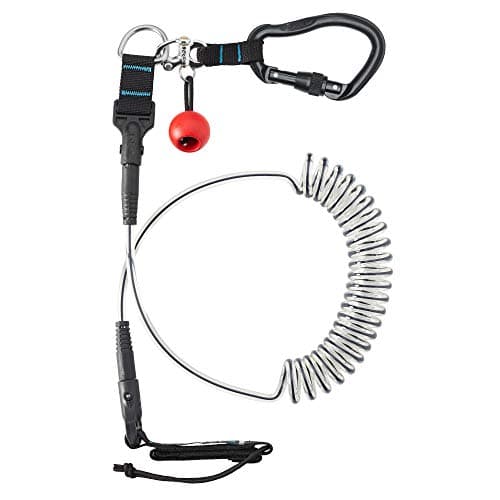 NRS Quick-Release SUP LeashThis is the one piece of gear on the page that is a safety decision rather than a comfort one. It attaches to the quick-release belt on a rescue life jacket, so the leash comes off your body with one pull. | Any moving water at all | Coiled section stretching to 9 ft, stainless steel D-ring end, shackle plus carabiner attachment, two in-line swivels, hook-and-loop closure for inflatable D-rings plus a lanyard for rigid board leash plugs, 0.94 lb | |
| 4 | 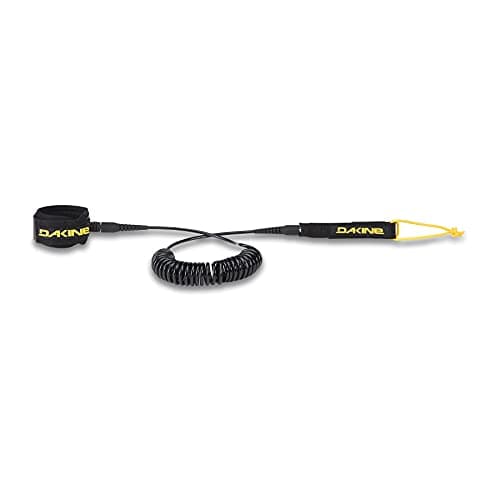 Dakine SUP Coiled Calf Leash, 10 ft x 3/16 inThe same leash as our top pick with the cuff moved a few inches up the leg. That is the whole difference, and whether it is worth anything to you depends on how often you step back on the board. | Keeping the cuff off your ankle bone | 10 ft x 3/16 in urethane Dura-Cord, straight-coil-straight construction, molded neoprene calf cuff, Posi-Lock hook and loop closure, 1 in detachable rail saver, marine-grade stainless steel swivels | |
| 5 | 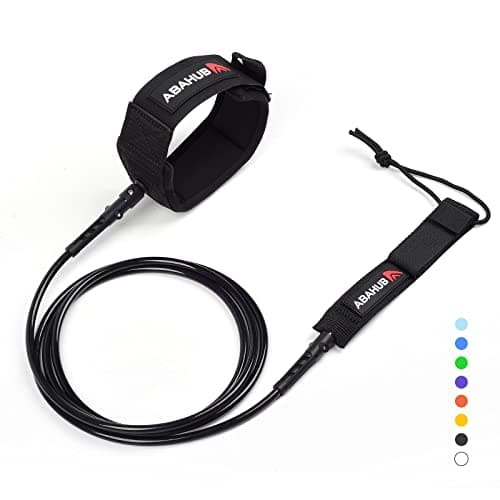 Abahub Premium Surfboard Leash, Straight, 10 ftA straight leash has one advantage and it is the whole reason to own one: it does not store energy. In waves, that is the difference between the board drifting away from you and being catapulted back at you. | Surf, and anywhere a coil would snap the board back at you | 10 ft straight, 7 mm TPU cord, double anti-corrosive steel swivels, 2.4 in neoprene ankle cuff with quick-release pull tab, triple-wrap nylon rail saver, hidden key pocket, 0.7 lb | |
| 6 | 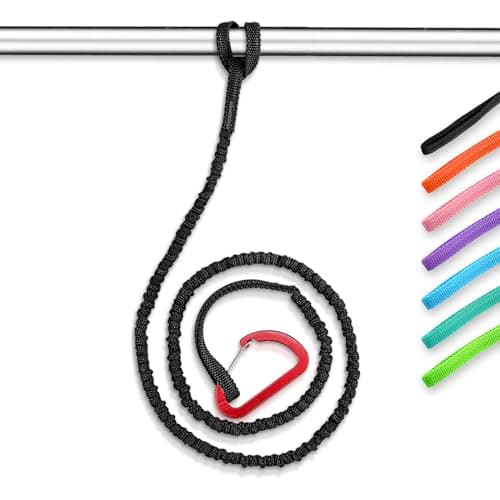 OCEANBROAD Kayak Paddle Leash with D-RingThis is not a board leash and does not replace one. It tethers the paddle to the boat, which is the second thing that leaves without you and the one nobody plans for. | The other thing that floats away | 4 to 7 ft stretchable bungee with nylon woven strap, alloy carabiner with a stainless gate, loop-knot attachment at the paddle end, 0.15 lb |
A paddle board is a large, light, flat object, which is another way of saying it is a sail. Fall off in any wind at all and the board leaves before you surface; a swimmer in clothes cannot catch a board being pushed downwind, and that is the whole reason the leash exists. It is not there to stop you losing your board. It is there to stop you being separated from the biggest piece of flotation within a mile.
That framing matters because it changes what a good leash is. It is not the one with the nicest cuff. It is the one that keeps you attached on the water you actually paddle — and, on one specific kind of water, the one you can get off in a second. Most leash pages treat this as a shopping decision between brands. It is really two decisions: what type, then what quality, and only the second one is about money.
How we judged these leashes
- **Does it suit the water it will be used on.** Coiled for flat water, straight for surf, quick-release for current. Getting this wrong is the only mistake in the category that is dangerous rather than annoying, so it comes before everything else.
- **Two swivels, published.** A swivel at each end is what stops a leash winding into a tight spiral over an afternoon of turns. One swivel is a compromise; none is a leash that will be tugging at your ankle by the second hour.
- **A rail saver.** The wide nylon strap between cord and board spreads the load across the tail instead of concentrating it on the leash plug. It costs the maker almost nothing and it is what protects the board.
- **Cord thickness and length, as printed.** These are the two specs that are actually comparable between leashes, and we rank on the numbers the listings publish rather than on how a leash is described.
- **What the release mechanism really is.** A pull tab on an ankle cuff and a quick-release belt at your chest are both called quick-release and they are not the same thing. We say which is which.
The water decides the leash, not the board
Almost every leash sold is a coiled ankle leash, and for almost every reader of this site that is correct, because almost everyone paddles a lake. The exceptions are narrow but they are not optional, and they are worth knowing before you order.
| Where you paddle | The leash | Why |
|---|---|---|
| Lake, pond, calm bay | Coiled, ankle or calf | Stays out of the water, no drag, nothing to snag |
| Slow river, Class I, easy exit | Quick-release waist belt, or none | Anything fixed to your leg is an entrapment risk in current |
| Anything faster than Class I | Quick-release waist belt, with instruction | This is whitewater SUP, a different sport with different training |
| Surf | Straight, matched to board length | A coil stores energy and returns the board along the line you are on |
| Yoga or fishing, anchored, flat water | Coiled — on while paddling out | Useful in transit, a tangle hazard while you are moving around the deck |
Coiled and straight: what the difference actually does
This is the distinction the category is organized around, and it is usually explained as a matter of taste. It is not. The two designs behave differently in a fall, and each behavior is right somewhere.
- **A coiled leash holds itself out of the water.** Ten feet of cord compresses to a foot or two of coil sitting on the deck behind you. Nothing trails, nothing drags, and nothing loops down toward the fin. On flat water this is all upside, which is why coiled leashes dominate the category.
- **A coiled leash is also a spring.** It stretches under load and then pulls back along the shortest line between you and the board. In waves that line runs through the water you are floating in, so the board comes back at you rather than away. That is a genuine hazard and it is why surfers do not use coils.
- **A straight leash trails and does not store energy.** The board gets dragged behind the whitewater instead of catapulted. The cost is constant low-level drag on every stroke and ten feet of loose cord in the water to catch on a fin or a submerged branch, which is exactly what you do not want on a lake.
Length: match the leash to the board
The rule the manufacturers publish is simple and worth following: a leash should be equal in length to your board, or slightly longer. Shorter than the board and a fall off the nose yanks the tail around. Much longer and you have surplus cord in the water for no benefit.
| Your board | Leash length | Notes |
|---|---|---|
| 9 ft to 10 ft 6 in | 10 ft | The standard size, and what most kit leashes are |
| 10 ft 6 in to 11 ft 6 in | 10 ft to 11 ft | A 10 ft coil that stretches further covers this comfortably |
| 11 ft 6 in and up (touring) | 11 ft or more | Longer than anything on this page reaches — look for an 11 or 12 ft coil |
| Under 9 ft (kids, surf-style) | 8 ft or 9 ft | Shorter board, shorter leash — Abahub sells 6 through 10 ft |
Coiled leashes complicate this slightly, because their relaxed length and their stretched length are different numbers. The figure that matters for matching your board is the stretched one, and every coiled leash on this page is sold by it. If a listing only gives you the relaxed coil length, it is not telling you what you need to know.
Top pick — Flat water, and the default if you buy one leash
Dakine SUP Coiled Ankle Leash, 10 ft x 3/16 in
The straight-coil-straight layout is the detail worth paying for: the coil sits above the water where it cannot drag, and the straight sections at each end take the load instead of the coil.
What the listing publishes
10 ft x 3/16 in urethane Dura-Cord, straight-coil-straight construction, molded neoprene cuff, Posi-Lock hook and loop closure, 0.45 lb
Dakine builds this as SUP-specific rather than a surf leash sold for boards. The difference is the coil, which keeps roughly ten feet of cord off the water instead of trailing it behind you for the whole paddle.
Straight-coil-straight means short straight lengths at the cuff and the rail-saver ends with the coil in the middle. The straight sections are what get yanked and flexed; putting them outside the coil is why this design outlasts an all-coil leash.
At 3/16 in the cord is thinner than the 7 mm budget leashes here. That is less drag and less bulk, and on flat water it is plenty; it is not a surf leash and Dakine does not sell it as one.
What it does well
- Straight-coil-straight keeps the cord out of the water and the wear off the coil
- Molded neoprene cuff and molded Opti-Flex ends rather than sewn-and-hoped construction
- 0.45 lb, the lightest full-size leash here
What it costs you
- Roughly twice the price of a budget coiled leash that does the same basic job
- An ankle cuff, so it is the wrong leash for moving water
- No quick-release tab published, unlike the budget leashes here
Skip this if you paddle anything with current. A coiled ankle leash is a flat-water tool, and on a river it is the exact hazard the quick-release belt exists to solve.
#ad · how this is funded · price as of October 9, 2026
Pick 2 — Replacing the leash that came in the box, cheaply
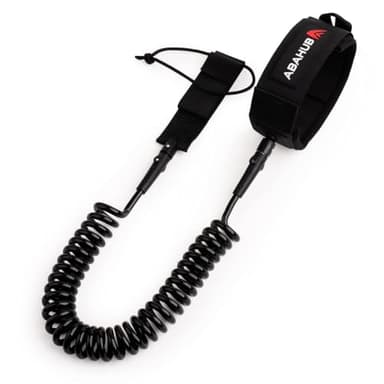
Abahub Coil SUP Leash, 10 ft
It has the three things that matter on a flat-water leash: a thick cord, two swivels and a rail saver. Buying up from here gets you better construction, not a different function.
What the listing publishes
10 ft coiled, 7 mm TPU cord, double anti-corrosive steel swivels, 2.4 in neoprene ankle cuff with quick-release pull tab, triple-wrap nylon rail saver, key pocket, 0.7 lb
Two swivels are the specification to check on any leash at this price. A leash with one swivel, or none, winds itself into a tight spiral over an afternoon of turns and then tugs at your ankle every stroke.
The triple-wrap rail saver is the wide nylon strap between the cord and the board. It spreads the pull across the tail rather than concentrating it on the leash plug, which is what saves the board rather than the leash.
There is a quick-release pull tab on the cuff. That is not the same thing as a quick-release belt: it is a tab you reach down and pull, which is a fine convenience on a lake and not something to rely on in current.
What it does well
- The cheapest leash here that still has two swivels and a rail saver
- 7 mm cord, thicker than the Dakine and harder to nick on a rock
- Quick-release pull tab and a key pocket on the cuff
What it costs you
- Sold as a surf-family leash, so build quality is priced accordingly
- Heavier than the Dakine at 0.7 lb, most of it in the cuff
- Ankle cuff only, so the moving-water rule applies here too
Skip this if the leash in your board's kit is intact. Kit leashes are one of the few parts of a package board that are genuinely fine, and replacing a working one is money better spent on a life jacket.
#ad · how this is funded · price as of October 9, 2026
Pick 3 — Any moving water at all
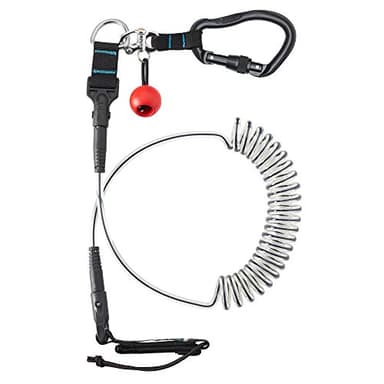
NRS Quick-Release SUP Leash
This is the one piece of gear on the page that is a safety decision rather than a comfort one. It attaches to the quick-release belt on a rescue life jacket, so the leash comes off your body with one pull.
What the listing publishes
Coiled section stretching to 9 ft, stainless steel D-ring end, shackle plus carabiner attachment, two in-line swivels, hook-and-loop closure for inflatable D-rings plus a lanyard for rigid board leash plugs, 0.94 lb
The critical design point is what it attaches to. NRS describes clipping the carabiner through the D-ring on the leash and the D-ring on the quick-release belt of a rescue life jacket, so the release you pull is the belt's, at your chest, not a tab down by your ankle.
A stainless D-ring at the leash end lets you swap the hardware to suit your vest. That matters because the leash is only as quick-releasing as whatever it is clipped to; on a life jacket with no release belt, this leash is just a waist leash.
It carries both a hook-and-loop closure for the D-ring on an inflatable and a lanyard for the leash plug on a rigid board, so it fits either board without extra parts. Two in-line swivels handle the tangling.
What it does well
- Designed to release from a rescue PFD's quick-release belt, at chest height
- Stainless D-ring lets you change the hardware to match your vest
- Fits inflatable D-rings and rigid leash plugs without buying anything else
What it costs you
- The most expensive leash here, and roughly four times a budget coil
- Needs a life jacket with a quick-release belt to do what it is for
- 0.94 lb, the heaviest leash on the page
Skip this if you only ever paddle flat water and own a standard foam life jacket. Without a release belt to clip to, you are paying a premium for hardware you cannot use as intended.
#ad · how this is funded · price as of October 9, 2026
Pick 4 — Keeping the cuff off your ankle bone
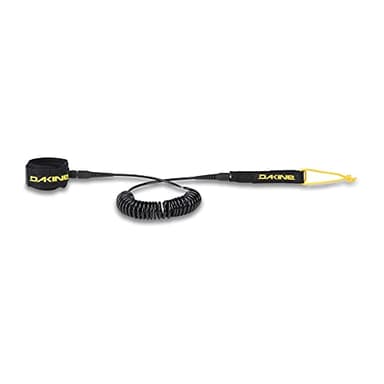
Dakine SUP Coiled Calf Leash, 10 ft x 3/16 in
The same leash as our top pick with the cuff moved a few inches up the leg. That is the whole difference, and whether it is worth anything to you depends on how often you step back on the board.
What the listing publishes
10 ft x 3/16 in urethane Dura-Cord, straight-coil-straight construction, molded neoprene calf cuff, Posi-Lock hook and loop closure, 1 in detachable rail saver, marine-grade stainless steel swivels
This is the calf version of the Dakine coiled leash at the top of this page: the same 3/16 in urethane Dura-Cord, the same straight-coil-straight layout, the same molded Opti-Flex ends. Only the cuff position changes, so everything the ankle version earns on construction it earns here too.
A calf cuff sits a few inches higher up the leg. The bulk comes off the ankle bone and the cord leaves your leg further from the fin, which is the practical argument for it — not any difference in strength, drag or reach.
Dakine publishes a 1 inch detachable rail saver on this leash. Detachable matters because the rail saver is the part that frays first, and it is also the part holding the board to you; being able to replace it is worth more than it sounds.
What it does well
- Calf cuff keeps the bulk off the ankle bone and the cord clear of the rail on a step-back turn
- The same Dura-Cord and straight-coil-straight construction as the ankle leash above
- 1 in detachable rail saver, so the first part to wear is a part you can replace
What it costs you
- Dakine does not publish a swivel count, which is one of the four specs we judge a leash on
- At 10 ft it is too short for a touring board over 11 ft 6 in, by the length rule above
- Still a leg-worn leash, so it stays off moving water
Skip this if you paddle anything with current, or you have never once caught a cuff on the rail. On moving water the quick-release waist system above is the only leash here that belongs, and on flat water the calf strap is a comfort preference rather than a better leash.
#ad · how this is funded · price as of October 9, 2026
Pick 5 — Surf, and anywhere a coil would snap the board back at you
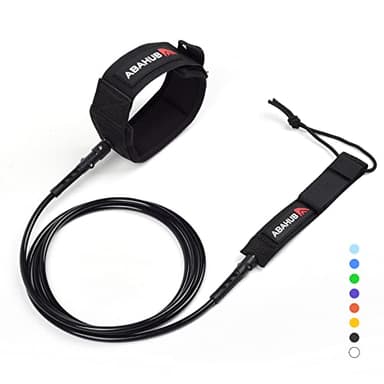
Abahub Premium Surfboard Leash, Straight, 10 ft
A straight leash has one advantage and it is the whole reason to own one: it does not store energy. In waves, that is the difference between the board drifting away from you and being catapulted back at you.
What the listing publishes
10 ft straight, 7 mm TPU cord, double anti-corrosive steel swivels, 2.4 in neoprene ankle cuff with quick-release pull tab, triple-wrap nylon rail saver, hidden key pocket, 0.7 lb
A coiled leash is a spring. Fall off in a wave and it stretches, then returns the board along the shortest line, which is the line you are floating on. A straight leash pulls the board along behind the whitewater instead.
The trade is drag. Ten feet of 7 mm cord trails in the water on every stroke, which you feel on a long flat paddle and do not notice at all in surf.
Abahub's own sizing guidance is to pick a leash equal to or slightly longer than the board, and this comes in 6, 7, 8, 9 and 10 ft. Ten feet is the size that matches the 10 ft to 10 ft 6 in all-round boards most beginners own, which is also what our own length table above recommends; check the length option before you order.
What it does well
- Straight cord does not spring the board back at you in waves
- Same 7 mm cord, two swivels and triple-wrap rail saver as the coiled version
- Five lengths, so you can match the leash to the board
What it costs you
- Trails in the water, so it drags on a flat-water paddle
- Ten feet of loose cord is more to snag on a fin or a branch
- Ankle cuff, and the same river rule applies
Skip this if you paddle lakes and slow rivers, which is nearly everybody reading this site. On flat water a coiled leash does the same job without dragging, and the surf advantage never comes up.
#ad · how this is funded · price as of October 9, 2026
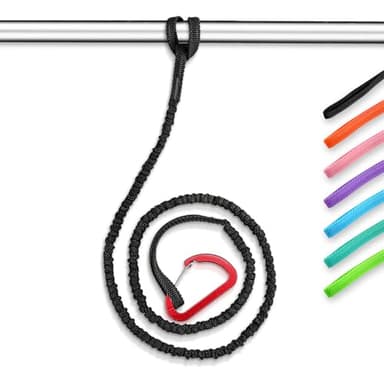
Pick 6 — The other thing that floats away
OCEANBROAD Kayak Paddle Leash with D-Ring
This is not a board leash and does not replace one. It tethers the paddle to the boat, which is the second thing that leaves without you and the one nobody plans for.
What the listing publishes
4 to 7 ft stretchable bungee with nylon woven strap, alloy carabiner with a stainless gate, loop-knot attachment at the paddle end, 0.15 lb
A dropped paddle in wind is gone faster than a swimmer can close the gap, and unlike a board it does not stop to wait. On a fishing or camping trip where you are handling gear in the boat, a paddle tether is the cheapest insurance on this site.
It attaches with a loop knot at the paddle and a carabiner at the boat or life jacket. The nylon and bungee construction stretches from about 4 to 7 feet, which is enough to paddle normally without feeling tethered.
Anything attached to you in a kayak is a snag risk, so clip it to a deck fitting rather than your body unless you have a reason not to. On moving water, think about it the same way as a board leash.
What it does well
- The cheapest item on this page by a wide margin
- Stretches 4 to 7 ft, so it does not shorten your stroke
- Alloy carabiner with a stainless gate rather than a plain steel clip
What it costs you
- Does nothing for the board or boat itself, only the paddle
- One more line in the cockpit to keep clear of
- Loop-knot attachment means it can slide on a smooth shaft if tied loosely
Skip this if you paddle a board with the paddle in your hands on flat water close to shore. The case for a paddle leash gets stronger the further out you go and the more you put the paddle down.
#ad · how this is funded · price as of October 9, 2026
Cord thickness, and the two swivels
Once the type is settled, only a couple of specs separate a good leash from a cheap one, and both are printed on the listing if you look for them.
| Leash | Type | Cord | Length | Swivels |
|---|---|---|---|---|
| Dakine SUP Coiled Ankle | Coiled, ankle | 3/16 in Dura-Cord | 10 ft | Not published |
| Abahub Coil SUP | Coiled, ankle | 7 mm TPU | 10 ft | Two |
| NRS Quick-Release | Coiled, waist system | Not published | Stretches to 9 ft | Two |
| Dakine SUP Coiled Calf | Coiled, calf | 3/16 in Dura-Cord | 10 ft | Not published |
| Abahub Premium Straight | Straight, ankle | 7 mm TPU | 10 ft (6-10 available) | Two |
| OCEANBROAD paddle leash | Paddle tether | Bungee and nylon | 4 to 7 ft | None |
Seven millimeters is the standard cord for an all-round leash and is what both Abahub leashes use. Thicker cord is stronger and draggier; the Dakine's 3/16 inch is thinner than 7 mm, which is a deliberate flat-water choice rather than a corner cut. Below about 6 mm you are looking at a competition leash built to break rather than to hold, and that is not what a beginner wants on a lake.
Ankle, calf or waist
- **Ankle** is the default and the most common. The cuff sits on the ankle bone, which is fine on flat water and mildly annoying if you step back on the board often, because the cuff catches the rail.
- **Calf** moves the cuff a few inches up the leg. Dakine's coiled calf leash is the one here, and the benefits are small but real: the bulk is off the ankle bone, the cord sits higher and further from the fin, and the cuff stops snagging the rail on a step-back turn. It is a comfort preference, not a safety upgrade.
- **Waist** is the safety category. The leash runs from the board to a belt at your waist or, better, to the quick-release belt on a rescue life jacket, so the release you reach for is at chest height where you can find it in current. This is the only configuration that belongs on moving water.
Quick-release: the tab is not the belt
Both Abahub leashes list a quick-release pull tab on the ankle cuff, and that is a useful thing — it is how you get a leash off quickly at the beach without fighting the hook and loop closure. It is not a river safety device. To use it you have to fold forward, find your ankle under water and pull, which is precisely what a current pinning you against the board prevents.
A leash is not a life jacket, and does not count as one
This needs saying plainly because leash marketing edges toward implying otherwise. A leash keeps you near flotation. It does not keep you at the surface, it does not work if you are unconscious, and it is not what the law is asking about. The US Coast Guard's position is that the life jacket has to be worn to do anything — the leash does not change that calculation at all. On federally controlled waters a stand up paddle board outside a surfing or swimming area is a vessel, which brings the carriage and wear rules with it. The rules in full, and the vests we would actually wear.
Fitting a leash so it does what it is for
- **Attach the rail saver to the leash plug, not the cord.** Thread the nylon strap through the plug's bar and back through its own loop. The point of the strap is that it, and not a thin cord, bears against the board.
- **Pull the rail saver tight and flat against the tail.** A loose strap slaps, and a twisted one wears through at the twist. On an inflatable, use the D-ring rather than trying to improvise a plug.
- **Set the cuff snug but not tight.** You should be able to slide one finger under it. Loose enough to rotate and it will chafe; tight enough to mark your leg and it will be uncomfortable after an hour.
- **Check the cord and the swivels before each season.** Leashes fail at the ends, where the cord meets the hardware. A nick, a chalky white patch or a swivel that no longer turns freely means it is done — and a twenty dollar leash is not worth nursing along.
What you can ignore
- **Color options.** Eight colors is not eight products. The specification is the cord, the swivels and the rail saver.
- **Key pockets.** A small pocket on the cuff is a genuinely nice touch and not a reason to choose one leash over another. Your car key is better off in a dry bag than strapped to your ankle in the water.
- **Breaking strength claims without a standard.** Leash listings quote strength figures with no test method attached, so they are not comparable between brands. Cord thickness and swivel count are.
- **Buying a leash at all, if your board came with one.** Package boards ship with a paddle, pump, fin, bag and leash, and the leash is one of the few kit parts that is usually fine. What is worth replacing in a package board is a shorter list than it looks.
The other thing that floats away
Boards get the leash and paddles get forgotten, which is backwards in one respect: a board drifts and a dropped paddle is simply gone, because it sits low and moves with both wind and current. A paddle tether costs less than lunch and matters most exactly where a board leash matters least — in a kayak, on a fishing trip, anywhere you put the paddle down to do something else. The same snag caution applies: clip it to a deck fitting rather than to yourself. The rest of the kit that earns its place.
When going without is the right call
There are two cases. The first is moving water without a quick-release system, where no leash is safer than the wrong one — that is not a license to skip the life jacket, it is a reason to buy the right leash before the trip. The second is board yoga on flat, protected water within easy swimming distance of shore, where ten feet of cord around your ankle is something to tangle in during a pose. Wear it while you paddle out, take it off once you are settled and the board is not going anywhere. Everywhere else, and certainly on any open water with wind, keep it on.
Questions people actually ask
Do you really need a leash on a paddle board?
Coiled or straight leash for a paddle board?
What length leash do I need for my paddle board?
Can you wear an ankle leash on a river?
Is a quick-release tab the same as a quick-release leash?
Does a leash count as a life jacket on a paddle board?
Is the leash that came with my inflatable board any good?
Ankle or calf leash for paddle boarding?
Where these numbers came from
Every figure on this page traces to one of these. Where a number could not be sourced, the page says so rather than estimating it.
- U.S. Coast Guard — Life Jacket Wear / Wearing Your Life Jacket (federal carriage and under-13 wear requirements)
- U.S. Coast Guard — Recreational Boaters (federal equipment requirements for vessels, paddlecraft included)
- Dakine SUP Coiled Ankle Leash 10 ft x 3/16 in — manufacturer specification as published on the Amazon listing, read 2026-09-19
- Abahub Coil SUP Leash, 10 ft, 7 mm — manufacturer specification as published on the Amazon listing, read 2026-09-19
- NRS Quick-Release SUP Leash — manufacturer specification as published on the Amazon listing, read 2026-09-19
- Dakine SUP Coiled Calf Leash 10 ft x 3/16 in — manufacturer specification as published on the Amazon listing, read 2026-10-06
- Abahub Premium Surfboard Leash, Straight, 10 ft — manufacturer specification as published on the Amazon listing, read 2026-10-05
- OCEANBROAD Kayak Paddle Leash with D-Ring — manufacturer specification as published on the Amazon listing, read 2026-09-19
Read next

Best for Rivers
The Best Paddle Boards for Rivers
Rivers reward short boards, inflatable hulls and a flexible fin. Which of our picks suit moving water, and where the honest line is for a beginner.
Top pick
Roc Inflatable Stand Up Paddle Board, 10 ft 6 in x 33 in
The default first inflatable board
#ad · how this is funded · price as of October 9, 2026
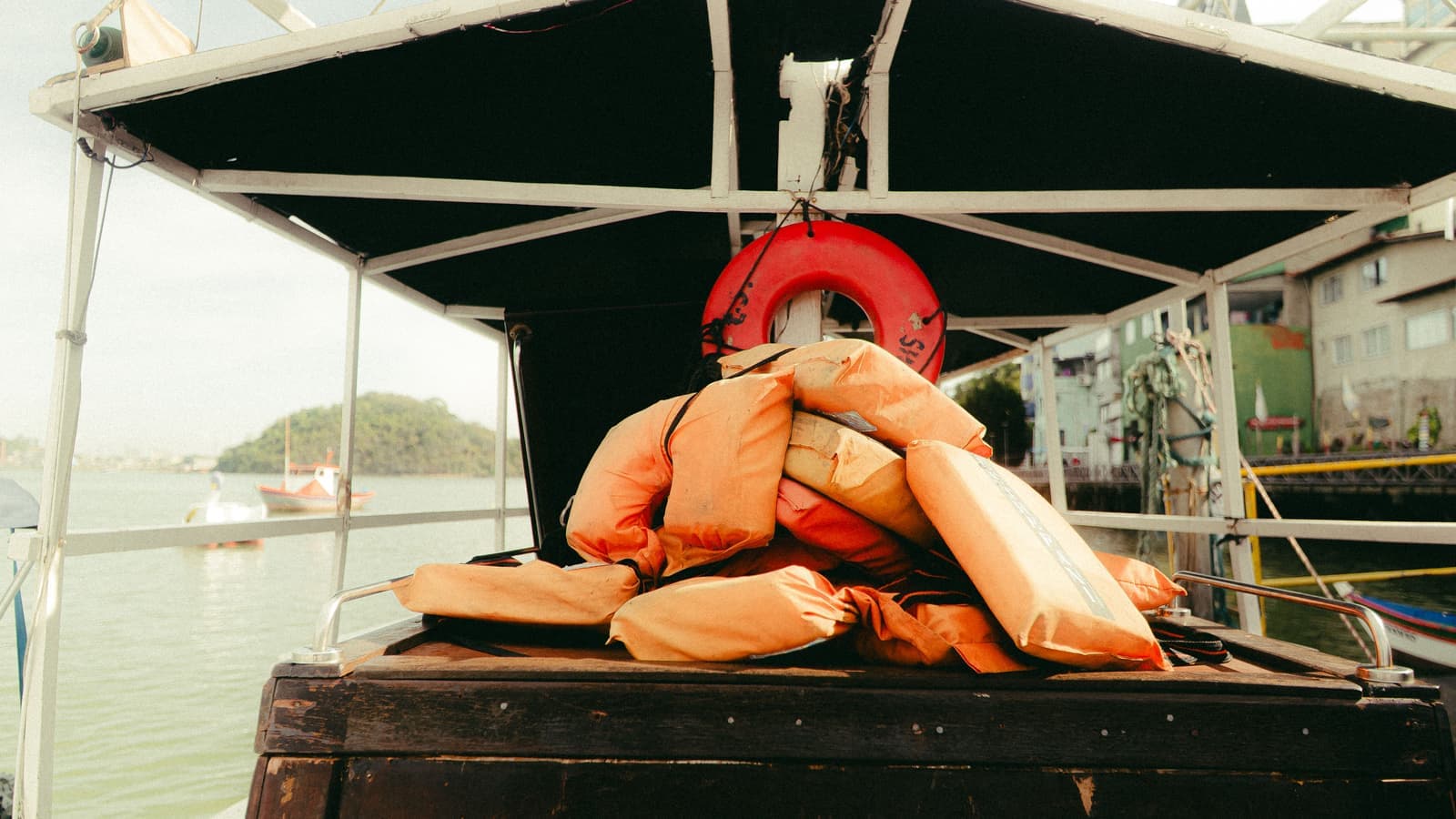
Best Life Jacket
The Best Life Jackets for Paddling
Approved vests compared on cut and comfort — the variables that decide whether it stays on.
Top pick
Onyx MoveVent Dynamic Paddle Vest
The PFD you will actually keep on
#ad · how this is funded · price as of October 9, 2026
Life Jacket Rules for Paddlers
The federal PFD requirement, the under-13 wear rule, and why your state matters — sourced, not paraphrased.
Top pick
Onyx MoveVent Dynamic Paddle Vest
The PFD you will actually keep on
#ad · how this is funded · price as of October 9, 2026
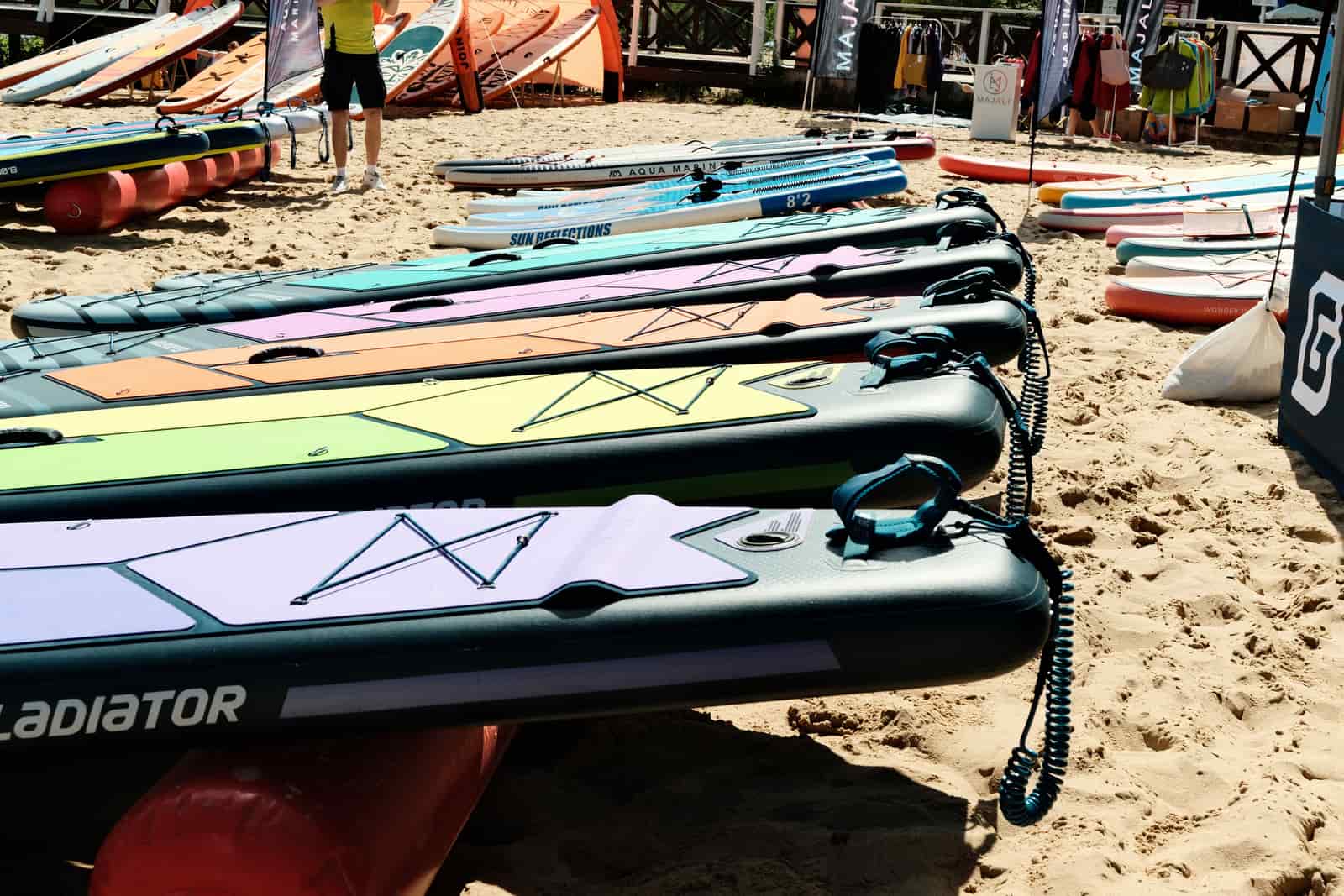
Best Inflatable
The Best Inflatable Paddle Boards
Inflatable SUPs ranked on width, thickness, capacity and packed weight, with every figure read off the listing.
Top pick
Roc Inflatable Stand Up Paddle Board, 10 ft 6 in x 33 in
The default first inflatable board
#ad · how this is funded · price as of October 9, 2026
Best First Accessory
Kayak Accessories: What Actually Earns a Place
Five accessories that change every outing, ranked by how much they improve it per dollar — and the ones you can safely skip for a season.
Top pick
Bending Branches Whisper Kayak Paddle, 230 cm
The first paddle worth keeping
#ad · how this is funded · price as of October 9, 2026
Best First Board
The Best Paddle Boards for Beginners
Five beginner boards ranked on published width and usable capacity, with the displacement arithmetic run on each one.
Top pick
Roc Inflatable Stand Up Paddle Board, 10 ft 6 in x 33 in
The default first inflatable board
#ad · how this is funded · price as of October 9, 2026