Paddle Boards
What Size Paddle Board Do I Need?
The answer is a volume in liters and a width in inches, and both come out of one piece of physics. Here is the arithmetic, a calculator that runs it, and the boards that satisfy it.

We have not paddled these, and we are not going to pretend we have. Here is what we did instead. Links to Amazon earn us a commission at no extra cost to you, and commission never decides a pick — how this site is funded.
| # | Product | Best for | The spec it turns on | Price |
|---|---|---|---|---|
| 1 | 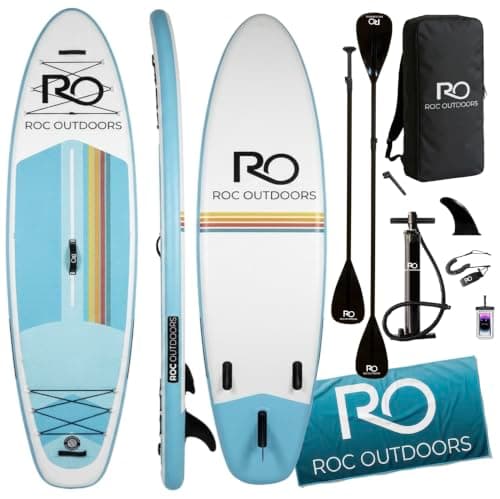 Roc Inflatable Stand Up Paddle Board, 10 ft 6 in x 33 inTop pick10 ft 6 in by 33 in is the shape the whole beginner category converged on, and this is the cheapest version of it that publishes a 350 lb rating. | The default first inflatable board | 126 x 33 x 6 in, 350 lb rated capacity, PVC drop-stitch, full accessory kit | |
| 2 | 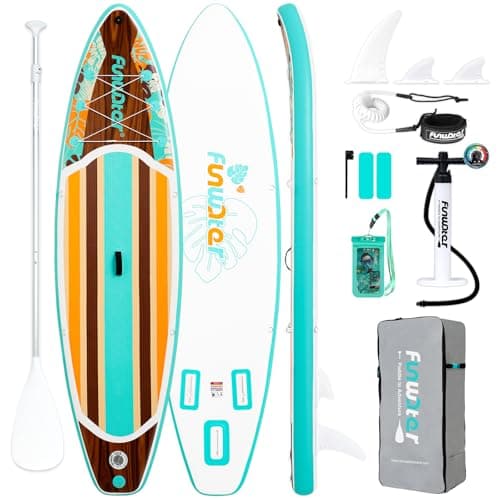 FunWater Inflatable Stand Up Paddle Board, 10 ft 6 in x 35 inThirty-five inches of width in a 10 ft 6 in board is the closest thing to a raft that still paddles like a board, and for a genuinely nervous beginner that is the right trade. | Maximum stability in a standard length | 126 x 35.1 x 6 in, 330 lb rated capacity, PVC drop-stitch | |
| 3 | 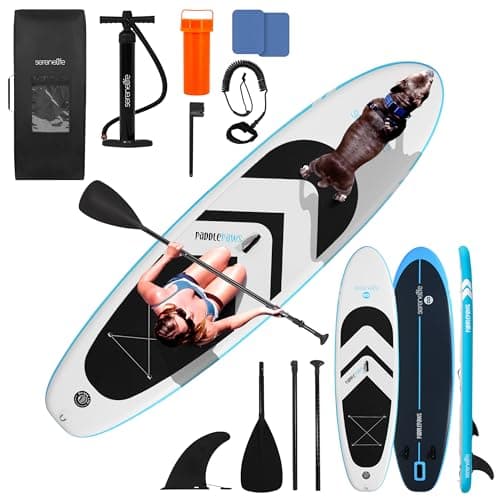 SereneLife XL Extra-Wide Inflatable Paddle Board, 35 in485 lb of rated capacity is the highest on this site, and for a paddler over 250 lb it is one of very few boards where the usable-capacity arithmetic still works. | A heavier paddler, or a board that carries the family | 35.04 in wide, up to 485 lb rated capacity depending on size, double-layer side rails |
Most sizing pages for paddle boards end in a chart. A chart is fine as far as it goes, and it does not tell you why the numbers are what they are, which means you cannot check it, adjust it, or apply it to a board that is not on the chart. So here is the reasoning first, then the calculator, then the boards.
Where the number comes from
Archimedes. A floating object displaces its own weight in water, and a liter of fresh water weighs almost exactly a kilogram. So a board with a volume of 90 liters will support 90 kilograms of total load — board, paddler and everything they are carrying — at the point where the deck is exactly level with the water.
That is the part that makes the whole thing click. A board sized to exactly your weight is a board floating with its deck at the waterline, which is a board you cannot stand on. Every multiplier a manufacturer publishes exists to buy back freeboard — the height of the deck above the water — and the size of the multiplier is really a statement about how much freeboard a given kind of paddler needs.
Work out your own size
Work out your board size
Two numbers in, a volume and a width out, with the arithmetic shown. Nothing is sent anywhere — this runs in your browser.
PFD, paddle, water, shoes, phone. 15 lb is a normal day; add a dog or a child here too.
Your board
195 L minimum, 33 in wide
Your loaded weight is 195 lb (88.5 kg). For a first board that means at least 195 liters of volume, and 230 liters if you want a dry deck, a passenger or a calm day's worth of margin. Below 124 L the board is technically afloat and not worth standing on.
Width: aim for 33 in, 32 in at the narrowest. 32 to 33 in is the beginner sweet spot for most adults, and it is what most 10 ft 6 in all-around boards are built at.
Where that came from
board volume (L) = (paddler lb + gear lb) / 2.205 x 2.2
(180 + 15) / 2.205 x 2.2 = 195 L
A useful shortcut falls out of that arithmetic: 2.2 liters per kilogram divided by 2.205 pounds per kilogram is almost exactly 1. So your loaded weight in pounds is your target volume in liters — 195 lb, 195 L. That is a coincidence of the units, not a law of nature, and it is accurate enough to shop with.
The chart, if you would rather just read it
| Your weight | Loaded weight | Minimum volume | Comfortable volume | Width |
|---|---|---|---|---|
| 120 lb | 135 lb | 135 L | 159 L | 32 in |
| 140 lb | 155 lb | 155 L | 183 L | 32 in |
| 160 lb | 175 lb | 175 L | 206 L | 33 in |
| 180 lb | 195 lb | 195 L | 230 L | 33 in |
| 200 lb | 215 lb | 215 L | 254 L | 34 in |
| 220 lb | 235 lb | 235 L | 277 L | 34 in |
| 250 lb | 265 lb | 264 L | 313 L | 35 in |
| 280 lb | 295 lb | 294 L | 348 L | 35 in |
Width is a separate question from volume
Two boards can have identical volume and behave completely differently, because volume can be distributed as length, width or thickness. A 12 foot touring board and a 10 foot all-around board might both be 240 liters; only one of them is a sensible first board.
Width is what governs initial stability — how solid the board feels when you first stand up and are not yet moving. Thurso Surf publishes 32 inches and over as the beginner band, 30 to 32 as intermediate, and under 30 as advanced. We move within that band by weight, because a heavier paddler sinks a board deeper and needs more of it in contact with the water.
| Your weight | Narrowest sensible | What we would buy |
|---|---|---|
| 120 lb | 31 in | 32 in |
| 150 lb | 32 in | 33 in |
| 180 lb | 32 in | 33 in |
| 210 lb | 33 in | 34 in |
| 240 lb | 33 in | 34 in |
| 270 lb | 34 in | 35 in |
Length is about behavior, not about you
People assume board length scales with paddler height. It does not, in any meaningful way. Length governs how the board tracks and turns, and the right length depends on the water you paddle rather than the body you have.
| Length | How it behaves | Right for |
|---|---|---|
| Under 9 ft | Turns instantly, no glide, little volume | Children, and surf |
| 10 ft to 10 ft 6 in | The all-around default: turns acceptably, tracks acceptably | A first board, almost always |
| 11 ft to 11 ft 6 in | Tracks noticeably straighter, needs more room to turn | Bigger water, longer paddles, a passenger |
| 12 ft and over | Fast and directional, awkward on a small pond | Touring and racing, not a first board |
When the answer is 'none of these'
If your loaded weight is over about 300 lb, the arithmetic starts running out of consumer boards. The highest rated capacity we found in the mainstream inflatable market is 485 lb, which is about 315 lb of usable load. Above that you are into specialist wide boards, a tandem board, or honestly a kayak — a sit-on-top hull carries load far better than a board does, and there is nothing second-best about that answer.
Below about 100 lb, most adult boards are simply too much board. A child on a 33 inch adult board cannot reach past the rail to paddle properly. The kids' board page covers what actually works.
So which board should you buy?
This is the part most sizing pages leave out. Below are the boards from our beginner roundup that satisfy the numbers above for most adults, with their published capacities and the usable figure worked out. If your number is higher than any of them, the SereneLife XL is the one to look at.
Top pick — The default first inflatable board
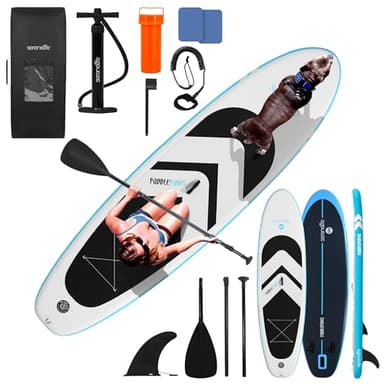
Roc Inflatable Stand Up Paddle Board, 10 ft 6 in x 33 in
10 ft 6 in by 33 in is the shape the whole beginner category converged on, and this is the cheapest version of it that publishes a 350 lb rating.
What the listing publishes
126 x 33 x 6 in, 350 lb rated capacity, PVC drop-stitch, full accessory kit
Usable at the 65 percent rule: 228 lb (range 210–245 lb), which leaves about 208 lb of paddler after a 20 lb day kit. Why 65 percent.
33 in of width is the number that decides whether you stand up on day one. Our width guidance puts 32 to 33 in as the beginner band for an adult between 150 and 200 lb, and this sits in it.
350 lb rated capacity means about 227 lb of loaded paddler at 65 percent. Applying the displacement arithmetic instead, a 195 lb loaded paddler wants roughly 195 L of volume -- this hull's 126 x 33 x 6 in envelope is comfortably past that.
Six inches of thickness is what makes a modern inflatable stiff. Four-inch boards flex under an adult in the middle and that flex is what people mistake for the board being unstable.
What it does well
- 33 in wide -- the width that gets a first-timer standing rather than kneeling
- 350 lb rating covers an adult with a child or a dog on board
- Ships with pump, paddle, leash and bag, so the listing price is close to the total
What it costs you
- The included paddle and pump are starter parts you will eventually replace
- 10 ft 6 in is a compromise length -- not fast, not especially maneuverable
- The listing does not publish a board weight
Skip this if you already know you want to cover distance. A 10 ft 6 in all-around board is a cruiser and an 11 ft 6 in touring shape is the honest answer for mileage.
#ad · how this is funded · price as of October 18, 2026
Pick 2 — Maximum stability in a standard length
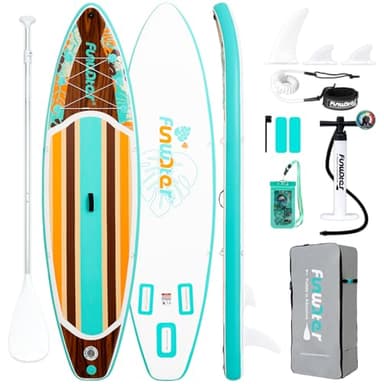
FunWater Inflatable Stand Up Paddle Board, 10 ft 6 in x 35 in
Thirty-five inches of width in a 10 ft 6 in board is the closest thing to a raft that still paddles like a board, and for a genuinely nervous beginner that is the right trade.
What the listing publishes
126 x 35.1 x 6 in, 330 lb rated capacity, PVC drop-stitch
Usable at the 65 percent rule: 215 lb (range 198–231 lb), which leaves about 195 lb of paddler after a 20 lb day kit. Why 65 percent.
35.1 in is above our beginner recommendation for every weight band on the site. Extra width is slower and it is not a mistake -- speed is not the thing standing between a first-timer and a good afternoon.
330 lb rated is about 215 lb of loaded paddler at 65 percent, the same as the FEATH-R-LITE, in a board three and a half inches wider.
Wide boards are harder to reach past when you paddle, so a wide board pushes you toward a slightly longer paddle. Our formula puts a 5 ft 8 in paddler on a 77 in SUP paddle regardless of board, but the reach penalty is real and worth knowing about.
What it does well
- 35.1 in wide -- as stable as an inflatable board gets at this length
- 330 lb rating with room for a child or a dog on the nose
- Full accessory kit included
What it costs you
- Wide is slow, and you will notice against a 31 in board
- Harder to reach the water past the rail, which tires your shoulders
- The listing does not publish a board weight
Skip this if you are reasonably confident on your feet already. Width you do not need is drag you pay for on every stroke.
#ad · how this is funded · price as of October 18, 2026
Pick 3 — A heavier paddler, or a board that carries the family
SereneLife XL Extra-Wide Inflatable Paddle Board, 35 in
485 lb of rated capacity is the highest on this site, and for a paddler over 250 lb it is one of very few boards where the usable-capacity arithmetic still works.
What the listing publishes
35.04 in wide, up to 485 lb rated capacity depending on size, double-layer side rails
Usable at the 65 percent rule: 315 lb (range 291–340 lb), which leaves about 295 lb of paddler after a 20 lb day kit. Why 65 percent.
485 lb rated is about 315 lb of loaded paddler at 65 percent. Almost nothing else in the consumer inflatable class gets there.
The listing publishes three capacities -- 350, 440 and 485 lb -- across three sizes. Buy against the specific size you are ordering rather than the highest number in the title, because those are different boards.
Double-layer side rails are the construction detail behind the rating. Rails are where an inflatable board flexes, and doubling them is what allows the load without the middle sagging.
What it does well
- Up to 485 lb rated -- roughly 315 lb of loaded paddler, the most headroom here
- 35 in wide, so it is stable at the loads it is rated for
- Double-layer rails are the right construction for a high-capacity board
What it costs you
- The advertised capacity is size-dependent and the title quotes the largest
- The listing does not publish a board weight or a length
- Big, wide boards are slow and awkward to turn
Skip this if you are an average-sized solo paddler. This is a lot of board to push around for capacity you will never use.
#ad · how this is funded · price as of October 18, 2026
Questions people actually ask
What size paddle board do I need for my weight?
Is a 10'6" paddle board too small for a 250 lb person?
What is a good volume for a beginner paddle board?
Does paddle board length depend on my height?
How do I know if my board is too small?
Where these numbers came from
Every figure on this page traces to one of these. Where a number could not be sourced, the page says so rather than estimating it.
- Thurso Surf — What Size Paddle Board Is Right for You (manufacturer, states the weight-in-kg x 2 volume rule and the 32 in beginner width band)
- ISLE Paddle Boards — Paddle Board Size & Weight Chart (manufacturer, published per-model capacities)
- Eddyline Kayaks — Maximum weight capacity versus ideal capacity for various styles of kayaks (manufacturer, states the 60-70% ideal-capacity band)
Read next
Lightest to Carry
The Lightest Paddle Boards, and What a Board Really Weighs
Published board weights run 12.2 to 24.5 lb across the boards we cover — and three of seven publish nothing at all. The lightest boards, and what light costs you.
Top pick
FEATH-R-LITE Inflatable Stand Up Paddle Board, 10 ft 6 in x 31.5 in
The lightest board to carry to the water
#ad · how this is funded · price as of October 18, 2026

Best for Yoga
The Best Paddle Boards for Yoga
Width for balance, length to lie down, and a deck with nothing on it. The three specs that make a board work for yoga, and which of ours have them.
Top pick
FunWater Inflatable Stand Up Paddle Board, 10 ft 6 in x 35 in
Maximum stability in a standard length
#ad · how this is funded · price as of October 18, 2026
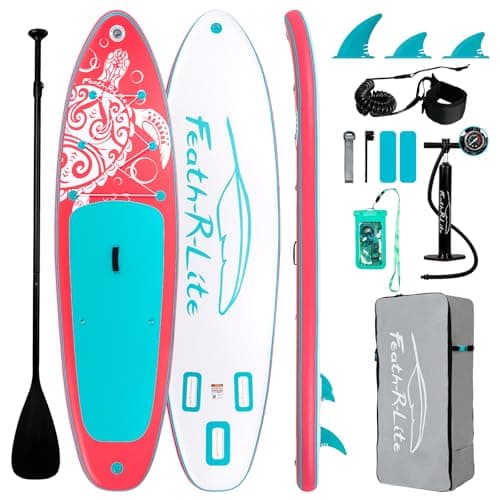
FEATH-R-LITE 10 ft 6 in Paddle Board: What the Specs Say
18.9 lb published board weight and 330 lb rated — the lightest carry here, with a width that sets a limit on paddler size.
Top pick
FEATH-R-LITE Inflatable Stand Up Paddle Board, 10 ft 6 in x 31.5 in
The lightest board to carry to the water
#ad · how this is funded · price as of October 18, 2026
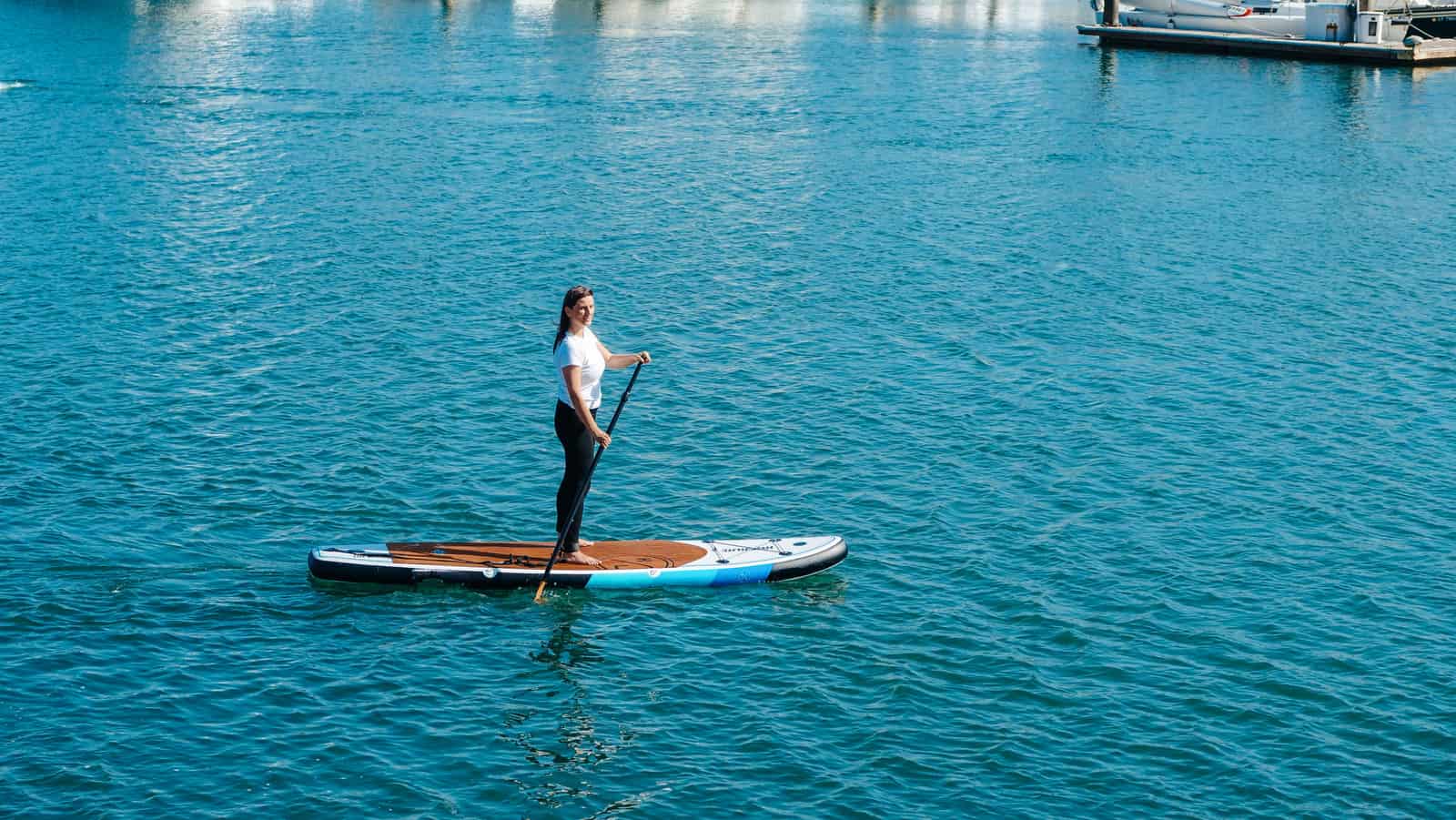
Best First Board
The Best Paddle Boards for Beginners
Five beginner boards ranked on published width and usable capacity, with the displacement arithmetic run on each one.
Top pick
Roc Inflatable Stand Up Paddle Board, 10 ft 6 in x 33 in
The default first inflatable board
#ad · how this is funded · price as of October 18, 2026

Paddle Board Weight Limits, Explained
Rated capacity is not usable capacity. The 65 percent rule, where it comes from, and what happens when you ignore it.
Top pick
SereneLife XL Extra-Wide Inflatable Paddle Board, 35 in
A heavier paddler, or a board that carries the family
#ad · how this is funded · price as of October 18, 2026
What Length Paddle Do You Need?
A paddle length calculator fitted to a manufacturer's published chart, with the derivation shown.
Top pick
Bending Branches Whisper Kayak Paddle, 230 cm
The first paddle worth keeping
#ad · how this is funded · price as of October 18, 2026