Paddle Boards
Inflatable vs Hard Paddle Board
A hard board is the better board. An inflatable is the better first board. Those two statements are not in conflict, and the reason why is the whole of this page.

We have not paddled these, and we are not going to pretend we have. Here is what we did instead. Links to Amazon earn us a commission at no extra cost to you, and commission never decides a pick — how this site is funded.
| # | Product | Best for | The spec it turns on | Price |
|---|---|---|---|---|
| 1 | 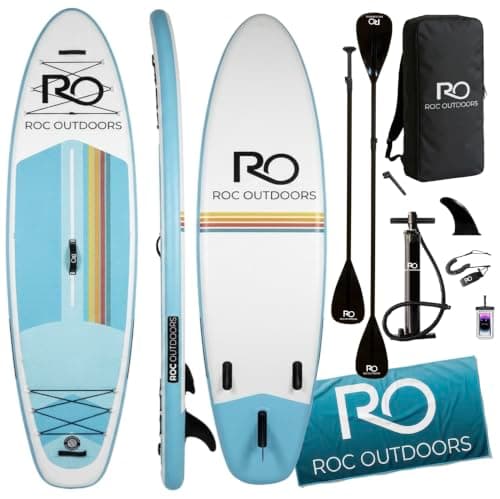 Roc Inflatable Stand Up Paddle Board, 10 ft 6 in x 33 inTop pick10 ft 6 in by 33 in is the shape the whole beginner category converged on, and this is the cheapest version of it that publishes a 350 lb rating. | The default first inflatable board | 126 x 33 x 6 in, 350 lb rated capacity, PVC drop-stitch, full accessory kit | |
| 2 | 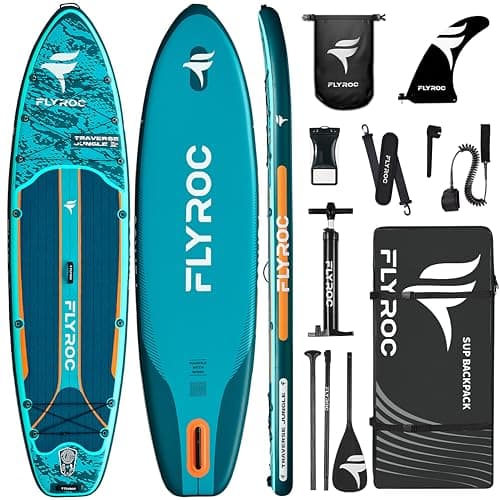 Flyroc 11 ft 6 in x 35 in Inflatable Paddle BoardA foot more waterline than the all-around boards with no narrowing to pay for it, and the highest rated capacity of any board here bar one. The published 18 lb is the figure to treat with some caution. | Distance without giving up width | 138 x 35 x 6 in, 18 lb board weight, 450 lb rated capacity, 15 D-rings |
This is usually written as though it were a close call decided by taste. It is not. For a first board the inflatable wins clearly on the things that determine how often you actually paddle, and loses on the things that determine how fast you go once you are good. Those are different questions and only one of them applies to you right now.
| Inflatable | Hard board | |
|---|---|---|
| Storage | Rolls into a bag the size of a large rucksack | Needs 10 to 12 ft of wall, a rack or a ceiling hoist |
| Transport | Boot of any car, or checked luggage | Roof bars and straps, every trip |
| Durability | Bounces off rocks and concrete | Dings, cracks and needs repairing |
| Stiffness | Good at 15 PSI, never rigid | Genuinely rigid |
| Speed and glide | Adequate | Noticeably better |
| In surf or chop | Skates and flexes | Holds a line |
| Price | Lower, and usually includes the whole kit | Higher, and the paddle is extra |
| Setup time | 8 to 12 minutes with a hand pump | None |
| Repair | Patch kit, at the launch | Resin, at home, over days |
The stiffness argument, honestly
Hard board advocates are right about stiffness and they usually overstate how much it matters to a beginner. A modern six-inch drop-stitch inflatable at full pressure is stiff enough that most paddlers cannot feel the difference at the speeds they paddle. The gap widens as you get better, faster and more powerful with each stroke — which is a real gap and a future one.
Where the stiffness argument is completely correct is at low pressure. An under-inflated board sags in the middle, and the difference between 15 PSI and 12 PSI is genuinely the difference between a good board and a bad one. That is a solvable problem — buy a pump with a working gauge — but it is a real one and it is the reason a lot of people conclude inflatables are rubbish.
The storage argument is the decisive one
A 10 ft 6 in hard board needs somewhere to live. Not a corner — a dedicated ten and a half feet of wall, ceiling or garage. Most people asking this question do not have that, and the ones who think they do often discover the board is in the way of something else by August.
That is not a minor inconvenience, because it compounds with transport. A hard board also needs roof bars, straps and a loading routine, which adds ten minutes to each end of every trip. The measurable outcome of both is fewer sessions. A worse board you use twenty times beats a better board you use four times, and that is the entire case.
When a hard board is genuinely the right call
- **You surf.** Inflatables do not hold a line on a wave. This is not a close call.
- **You race or you want to.** Glide and top speed are where hard boards win outright, and both matter to a racer.
- **You have the storage and a roof rack already.** If the two costs are already paid, the inflatable's advantage largely disappears.
- **You will paddle several times a week.** Setup time you pay 150 times a year is a real cost, and an electric pump only partly solves it.
What about the money?
Inflatables are cheaper, and the comparison is wider than the headline figure suggests because of what is in the box. An inflatable package usually includes the paddle, pump, leash, fin and bag. A hard board is a board — the paddle is separate, and so are the roof bars and straps you need to move it.
We do not print prices in body copy on this site, because a number typed into a sentence is stale within a week. The buy buttons below carry the live figure. Here is how the price layer works and why it sometimes just says 'check price'.
Two inflatables worth starting with
Top pick — The default first inflatable board
Roc Inflatable Stand Up Paddle Board, 10 ft 6 in x 33 in
10 ft 6 in by 33 in is the shape the whole beginner category converged on, and this is the cheapest version of it that publishes a 350 lb rating.
What the listing publishes
126 x 33 x 6 in, 350 lb rated capacity, PVC drop-stitch, full accessory kit
Usable at the 65 percent rule: 228 lb (range 210–245 lb), which leaves about 208 lb of paddler after a 20 lb day kit. Why 65 percent.
33 in of width is the number that decides whether you stand up on day one. Our width guidance puts 32 to 33 in as the beginner band for an adult between 150 and 200 lb, and this sits in it.
350 lb rated capacity means about 227 lb of loaded paddler at 65 percent. Applying the displacement arithmetic instead, a 195 lb loaded paddler wants roughly 195 L of volume -- this hull's 126 x 33 x 6 in envelope is comfortably past that.
Six inches of thickness is what makes a modern inflatable stiff. Four-inch boards flex under an adult in the middle and that flex is what people mistake for the board being unstable.
What it does well
- 33 in wide -- the width that gets a first-timer standing rather than kneeling
- 350 lb rating covers an adult with a child or a dog on board
- Ships with pump, paddle, leash and bag, so the listing price is close to the total
What it costs you
- The included paddle and pump are starter parts you will eventually replace
- 10 ft 6 in is a compromise length -- not fast, not especially maneuverable
- The listing does not publish a board weight
Skip this if you already know you want to cover distance. A 10 ft 6 in all-around board is a cruiser and an 11 ft 6 in touring shape is the honest answer for mileage.
#ad · how this is funded · price as of October 18, 2026
Pick 2 — Distance without giving up width
Flyroc 11 ft 6 in x 35 in Inflatable Paddle Board
A foot more waterline than the all-around boards with no narrowing to pay for it, and the highest rated capacity of any board here bar one. The published 18 lb is the figure to treat with some caution.
What the listing publishes
138 x 35 x 6 in, 18 lb board weight, 450 lb rated capacity, 15 D-rings
Usable at the 65 percent rule: 293 lb (range 270–315 lb), which leaves about 273 lb of paddler after a 20 lb day kit. Why 65 percent.
138 in of length is the reason this tracks. Every extra inch of waterline is distance covered per stroke, and the difference between a 10 ft 6 in and an 11 ft 6 in board over a mile is not subtle.
450 lb rated is about 292 lb of loaded paddler at 65 percent, which is genuine headroom rather than a marketing number. The listing's own 'up to 3 adults' framing is still optimistic — three adults is past 450 lb before anyone brings a bag.
18 lb for 138 x 35 in is light enough to be worth questioning. It is the figure the listing publishes and the only source for it, and the board's own feature text does not repeat it. Treat it as indicative rather than something to plan a long carry around.
Flyroc publish military-grade PVC with drop-stitch construction and a dual-layer sidewall, which is the right spec language for this class. What they do not publish is a maximum pressure, and pressure is what decides how stiff an inflatable actually gets.
What it does well
- 11 ft 6 in tracks straight and covers real distance
- 35 in of width means the extra length costs you no stability
- 450 lb rated, about 292 lb usable — real room for a passenger or gear
- 15 D-rings plus front and rear bungee, so a seat or a cooler both have somewhere to go
What it costs you
- 'Up to 3 adults' is not supported by 450 lb once you do the arithmetic
- The 18 lb board weight appears only in the listing's dimensions block
- No published maximum pressure, so stiffness is not a spec you can check
- 11 ft 6 in is a big object to turn on a small pond
Skip this if your water is a small pond or a tight creek. Length is only an advantage where there is room to use it, and a 10 ft 6 in board turns in half the space.
#ad · how this is funded · price as of October 18, 2026
Questions people actually ask
Are inflatable paddle boards as good as hard ones?
Do inflatable paddle boards pop?
How long do inflatable paddle boards last?
Can you leave an inflatable paddle board inflated all summer?
Is a hard paddle board worth it for a beginner?
Where these numbers came from
Every figure on this page traces to one of these. Where a number could not be sourced, the page says so rather than estimating it.
Read next

Best for Rivers
The Best Paddle Boards for Rivers
Rivers reward short boards, inflatable hulls and a flexible fin. Which of our picks suit moving water, and where the honest line is for a beginner.
Top pick
Roc Inflatable Stand Up Paddle Board, 10 ft 6 in x 33 in
The default first inflatable board
#ad · how this is funded · price as of October 18, 2026
Best Inflatable
The Best Inflatable Paddle Boards
Inflatable SUPs ranked on width, thickness, capacity and packed weight, with every figure read off the listing.
Top pick
Roc Inflatable Stand Up Paddle Board, 10 ft 6 in x 33 in
The default first inflatable board
#ad · how this is funded · price as of October 18, 2026
Best First Board
The Best Paddle Boards for Beginners
Five beginner boards ranked on published width and usable capacity, with the displacement arithmetic run on each one.
Top pick
Roc Inflatable Stand Up Paddle Board, 10 ft 6 in x 33 in
The default first inflatable board
#ad · how this is funded · price as of October 18, 2026
Where to Keep a Kayak or Paddle Board
Where to put it, how to avoid deforming the hull, and what the off-season actually requires.
Top pick
Roc Inflatable Stand Up Paddle Board, 10 ft 6 in x 33 in
The default first inflatable board
#ad · how this is funded · price as of October 18, 2026

Best Pump
Pumps, Pressure and Patches
Hand versus electric, and why the last three PSI are the ones that decide how the board feels.
Top pick
SereneLife Electric Paddle Board Pump, 20 PSI dual-stage
Anyone who launches more than twice a month
#ad · how this is funded · price as of October 18, 2026
Paddle Board or Kayak?
The honest board-versus-boat comparison, from a site that earns identically either way.
Top pick
Roc Inflatable Stand Up Paddle Board, 10 ft 6 in x 33 in
The default first inflatable board
#ad · how this is funded · price as of October 18, 2026