Kayaks
The Best Inflatable Kayaks
The answer to no garage, no roof rack and no storage. It is a genuinely good answer, and it comes with one number that catches nearly everyone out.
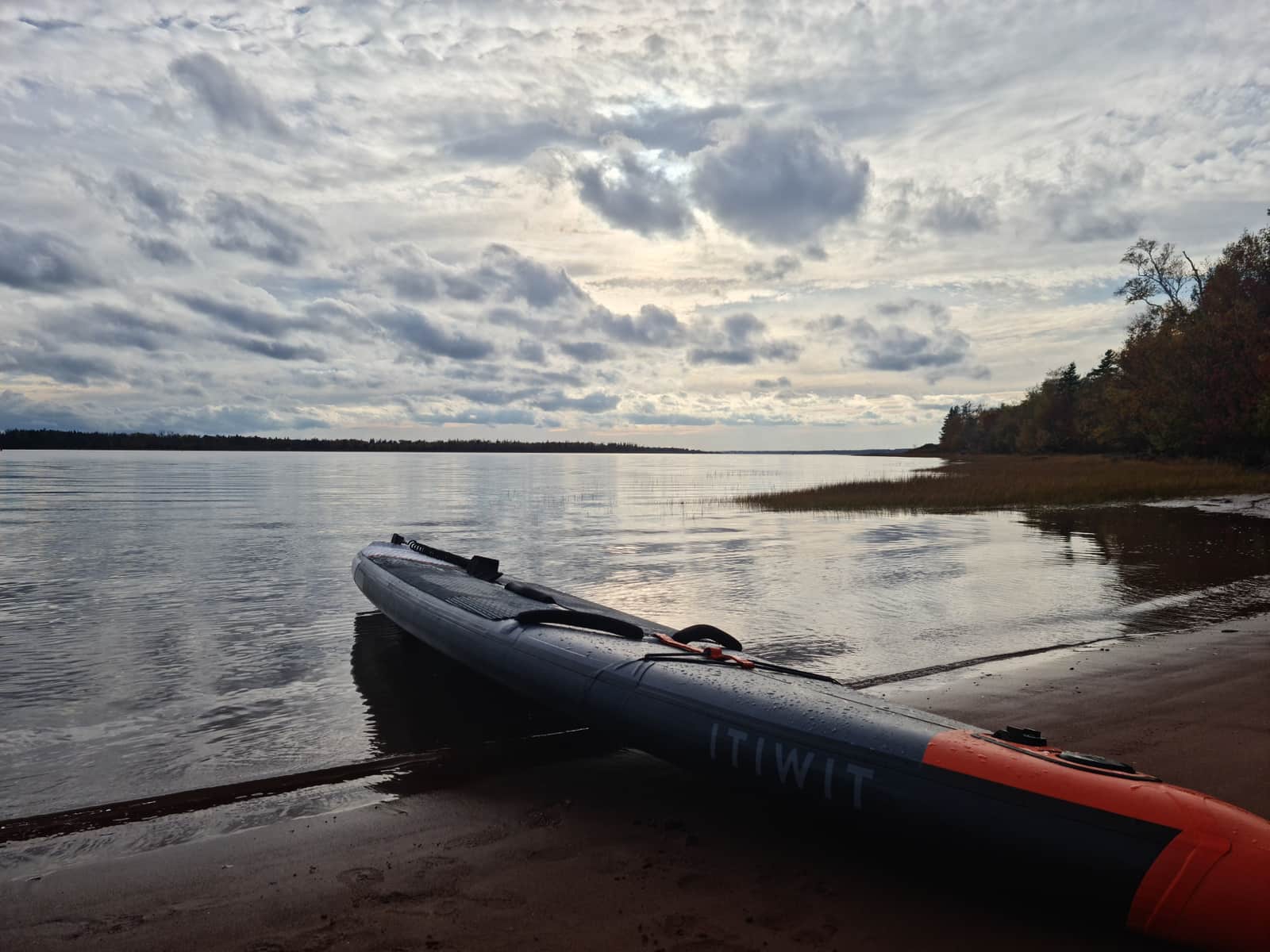
We have not paddled these, and we are not going to pretend we have. Here is what we did instead. Links to Amazon earn us a commission at no extra cost to you, and commission never decides a pick — how this site is funded.
| # | Product | Best for | The spec it turns on | Price |
|---|---|---|---|---|
| 1 | 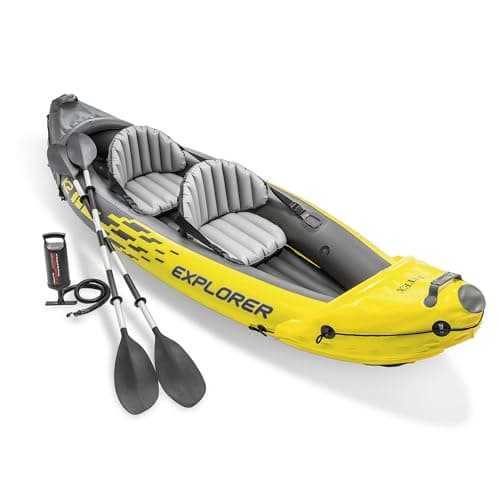 Intex Explorer K2 Inflatable Kayak, 2-person (oars and pump included)Top pickBought as a tandem it disappoints; bought as a very roomy solo boat with 400 lb of rating and no rack requirement, it is the most useful inflatable here. | Two people, no roof rack, small budget | 123 in long, 36 in beam, 35 lb packed, 400 lb rated capacity, two oars and a pump included | |
| 2 | 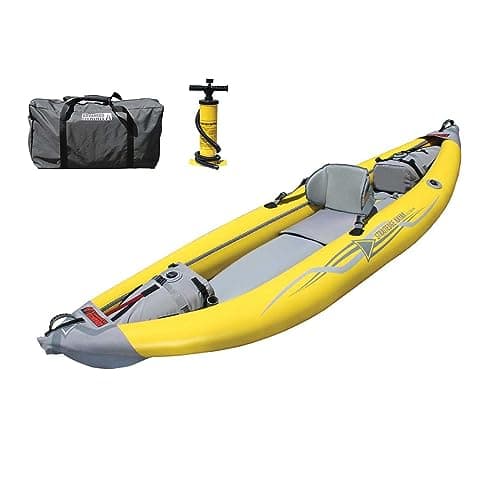 Advanced Elements StraitEdge Inflatable KayakRigid frames built into the bow and stern give an inflatable something the class normally cannot have: an actual pointed end that cuts water instead of pushing it. | An inflatable you would still choose with a garage | 116 in long, 35 in beam, 37 lb, 300 lb rated capacity, aluminum bow and stern ribs | |
| 3 | 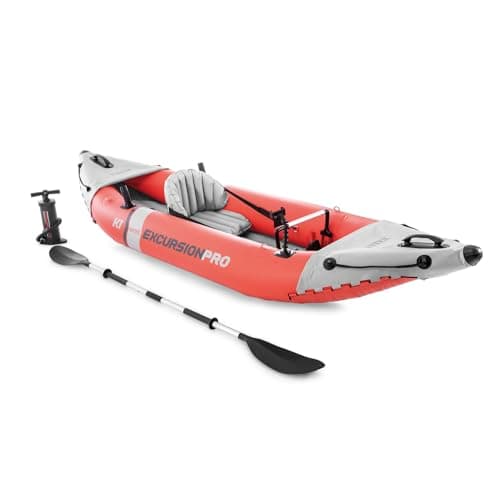 Intex Excursion Pro K1 Inflatable Kayak (paddle and pump included)A laminate hull and a high-pressure floor rather than plain vinyl, which is the difference between an inflatable that tracks and one that argues with you. | The stiffest inflatable in the entry price class | 120 in long, 36 in beam, 31.2 lb packed, 220 lb rated capacity | |
| 4 | 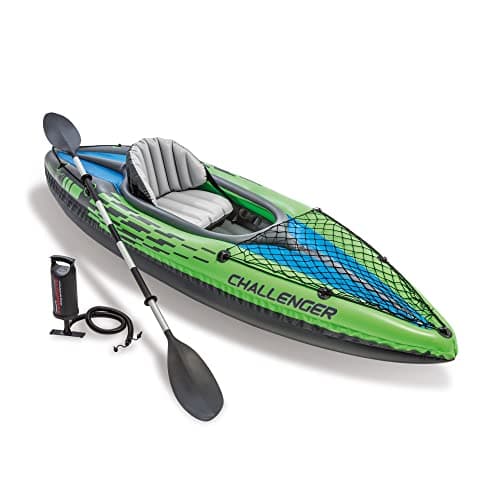 Intex Challenger K1 Inflatable Kayak (paddle and pump included)The honest answer to 'I have an apartment and a sedan'. It is a real boat on flat water and it is not a hard-shell substitute, and it is worth being clear about which of those you are buying. | No car rack, no garage, no storage | 108 in long, 30 in beam, 26 lb packed, 220 lb rated capacity, paddle and pump in the box |
Inflatable kayaks solve the two problems that stop most people buying a boat: where to keep it and how to move it. A 26 lb bag in a cupboard and a car trunk is a completely different proposition from a 47 lb hull, a roof rack, straps and ten feet of garage wall.
They are also where the capacity trap is worst, and it is worth putting that up front rather than at the bottom.
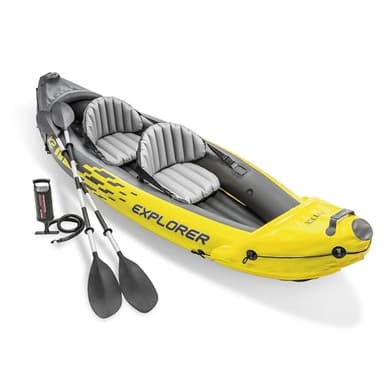
Top pick — Two people, no roof rack, small budget
Intex Explorer K2 Inflatable Kayak, 2-person (oars and pump included)
Bought as a tandem it disappoints; bought as a very roomy solo boat with 400 lb of rating and no rack requirement, it is the most useful inflatable here.
What the listing publishes
123 in long, 36 in beam, 35 lb packed, 400 lb rated capacity, two oars and a pump included
Usable at the 65 percent rule: 260 lb (range 240–280 lb), which leaves about 240 lb of paddler after a 20 lb day kit. Why 65 percent.
400 lb rated is about 260 lb usable at 65 percent. Two adults and gear will exceed that more often than not, which is why we recommend it as a spacious single rather than a genuine two-seater.
As a solo it is transformative: 260 lb of usable capacity against the Challenger K1's 143 lb, for nine extra pounds in the bag.
36 in of beam is wider than every hard-shell on this site. Inflatables are wide because air is what makes them stiff, and the side effect is a very forgiving platform.
What it does well
- 400 lb rated capacity -- 260 lb usable, which covers almost any solo adult with gear
- 36 in beam is the most stable platform on this site
- 35 lb in a bag: no rack, no straps, no garage
What it costs you
- Genuinely tight as a two-adult tandem once you apply the usable-capacity rule
- The included oars are oars, not proper kayak paddles -- budget to replace them
- Vinyl construction wallows in wind like every boat in this class
Skip this if you want a true two-adult tandem. Buy a hard-shell tandem with 500 lb or more of rating, or accept this as the roomiest solo inflatable in the price class.
#ad · how this is funded · price as of October 18, 2026
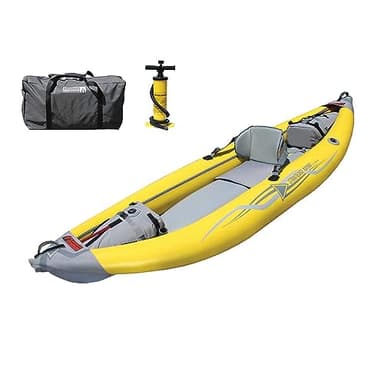
Pick 2 — An inflatable you would still choose with a garage
Advanced Elements StraitEdge Inflatable Kayak
Rigid frames built into the bow and stern give an inflatable something the class normally cannot have: an actual pointed end that cuts water instead of pushing it.
What the listing publishes
116 in long, 35 in beam, 37 lb, 300 lb rated capacity, aluminum bow and stern ribs
Usable at the 65 percent rule: 195 lb (range 180–210 lb), which leaves about 175 lb of paddler after a 20 lb day kit. Why 65 percent.
300 lb rated is about 195 lb usable at 65 percent and 175 lb of paddler after gear, which is 52 lb more headroom than any Intex here.
The aluminum ribs are the reason. A blunt inflatable bow shoves a wall of water; a defined one parts it, and the difference in effort over two miles is not subtle.
37 lb packed is the heaviest inflatable here and about the same as the lightest hard-shell we cover, so the storage advantage is real and the weight advantage is small.
What it does well
- Rigid bow and stern frames give it a real waterline shape, not a bag shape
- 300 lb rated is the highest of the solo inflatables here
- Folds into a bag, so an apartment is still not a problem
What it costs you
- 37 lb packed, the heaviest inflatable here
- Costs several times what an entry inflatable costs
- Setup is longer and fussier than a plain vinyl hull
Skip this if you are buying an inflatable purely because it is cheap. This is the expensive end of the class and the Explorer K2 covers the budget case.
#ad · how this is funded · price as of October 18, 2026
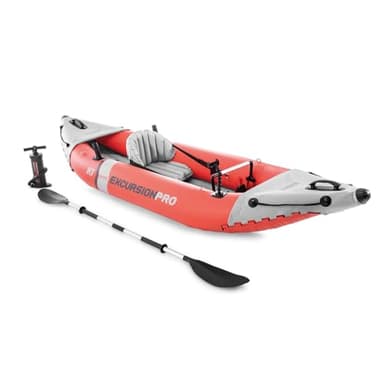
Pick 3 — The stiffest inflatable in the entry price class
Intex Excursion Pro K1 Inflatable Kayak (paddle and pump included)
A laminate hull and a high-pressure floor rather than plain vinyl, which is the difference between an inflatable that tracks and one that argues with you.
What the listing publishes
120 in long, 36 in beam, 31.2 lb packed, 220 lb rated capacity
Usable at the 65 percent rule: 143 lb (range 132–154 lb), which leaves about 123 lb of paddler after a 20 lb day kit. Why 65 percent.
220 lb rated is about 143 lb usable and 123 lb of paddler after gear -- the same limiting number as the Challenger K1, despite the better construction. Construction quality and capacity are separate specs and this is the clearest case of it on the site.
Stiffness is the whole story with inflatables. A high-pressure floor makes the hull behave like a shape instead of a bag, and it is the single upgrade that most changes how one paddles.
36 in of beam plus a stiff floor is an unusually settled platform for standing to fish or to take a photo.
What it does well
- Laminate hull and high-pressure floor track far better than plain vinyl
- 36 in beam plus a stiff floor is stable enough to stand on carefully
- 31 lb in a bag, still no rack required
What it costs you
- 220 lb rated -- roughly 123 lb of paddler after gear, same as the cheapest Intex
- Higher pressure means more pumping, and a gauge you should actually read
- Costs meaningfully more than the Challenger K1 for no extra capacity
Skip this if capacity is your constraint rather than feel. The Explorer K2 has 180 lb more rating for less money, and it is the better answer for a heavier paddler.
#ad · how this is funded · price as of October 18, 2026
Pick 4 — No car rack, no garage, no storage
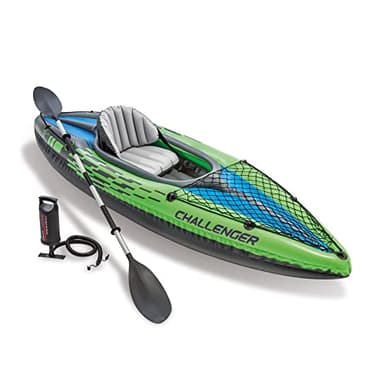
Intex Challenger K1 Inflatable Kayak (paddle and pump included)
The honest answer to 'I have an apartment and a sedan'. It is a real boat on flat water and it is not a hard-shell substitute, and it is worth being clear about which of those you are buying.
What the listing publishes
108 in long, 30 in beam, 26 lb packed, 220 lb rated capacity, paddle and pump in the box
Usable at the 65 percent rule: 143 lb (range 132–154 lb), which leaves about 123 lb of paddler after a 20 lb day kit. Why 65 percent.
220 lb rated is about 143 lb usable at 65 percent and roughly 123 lb of paddler once a PFD, paddle and water are subtracted. That is the single most important number on this listing and it rules out most adult men.
26 lb packed into a bag is what you are actually paying for. No roof bars, no straps, no cart, no garage wall -- the entire transport problem this site spends a page on simply does not exist.
Vinyl over a drop-stitch floor is not the same construction as a drop-stitch inflatable board. Expect fifteen minutes of setup, expect it to be soft, and do not expect it to hold a line in wind.
What it does well
- 26 lb in a bag removes the roof rack, the straps and the storage problem in one purchase
- Paddle and pump are included, so the number on the listing is close to the total
- 30 in beam and a wide flat floor is very stable at rest
What it costs you
- 220 lb rated is about 123 lb of paddler after gear -- read that before anything else
- Fifteen minutes of pumping at each end of every trip
- Soft hull, so it wallows in wind and tracks poorly
Skip this if you weigh over about 125 lb dressed and carrying gear. The capacity arithmetic is unambiguous and the Excursion Pro or the Explorer K2 are the honest upgrades.
#ad · how this is funded · price as of October 18, 2026
The capacity table, because it is the whole decision
| Boat | Seats | Rated | Usable at 65% | Paddler after 20 lb of gear |
|---|---|---|---|---|
| Intex Challenger K1 | 1 | 220 lb | 143 lb | 123 lb |
| Intex Excursion Pro K1 | 1 | 220 lb | 143 lb | 123 lb |
| Advanced Elements StraitEdge | 1 | 300 lb | 195 lb | 175 lb |
| Intex Explorer K2 | 2 | 400 lb | 260 lb | 240 lb |
That table is why we recommend a tandem as a solo boat. The Explorer K2 gives a solo paddler 240 lb of headroom for nine more pounds in the bag than the Challenger K1's 123 lb, and it is usually cheaper than the Excursion Pro which offers no more capacity at all.
Stiffness: what actually separates a good inflatable from a bad one
An inflatable kayak is a shape held by air pressure. How well it holds that shape under a paddler is the single biggest quality difference in the category, and it is not in the price.
| Construction | What it is | How it paddles |
|---|---|---|
| Plain vinyl | Welded PVC tubes with a low-pressure floor | Soft. Pushes water, wallows in wind, tracks poorly |
| Laminate with high-pressure floor | Reinforced skin, drop-stitch or high-pressure floor | Noticeably stiffer. Holds a line, feels like a shape |
| Rigid-framed | Aluminum ribs built into the bow and stern | A real waterline shape. Parts water instead of shoving it |
That last row is what the Advanced Elements StraitEdge does, and it is why it costs several times what an Intex does. A blunt inflatable bow pushes a wall of water in front of it; a defined one parts it, and the difference in effort over two miles is not subtle.
The honest disadvantages
- **Setup time.** Ten to fifteen minutes at each end of every trip. An electric pump helps and does not eliminate it.
- **Wind.** A soft hull sitting high on the water is a sail. This is the most-felt drawback and no amount of pressure fixes it entirely.
- **Tracking.** Even a stiff inflatable wanders more than a hard-shell of the same length. The fin helps and does not solve it.
- **Capacity.** The single biggest issue at the entry level, per the table above.
- **Longevity.** Five to ten seasons is normal for the PVC. That is fine and it is not the fifteen-plus years a rotomolded hull will give.
The honest advantages
- **No storage problem at all.** This is the entire point and it is a very large point.
- **No roof rack, no straps, no loading routine.** The transport problem simply does not exist.
- **Wider than any hard-shell here.** 36 inches on the Explorer K2 versus 30 on a typical hard-shell, so very stable at rest.
- **Bounces off things.** On shallow gravelly rivers this is a genuine durability advantage over rotomolded plastic.
- **Travels.** Checked luggage, a train, a small car. A hard-shell does none of those.
Check the number against yourself
Does that kayak actually fit you?
Put in your weight and the rated capacity printed on the listing. This is the arithmetic the listing does not do for you.
The answer
No — you are 5 lb over
A 300 lb rating is the point at which the hull still floats, not the point at which it still behaves. Eddyline, a kayak manufacturer, publishes that the ideal load stops at about 60 to 70 percent of the maximum. At 65 percent that is 195 lb of everything aboard, and after a 20 lb day kit — paddle, PFD, water, dry bag — about 175 lb of paddler.
You are not going to sink. You will sit lower than the hull was designed to sit, which costs you stability and speed and makes the boat feel worse than it is. Look for a rating of at least 325 lb.
Where that came from
usable capacity = rated capacity x 0.60 to 0.70
300 x 0.65 = 195 lb of paddler, gear, clothing and PFD
Questions people actually ask
Are inflatable kayaks any good?
How much weight can an inflatable kayak hold?
Do inflatable kayaks puncture easily?
How long does it take to inflate a kayak?
Is an inflatable kayak worth it if I have a garage?
Where these numbers came from
Every figure on this page traces to one of these. Where a number could not be sourced, the page says so rather than estimating it.
- Eddyline Kayaks — Maximum weight capacity versus ideal capacity for various styles of kayaks (manufacturer, states the 60-70% ideal-capacity band)
- Intex Explorer K2 Inflatable Kayak — manufacturer specification as published on the Amazon listing, read 2026-09-02
- Advanced Elements StraitEdge Inflatable Kayak — manufacturer specification as published on the Amazon listing, read 2026-10-03
- Intex Excursion Pro K1 Inflatable Kayak — manufacturer specification as published on the Amazon listing, read 2026-09-02
- Intex Challenger K1 Inflatable Kayak — manufacturer specification as published on the Amazon listing, read 2026-09-02
Read next
Best K2 Alternative
Intex Explorer K2 Alternatives
Alternatives to the K2 sorted by what you actually want fixed: tracking, packed weight, capacity, or the fact that it is an inflatable at all.
Top pick
Intex Explorer K2 Inflatable Kayak, 2-person (oars and pump included)
Two people, no roof rack, small budget
#ad · how this is funded · price as of October 18, 2026
Intex Excursion Pro K1: Stiffness You Can Feel, Capacity You Cannot Ignore
The best-constructed inflatable we cover — laminate hull, high-pressure floor, two removable skegs. Rated 220 lb, the same limit as boats built far worse.
Top pick
Intex Excursion Pro K1 Inflatable Kayak (paddle and pump included)
The stiffest inflatable in the entry price class
#ad · how this is funded · price as of October 18, 2026
Intex Challenger K1 vs Explorer K2
The two cheapest inflatables, hull against hull. The counter-intuitive answer: the two-person K2 is the better solo boat for most adults, because 400 lb rated beats 220.
Top pick
Intex Explorer K2 Inflatable Kayak, 2-person (oars and pump included)
Two people, no roof rack, small budget
#ad · how this is funded · price as of October 18, 2026
Are Inflatable Kayaks Worth It?
Worth it if storage or a roof rack is your problem. Not worth it if performance is. How to tell which buyer you are from the published capacity and your own garage.
Top pick
Intex Explorer K2 Inflatable Kayak, 2-person (oars and pump included)
Two people, no roof rack, small budget
#ad · how this is funded · price as of October 18, 2026
Intex Explorer K2: What the Specs Say
400 lb rated, 36 in wide, 35 lb in a bag — and a much better solo kayak than the two-person boat it is marketed as.
Top pick
Intex Explorer K2 Inflatable Kayak, 2-person (oars and pump included)
Two people, no roof rack, small budget
#ad · how this is funded · price as of October 18, 2026
Best Budget Kayak
The Best Budget Kayaks
Budget kayaks with the specific compromise each one makes, named. Capacity is usually the one that catches people.
Top pick
Intex Explorer K2 Inflatable Kayak, 2-person (oars and pump included)
Two people, no roof rack, small budget
#ad · how this is funded · price as of October 18, 2026