Paddle Boards
The Best Paddle Boards for Rivers
Moving water rewards the opposite specs from a lake. Shorter, tougher, and a fin you can knock off without ending the day — plus a hard limit on which rivers a beginner belongs on at all.
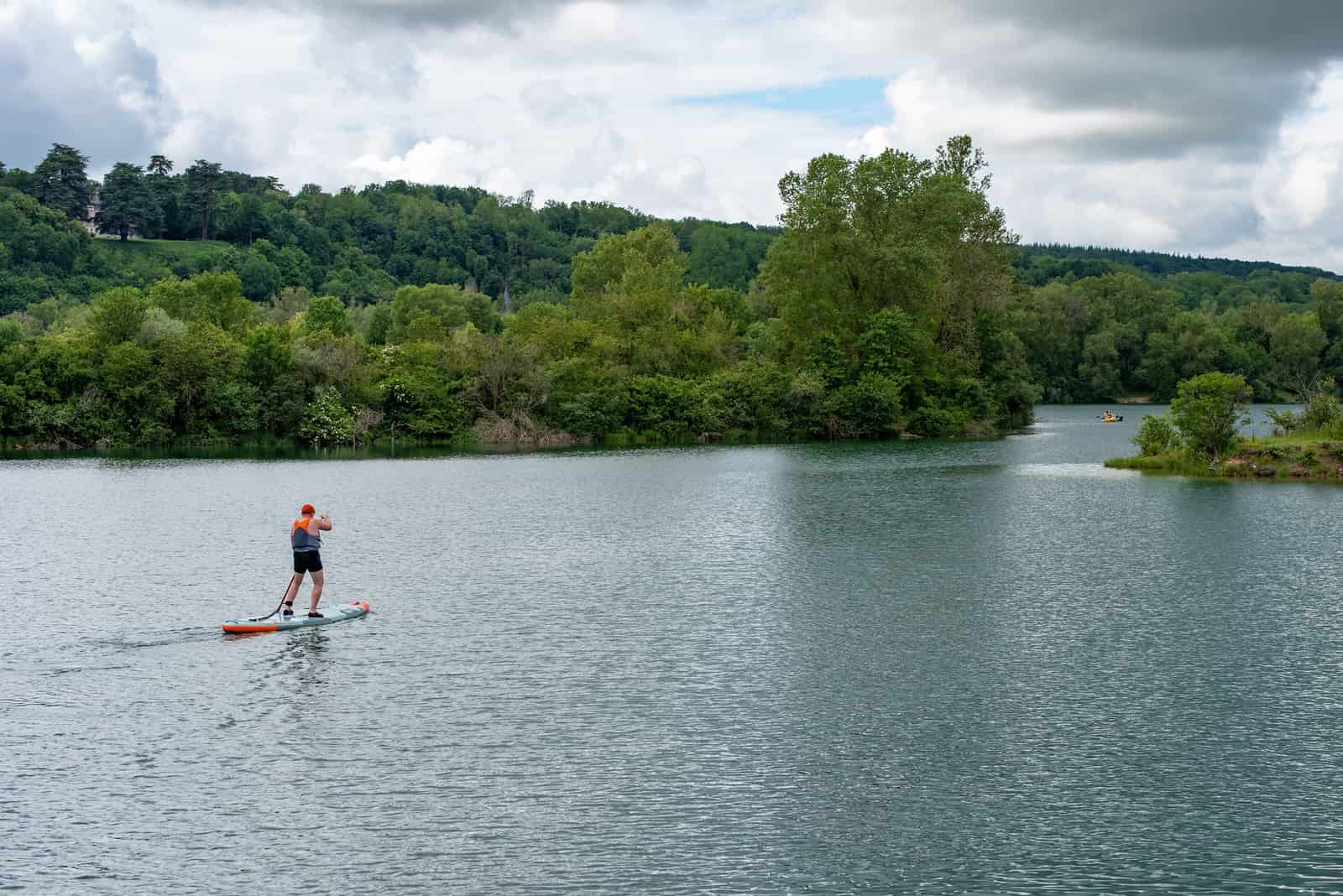
We have not paddled these, and we are not going to pretend we have. Here is what we did instead. Links to Amazon earn us a commission at no extra cost to you, and commission never decides a pick — how this site is funded.
| # | Product | Best for | The spec it turns on | Price |
|---|---|---|---|---|
| 1 | 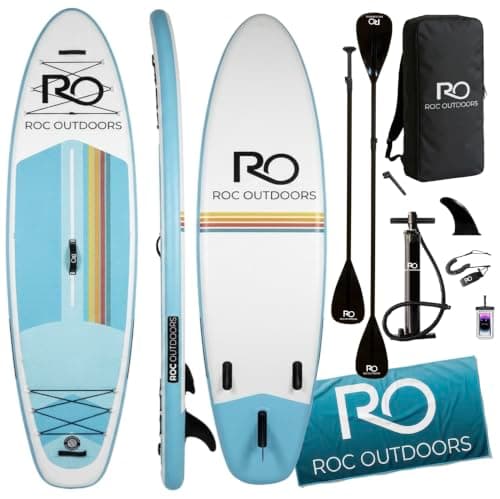 Roc Inflatable Stand Up Paddle Board, 10 ft 6 in x 33 inTop pick10 ft 6 in by 33 in is the shape the whole beginner category converged on, and this is the cheapest version of it that publishes a 350 lb rating. | The default first inflatable board | 126 x 33 x 6 in, 350 lb rated capacity, PVC drop-stitch, full accessory kit | |
| 2 | 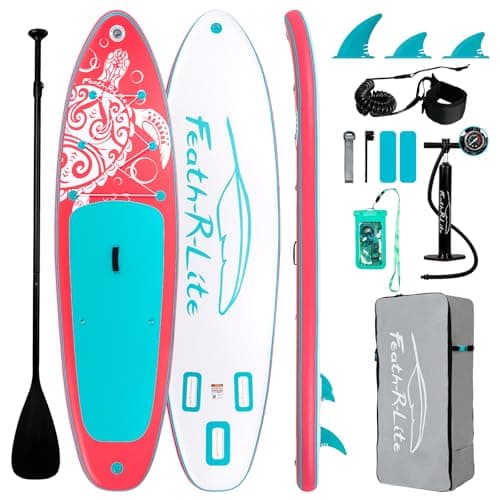 FEATH-R-LITE Inflatable Stand Up Paddle Board, 10 ft 6 in x 31.5 inEighteen and a half pounds is a genuinely low number for a drop-stitch board, and it is the spec that decides whether the board gets carried past the first parking lot. | The lightest board to carry to the water | 118.1 x 31.5 x 5.91 in, 18.9 lb board weight, 330 lb rated capacity | |
| 3 | 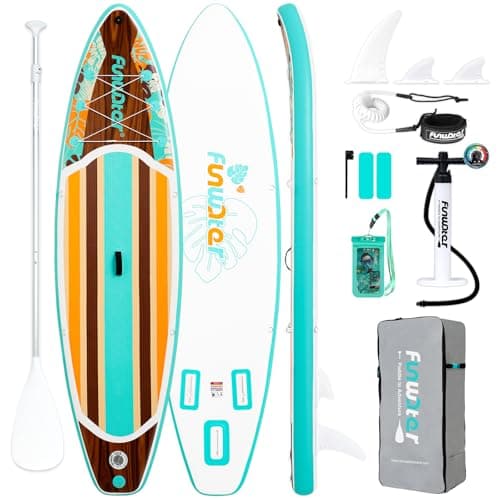 FunWater Inflatable Stand Up Paddle Board, 10 ft 6 in x 35 inThirty-five inches of width in a 10 ft 6 in board is the closest thing to a raft that still paddles like a board, and for a genuinely nervous beginner that is the right trade. | Maximum stability in a standard length | 126 x 35.1 x 6 in, 330 lb rated capacity, PVC drop-stitch | |
| 4 | 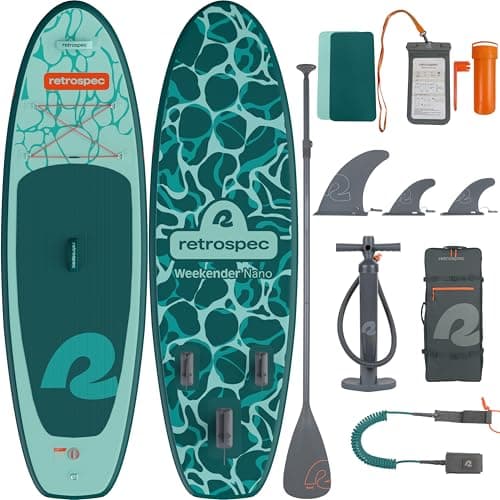 Retrospec Weekender-Nano Inflatable Paddle Board, 8 ftTwelve pounds and eight and a half feet: sized so a child can carry, inflate and drag their own board, which is the entire difference between their board and yours. | A child's own board | 102 x 28 x 5 in, 12.2 lb board weight, 140 lb rated capacity |
Almost every paddle board buying guide is written for flat water, and the advice inverts on a river. Length stops being an advantage. Rigidity stops being the priority. And the fin, which nobody thinks about on a lake, becomes the part most likely to end your afternoon.
Inflatable beats hard, and it is not close
On a lake the inflatable-versus-hard argument is a genuine trade. On a river it is settled by what happens when you hit something, and on a river you will hit something.
- **Rock strikes.** A drop-stitch PVC hull deforms and recovers. An epoxy hard board dings, cracks and eventually delaminates. River bottoms are shallow and unforgiving and this is the whole argument.
- **Dragging.** Rivers mean shallows you walk the board through. PVC tolerates being dragged over gravel in a way a painted hard board does not.
- **Getting home.** If your exit is a mile of riverbank, a board that packs into a bag is a very different afternoon from a board you carry.
The full inflatable-versus-hard comparison covers the lake case, where the answer is much less one-sided.
Shorter turns, and turning is what a river asks for
A lake rewards waterline: longer boards glide further per stroke and hold a line. A river gives you a current that already provides the forward motion and a channel that keeps changing direction. What you need is the ability to pivot, quickly, repeatedly, often on one side.
| Length | On a river | Trade |
|---|---|---|
| 8 to 9 ft | Pivots almost on the spot | Wanders badly on any flat section |
| 10 to 10 ft 6 in | The usable middle. Turns inside most bends | The sensible default |
| 11 ft 6 in and up | Holds a line beautifully, fights every bend | Better saved for the lake |
That is why the 11 ft 6 in boards we recommend elsewhere on this site do not appear at the top of this page. They are better boards for open water and worse boards here, which is the entire reason this page exists separately.
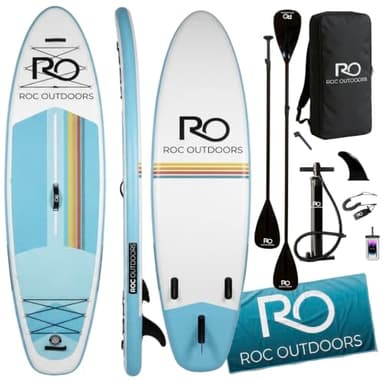
Top pick — The default first inflatable board
Roc Inflatable Stand Up Paddle Board, 10 ft 6 in x 33 in
10 ft 6 in by 33 in is the shape the whole beginner category converged on, and this is the cheapest version of it that publishes a 350 lb rating.
What the listing publishes
126 x 33 x 6 in, 350 lb rated capacity, PVC drop-stitch, full accessory kit
Usable at the 65 percent rule: 228 lb (range 210–245 lb), which leaves about 208 lb of paddler after a 20 lb day kit. Why 65 percent.
33 in of width is the number that decides whether you stand up on day one. Our width guidance puts 32 to 33 in as the beginner band for an adult between 150 and 200 lb, and this sits in it.
350 lb rated capacity means about 227 lb of loaded paddler at 65 percent. Applying the displacement arithmetic instead, a 195 lb loaded paddler wants roughly 195 L of volume -- this hull's 126 x 33 x 6 in envelope is comfortably past that.
Six inches of thickness is what makes a modern inflatable stiff. Four-inch boards flex under an adult in the middle and that flex is what people mistake for the board being unstable.
What it does well
- 33 in wide -- the width that gets a first-timer standing rather than kneeling
- 350 lb rating covers an adult with a child or a dog on board
- Ships with pump, paddle, leash and bag, so the listing price is close to the total
What it costs you
- The included paddle and pump are starter parts you will eventually replace
- 10 ft 6 in is a compromise length -- not fast, not especially maneuverable
- The listing does not publish a board weight
Skip this if you already know you want to cover distance. A 10 ft 6 in all-around board is a cruiser and an 11 ft 6 in touring shape is the honest answer for mileage.
#ad · how this is funded · price as of October 9, 2026
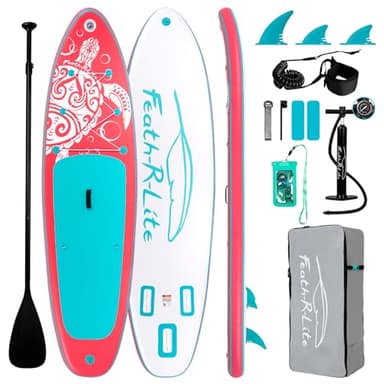
Pick 2 — The lightest board to carry to the water
FEATH-R-LITE Inflatable Stand Up Paddle Board, 10 ft 6 in x 31.5 in
Eighteen and a half pounds is a genuinely low number for a drop-stitch board, and it is the spec that decides whether the board gets carried past the first parking lot.
What the listing publishes
118.1 x 31.5 x 5.91 in, 18.9 lb board weight, 330 lb rated capacity
Usable at the 65 percent rule: 215 lb (range 198–231 lb), which leaves about 195 lb of paddler after a 20 lb day kit. Why 65 percent.
330 lb rated is about 215 lb of loaded paddler at 65 percent, which covers most adults with gear.
31.5 in of width is just under our 32 in beginner recommendation. For a paddler under about 150 lb that is fine; for a 200 lb paddler it is the reason to look at the 33 in boards instead.
At 118 in this is closer to a 9 ft 10 in board than a true 10 ft 6 in, despite how the category is marketed. Shorter is more maneuverable and less directionally stable, and the listing's own dimensions are the place to check that rather than the product name.
What it does well
- 18.9 lb published board weight is at the light end of the class
- Rated to 330 lb, so an adult with a day kit has real headroom
- Shorter hull is easier to turn and easier to pack
What it costs you
- 31.5 in is narrower than our 32 in beginner floor for an average adult
- 118 in is shorter than the 10 ft 6 in the category name implies
- Less glide per stroke than a longer board
Skip this if you are over about 180 lb. Half an inch of width sounds trivial and it is the difference between standing and kneeling for a heavier paddler.
#ad · how this is funded · price as of October 9, 2026
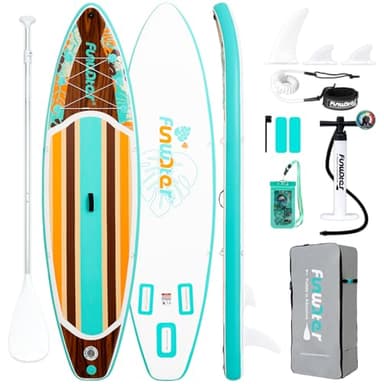
Pick 3 — Maximum stability in a standard length
FunWater Inflatable Stand Up Paddle Board, 10 ft 6 in x 35 in
Thirty-five inches of width in a 10 ft 6 in board is the closest thing to a raft that still paddles like a board, and for a genuinely nervous beginner that is the right trade.
What the listing publishes
126 x 35.1 x 6 in, 330 lb rated capacity, PVC drop-stitch
Usable at the 65 percent rule: 215 lb (range 198–231 lb), which leaves about 195 lb of paddler after a 20 lb day kit. Why 65 percent.
35.1 in is above our beginner recommendation for every weight band on the site. Extra width is slower and it is not a mistake -- speed is not the thing standing between a first-timer and a good afternoon.
330 lb rated is about 215 lb of loaded paddler at 65 percent, the same as the FEATH-R-LITE, in a board three and a half inches wider.
Wide boards are harder to reach past when you paddle, so a wide board pushes you toward a slightly longer paddle. Our formula puts a 5 ft 8 in paddler on a 77 in SUP paddle regardless of board, but the reach penalty is real and worth knowing about.
What it does well
- 35.1 in wide -- as stable as an inflatable board gets at this length
- 330 lb rating with room for a child or a dog on the nose
- Full accessory kit included
What it costs you
- Wide is slow, and you will notice against a 31 in board
- Harder to reach the water past the rail, which tires your shoulders
- The listing does not publish a board weight
Skip this if you are reasonably confident on your feet already. Width you do not need is drag you pay for on every stroke.
#ad · how this is funded · price as of October 9, 2026
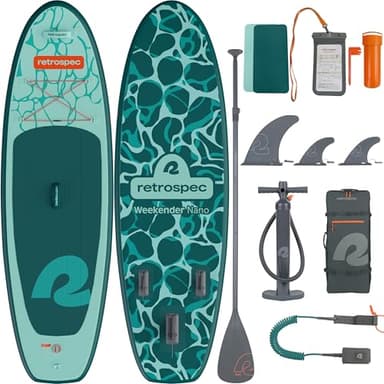
Pick 4 — A child's own board
Retrospec Weekender-Nano Inflatable Paddle Board, 8 ft
Twelve pounds and eight and a half feet: sized so a child can carry, inflate and drag their own board, which is the entire difference between their board and yours.
What the listing publishes
102 x 28 x 5 in, 12.2 lb board weight, 140 lb rated capacity
Usable at the 65 percent rule: 91 lb (range 84–98 lb), which leaves about 71 lb of paddler after a 20 lb day kit. Why 65 percent.
140 lb rated is about 91 lb of loaded child at 65 percent, so this covers most children up to roughly eleven or twelve.
28 in of width is narrow by our adult standard and correct here -- children weigh less, so they need less width for the same margin, and a narrower board is one they can actually reach past to paddle.
12.2 lb is the spec that makes it theirs. A child who cannot lift their own board is a passenger on a family outing rather than a participant in one.
What it does well
- 12.2 lb -- genuinely child-portable
- 28 in width is proportionate to a child's weight and reach
- 8 ft 6 in turns quickly, which is what children actually want to do
What it costs you
- 140 lb rated, so a teenager will outgrow it
- 5 in thickness is less stiff than a 6 in adult board
- Too small to be useful to an adult afterwards
Skip this if your child is already near 90 lb dressed. Buy a narrow adult board instead -- it will last them into their teens and this will not.
#ad · how this is funded · price as of October 9, 2026
The fin is the part that ends days
Every board here ships with a removable center fin that drops several inches below the hull. On a lake that fin is what keeps you tracking. In a river with a shallow gravel bar it is a lever that catches, and it either snaps, tears out its box, or stops the board dead while you keep moving.
- **Use a flexible or rubber fin** where the board supports one. It folds over a rock and springs back rather than levering against it.
- **Run the smaller side fins alone** in genuinely shallow water and accept the tracking penalty. It is a smaller penalty than a broken fin box.
- **Never fix a fin permanently** on a board you take on moving water. The whole point is that it is a sacrificial part.
The leash rule that is specific to moving water
This is the one genuinely dangerous difference between a lake and a river, and it gets stated too rarely.
A life jacket is worn rather than stowed for the same reason: current gives you far less time than flat water does. What the rules require, and what they do not cover.
Reading a slow river before you launch
Flat water is one thing everywhere. A river is a different thing every hundred yards, and four features account for nearly all of the trouble a beginner finds.
- **Strainers.** A fallen tree or a branch pile that water flows through and a body does not. This is the genuine killer on moving water. You avoid it by looking downstream constantly and by staying on the inside of bends, where trees fall in on the outside.
- **Eddies.** The calm, sometimes upstream-moving pocket behind an obstruction. These are your friends — they are where you stop, rest and get your bearings without fighting the current.
- **The outside of a bend** runs fastest, deepest and carries the debris. The inside runs slow and shallow. As a beginner you want the inside of every corner, accepting that you may have to walk a shallow section.
- **The take-out.** Know where you are getting out and what it looks like from the water before you start, because a river only goes one way and missing your exit is the most common way a pleasant afternoon turns into a long walk.
The shuttle is the other planning item nobody mentions: a river trip ends somewhere other than where it started, so you need two vehicles, a bike, or a willing driver. That logistics problem is why most people paddle lakes.
Water level changes all of this. The same stretch that is a gentle drift in late summer can be pushy and full of debris after rain, and a river you know well is a different river two days after a storm. Check a gauge if the run has one, look at the color of the water, and be willing to walk away — the section will still be there next weekend.
What to wear, which matters more here
On a lake you fall in near where you can get out. On a river the current carries you away from your board and downstream, and a swim is longer and colder than the same swim on flat water.
- **Shoes, always.** You will walk shallow sections over rock and gravel, and river bottoms hide glass and metal. Bare feet are a lake habit that does not transfer.
- **Dress for the water temperature, not the air.** A warm afternoon over 55-degree water is a cold-water day. Cold shock is what turns a swim into an emergency, and it does not care what the forecast says.
- **Nothing that traps you.** No loose straps, no cotton hoodie with a drawstring, nothing dangling. In current, anything that can snag is a hazard.
What you can ignore
- **Carbon and premium construction.** You are going to hit rocks. Buy something you are willing to scratch.
- **Tracking-optimized long hulls.** Everything that makes a board track makes it fight a bend.
- **High-pressure race rigidity.** Useful for speed, irrelevant at river pace, and higher pressure is more strain on a hull taking impacts.
- **River-specific branding on a standard board.** Construction and length are the specs; the graphics are not.
Questions people actually ask
Can you paddle board on a river?
What size paddle board is best for a river?
Is an inflatable or hard board better for rivers?
Should you wear a leash paddle boarding on a river?
What fin should I use on a river?
Is a kayak better than a paddle board on a river?
What is a strainer and why does it matter?
Should you kneel or stand paddle boarding on a river?
How do you plan a river paddle if it only goes one way?
Where these numbers came from
Every figure on this page traces to one of these. Where a number could not be sourced, the page says so rather than estimating it.
- Thurso Surf — What Size Paddle Board Is Right for You (manufacturer, states the weight-in-kg x 2 volume rule and the 32 in beginner width band)
- Eddyline Kayaks — Maximum weight capacity versus ideal capacity for various styles of kayaks (manufacturer, states the 60-70% ideal-capacity band)
- U.S. Coast Guard — Life Jacket Wear / Wearing Your Life Jacket (federal carriage and under-13 wear requirements)
- Roc Inflatable Stand Up Paddle Board 10 ft 6 in — manufacturer specification as published on the Amazon listing, read 2026-09-02
- FEATH-R-LITE Inflatable Stand Up Paddle Board — manufacturer specification as published on the Amazon listing, read 2026-09-02
- FunWater Inflatable Stand Up Paddle Board — manufacturer specification as published on the Amazon listing, read 2026-09-02
- Retrospec Weekender-Nano Inflatable Paddle Board 8 ft — manufacturer specification as published on the Amazon listing, read 2026-09-02
Read next
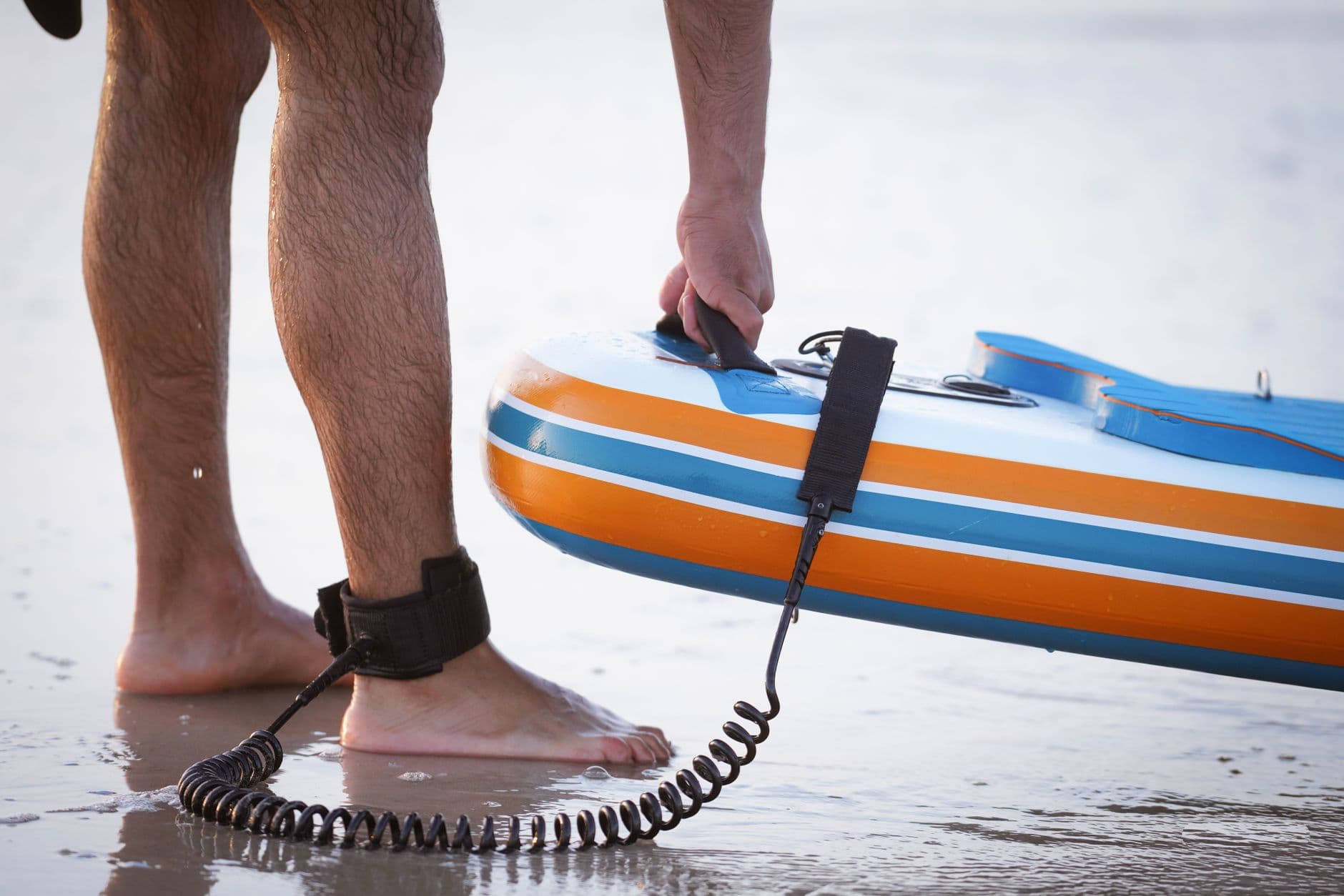
Best SUP Leash
The Best Paddle Board Leashes
The water decides the leash: coiled for flat, straight for surf, quick-release for anything moving. Six picks, and the river rule that makes the choice a safety one.
Top pick
Dakine SUP Coiled Ankle Leash, 10 ft x 3/16 in
Flat water, and the default if you buy one leash
#ad · how this is funded · price as of October 9, 2026

Inflatable vs Hard Paddle Board
Hard boards are better boards. Inflatables are better first boards. Here is exactly where each one wins.
Top pick
Roc Inflatable Stand Up Paddle Board, 10 ft 6 in x 33 in
The default first inflatable board
#ad · how this is funded · price as of October 9, 2026
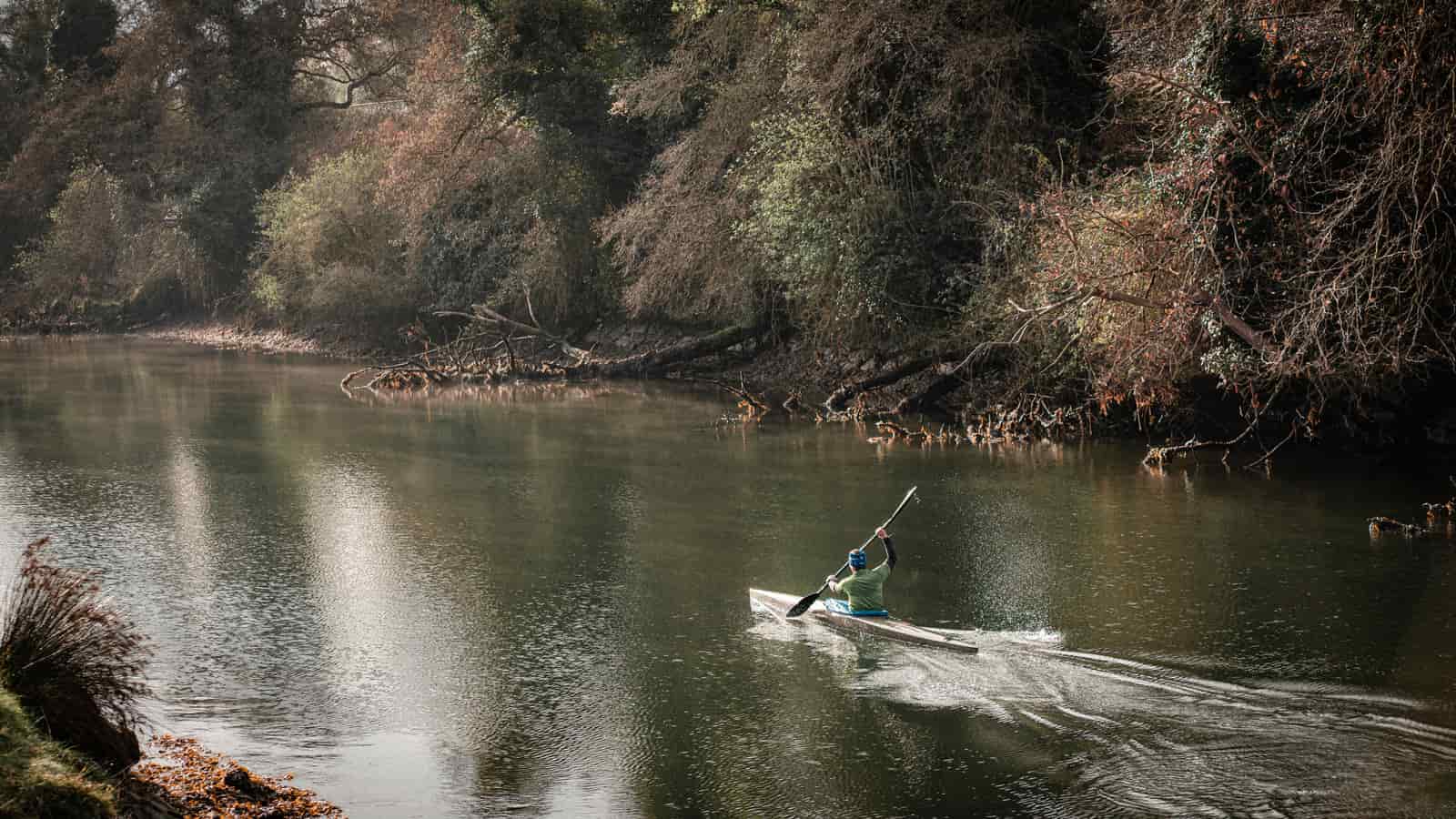
Best for Rivers
The Best Kayaks for Slow Rivers
Slow rivers want a shorter hull than a lake does. The picks, plus a clear line about what this page does not cover.
Top pick
Perception Flash 9.5 Sit-Inside Kayak
The most capacity in the shortest hull
#ad · how this is funded · price as of October 9, 2026

What Size Paddle Board Do I Need?
A volume and width calculator that shows its working, and ends in an actual board rather than a chart.
Top pick
Roc Inflatable Stand Up Paddle Board, 10 ft 6 in x 33 in
The default first inflatable board
#ad · how this is funded · price as of October 9, 2026
Life Jacket Rules for Paddlers
The federal PFD requirement, the under-13 wear rule, and why your state matters — sourced, not paraphrased.
Top pick
Onyx MoveVent Dynamic Paddle Vest
The PFD you will actually keep on
#ad · how this is funded · price as of October 9, 2026
Best First Board
The Best Paddle Boards for Beginners
Five beginner boards ranked on published width and usable capacity, with the displacement arithmetic run on each one.
Top pick
Roc Inflatable Stand Up Paddle Board, 10 ft 6 in x 33 in
The default first inflatable board
#ad · how this is funded · price as of October 9, 2026