Kayaks
Kayak Weight Capacity, Explained
Every kayak publishes a maximum capacity and it is a flotation figure, not a performance one. The difference between the two is about a third of the number, and it changes which boats you should be looking at.
We have not paddled these, and we are not going to pretend we have. Here is what we did instead. Links to Amazon earn us a commission at no extra cost to you, and commission never decides a pick — how this site is funded.
| # | Product | Best for | The spec it turns on | Price |
|---|---|---|---|---|
| 1 | 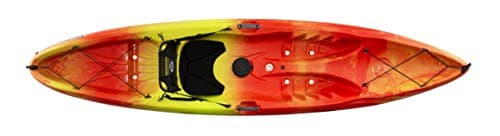 Perception Tribe 11.5 Sit-on-Top KayakTop pickThe combination almost nothing else manages: 350 lb of rating, a 30 in beam and enough waterline to hold a line, in a hull a first-timer can climb back onto from the water. | The all-round first sit-on-top | 137 in long, 30.25 in beam, 52 lb hull, 350 lb rated capacity | |
| 2 | 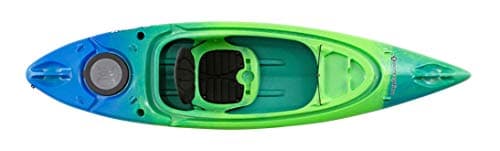 Perception Flash 9.5 Sit-Inside KayakA 325 lb rating in a hull under ten feet is unusual, and it is what makes this the short-boat answer for a larger paddler who still has to store it in an apartment. | The most capacity in the shortest hull | 113 in long, 28.5 in beam, 41 lb hull, 325 lb rated capacity |
Rated capacity is the most-compared and least-understood number in the category. It is printed in every listing title, it is what buyers filter on, and it does not mean what almost everyone assumes.
What the rating actually is
It is a flotation limit — the load at which the manufacturer is confident the hull still floats and supports its passenger. Eddyline, a kayak manufacturer, describes it directly: the maximum weight capacity is the rating a manufacturer assigns to indicate how much weight the boat can hold and stay afloat, and this is different from the ideal capacity, which is the zone where the waterline sits near its intended level for maximum performance.
They then state where that ideal zone stops: at about 60 to 70 percent of the maximum. That is a manufacturer describing its own ratings, which is why it is the source we use rather than a rule of thumb from a forum.
| Rated capacity | Usable (60-70%) | Usable at 65% | Left for the paddler |
|---|---|---|---|
| 250 lb | 150-175 lb | 163 lb | 143 lb |
| 275 lb | 165-193 lb | 179 lb | 159 lb |
| 300 lb | 180-210 lb | 195 lb | 175 lb |
| 325 lb | 195-227 lb | 211 lb | 191 lb |
| 350 lb | 210-245 lb | 228 lb | 208 lb |
| 400 lb | 240-280 lb | 260 lb | 240 lb |
| 450 lb | 270-315 lb | 293 lb | 273 lb |
| 500 lb | 300-350 lb | 325 lb | 305 lb |
Try it on the boat you are looking at
Does that kayak actually fit you?
Put in your weight and the rated capacity printed on the listing. This is the arithmetic the listing does not do for you.
The answer
No — you are 5 lb over
A 300 lb rating is the point at which the hull still floats, not the point at which it still behaves. Eddyline, a kayak manufacturer, publishes that the ideal load stops at about 60 to 70 percent of the maximum. At 65 percent that is 195 lb of everything aboard, and after a 20 lb day kit — paddle, PFD, water, dry bag — about 175 lb of paddler.
You are not going to sink. You will sit lower than the hull was designed to sit, which costs you stability and speed and makes the boat feel worse than it is. Look for a rating of at least 325 lb.
Where that came from
usable capacity = rated capacity x 0.60 to 0.70
300 x 0.65 = 195 lb of paddler, gear, clothing and PFD
What overloading actually does
Nothing sudden, which is exactly why it goes unnoticed for a whole season. The boat gets quietly worse in four ways at once, and a first-time paddler has nothing to compare it against.
- **Freeboard drops.** The distance from the water to the top edge of the hull shrinks, so wakes and chop come over the side that would otherwise have passed under it.
- **Stability drops.** A hull sitting deeper has a different shape at the waterline than the one its designer drew, and generally a less stable one.
- **It gets slower.** More wetted surface, more drag, more effort per stroke, for the whole trip.
- **It handles worse.** A boat sitting low is sluggish to turn and slower to respond, which is most noticeable exactly when you want it not to be.
What counts toward the number
| Item | Typical weight |
|---|---|
| You, in wet clothes and shoes | your weight + 3 to 6 lb |
| PFD | 1.5 to 2 lb |
| Paddle | 2 to 3 lb |
| Water and food for a day | 3 to 6 lb |
| Dry bag with a change of clothes | 3 to 6 lb |
| Pump, sponge, whistle, first aid | 2 to 4 lb |
| A dog | 20 to 90 lb |
| Overnight camping kit | 25 to 50 lb |
Twenty pounds is a realistic solo day kit and is what our calculator assumes. An overnight trip is closer to fifty, which is why touring boats publish much higher ratings than recreational ones.
Sizing around it
Why manufacturers do not just publish the usable number
Because it is a range rather than a figure, and because it depends on what you consider acceptable. A racer wants a boat riding high; a camper on a week-long trip accepts sitting low in exchange for carrying food. The flotation number is objective and testable, and the ideal-load number is a judgment.
That is a reasonable position and it leaves the buyer holding a number that means less than it appears to. Doing the multiplication yourself is the fix, and it is one step.
Boats with genuine headroom
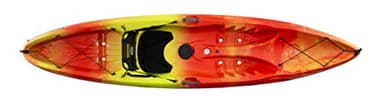
Top pick — The all-round first sit-on-top
Perception Tribe 11.5 Sit-on-Top Kayak
The combination almost nothing else manages: 350 lb of rating, a 30 in beam and enough waterline to hold a line, in a hull a first-timer can climb back onto from the water.
What the listing publishes
137 in long, 30.25 in beam, 52 lb hull, 350 lb rated capacity
Usable at the 65 percent rule: 228 lb (range 210–245 lb), which leaves about 208 lb of paddler after a 20 lb day kit. Why 65 percent.
350 lb rated is about 228 lb usable at 65 percent and 208 lb of paddler after a day kit -- the most headroom of any single boat here, and enough that a 200 lb adult is inside the comfortable band rather than at the edge of it.
Sit-on-top means the deck is open and self-draining. The reason that matters to a beginner is not comfort, it is that remounting from deep water is a maneuver you can actually perform, where a flooded sit-inside cockpit is not.
52 lb is the price. This is at the top of what one person carries any distance, and the reason a cart appears in our cost totals for this boat and not for the Argo.
What it does well
- 350 lb rated capacity gives real headroom for larger adults or a child up front
- Open self-draining deck is the forgiving choice for a first summer
- 137 in of hull tracks far better than the 9 and 10 ft boats here
What it costs you
- 52 lb is a two-person lift onto a roof for most people
- You will get wet. Sit-on-tops always do, and that is a season decision not a design flaw
- 11 ft 5 in needs more storage length than the 10 ft boats
Skip this if you paddle in cold water or a cold shoulder season. An open deck in 55-degree water is a different and less pleasant sport, and a sit-inside is the right answer there.
#ad · how this is funded · price as of October 18, 2026
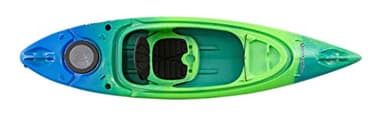
Pick 2 — The most capacity in the shortest hull
Perception Flash 9.5 Sit-Inside Kayak
A 325 lb rating in a hull under ten feet is unusual, and it is what makes this the short-boat answer for a larger paddler who still has to store it in an apartment.
What the listing publishes
113 in long, 28.5 in beam, 41 lb hull, 325 lb rated capacity
Usable at the 65 percent rule: 211 lb (range 195–227 lb), which leaves about 191 lb of paddler after a 20 lb day kit. Why 65 percent.
325 lb rated works out to about 211 lb usable at 65 percent, and roughly 191 lb of that is paddler once a paddle, PFD, water and a dry bag are subtracted. That is 30 lb more headroom than the Argo in a boat that is seven inches shorter.
Under 10 ft is the length that stops being a two-person carry and starts fitting on a balcony or standing on end in a closet. It is also the length that wanders on open water, because there is not enough waterline to hold a straight line in a crosswind.
The flat-bottom section is why the numbers work: a flatter hull carries more load for its length and feels solid at rest, at the cost of speed you were not going to use.
What it does well
- 325 lb rating is the highest of the sub-10-ft boats here
- Short enough to store somewhere a 12 ft boat will never fit
- Flat-bottom section feels settled the moment you sit down
What it costs you
- 9 ft 5 in wanders in wind -- you will correct your course constantly
- 41 lb is manageable but noticeably heavier than the Argo
- Slow. This is a hull for pottering, not for covering distance
Skip this if your water is a large lake or an open bay. Short hulls are hard work in wind, and that is a length problem no amount of technique fixes.
#ad · how this is funded · price as of October 18, 2026
Questions people actually ask
What is the 65 percent rule for kayaks?
What happens if you go over a kayak's weight limit?
Does kayak weight capacity include the paddler?
How much capacity do I need for my weight?
Is a 250 lb capacity kayak enough for a 200 lb person?
Where these numbers came from
Every figure on this page traces to one of these. Where a number could not be sourced, the page says so rather than estimating it.
- Eddyline Kayaks — Maximum weight capacity versus ideal capacity for various styles of kayaks (manufacturer, states the 60-70% ideal-capacity band)
- U.S. Coast Guard — Recreational Boaters (federal equipment requirements for vessels, paddlecraft included)
- Perception Tribe 11.5, 350 lb rated capacity — manufacturer specification as published on the Amazon listing, read 2026-09-02
Read next

What Size Kayak Do I Need?
Capacity, length and width worked out properly — including the 65 percent rule that changes which boats you should be looking at.
Top pick
Perception Tribe 11.5 Sit-on-Top Kayak
The all-round first sit-on-top
#ad · how this is funded · price as of October 18, 2026

Paddle Board Weight Limits, Explained
Rated capacity is not usable capacity. The 65 percent rule, where it comes from, and what happens when you ignore it.
Top pick
SereneLife XL Extra-Wide Inflatable Paddle Board, 35 in
A heavier paddler, or a board that carries the family
#ad · how this is funded · price as of October 18, 2026

Best for Larger Paddlers
The Best Kayaks for Bigger Paddlers
Kayaks with real capacity headroom for paddlers over 220 lb — the arithmetic done properly, not the rated number.
Top pick
Perception Rambler 13.5 Tandem Sit-on-Top Kayak
Two adults plus a child or a dog
#ad · how this is funded · price as of October 18, 2026
Best Fishing Kayak
The Best Kayaks for Fishing
Tackle is heavier than anyone plans for. The capacity, beam and deck specs that actually decide a first fishing kayak — and why the angler badge is not one of them.
Top pick
Perception Tribe 11.5 Sit-on-Top Kayak
The all-round first sit-on-top
#ad · how this is funded · price as of October 18, 2026

Best for Camping
The Best Kayaks for Camping
A camping load is 40 to 70 lb on top of your own weight. Which published capacities genuinely cover it, and where the gear actually goes.
Top pick
Perception Rambler 13.5 Tandem Sit-on-Top Kayak
Two adults plus a child or a dog
#ad · how this is funded · price as of October 18, 2026

Best First Kayak
The Best Kayaks for Beginners
Beginner kayaks ranked on width, carry weight and usable capacity — with the 65 percent arithmetic run on every one.
Top pick
Perception Tribe 11.5 Sit-on-Top Kayak
The all-round first sit-on-top
#ad · how this is funded · price as of October 18, 2026