Gear & Getting There
Pumps, Pressure and Patches
Under-inflation is the single most common reason a perfectly good inflatable board feels wrong, and the pump in the box is usually why.

We have not paddled these, and we are not going to pretend we have. Here is what we did instead. Links to Amazon earn us a commission at no extra cost to you, and commission never decides a pick — how this site is funded.
| # | Product | Best for | The spec it turns on | Price |
|---|---|---|---|---|
| 1 | 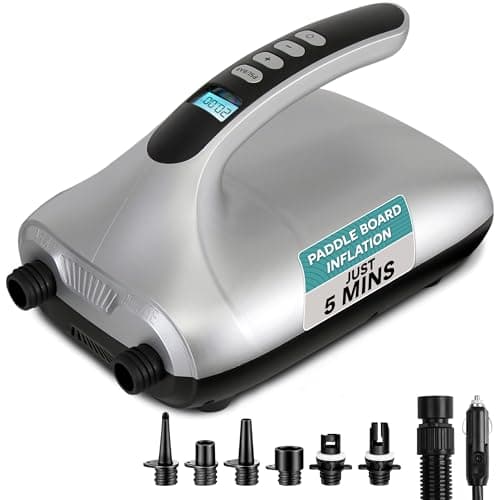 SereneLife Electric Paddle Board Pump, 20 PSI dual-stageTop pickTen minutes of pumping replaced by ten minutes of standing there. That sounds trivial until it is the reason you did not go out after work. | Anyone who launches more than twice a month | 20 PSI maximum, dual-stage, auto shut-off, 4.2 lb | |
| 2 | 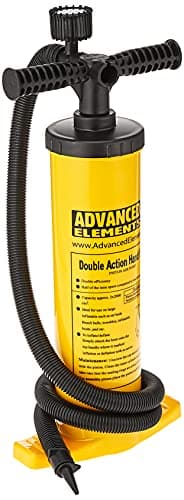 Advanced Elements Double Action Hand Pump with Pressure GaugeThe gauge is the reason to buy a hand pump rather than the cheapest one: an under-inflated board is soft in the middle and that is what beginners mistake for the board being unstable. | The backup that always works | Double action, integrated pressure gauge, 2.3 lb |
An inflatable board is rigid because of drop-stitch: thousands of threads between the top and bottom skins, holding them a fixed distance apart. That construction only does its job at pressure, and the relationship is not gentle.
A board specified at 15 PSI and inflated to 12 sags in the middle under an adult, exactly the way a cheap four-inch board does. That sag is what people describe as the board feeling tippy — and it is why the pump is not an accessory. It is part of whether the board works.
Top pick — Anyone who launches more than twice a month
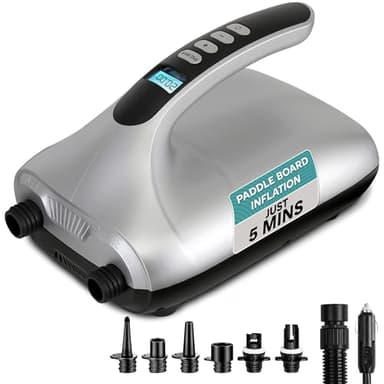
SereneLife Electric Paddle Board Pump, 20 PSI dual-stage
Ten minutes of pumping replaced by ten minutes of standing there. That sounds trivial until it is the reason you did not go out after work.
What the listing publishes
20 PSI maximum, dual-stage, auto shut-off, 4.2 lb
Dual-stage means it moves high volume at low pressure first, then switches to low volume at high pressure. A single-stage pump either takes forever or stalls before it reaches board pressure.
Auto shut-off at a set PSI is what makes it correct rather than just fast: the board reaches its specified pressure every time instead of whatever you had the arms for.
20 PSI is well past what a board needs. Set it to the pressure printed on your board, usually 12 to 15 PSI, not to the pump's maximum.
What it does well
- Auto shut-off means the board is at its specified pressure every time
- Dual-stage design actually reaches board pressure rather than stalling
- Removes the single biggest reason inflatable boards stay in the cupboard
What it costs you
- 4.2 lb of extra kit and a power source to think about
- Loud enough to be antisocial at a quiet launch
- One more thing that can fail, which is why the hand pump stays in the bag
Skip this if you launch a handful of times a summer. The hand pump that came with your board is adequate at that frequency and free.
#ad · how this is funded · price as of October 18, 2026
Pick 2 — The backup that always works
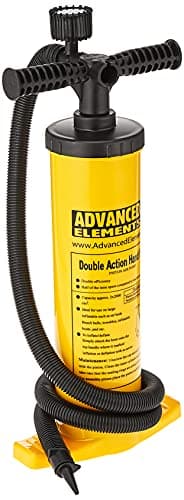
Advanced Elements Double Action Hand Pump with Pressure Gauge
The gauge is the reason to buy a hand pump rather than the cheapest one: an under-inflated board is soft in the middle and that is what beginners mistake for the board being unstable.
What the listing publishes
Double action, integrated pressure gauge, 2.3 lb
Double action means it moves air on both the push and the pull, which roughly halves the strokes. It also means the last few PSI take real effort, and most pumps let you switch to single action for exactly that reason.
The gauge matters more than the pump. Drop-stitch boards are specified at a pressure -- typically 12 to 15 PSI -- and a board two PSI under feels like a different, worse board.
2.3 lb and no battery means it works at the tenth launch of the day, in the rain, in a parking lot with no power. That is why it belongs in the bag even if you own an electric one.
What it does well
- Integrated gauge tells you when the board is actually at pressure
- Double action halves the stroke count for most of the inflation
- No battery to be flat, ever
What it costs you
- The last 3 PSI on a 6 in board is genuinely hard work
- 2.3 lb and bulky in a pack
- Slower than any electric pump, by a lot
Skip this if you have already bought an electric pump and only ever launch from a car. Keep the pump the board came with as the backup and save the money.
#ad · how this is funded · price as of October 18, 2026
The last three PSI are the whole problem
Inflating a board is easy until it is not. The first 10 PSI go quickly. The last three or four are hard work, because you are compressing air against rising back-pressure with your body weight, and they are exactly the range that determines whether the board is stiff.
That is why so many boards get paddled soft. It is not laziness — it is that the hardest part of the job is the part with the least visible payoff, and a lot of kit pumps have a gauge that is either absent or unreadable.
Hand pumps: double action, with a gauge
Double action means the pump moves air on both the push and the pull, which roughly halves the number of strokes. Almost all of them let you switch to single action for the final stage, which is the point where pushing on both directions becomes genuinely difficult.
A good hand pump has no battery, weighs a couple of pounds, works at the tenth launch of the day and in the rain, and costs very little. That is why one belongs in the bag even if you own an electric pump.
Electric pumps: the auto shut-off is the feature
People buy electric pumps for speed and keep them for the auto shut-off. You set a target pressure, connect it, and walk away — and the board reaches its specified pressure every time, rather than whatever your arms were good for.
Dual-stage is the specification that matters. A dual-stage pump moves high volume at low pressure to fill the board quickly, then switches to low volume at high pressure to reach the final figure. A single-stage pump either takes an age or stalls before it gets there.
| Hand pump | Electric pump | |
|---|---|---|
| Time to 15 PSI | 8 to 12 minutes, with effort | 4 to 6 minutes, with none |
| Reaches full pressure | If you keep going | Every time, automatically |
| Needs power | No | Yes — 12 V, USB or a battery |
| Weight | About 2.3 lb | About 4.2 lb |
| Noise | None | Loud |
| Fails when | Almost never | Battery flat, or in the rain |
Set an electric pump to the pressure printed on your board, not to the pump's maximum. A 20 PSI pump on a 15 PSI board should be set to 15.
Repair, which is simpler than people fear
Almost every inflatable ships with a patch kit and a valve wrench, and the two most common problems are neither of them serious.
- **A slow leak that turns out to be the valve.** By far the most common. The valve core works loose over a season. Tighten it with the supplied wrench, and check it before assuming the board has a hole.
- **Find a real leak with soapy water.** Inflate the board, spray or brush soapy water over the seams and rails, and look for bubbles. It is the same technique as a bicycle tire and it is reliable.
- **Patch it dry, flat and clean.** Deflate, clean the area with alcohol, apply the patch and the supplied adhesive, and weight it flat for 24 hours. Do not rush the cure.
- **Deck pad damage is cosmetic.** Scuffs and gouges in the EVA look bad and affect nothing structural.
Who does not need to buy a pump
- **Anyone launching a handful of times a summer.** The pump in the box is adequate at that frequency and costs nothing.
- **Hard-shell owners.** Obviously.
- **Anyone launching where there is no power and no way to charge.** Then the hand pump is the pump, and a good one is worth having.
Questions people actually ask
What PSI should an inflatable paddle board be?
Is an electric paddle board pump worth it?
How long does it take to pump up a paddle board by hand?
Why does my inflatable paddle board feel unstable?
How do I find a leak in an inflatable paddle board?
Do I still need a hand pump if I have an electric one?
Where these numbers came from
Every figure on this page traces to one of these. Where a number could not be sourced, the page says so rather than estimating it.
- Thurso Surf — What Size Paddle Board Is Right for You (manufacturer, states the weight-in-kg x 2 volume rule and the 32 in beginner width band)
- Electric Paddle Board Pump, 20 PSI dual-stage with auto shut-off — manufacturer specification as published on the Amazon listing, read 2026-09-02
- Advanced Elements Double Action Hand Pump with Pressure Gauge — manufacturer specification as published on the Amazon listing, read 2026-09-02
Read next
Best Inflatable
The Best Inflatable Paddle Boards
Inflatable SUPs ranked on width, thickness, capacity and packed weight, with every figure read off the listing.
Top pick
Roc Inflatable Stand Up Paddle Board, 10 ft 6 in x 33 in
The default first inflatable board
#ad · how this is funded · price as of October 18, 2026
Best Inflatable Kayak
The Best Inflatable Kayaks
Inflatable kayaks ranked on capacity and hull stiffness — including the 220 lb rating that rules out most adults.
Top pick
Intex Explorer K2 Inflatable Kayak, 2-person (oars and pump included)
Two people, no roof rack, small budget
#ad · how this is funded · price as of October 18, 2026
Where to Keep a Kayak or Paddle Board
Where to put it, how to avoid deforming the hull, and what the off-season actually requires.
Top pick
Roc Inflatable Stand Up Paddle Board, 10 ft 6 in x 33 in
The default first inflatable board
#ad · how this is funded · price as of October 18, 2026

Inflatable vs Hard Paddle Board
Hard boards are better boards. Inflatables are better first boards. Here is exactly where each one wins.
Top pick
Roc Inflatable Stand Up Paddle Board, 10 ft 6 in x 33 in
The default first inflatable board
#ad · how this is funded · price as of October 18, 2026
Gear & Getting There
Paddles, life jackets, carriers, pumps and dry bags — the two thirds of a setup that nobody researches.