Paddle Boards
Flyroc 11'6" x 35": Distance Without Giving Up Width
Long boards normally get narrow as they get long, which is what makes them hard for a beginner. This one stays at thirty-five inches, and that combination is the reason it is here.
We have not paddled these, and we are not going to pretend we have. Here is what we did instead. Links to Amazon earn us a commission at no extra cost to you, and commission never decides a pick — how this site is funded.
| # | Product | Best for | The spec it turns on | Price |
|---|---|---|---|---|
| 1 | Flyroc 11 ft 6 in x 35 in Inflatable Paddle BoardTop pickA foot more waterline than the all-around boards with no narrowing to pay for it, and the highest rated capacity of any board here bar one. The published 18 lb is the figure to treat with some caution. | Distance without giving up width | 138 x 35 x 6 in, 18 lb board weight, 450 lb rated capacity, 15 D-rings |
We have not paddled this board. What follows is what its published specification means, run through the same arithmetic we apply to everything on this site, plus a direct account of which of its claims we would not lean on.
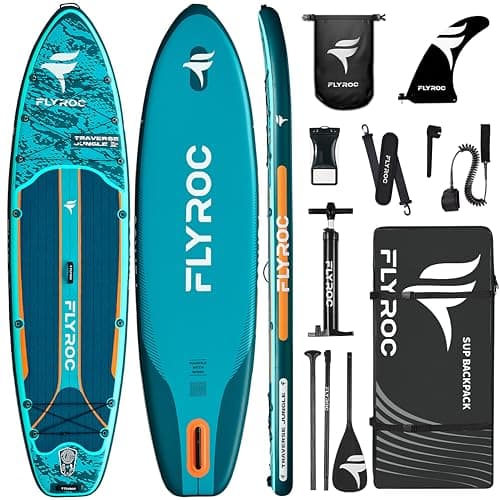
Top pick — Distance without giving up width
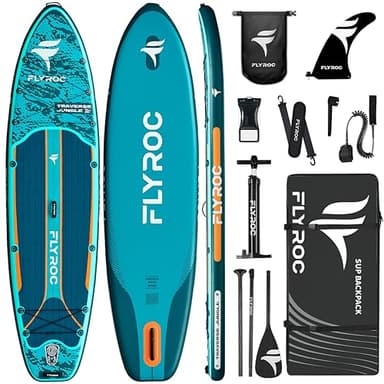
Flyroc 11 ft 6 in x 35 in Inflatable Paddle Board
A foot more waterline than the all-around boards with no narrowing to pay for it, and the highest rated capacity of any board here bar one. The published 18 lb is the figure to treat with some caution.
What the listing publishes
138 x 35 x 6 in, 18 lb board weight, 450 lb rated capacity, 15 D-rings
Usable at the 65 percent rule: 293 lb (range 270–315 lb), which leaves about 273 lb of paddler after a 20 lb day kit. Why 65 percent.
138 in of length is the reason this tracks. Every extra inch of waterline is distance covered per stroke, and the difference between a 10 ft 6 in and an 11 ft 6 in board over a mile is not subtle.
450 lb rated is about 292 lb of loaded paddler at 65 percent, which is genuine headroom rather than a marketing number. The listing's own 'up to 3 adults' framing is still optimistic — three adults is past 450 lb before anyone brings a bag.
18 lb for 138 x 35 in is light enough to be worth questioning. It is the figure the listing publishes and the only source for it, and the board's own feature text does not repeat it. Treat it as indicative rather than something to plan a long carry around.
Flyroc publish military-grade PVC with drop-stitch construction and a dual-layer sidewall, which is the right spec language for this class. What they do not publish is a maximum pressure, and pressure is what decides how stiff an inflatable actually gets.
What it does well
- 11 ft 6 in tracks straight and covers real distance
- 35 in of width means the extra length costs you no stability
- 450 lb rated, about 292 lb usable — real room for a passenger or gear
- 15 D-rings plus front and rear bungee, so a seat or a cooler both have somewhere to go
What it costs you
- 'Up to 3 adults' is not supported by 450 lb once you do the arithmetic
- The 18 lb board weight appears only in the listing's dimensions block
- No published maximum pressure, so stiffness is not a spec you can check
- 11 ft 6 in is a big object to turn on a small pond
Skip this if your water is a small pond or a tight creek. Length is only an advantage where there is room to use it, and a 10 ft 6 in board turns in half the space.
#ad · how this is funded · price as of October 9, 2026
Why length and width normally fight each other
Glide comes from waterline length and from a hull shape that slips through water rather than shoving it aside. Both of those push a designer the same way: longer and narrower. That is why touring and race boards are 12 feet and 30 inches, and why a beginner who shops on length alone often ends up on an advanced-width board.
Thirty-five inches is the other end of that scale — it is the width we point nervous first-timers at, and it is wider than the 32 inches we treat as the beginner floor. Putting it on a 138 inch hull means the tracking arrives without the balance penalty, and that is the whole argument for this board. How width and length actually trade.
| Spec | Published | What it means |
|---|---|---|
| Length | 138 in (11 ft 6 in) | A foot more waterline than an all-around board |
| Width | 35 in | Above our 32 in beginner floor, not below it |
| Thickness | 6 in | Correct adult drop-stitch thickness |
| Board weight | 18 lb | Published in the dimensions block only — see below |
| Rated capacity | 450 lb | About 292 lb usable at 65 percent |
| Construction | Military-grade PVC, drop stitch, dual-layer sidewall | The right spec language for the class |
| Maximum pressure | Not published | The spec that would tell you how stiff it gets |
| Attachment points | 15 D-rings, 6-point front and 4-point rear bungee | A seat, a cooler and a dry bag all have somewhere to go |
| Handles | Front, middle and rear | Middle handle is the one you carry it by |
450 lb is real headroom. It is not three adults
The listing says up to 3 adults, and we would not plan around that. Rated capacity is the load at which the board floats where the designer intended, not a structural limit, so we work at 65 percent of it across this site.
What 292 lb does cover, comfortably, is one adult of almost any size plus a child or a dog, or a single heavier paddler with a cooler and a tackle box. That is genuinely more headroom than most boards in this bracket publish, and it is the practical reason to choose this over a 330 lb board. Two light adults sit right at the edge of it rather than inside it.
The 18 lb figure is the one we would question
Eighteen pounds for 138 by 35 by 6 inches would make this the lightest full-size board on this site, and lighter than boards a foot shorter and three inches narrower. That is possible and it is also the kind of number that turns out to be a data-entry artifact.
The specific reason for caution: the figure appears in the listing's dimensions block and nowhere in the feature text, and the same listing's height dimension is obviously a placeholder. We have recorded 18 lb because it is what the manufacturer publishes and we do not invent figures to replace ones we dislike — but if the carry from the car is the thing deciding your purchase, treat it as indicative and do not be surprised by a couple of extra pounds. Board weight, and which listings publish it.
What the construction spec tells you, and what is missing
Flyroc publish military-grade PVC with drop-stitch construction and a dual-layer sidewall. Drop stitch is the thing that matters: thousands of threads holding the top and bottom skins at a fixed distance, which is what lets an inflatable behave like a rigid board instead of a lilo. A dual-layer sidewall is the standard durability upgrade in this class and it is what survives being dragged up a gravel launch.
The gap is pressure. No maximum PSI appears anywhere on the listing, and pressure is the single specification that determines how stiff the board actually gets under your weight — a 6 inch board at 12 PSI and the same board at 18 PSI are different objects to stand on. We cannot tell you which this is, and we are not going to guess.
Fifteen D-rings is a more useful number than it sounds
Attachment points are what let a board do more than one job. Fifteen D-rings plus a 6-point bungee at the nose and a 4-point at the tail means a dry bag at the front, a cooler at the back, and — the one worth knowing about — a kayak-style seat clipped to the center rings for when your legs have had enough or the wind gets up.
The seat is not included, and that is worth saying plainly because the listing's accessory count is high enough to make you assume everything is in the box. If seated paddling is the point, the Retrospec June ships with its seat. The fishing and sitting case.
What is in the box
- **A single-blade adjustable paddle.** The part you replace first on every package board. What a better SUP paddle changes.
- **A double-action pump**, which Flyroc say inflates the board in under ten minutes. Double-action means it moves air on both strokes, which genuinely halves the work.
- **A 1680D backpack** — a heavier denier than the 900D bags that come with cheaper boards, and the difference between a bag that survives three seasons and one that does not.
- **A large US-box fin**, a safety leash, a shoulder strap, a 5 L waterproof bag, a phone case and a maintenance wrench.
- **No life jacket, and no seat.** The first is not optional on the water. Which vest to actually wear.
Where 11 ft 6 in stops being an advantage
Length is only worth having where there is room to use it. On a small pond, a narrow creek or a crowded swimming area, a 138 inch board is a nuisance to turn and you get none of the tracking benefit because you are never going in a straight line for long.
The other cost is wind. A longer board standing proud of the water presents more side area, and a crosswind pushes it. That is a real effect and it lands hardest on a beginner who has not yet learned to kneel and keep paddling rather than fight it.
Who it suits
- **Anyone who wants to cover distance in their first season** without buying a narrow board to do it.
- **Heavier paddlers.** 292 lb of usable load is more headroom than most boards in this bracket. Boards ranked on capacity.
- **One adult plus a child or a dog**, which is the configuration the arithmetic genuinely supports.
- **Anyone who wants to clip things on.** Fifteen D-rings covers fishing, camping and a seat.
Who it does not
- **Three adults, whatever the listing says.** The number does not reach.
- **Small ponds and tight creeks.** Buy a 10 ft 6 in board and turn in half the space. The all-around picks.
- **Anyone buying primarily on the 18 lb figure.** We would not stake a long carry on a number the feature text does not repeat.
- **Anyone who needs a published pressure rating** before they trust an inflatable's stiffness. This listing does not give you one.
Questions people actually ask
What is the weight capacity of the Flyroc 11'6"?
How much does the Flyroc 11'6" weigh?
Is an 11'6" paddle board too big for a beginner?
Does a longer paddle board track better?
Can you put a seat on the Flyroc 11'6"?
What happened to the Bigfly 11'6" that used to be recommended here?
Where these numbers came from
Every figure on this page traces to one of these. Where a number could not be sourced, the page says so rather than estimating it.
- Thurso Surf — What Size Paddle Board Is Right for You (manufacturer, states the weight-in-kg x 2 volume rule and the 32 in beginner width band)
- Eddyline Kayaks — Maximum weight capacity versus ideal capacity for various styles of kayaks (manufacturer, states the 60-70% ideal-capacity band)
- Flyroc 11'6 x 35 in Inflatable Stand Up Paddle Board — manufacturer specification as published on the Amazon listing, read 2026-10-04
Read next
Best Inflatable
The Best Inflatable Paddle Boards
Inflatable SUPs ranked on width, thickness, capacity and packed weight, with every figure read off the listing.
Top pick
Roc Inflatable Stand Up Paddle Board, 10 ft 6 in x 33 in
The default first inflatable board
#ad · how this is funded · price as of October 9, 2026

Best for Heavier Paddlers
The Best Paddle Boards for Heavier Paddlers
Rated capacity divided by 0.65 is the number that fits you, and it rules out most beginner boards above about 215 lb. The boards with genuine headroom, ranked.
Top pick
SereneLife XL Extra-Wide Inflatable Paddle Board, 35 in
A heavier paddler, or a board that carries the family
#ad · how this is funded · price as of October 9, 2026
Lightest to Carry
The Lightest Paddle Boards, and What a Board Really Weighs
Published board weights run 12.2 to 24.5 lb across the boards we cover — and three of seven publish nothing at all. The lightest boards, and what light costs you.
Top pick
FEATH-R-LITE Inflatable Stand Up Paddle Board, 10 ft 6 in x 31.5 in
The lightest board to carry to the water
#ad · how this is funded · price as of October 9, 2026
Bigfly 11'6" Paddle Board: Distance Without the Wobble
138 x 35 x 6 in at 19.8 lb — a foot more waterline than an all-around board with none of the usual narrowing.

What Size Paddle Board Do I Need?
A volume and width calculator that shows its working, and ends in an actual board rather than a chart.
Top pick
Roc Inflatable Stand Up Paddle Board, 10 ft 6 in x 33 in
The default first inflatable board
#ad · how this is funded · price as of October 9, 2026

Paddle Board Weight Limits, Explained
Rated capacity is not usable capacity. The 65 percent rule, where it comes from, and what happens when you ignore it.
Top pick
SereneLife XL Extra-Wide Inflatable Paddle Board, 35 in
A heavier paddler, or a board that carries the family
#ad · how this is funded · price as of October 9, 2026