Paddle Boards
Can You Use a Paddle Board Like a Kayak?
Yes, and it takes exactly two parts: a seat that clips to the deck D-rings and a paddle that converts to two blades. The Pelican sit-on-top or SUP seat is the one that fits both craft.
We have not paddled these, and we are not going to pretend we have. Here is what we did instead. Links to Amazon earn us a commission at no extra cost to you, and commission never decides a pick — how this site is funded.
| # | Product | Best for | The spec it turns on | Price |
|---|---|---|---|---|
| 1 | 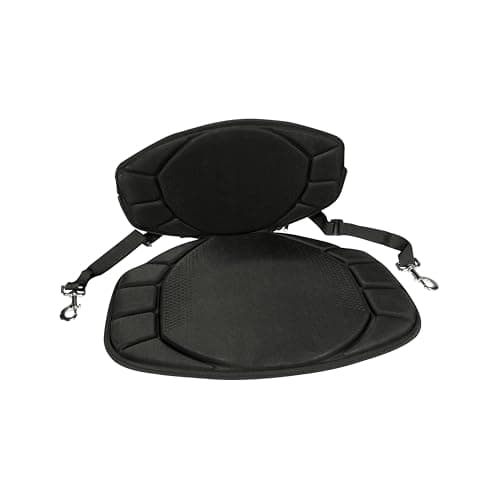 Pelican Sit-on-Top Kayak or SUP SeatTop pickThe widest, deepest seat bottom here and the one that also works on a paddle board. The back is low, so buy it for the base rather than for lumbar support. | A Pelican or Lifetime sit-on-top, or a paddle board | Back 15 in wide x 8 in tall, bottom 17.5 x 14 in, straps to 28 in front and 21 in rear, water-repellent nylon | |
| 2 | 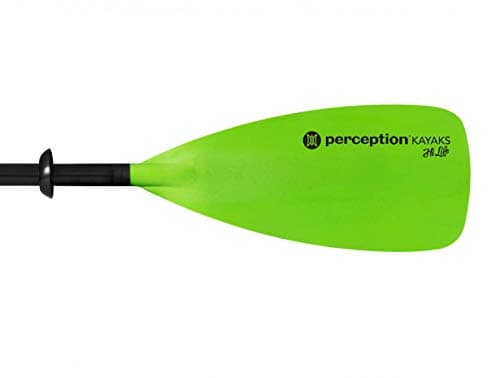 Perception Hi-Life Convertible SUP/Kayak Paddle, 3-PieceThe honest answer to using one paddle on both craft: a third section that turns a two-bladed kayak paddle into a single-bladed stand-up paddle. Nothing else on this site does both jobs without being wrong for one of them. | Owning one paddle for a board and a boat | 3-piece, anodized aluminum shaft, fiberglass-reinforced polypropylene blades, 3.8 lb; Perception publishes an adjustment range of 215 to 230 cm for the kayak configuration | |
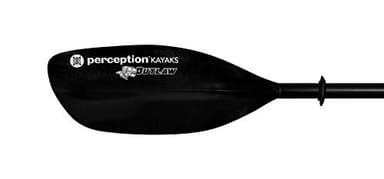
| 3 | 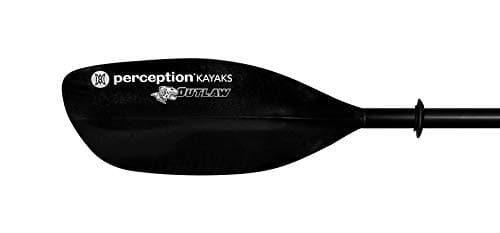 Perception Outlaw 3-Piece SUP/Kayak Convertible Paddle, 90.5 inThe same convertible idea at a longer published length. 90.5 in is 230 cm, the top of the recreational kayak range, which is the length a wide boat or a wide board actually needs. | A longer convertible, for a wide board or a wide boat | 3-piece, 90.5 in, nylon blade, aluminum shaft, SUP-kayak convertible | |
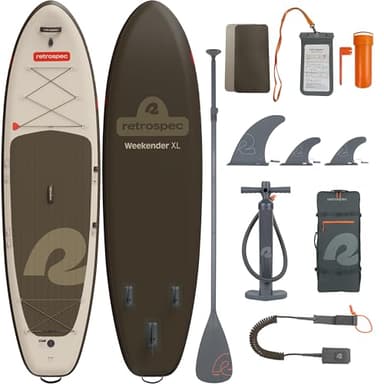
| 4 | 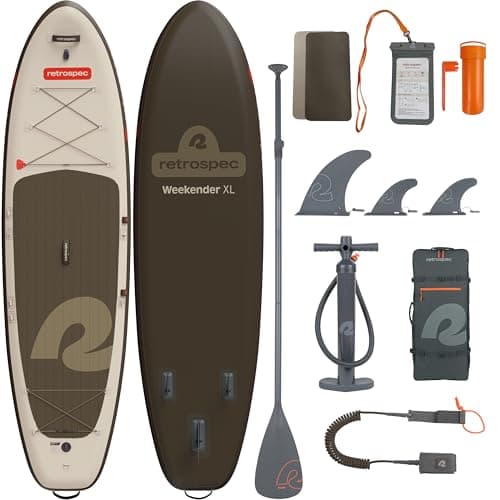 Retrospec Weekender XL Inflatable Paddle Board, 11 ftEight inches of drop-stitch instead of the usual six, which is where the stiffness to carry two people comes from. 400 lb recommended is the highest limit here that still belongs to a board one person can carry. | Two adults who want one board, not a raft | 11 ft x 35 in x 8 in inflated, 31 lb with fins, 400 lb recommended weight limit, 3 removable tracking fins, 12-15 PSI, 11 D-rings | |
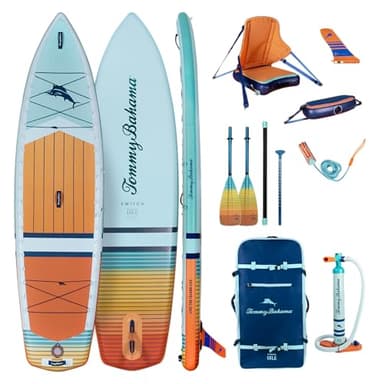
| 5 | 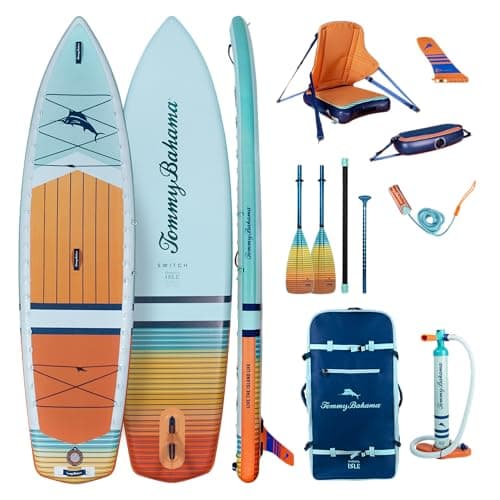 ISLE & Tommy Bahama Switch Inflatable Hybrid Kayak-SUP, 11 ft 6 inThe purpose-built version of the thing people improvise with a clip-on seat: a board designed from the start to be paddled standing or sitting, with the seat and a convertible paddle in the box. It costs several times what the improvised version does. | Someone who genuinely wants both, and will pay for it | 11.6 x 35.5 x 6 in inflated, 425 lb maximum; ships as a 2-in-1 bundle with seat, paddle, pump and travel bag |
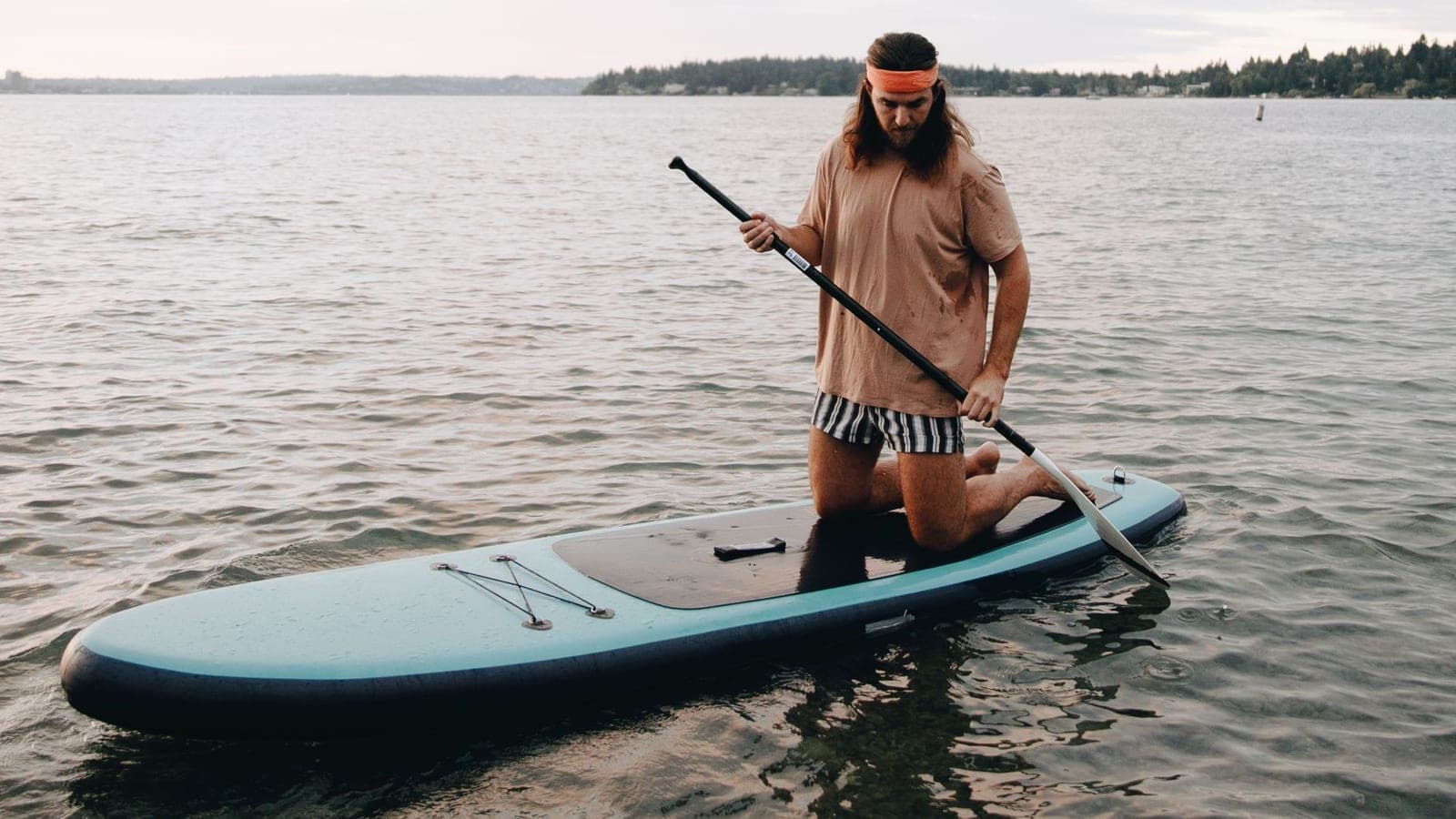
Two different questions hide inside this one. Can you sit down on a paddle board and paddle it? Yes, trivially — people kneel and sit on boards all the time. Can you use a paddle board the way you would use a kayak, for an hour, with a back to lean on and a stroke that gets you somewhere? That needs two specific parts, and it is the question this page answers.
Why anyone wants this
- **Standing gets tiring, and wind makes it worse.** On a board you are the sail. Sitting down removes most of your windage and most of the balance work at the same time.
- **One craft instead of two.** A board in a backpack that converts to a sit-down boat is the whole answer for someone with a hatchback and a closet.
- **Fishing and photography.** Both are hands-off-the-paddle activities, and both are far easier sitting.
- **Taking someone who will not stand.** A nervous passenger, an older parent, a child. Seated is the version they will agree to.
- **Covering distance.** A two-bladed stroke from a seated position is more efficient than a single blade from standing, over an hour.
Part one: the seat, and the D-rings it needs
A clip-on kayak seat is four straps and a padded back. It needs four anchor points on the deck in roughly the right places — two beside your hips for the seat base and two behind for the backrest tension — and that is the specification to check on your board before you buy anything.
Most beginner inflatable boards have between four and sixteen D-rings. The Retrospec Weekender XL publishes eleven: six front cargo, four rear cargo, one tail for the leash. That rear group of four is what a seat clips to. A board with only a single bungee patch at the nose and nothing at the tail cannot take a seat at all, and no amount of strap length fixes it.
The seat we would buy for this is the one that was designed to do both jobs rather than the best kayak seat on the market. The full kayak seat ranking orders the category on back height and hull fit, and most of what wins there is a tall-back seat for a hard deck — too tall and too heavy to perch on an inflatable.
Part two: the paddle, which is the part people get wrong
Here is the non-obvious bit. Your SUP paddle will not work seated, and your kayak paddle will not work standing, and the reason is a length relationship that sounds backwards until you work it through.
So the answer is a convertible: a three-piece paddle with a spare section that turns a two-bladed kayak paddle into a single-bladed stand-up paddle. Perception publishes a 215 to 230 cm adjustment range for the Hi-Life in its kayak configuration, which is the standard recreational band. It is 3.8 lb, which is heavy, and that weight is the price of the mechanism.
| Paddle | Standing on a board | Seated, two-bladed |
|---|---|---|
| Your existing SUP paddle | Yes — it is the right tool | No — single blade, wrong angle, you will switch sides constantly |
| Your existing kayak paddle | No — both blades clear the water | Yes, in a kayak seat at kayak height |
| Perception Hi-Life, 3-piece convertible | Yes | Yes, 215 to 230 cm |
| Perception Outlaw, 90.5 in convertible | Yes | Yes, at the long end of the range |
Top pick — A Pelican or Lifetime sit-on-top, or a paddle board
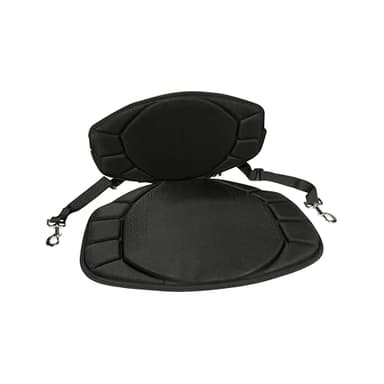
Pelican Sit-on-Top Kayak or SUP Seat
The widest, deepest seat bottom here and the one that also works on a paddle board. The back is low, so buy it for the base rather than for lumbar support.
What the listing publishes
Back 15 in wide x 8 in tall, bottom 17.5 x 14 in, straps to 28 in front and 21 in rear, water-repellent nylon
A 17.5 by 14 inch base is the most seat under you of anything on this page, which matters more than back height on a flat sit-on-top deck or a board.
The 8 inch back is lumbar support only. If mid-back fatigue is your complaint, this is the wrong seat and a taller back is the fix.
It clips to D-rings, and the listing says plainly that some boats need Pelican's separate mounting kit. Check your deck has four attachment points before ordering.
What it does well
- 17.5 x 14 in base is the largest seat bottom here
- Works on paddle boards as well as sit-on-top kayaks
- Long straps (28 in front, 21 in rear) reach most deck layouts
What it costs you
- 8 in back offers lumbar support only
- May need a separate mounting kit if your deck lacks D-rings
- Nylon and padding need drying after every trip
Skip this if your back rather than your seat bones is what hurts. An 8 inch backrest does not reach where mid-back fatigue lives; the BKC or the Surf to Summit does.
#ad · how this is funded · price as of October 18, 2026
Pick 2 — Owning one paddle for a board and a boat
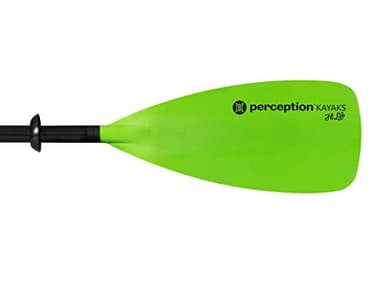
Perception Hi-Life Convertible SUP/Kayak Paddle, 3-Piece
The honest answer to using one paddle on both craft: a third section that turns a two-bladed kayak paddle into a single-bladed stand-up paddle. Nothing else on this site does both jobs without being wrong for one of them.
What the listing publishes
3-piece, anodized aluminum shaft, fiberglass-reinforced polypropylene blades, 3.8 lb; Perception publishes an adjustment range of 215 to 230 cm for the kayak configuration
This is a real mechanical fix rather than a marketing claim. A kayak paddle and a SUP paddle are not the same length problem — you hold a kayak paddle in the middle and a SUP paddle at the top — so a paddle that does both has to change its total length, and the third section is how.
Perception publishes 215 to 230 cm for the kayak configuration, which is the standard recreational range and covers most adults in a 29 to 34 in boat. Note the maker's own page prints '74-80 in' beside that range, and 215 cm is 84.6 in, so the two figures on the page do not convert to each other. We have quoted both rather than quietly picking one.
3.8 lb is heavy for a paddle. Aluminum and reinforced polypropylene is the durable, inexpensive end of the market, and a convertible has more hardware than a plain paddle, so some of that weight is the mechanism.
A push-button ferrule sets the length. That is quick, and it is also the part that wears, loosens and rattles over seasons of saltwater use.
What it does well
- Genuinely converts between a two-bladed kayak paddle and a single-bladed SUP paddle
- 215 to 230 cm covers the normal recreational kayak range
- Nylon-class blades that survive gravel launches and dock edges
- One paddle to store, carry and pay for instead of two
What it costs you
- 3.8 lb, noticeably heavier than a dedicated paddle in either mode
- The maker's own published length figures are internally inconsistent
- Push-button ferrules are the first thing to loosen and rattle
- Costs more than a decent dedicated paddle for whichever craft you use most
Skip this if you only own one of the two craft, or you already own a kayak paddle. A dedicated paddle of either kind is lighter and stiffer at this price, and the conversion is only worth paying for if you will actually use both modes.
#ad · how this is funded · price as of October 18, 2026
Pick 3 — A longer convertible, for a wide board or a wide boat
Perception Outlaw 3-Piece SUP/Kayak Convertible Paddle, 90.5 in
The same convertible idea at a longer published length. 90.5 in is 230 cm, the top of the recreational kayak range, which is the length a wide boat or a wide board actually needs.
What the listing publishes
3-piece, 90.5 in, nylon blade, aluminum shaft, SUP-kayak convertible
90.5 in is 230 cm. Paddle length scales with how far your hands are from the water, and the two things that push that up are a wide hull and a raised seat — both of which describe the 30 to 35 in sit-on-tops and inflatable boards this site recommends most.
Where the Hi-Life adjusts, this publishes one length. A fixed length is stiffer and has one less thing to loosen; it also means you have to be the paddler it fits.
Nylon blade on an aluminum shaft, the same durable and unexciting combination as the rest of the sub-$200 market. Nothing here is light.
The listing does not publish a weight. Assume it is in the same 3 to 4 lb band as every other aluminum-shafted three-piece, because that is what the construction costs.
What it does well
- 90.5 in / 230 cm, the right length for a wide hull or a raised seat
- Fixed length, so nothing slips mid-stroke
- Nylon blade survives launches that chip composite
- Converts between kayak and SUP configurations
What it costs you
- No published weight on the listing
- One length only — too long for a narrow boat or a short paddler
- Costs more than the adjustable Hi-Life
- Aluminum shaft, so it is cold to hold and flexes under a hard stroke
Skip this if your boat is under 29 in wide or you are under about 5 ft 6 in. 230 cm is the long end of the range and an over-long paddle makes every stroke heavier for no gain.
#ad · how this is funded · price as of October 18, 2026
Pick 4 — Two adults who want one board, not a raft
Retrospec Weekender XL Inflatable Paddle Board, 11 ft
Eight inches of drop-stitch instead of the usual six, which is where the stiffness to carry two people comes from. 400 lb recommended is the highest limit here that still belongs to a board one person can carry.
What the listing publishes
11 ft x 35 in x 8 in inflated, 31 lb with fins, 400 lb recommended weight limit, 3 removable tracking fins, 12-15 PSI, 11 D-rings
Usable at the 65 percent rule: 260 lb (range 240–280 lb), which leaves about 240 lb of paddler after a 20 lb day kit. Why 65 percent.
Thickness is the spec doing the work. Retrospec publishes 8 in against the 6 in that almost every board on this site uses, and a thicker drop-stitch core resists the middle-sagging that puts a second person's weight into the water rather than on top of it.
400 lb is Retrospec's recommended weight limit rather than a flotation maximum, which is a more useful number than most published ratings — but it still covers two adults only if they are two fairly light adults. Two 170 lb paddlers plus a paddle each is 355 lb before anything else goes aboard.
11 D-rings — six front cargo, four rear cargo, one tail for the leash — is what makes it usable as a seated craft too. A clip-on kayak seat needs four anchor points in roughly the right places, and this deck has them.
31 lb with fins is heavier than a 10 ft 6 in board and lighter than the multi-person boards. It is the weight at which one adult can still get it from the car to the water alone.
What it does well
- 8 in thick, so it sags far less than a 6 in board under two people
- 400 lb recommended limit, the highest here for a single-carry board
- 11 D-rings, enough to clip a seat on and still carry gear
- Ships with paddle, pump, waterproof phone case and repair kit in a backpack
What it costs you
- 31 lb is a real carry once the backpack is loaded
- 35 in wide is slow — this is a stable platform, not a quick board
- Only one paddle in the box, so a second paddler costs extra
- 8 in thickness puts you higher off the water, which feels less settled when you first stand
Skip this if you will paddle alone and standing. A 32 in, 6 in board is lighter, faster and cheaper, and the extra thickness here buys you nothing on your own.
#ad · how this is funded · price as of October 18, 2026
Pick 5 — Someone who genuinely wants both, and will pay for it
ISLE & Tommy Bahama Switch Inflatable Hybrid Kayak-SUP, 11 ft 6 in
The purpose-built version of the thing people improvise with a clip-on seat: a board designed from the start to be paddled standing or sitting, with the seat and a convertible paddle in the box. It costs several times what the improvised version does.
What the listing publishes
11.6 x 35.5 x 6 in inflated, 425 lb maximum; ships as a 2-in-1 bundle with seat, paddle, pump and travel bag
Usable at the 65 percent rule: 276 lb (range 255–298 lb), which leaves about 256 lb of paddler after a 20 lb day kit. Why 65 percent.
35.5 in of width and a published 425 lb maximum put it in the same stability class as the widest boards on this site, which is what a craft has to be if you are going to sit low in it and paddle with a two-bladed stroke.
The reason to pay for this rather than clip a seat onto an ordinary board is the seat mounting: a hybrid is built with the anchor points and the deck geometry for a seat, so the seat does not creep and the trim does not go bow-high when you sit down behind the center.
It arrives as a bundle — seat, paddle, pump, travel bag — so the price is not directly comparable to a bare board. It is comparable to a board plus a seat plus a convertible paddle, which is the honest way to read it.
At this price it is also competing with buying a cheap board and a cheap kayak separately, and for a lot of households that is the better answer. The hybrid wins only when storage or car space means you can own exactly one craft.
What it does well
- Designed as a two-mode craft, so the seated mode is not an improvisation
- 35.5 in wide and 425 lb rated, stable enough for either mode
- Seat, paddle, pump and bag included
- One craft to store and carry instead of two
What it costs you
- Several times the price of a board plus a clip-on seat
- 6 in thick rather than 8, so it is softer underfoot at high load than the thickest boards here
- No published board weight on the listing
- Paying for two modes you may only ever use one of
Skip this if you have room for two craft. A separate board and a separate kayak each do their own job better, and together they usually cost less than this.
#ad · how this is funded · price as of October 18, 2026
What you give up, without softening it
A converted board is a real craft and it is not a kayak. Three differences are permanent and worth knowing before you spend.
- **You are wet from the waist down.** A board has no cockpit and no freeboard. Sitting on a flat deck an inch above the water means water runs under you continuously. A sit-inside kayak keeps your legs dry; a converted board does not even try.
- **It is slower than a kayak of the same length.** A board is wide and flat with a blunt entry. An 11 ft board and an 11 ft kayak are not the same boat, and over a mile you will feel the whole difference.
- **The back angle is a compromise.** A kayak seat is molded into a hull at a designed angle. A clip-on seat on a flat deck sits you more upright than you want, and tightening the straps to fix that pulls the seat forward instead.
- **Trim goes bow-high if you sit too far back.** Your weight in one place rather than spread across two feet lifts the nose, and a lifted nose catches wind. Sit at or slightly behind the center of the deck pad, not at the tail.
- **The seat is one more thing to carry, rig and lose.** Rigging it takes a couple of minutes at each end of every trip.
The purpose-built alternative, and when it is worth it
A hybrid kayak-SUP is a board designed from the start to do both, with the seat anchor points and the deck geometry built in rather than clipped on. The ISLE and Tommy Bahama Switch publishes 11.6 by 35.5 by 6 in and a 425 lb maximum, and ships with the seat, a paddle, a pump and a bag.
It also costs several times what a board plus a seat plus a convertible paddle costs, and the honest comparison at that money is not against a converted board — it is against owning a cheap board and a cheap kayak separately, which does both jobs better. The hybrid wins in exactly one case: when you can only store and carry one craft and you genuinely want both modes.
| Route | What you get | The catch |
|---|---|---|
| Seat clipped to the board you own | Two modes for the price of a seat | Needs four rear D-rings; the seat creeps; you are wet |
| Board chosen for it, plus seat and convertible paddle | A deck with the D-rings and a paddle that does both | Three purchases, and the paddle is heavy |
| Purpose-built hybrid | Designed seat mounting, nothing improvised | Several times the price; beaten by a board and a kayak if you have room for both |
Rigging it so it actually works
- **Inflate the board to its full rated pressure.** Retrospec publishes 12 to 15 PSI for the Weekender XL. A soft board sags under a seated load far more than under a standing one, because all your weight is in one spot.
- **Clip the seat base to the two D-rings beside where you will sit**, then run the backrest straps to the two behind and tension them last.
- **Sit down on dry land and lean back.** If the seat slides forward, the rear straps are too loose or the anchor points are too far back for your weight.
- **Set the paddle to its kayak length before you launch**, not while afloat. A push-button ferrule is easy on the beach and awkward on the water.
- **Keep the leash on.** A board you fall off is a board that leaves without you, and sitting down does not change that. The leashes we would buy.
What you can ignore
- **Footrests and bracing.** A board has nowhere to brace and you do not need to. Seated SUP paddling is a leisurely stroke, not a torso-driven kayak stroke.
- **Removing the fin.** It stays. The fin is what stops you weathercocking, and seated you have less control over direction, not more.
- **'Kayak conversion kit' as a product category.** Most of what is sold under that name is a seat and two straps. Buy the seat.
- **Gel cushions.** They are a sit-inside kayak fix for a molded seat pan. On a flat inflatable deck a strapped seat with a back is the thing that helps.
If what you really want is to sit down and cover distance in comfort, read the board-or-kayak comparison before spending anything. For a lot of people the honest answer is that they wanted a kayak.
Questions people actually ask
Can you sit down on a paddle board and paddle it?
Will a kayak seat fit a paddle board?
Can you use a kayak paddle on a paddle board?
Is a converted paddle board as good as a kayak?
What pressure should the board be at if I am sitting on it?
Is a hybrid kayak-SUP worth buying instead?
Should I take the fin out when sitting down?
Where these numbers came from
Every figure on this page traces to one of these. Where a number could not be sourced, the page says so rather than estimating it.
- Confluence Outdoor / Perception — Hi Life convertible SUP/kayak paddle (manufacturer: three-piece, anodized aluminum shaft, fiberglass-reinforced polypropylene blade, 3.8 lb, published kayak adjustment 215 to 230 cm), read 2026-10-17
- Retrospec — Weekender XL 11 ft inflatable paddle board (manufacturer specification table: 11 ft x 35 in x 8 in inflated, 31 lb with fins, 400 lb recommended weight limit, 3 removable tracking fins, 12-15 PSI, 11 D-rings), read 2026-10-17
- NIXY Sports — What Size SUP Paddle Do I Need (manufacturer, the height-plus-8-to-10-inches rule)
- NRS — Kayak Paddle Sizing Guides (manufacturer, publishes the low-angle and high-angle length charts our formula is fitted to)
- Pelican Sit-on-Top Kayak or SUP Seat — manufacturer specification as published on the Amazon listing, read 2026-09-02
- Perception Hi-Life Convertible SUP/Kayak Paddle — manufacturer specification as published on the Amazon listing, read 2026-10-17
- Perception Outlaw 3-Piece SUP/Kayak Convertible Paddle, 90.5 in — manufacturer specification as published on the Amazon listing, read 2026-10-17
- Retrospec Weekender XL Inflatable Paddle Board — manufacturer specification as published on the Amazon listing, read 2026-10-17
- ISLE & Tommy Bahama Switch Inflatable Hybrid Kayak-SUP — manufacturer specification as published on the Amazon listing, read 2026-10-17
Read next

Best Seat Upgrade
The Best Kayak Seat Upgrades
The seat is the weakest part of a budget kayak and the cheapest to fix. Which kind fits your hull, what back height actually helps, and five honest picks.
Top pick
BKC UH-PS223 Memory Foam Kayak Seat
A tall back on a sit-on-top, for the least money
#ad · how this is funded · price as of October 18, 2026

Paddle Board or Kayak?
The honest board-versus-boat comparison, from a site that earns identically either way.
Top pick
Roc Inflatable Stand Up Paddle Board, 10 ft 6 in x 33 in
The default first inflatable board
#ad · how this is funded · price as of October 18, 2026

What Length Paddle Do You Need?
A paddle length calculator fitted to a manufacturer's published chart, with the derivation shown.
Top pick
Bending Branches Whisper Kayak Paddle, 230 cm
The first paddle worth keeping
#ad · how this is funded · price as of October 18, 2026
Best for Fishing
The Best Paddle Boards for Fishing
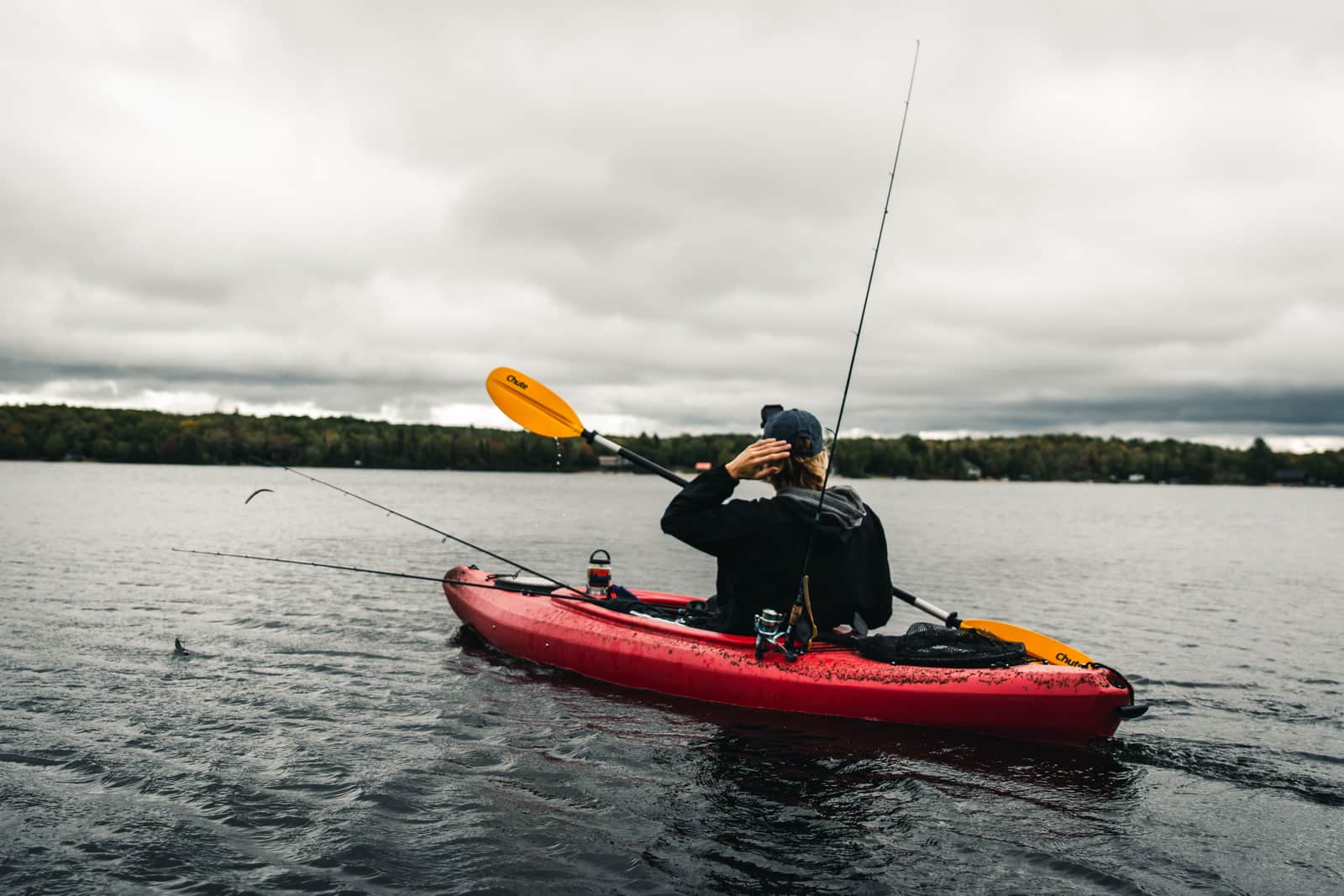
Fishing boards need width, capacity for tackle, and a seat. Here is what actually changes versus a normal board.
Top pick
Retrospec June Inflatable Fishing Paddle Board, 11 ft 6 in
Fishing, or paddling seated
#ad · how this is funded · price as of October 18, 2026

Best SUP Paddle
The Best SUP Paddles for a First Board
The kit paddle is the first upgrade on any board. Length by the height-plus-nine rule, weight that compounds a thousand strokes an hour, and two honest picks.
Top pick
OCEANBROAD Adjustable SUP Paddle, aluminum shaft
Replacing the paddle that came in the box
#ad · how this is funded · price as of October 18, 2026
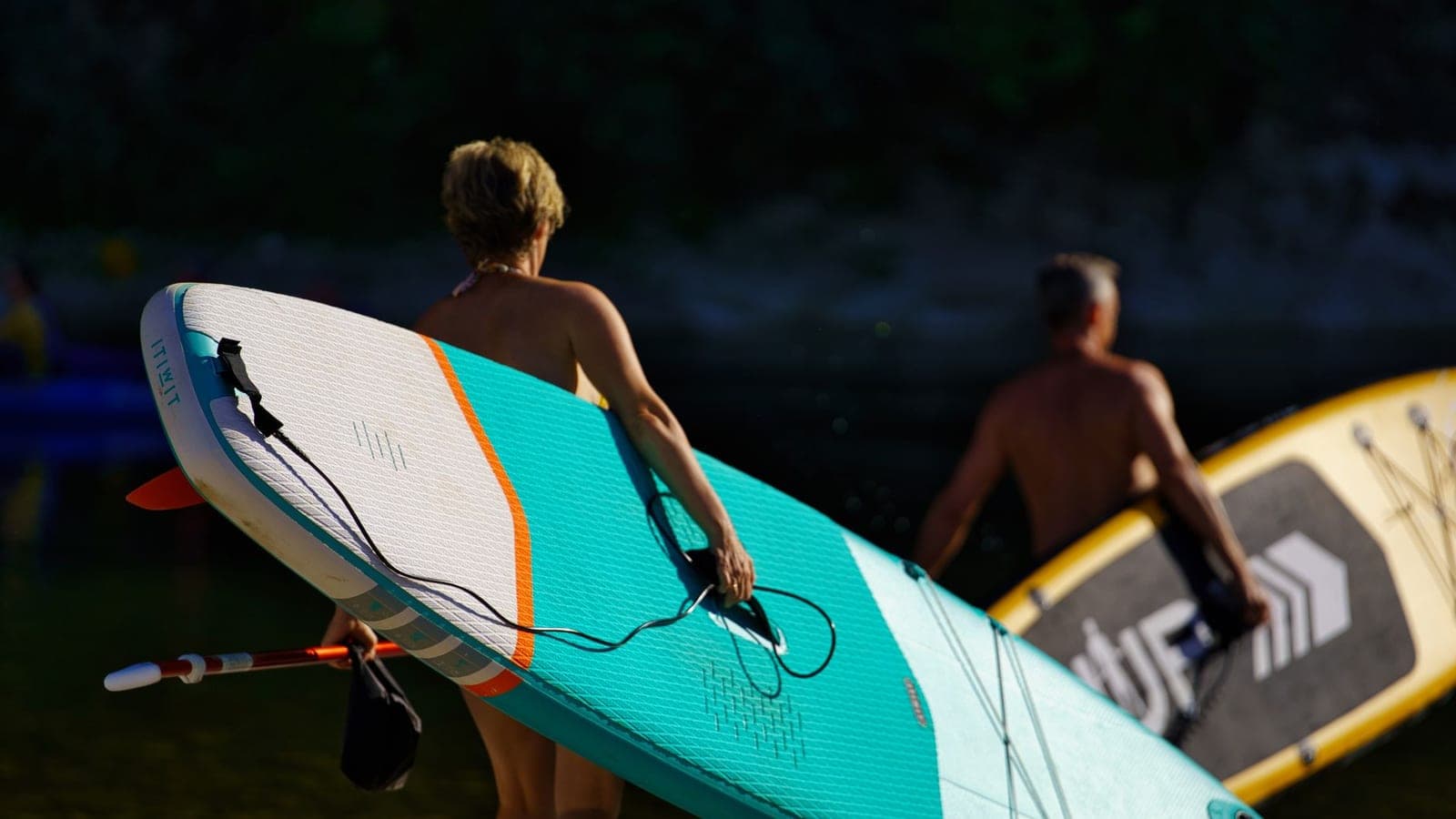
Can Two People Ride One Paddle Board?
Two adults need about 400 lb rated and 35 in of width. Why most beginner boards cannot do it, and the three that can.
Top pick
Retrospec Weekender XL Inflatable Paddle Board, 11 ft
Two adults who want one board, not a raft
#ad · how this is funded · price as of October 18, 2026