Choosing Your First
Should You Rent or Buy Your First Kayak?
The honest answer is arithmetic, and it turns on one question almost nobody asks first: how many times will you actually go this year?
We have not paddled these, and we are not going to pretend we have. Here is what we did instead. Links to Amazon earn us a commission at no extra cost to you, and commission never decides a pick — how this site is funded.
| # | Product | Best for | The spec it turns on | Price |
|---|---|---|---|---|
| 1 | 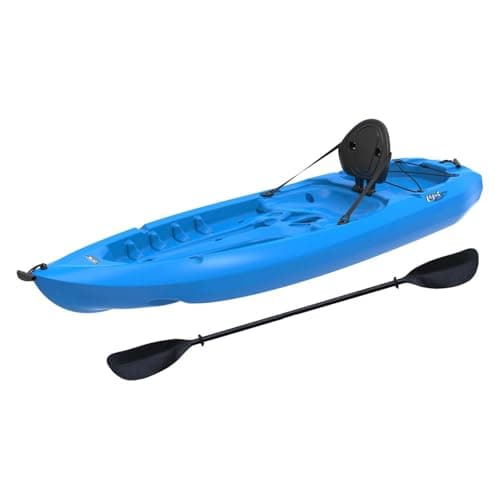 Lifetime Lotus Sit-on-Top Kayak, 8 ft (paddle included)Top pickEight feet, thirty inches wide, a paddle in the box. It is not a good boat and it is an honest one -- this is a pond and a cabin dock, not a lake crossing. | The cheapest complete way onto flat water | 96 in long, 30 in beam, 39 lb hull, 250 lb rated capacity, paddle included | |
| 2 | 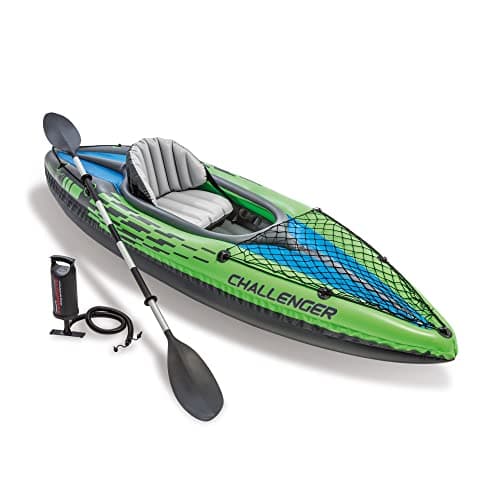 Intex Challenger K1 Inflatable Kayak (paddle and pump included)The honest answer to 'I have an apartment and a sedan'. It is a real boat on flat water and it is not a hard-shell substitute, and it is worth being clear about which of those you are buying. | No car rack, no garage, no storage | 108 in long, 30 in beam, 26 lb packed, 220 lb rated capacity, paddle and pump in the box | |
| 3 | 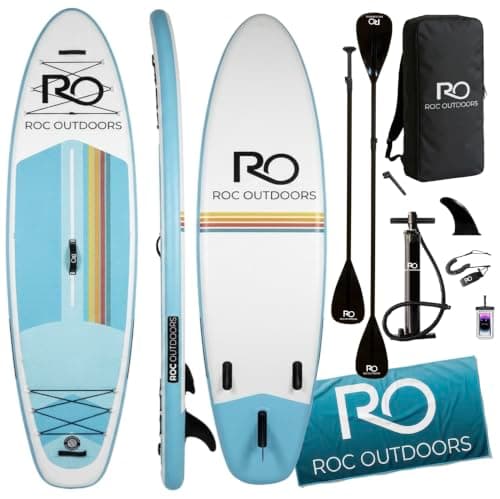 Roc Inflatable Stand Up Paddle Board, 10 ft 6 in x 33 in10 ft 6 in by 33 in is the shape the whole beginner category converged on, and this is the cheapest version of it that publishes a 350 lb rating. | The default first inflatable board | 126 x 33 x 6 in, 350 lb rated capacity, PVC drop-stitch, full accessory kit |
This is the first real decision, it comes before hull shape and sizing, and it is usually made backwards — people buy because a boat was on sale, or rent for three summers because buying felt like a commitment. Both are decidable in about five minutes.
The break-even, run properly
The comparison people run is rental fee against sticker price, and it is wrong in both directions. Buying has costs beyond the boat, and renting has costs beyond the fee.
Total cost of owning a first setup is the hull plus a paddle plus a life jacket, and for a hard-shell it is also whatever gets the boat to the water. That last item is the one people forget and it is not small — foam blocks and straps for a car with no roof bars, or a rack, or a cart for the walk from the parking lot.
- **Renting also has hidden costs.** The drive to a specific outfitter rather than the nearest water, their hours, their season, and the fact that popular days need booking ahead.
- **Renting has a real hidden benefit.** It includes the boat getting to the water, which for a hard-shell owner is a rack, straps and a lift every single time.
- **Owning has a hidden benefit that dominates everything else.** You go more often, because the decision to paddle stops being a booking and starts being a whim.
When renting is genuinely the right answer
Three cases, and they are common enough that we would rather say so than sell a boat to someone who should not buy one yet.
- **You have never done it.** One rental afternoon tells you whether you like being on the water more reliably than any amount of research. It is the cheapest possible test of the entire hypothesis.
- **You genuinely do not know what you want.** Renting a sit-on-top one weekend and a sit-inside the next answers the sit-on-top versus sit-inside question from your own experience rather than from our table.
- **Storage or transport has no answer yet.** If there is no realistic place to keep a 10 ft hull and no way to move it, buying a hard-shell creates a problem that outlives the enthusiasm. Rent while you solve it — or buy an inflatable, which is the same solution in a different shape.
When buying wins earlier than the math suggests
The break-even calculation assumes the number of outings is fixed, and it is not. It is the thing most affected by which choice you make.
A rented kayak requires a plan: check hours, drive to the outfitter, hope for availability, return by a deadline. An owned kayak requires noticing it is a nice evening. Most people who buy paddle several times more often than they projected, and most people who rent paddle less. That effect is larger than the price difference and it is the strongest argument for owning if you already know you enjoy it.
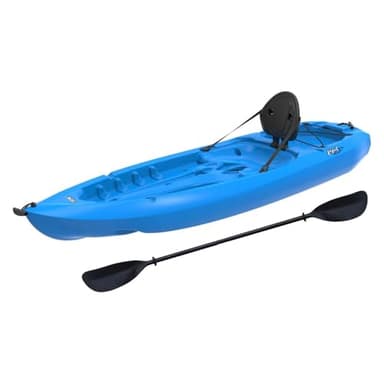
Top pick — The cheapest complete way onto flat water
Lifetime Lotus Sit-on-Top Kayak, 8 ft (paddle included)
Eight feet, thirty inches wide, a paddle in the box. It is not a good boat and it is an honest one -- this is a pond and a cabin dock, not a lake crossing.
What the listing publishes
96 in long, 30 in beam, 39 lb hull, 250 lb rated capacity, paddle included
Usable at the 65 percent rule: 163 lb (range 150–175 lb), which leaves about 143 lb of paddler after a 20 lb day kit. Why 65 percent.
250 lb rated is about 163 lb usable at 65 percent and 143 lb of paddler after gear. Read that number twice before you buy: a 180 lb adult is over it before they pick up the paddle.
The included paddle is the reason this is the cheapest genuine way onto the water, and it is also a paddle you will replace. Budget for that in year two, not year one.
Eight feet with a 30 in beam is very stable at rest and effectively unsteerable in wind. On a pond that is fine. On anything with fetch it is not.
What it does well
- Cheapest complete package here -- hull and paddle in one box
- 30 in beam on an 8 ft hull is extremely stable sitting still
- 39 lb and 8 ft: one person, one trip, fits in a lot of car interiors
What it costs you
- 250 lb rating means about 143 lb of paddler once gear is subtracted
- 8 ft is slow and blows around in any real wind
- The included paddle is a starter part, not a keeper
Skip this if you weigh more than about 145 lb dressed and carrying gear, or your water is anything larger than a small pond. Both are hard limits here, not preferences.
#ad · how this is funded · price as of October 9, 2026
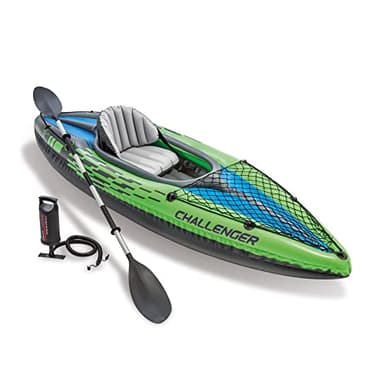
Pick 2 — No car rack, no garage, no storage
Intex Challenger K1 Inflatable Kayak (paddle and pump included)
The honest answer to 'I have an apartment and a sedan'. It is a real boat on flat water and it is not a hard-shell substitute, and it is worth being clear about which of those you are buying.
What the listing publishes
108 in long, 30 in beam, 26 lb packed, 220 lb rated capacity, paddle and pump in the box
Usable at the 65 percent rule: 143 lb (range 132–154 lb), which leaves about 123 lb of paddler after a 20 lb day kit. Why 65 percent.
220 lb rated is about 143 lb usable at 65 percent and roughly 123 lb of paddler once a PFD, paddle and water are subtracted. That is the single most important number on this listing and it rules out most adult men.
26 lb packed into a bag is what you are actually paying for. No roof bars, no straps, no cart, no garage wall -- the entire transport problem this site spends a page on simply does not exist.
Vinyl over a drop-stitch floor is not the same construction as a drop-stitch inflatable board. Expect fifteen minutes of setup, expect it to be soft, and do not expect it to hold a line in wind.
What it does well
- 26 lb in a bag removes the roof rack, the straps and the storage problem in one purchase
- Paddle and pump are included, so the number on the listing is close to the total
- 30 in beam and a wide flat floor is very stable at rest
What it costs you
- 220 lb rated is about 123 lb of paddler after gear -- read that before anything else
- Fifteen minutes of pumping at each end of every trip
- Soft hull, so it wallows in wind and tracks poorly
Skip this if you weigh over about 125 lb dressed and carrying gear. The capacity arithmetic is unambiguous and the Excursion Pro or the Explorer K2 are the honest upgrades.
#ad · how this is funded · price as of October 9, 2026
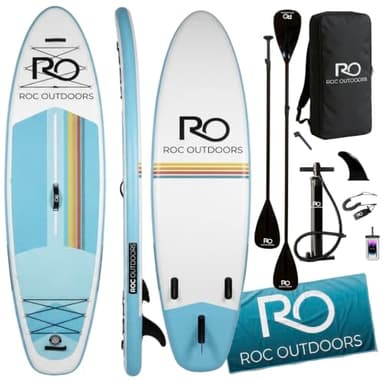
Pick 3 — The default first inflatable board
Roc Inflatable Stand Up Paddle Board, 10 ft 6 in x 33 in
10 ft 6 in by 33 in is the shape the whole beginner category converged on, and this is the cheapest version of it that publishes a 350 lb rating.
What the listing publishes
126 x 33 x 6 in, 350 lb rated capacity, PVC drop-stitch, full accessory kit
Usable at the 65 percent rule: 228 lb (range 210–245 lb), which leaves about 208 lb of paddler after a 20 lb day kit. Why 65 percent.
33 in of width is the number that decides whether you stand up on day one. Our width guidance puts 32 to 33 in as the beginner band for an adult between 150 and 200 lb, and this sits in it.
350 lb rated capacity means about 227 lb of loaded paddler at 65 percent. Applying the displacement arithmetic instead, a 195 lb loaded paddler wants roughly 195 L of volume -- this hull's 126 x 33 x 6 in envelope is comfortably past that.
Six inches of thickness is what makes a modern inflatable stiff. Four-inch boards flex under an adult in the middle and that flex is what people mistake for the board being unstable.
What it does well
- 33 in wide -- the width that gets a first-timer standing rather than kneeling
- 350 lb rating covers an adult with a child or a dog on board
- Ships with pump, paddle, leash and bag, so the listing price is close to the total
What it costs you
- The included paddle and pump are starter parts you will eventually replace
- 10 ft 6 in is a compromise length -- not fast, not especially maneuverable
- The listing does not publish a board weight
Skip this if you already know you want to cover distance. A 10 ft 6 in all-around board is a cruiser and an 11 ft 6 in touring shape is the honest answer for mileage.
#ad · how this is funded · price as of October 9, 2026
What a rental actually includes
Comparing a rental fee to a boat price treats the two as the same product, and they are not. A rental is a bundle, and most of what is bundled is the part beginners find hardest.
- **The boat is at the water already.** No rack, no straps, no lifting a 50 lb hull onto a car roof, no carry from the parking lot. For a lot of people this is the single biggest barrier to paddling and the rental erases it.
- **A paddle and a life jacket come with it.** Both are legally or practically mandatory purchases when you buy, and both are included here.
- **Someone points you at the safe water.** An outfitter will tell you where the wind funnels and which direction to head out. That local knowledge is genuinely worth something on a first outing.
- **Nothing needs storing afterward.** You hand it back. No garage wall, no drying, no eleven months of it being in the way.
Read that list and the fee makes more sense. You are not renting a hull, you are renting a solved logistics problem — which is exactly the problem that keeps first-time owners from using boats they already paid for.
The third option nobody mentions
There is a used market in this category and it is unusually good, because kayaks are bought with enthusiasm and sold with honesty. A large share of secondhand recreational boats are barely used — bought in spring, paddled twice, sold in autumn when the garage is needed.
- **Rotomolded plastic hulls last decades.** The material barely degrades. A ten-year-old recreational kayak that has been stored out of direct sun is a functionally sound boat.
- **Check for UV damage and deformation.** Chalky, faded plastic that has lived outdoors is brittle. A hull stored on its side against a wall can take a permanent flat spot that ruins how it tracks.
- **Inflatables are the opposite.** Buy those new. Seams, valves and the interior of a chamber are the parts that fail, and none of them can be inspected in a driveway.
- **Budget for a new paddle and life jacket regardless.** A secondhand life jacket of unknown age and storage history is not a saving worth making.
A used hard-shell plus a new paddle and jacket is frequently the cheapest genuinely good first setup there is, and it moves the break-even point substantially toward buying.
If you buy, buy for the constraint you actually have
The reason people end up renting for years is rarely the boat price. It is that they cannot see where the boat would live or how it would get to the water. Those are solvable and they are worth solving before you shop for a hull.
- **No storage and no rack** points at an inflatable. It lives in a closet and rides in a trunk, and the entry tier is the cheapest complete way onto flat water there is.
- **Storage but no roof bars** points at a light hard-shell plus a foam block kit — how to carry a boat without a rack.
- **A long walk from parking to water** points at hull weight above everything else, and probably a cart.
The best first boat is the one whose ownership costs you have already answered. What a first setup really costs runs those totals, and storing a board or a boat covers the eleven months it is not on the water.
One last note on how this decision usually goes wrong. People treat buying as the committed choice and renting as the cautious one, and over three seasons it is frequently the reverse: the renter spends more, goes less, and still owns nothing. The genuinely cautious version is to rent once, confirm you like it, and then buy at the honest starter tier rather than deferring the decision for another summer.
Questions people actually ask
Is it cheaper to rent or buy a kayak?
Should I rent a kayak before buying one?
How many times do you have to kayak for buying to be worth it?
What if I have nowhere to store a kayak?
Is renting a good way to try different kayaks?
Is a used kayak a good first boat?
Should I buy a used inflatable kayak or paddle board?
Where these numbers came from
Every figure on this page traces to one of these. Where a number could not be sourced, the page says so rather than estimating it.
- Eddyline Kayaks — Maximum weight capacity versus ideal capacity for various styles of kayaks (manufacturer, states the 60-70% ideal-capacity band)
- U.S. Coast Guard — Recreational Boaters (federal equipment requirements for vessels, paddlecraft included)
- Lifetime Lotus Sit-on-Top Kayak 8 ft — manufacturer specification as published on the Amazon listing, read 2026-09-02
- Intex Challenger K1 Inflatable Kayak — manufacturer specification as published on the Amazon listing, read 2026-09-02
- Roc Inflatable Stand Up Paddle Board 10 ft 6 in — manufacturer specification as published on the Amazon listing, read 2026-09-02
Read next
Are Inflatable Kayaks Worth It?
Worth it if storage or a roof rack is your problem. Not worth it if performance is. How to tell which buyer you are from the published capacity and your own garage.
Top pick
Intex Explorer K2 Inflatable Kayak, 2-person (oars and pump included)
Two people, no roof rack, small budget
#ad · how this is funded · price as of October 9, 2026
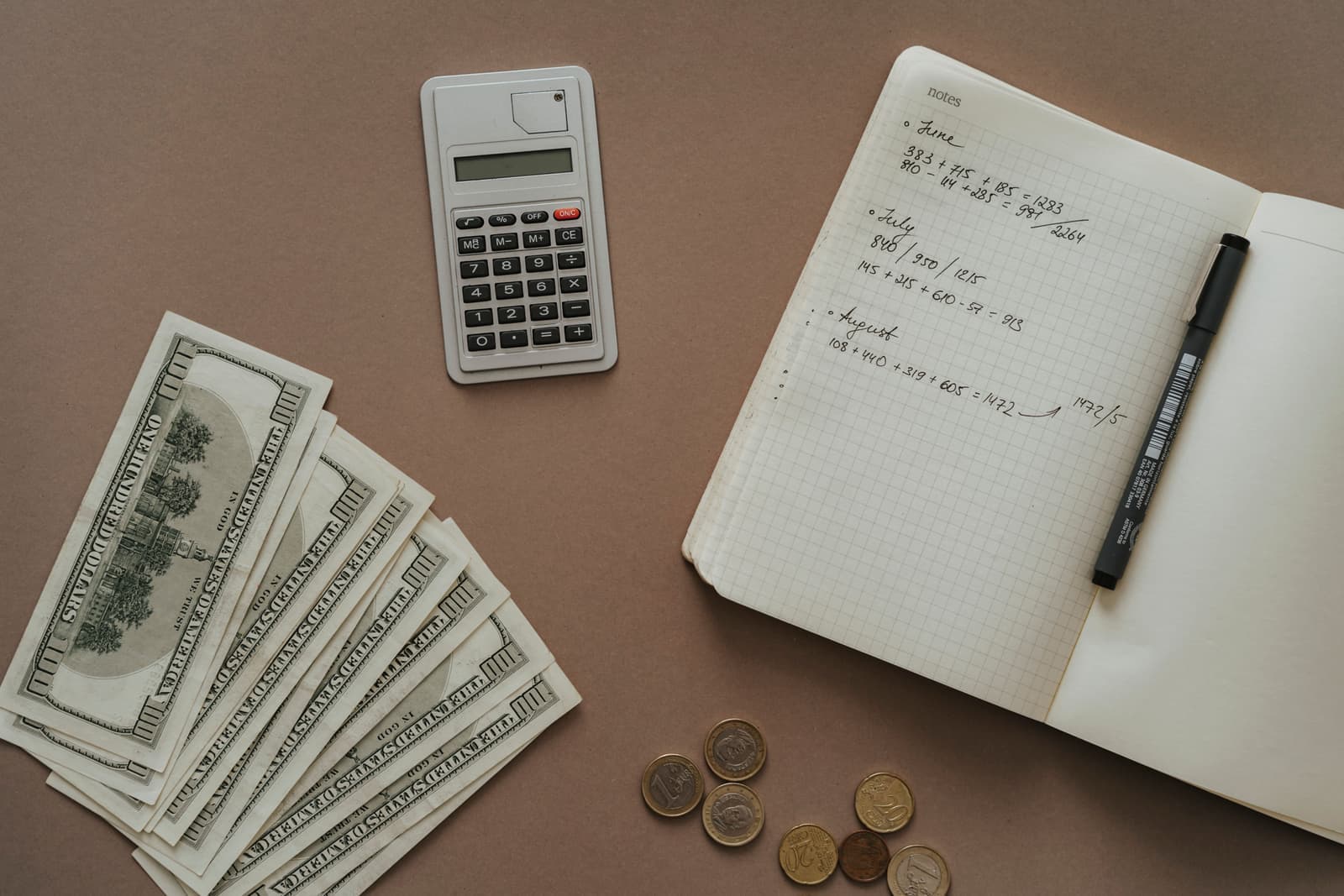
What a First Setup Actually Costs
Every line item in a first setup, including the ones that surprise people — with live prices rather than stale numbers.
Top pick
Perception Tribe 11.5 Sit-on-Top Kayak
The all-round first sit-on-top
#ad · how this is funded · price as of October 9, 2026

Best Budget Kayak
The Best Budget Kayaks
Budget kayaks with the specific compromise each one makes, named. Capacity is usually the one that catches people.
Top pick
Intex Explorer K2 Inflatable Kayak, 2-person (oars and pump included)
Two people, no roof rack, small budget
#ad · how this is funded · price as of October 9, 2026

Sit-On-Top vs Sit-In Kayak
Water temperature and remounting decide this, not preference. The honest comparison, with picks for each.
Top pick
Perception Tribe 11.5 Sit-on-Top Kayak
The all-round first sit-on-top
#ad · how this is funded · price as of October 9, 2026
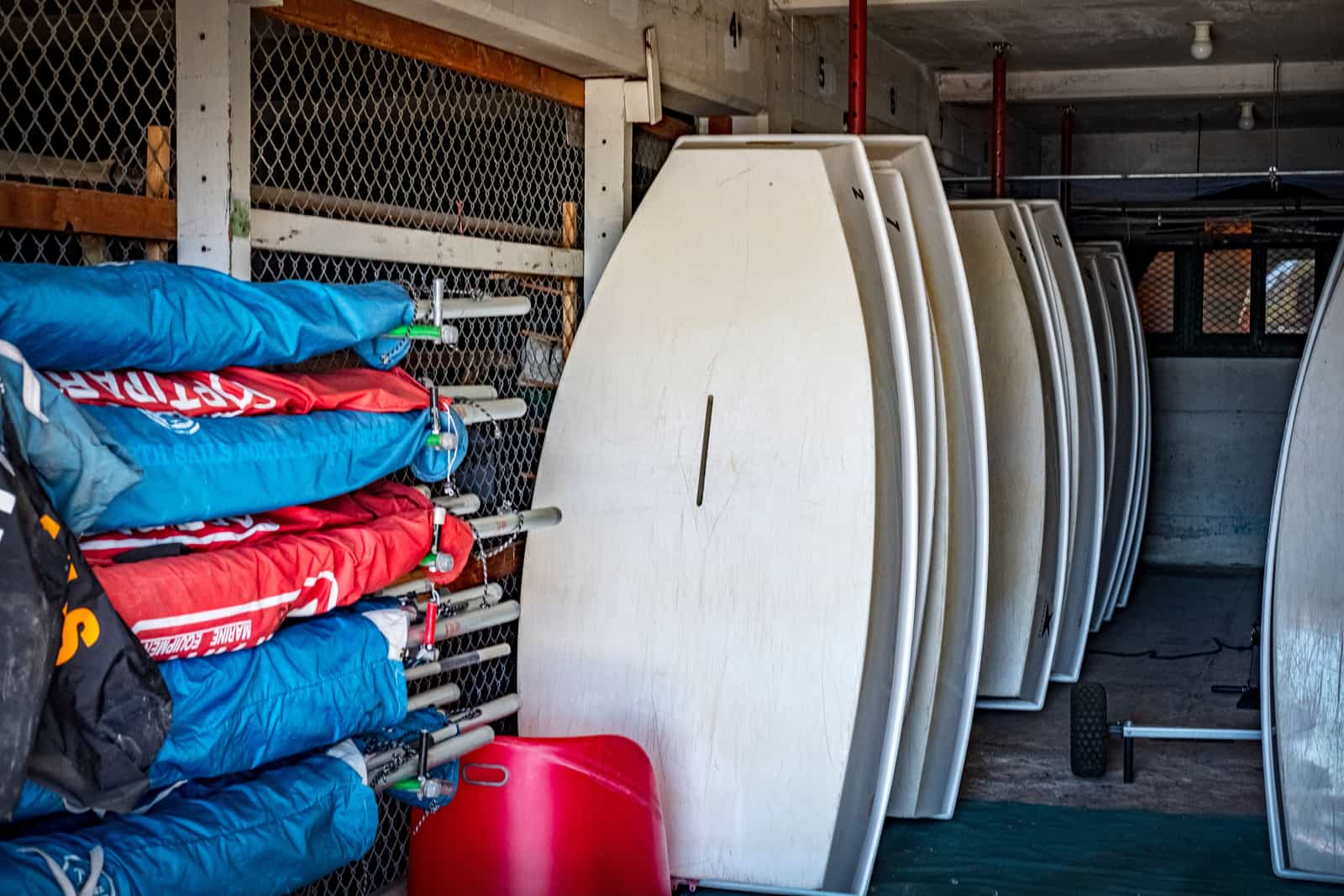
Where to Keep a Kayak or Paddle Board
Where to put it, how to avoid deforming the hull, and what the off-season actually requires.
Top pick
Roc Inflatable Stand Up Paddle Board, 10 ft 6 in x 33 in
The default first inflatable board
#ad · how this is funded · price as of October 9, 2026

Your First Time on the Water
What a first outing is actually like, the checklist that matters, and the three mistakes beginners reliably make.
Top pick
Onyx MoveVent Dynamic Paddle Vest
The PFD you will actually keep on
#ad · how this is funded · price as of October 9, 2026