Paddle Boards
Can Two People Ride One Paddle Board?
Two average adults is roughly 355 lb loaded, which is past the usable limit of almost every board sold as a beginner board. Three clear it, and one of them is built for it.
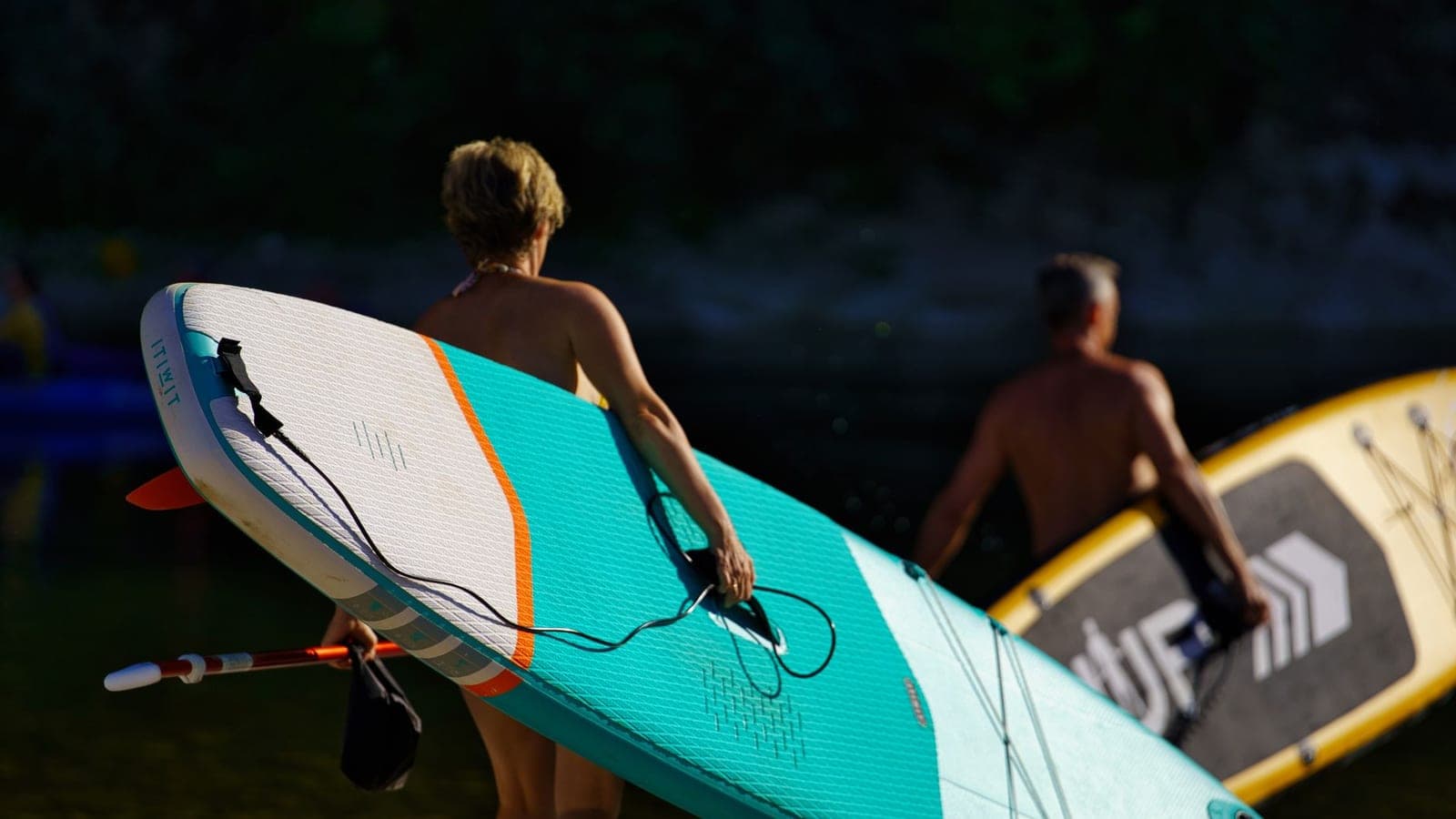
We have not paddled these, and we are not going to pretend we have. Here is what we did instead. Links to Amazon earn us a commission at no extra cost to you, and commission never decides a pick — how this site is funded.
| # | Product | Best for | The spec it turns on | Price |
|---|---|---|---|---|
| 1 | 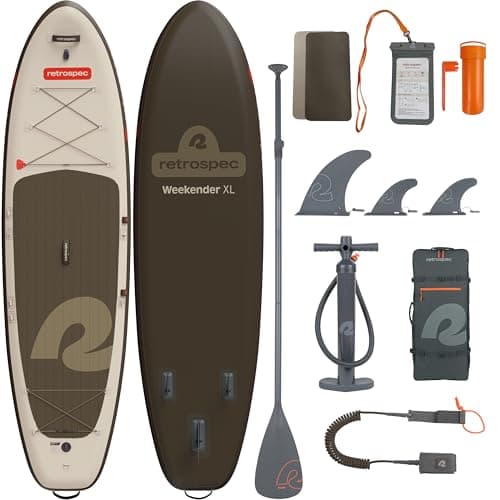 Retrospec Weekender XL Inflatable Paddle Board, 11 ftTop pickEight inches of drop-stitch instead of the usual six, which is where the stiffness to carry two people comes from. 400 lb recommended is the highest limit here that still belongs to a board one person can carry. | Two adults who want one board, not a raft | 11 ft x 35 in x 8 in inflated, 31 lb with fins, 400 lb recommended weight limit, 3 removable tracking fins, 12-15 PSI, 11 D-rings | |
| 2 | 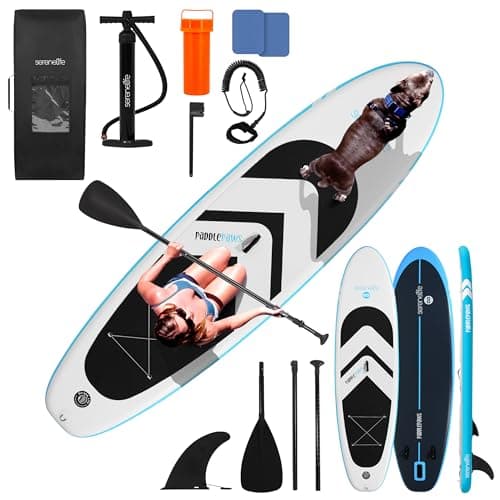 SereneLife XL Extra-Wide Inflatable Paddle Board, 35 in485 lb of rated capacity is the highest on this site, and for a paddler over 250 lb it is one of very few boards where the usable-capacity arithmetic still works. | A heavier paddler, or a board that carries the family | 35.04 in wide, up to 485 lb rated capacity depending on size, double-layer side rails | |
| 3 | 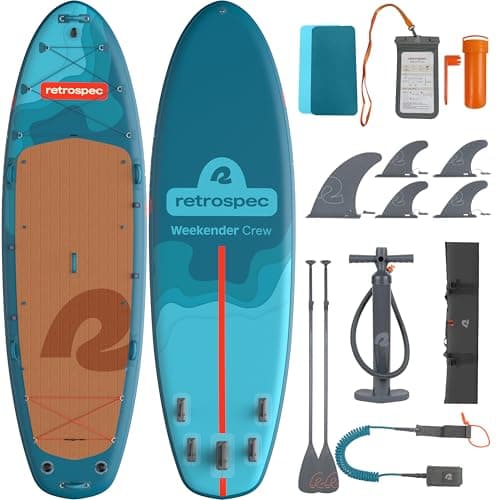 Retrospec Weekender Crew Multi-Person Inflatable Paddle Board, 12 ftThe only board here actually designed for more than one paddler: five fins instead of three, more grab handles, and two paddles in the box. The capacity figure is the catch, because the maker and the listing do not agree on it. | A household that wants everyone on one board | 12 ft, about 36 lb, five slide-in fins, ships with a pair of 3-piece 63-84 in paddles and a dual-action pump; Retrospec states up to 500 lb and 2 to 3 paddlers, the Amazon listing states 400 lb for the 12 ft size | |
| 4 | 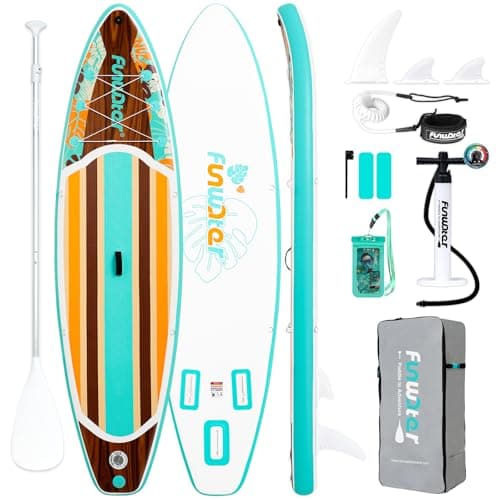 FunWater Inflatable Stand Up Paddle Board, 10 ft 6 in x 35 inThirty-five inches of width in a 10 ft 6 in board is the closest thing to a raft that still paddles like a board, and for a genuinely nervous beginner that is the right trade. | Maximum stability in a standard length | 126 x 35.1 x 6 in, 330 lb rated capacity, PVC drop-stitch |
People ask this hoping the answer is yes and the board they already own will do. Usually the board will not, and the reason is arithmetic rather than technique. Here is the arithmetic, then the boards that pass it.
The number two people actually make
Add both paddlers, both paddles, and whatever else goes aboard. Then compare that against the published rating, not against your own impression of how big the board looks.
355 lb of load. Now look at what the beginner class publishes: the 10 ft 6 in boards this site recommends most run 275 to 350 lb rated, and the 65 percent usable rule takes a further third off that. A 350 lb board is about a 227 lb board in practice, which is one adult and a small dog, not two adults.
| Rated capacity | Usable (60-70%) | Usable at 65% | Left for the paddler |
|---|---|---|---|
| 250 lb | 150-175 lb | 163 lb | 143 lb |
| 275 lb | 165-193 lb | 179 lb | 159 lb |
| 300 lb | 180-210 lb | 195 lb | 175 lb |
| 325 lb | 195-227 lb | 211 lb | 191 lb |
| 350 lb | 210-245 lb | 228 lb | 208 lb |
| 400 lb | 240-280 lb | 260 lb | 240 lb |
| 450 lb | 270-315 lb | 293 lb | 273 lb |
| 500 lb | 300-350 lb | 325 lb | 305 lb |
Width and thickness do as much work as the rating
Rating is a flotation number. Two things decide whether the board actually behaves with two people on it, and only one of them is capacity.
- **Width.** 32 inches is the beginner-stable band for one person. Two people shift weight independently and at different moments, so you want the top of the range — 35 inches is the width we would not go under for two adults.
- **Thickness.** Almost every board on this site is 6 inches thick. Under 355 lb, a 6 inch drop-stitch core sags in the middle, and a sagging board puts the heaviest part of the load into the water. 8 inches is the spec that fixes it, and Retrospec publishes 8 in on both of the boards here that are meant for two.
- **Length.** 12 feet of waterline holds a straight line under a shifting load in a way that 10 ft 6 in does not. This is the one case where the longer board is also the easier one.
- **Fin count.** Three fins is standard. Retrospec's multi-person boards use five, and the reason is exactly this: more fin area recovers a course every time someone moves a foot.
| Board | Published rating | Width | Thickness | Verdict for two adults |
|---|---|---|---|---|
| Retrospec Weekender Crew, 12 ft | Up to 500 lb (maker) / 400 lb (listing) | Not published | 8 in | Designed for 2 to 3 paddlers |
| Retrospec Weekender XL, 11 ft | 400 lb recommended | 35 in | 8 in | Yes, for two average adults |
| SereneLife XL | Up to 485 lb at its largest size | 35 in | 6 in | Yes on rating, softer underfoot |
| FunWater 10 ft 6 in | 330 lb | 35.1 in | 6 in | One adult and a child, not two adults |
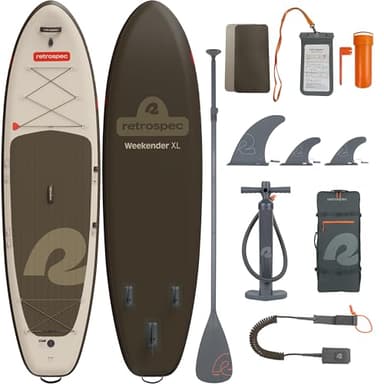
Top pick — Two adults who want one board, not a raft
Retrospec Weekender XL Inflatable Paddle Board, 11 ft
Eight inches of drop-stitch instead of the usual six, which is where the stiffness to carry two people comes from. 400 lb recommended is the highest limit here that still belongs to a board one person can carry.
What the listing publishes
11 ft x 35 in x 8 in inflated, 31 lb with fins, 400 lb recommended weight limit, 3 removable tracking fins, 12-15 PSI, 11 D-rings
Usable at the 65 percent rule: 260 lb (range 240–280 lb), which leaves about 240 lb of paddler after a 20 lb day kit. Why 65 percent.
Thickness is the spec doing the work. Retrospec publishes 8 in against the 6 in that almost every board on this site uses, and a thicker drop-stitch core resists the middle-sagging that puts a second person's weight into the water rather than on top of it.
400 lb is Retrospec's recommended weight limit rather than a flotation maximum, which is a more useful number than most published ratings — but it still covers two adults only if they are two fairly light adults. Two 170 lb paddlers plus a paddle each is 355 lb before anything else goes aboard.
11 D-rings — six front cargo, four rear cargo, one tail for the leash — is what makes it usable as a seated craft too. A clip-on kayak seat needs four anchor points in roughly the right places, and this deck has them.
31 lb with fins is heavier than a 10 ft 6 in board and lighter than the multi-person boards. It is the weight at which one adult can still get it from the car to the water alone.
What it does well
- 8 in thick, so it sags far less than a 6 in board under two people
- 400 lb recommended limit, the highest here for a single-carry board
- 11 D-rings, enough to clip a seat on and still carry gear
- Ships with paddle, pump, waterproof phone case and repair kit in a backpack
What it costs you
- 31 lb is a real carry once the backpack is loaded
- 35 in wide is slow — this is a stable platform, not a quick board
- Only one paddle in the box, so a second paddler costs extra
- 8 in thickness puts you higher off the water, which feels less settled when you first stand
Skip this if you will paddle alone and standing. A 32 in, 6 in board is lighter, faster and cheaper, and the extra thickness here buys you nothing on your own.
#ad · how this is funded · price as of October 18, 2026
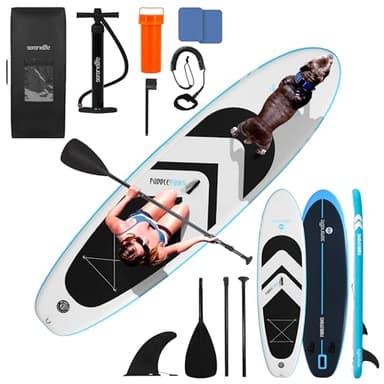
Pick 2 — A heavier paddler, or a board that carries the family
SereneLife XL Extra-Wide Inflatable Paddle Board, 35 in
485 lb of rated capacity is the highest on this site, and for a paddler over 250 lb it is one of very few boards where the usable-capacity arithmetic still works.
What the listing publishes
35.04 in wide, up to 485 lb rated capacity depending on size, double-layer side rails
Usable at the 65 percent rule: 315 lb (range 291–340 lb), which leaves about 295 lb of paddler after a 20 lb day kit. Why 65 percent.
485 lb rated is about 315 lb of loaded paddler at 65 percent. Almost nothing else in the consumer inflatable class gets there.
The listing publishes three capacities -- 350, 440 and 485 lb -- across three sizes. Buy against the specific size you are ordering rather than the highest number in the title, because those are different boards.
Double-layer side rails are the construction detail behind the rating. Rails are where an inflatable board flexes, and doubling them is what allows the load without the middle sagging.
What it does well
- Up to 485 lb rated -- roughly 315 lb of loaded paddler, the most headroom here
- 35 in wide, so it is stable at the loads it is rated for
- Double-layer rails are the right construction for a high-capacity board
What it costs you
- The advertised capacity is size-dependent and the title quotes the largest
- The listing does not publish a board weight or a length
- Big, wide boards are slow and awkward to turn
Skip this if you are an average-sized solo paddler. This is a lot of board to push around for capacity you will never use.
#ad · how this is funded · price as of October 18, 2026
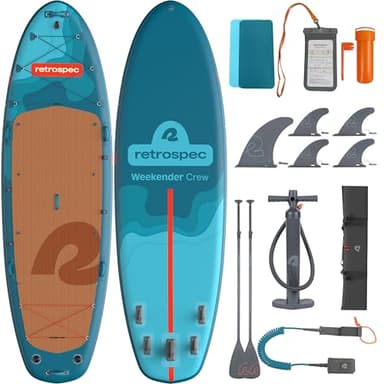
Pick 3 — A household that wants everyone on one board
Retrospec Weekender Crew Multi-Person Inflatable Paddle Board, 12 ft
The only board here actually designed for more than one paddler: five fins instead of three, more grab handles, and two paddles in the box. The capacity figure is the catch, because the maker and the listing do not agree on it.
What the listing publishes
12 ft, about 36 lb, five slide-in fins, ships with a pair of 3-piece 63-84 in paddles and a dual-action pump; Retrospec states up to 500 lb and 2 to 3 paddlers, the Amazon listing states 400 lb for the 12 ft size
Retrospec's own product page states up to 500 lb and 2 to 3 paddlers for the 12 ft size. The Amazon listing for the 12 ft and 15 ft pair states 400 lb and 1,050 lb respectively. We have cited both and we are not going to pick the flattering one: size yourself against 400 lb and the board will not disappoint you.
Five slide-in fins rather than three is the real multi-person feature. Two people shift weight independently, and a board with more fin area under it recovers a straight line instead of slewing every time someone moves a foot.
Two three-piece paddles adjusting 63 to 80 in come in the box. That matters more than it sounds: a second paddler on a single-paddle board is a passenger, and a passenger is why people stop taking a second person out.
About 36 lb is a two-person carry in practice once the bag is packed, which is fine, because the whole point of the board is that there are two of you.
What it does well
- Five fins, so it holds a line while people move around on it
- Two adjustable paddles included, not one
- 12 ft of waterline, which is the length a loaded board needs to stop wandering
- Dual-action hand-and-foot pump included
What it costs you
- Maker and listing publish different capacities for the same board (500 lb vs 400 lb)
- A size-selector listing — the 12 ft and the 15 ft XL share one page, so check which you are buying
- About 36 lb packed, a heavy walk for one person
- Costs more than two entry boards bought separately
Skip this if the two of you would each rather have your own board. Two 10 ft 6 in boards cost about the same, both of you get to steer, and neither of you has to coordinate a stroke.
#ad · how this is funded · price as of October 18, 2026
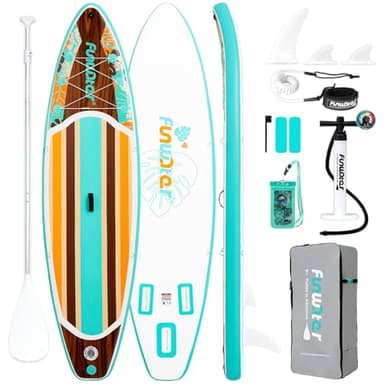
Pick 4 — Maximum stability in a standard length
FunWater Inflatable Stand Up Paddle Board, 10 ft 6 in x 35 in
Thirty-five inches of width in a 10 ft 6 in board is the closest thing to a raft that still paddles like a board, and for a genuinely nervous beginner that is the right trade.
What the listing publishes
126 x 35.1 x 6 in, 330 lb rated capacity, PVC drop-stitch
Usable at the 65 percent rule: 215 lb (range 198–231 lb), which leaves about 195 lb of paddler after a 20 lb day kit. Why 65 percent.
35.1 in is above our beginner recommendation for every weight band on the site. Extra width is slower and it is not a mistake -- speed is not the thing standing between a first-timer and a good afternoon.
330 lb rated is about 215 lb of loaded paddler at 65 percent, the same as the FEATH-R-LITE, in a board three and a half inches wider.
Wide boards are harder to reach past when you paddle, so a wide board pushes you toward a slightly longer paddle. Our formula puts a 5 ft 8 in paddler on a 77 in SUP paddle regardless of board, but the reach penalty is real and worth knowing about.
What it does well
- 35.1 in wide -- as stable as an inflatable board gets at this length
- 330 lb rating with room for a child or a dog on the nose
- Full accessory kit included
What it costs you
- Wide is slow, and you will notice against a 31 in board
- Harder to reach the water past the rail, which tires your shoulders
- The listing does not publish a board weight
Skip this if you are reasonably confident on your feet already. Width you do not need is drag you pay for on every stroke.
#ad · how this is funded · price as of October 18, 2026
What two people on one board is actually like
Worth setting expectations, because the boards above make it possible rather than pleasant, and the difference matters when you are deciding what to spend.
- **One of you steers.** A board has no rudder and two paddles on opposite sides cancel. In practice the rear paddler steers and the front paddler provides power, the same division as a tandem kayak.
- **It is slow.** A 35 inch board with 355 lb on it has a great deal of wetted surface. Plan on a leisurely cruise rather than a crossing.
- **Standing together takes practice.** Two people standing on one board is a balance exercise. Most pairs end up with one standing and one sitting or kneeling, which works well and is not a failure.
- **Getting on from deep water with two of you is hard.** Do it in water you can stand up in, one at a time, rear person first.
- **Both of you need a life jacket.** Every person aboard needs their own approved wearable PFD. What the law requires.
Getting on, and getting on again
The part nobody warns you about. Two people boarding one inflatable is the moment most first attempts end in the water, and it is a sequence rather than a knack.
- **Do it in water you can both stand up in**, knee to thigh deep. Not off a dock, and not in the deep.
- **Rear person first, kneeling, at the center of the deck pad.** They are the heavier end of the trim and they are also the one who will be steering.
- **Front person second, also kneeling**, ahead of the center. Both of you on your knees, both hands on the rails.
- **Paddle away kneeling for the first minute.** Get the trim settled and the direction established before anybody changes height.
- **One person stands at a time**, slowly, with the other staying low and still. If somebody is going to stay down for the whole trip, make it the front person — the rear paddler steering needs the view.
If you both end up in the water, nothing has gone wrong other than that you are wet. Stand up, get the board flat, and start the sequence again. Both of you should be wearing a life jacket and the rear person should be on the leash, because an inflatable with 355 lb of momentum goes a long way without you.
Paddling as a pair, which is a different skill
- **Decide who steers before you launch.** The rear paddler. A board has no rudder, and two people correcting independently will zigzag the whole trip.
- **Opposite sides, same cadence.** Front paddler picks the rhythm, rear paddler matches it and uses their stroke to correct.
- **The rear paddler turns with a sweep**, a long stroke out away from the rail, rather than by switching sides. Switching sides is how you lose a straight line.
- **Call the switches.** On a long stretch you both change sides at the same time, on a count. This is the single thing that makes a pair feel competent rather than chaotic.
- **Weight stays near the center.** Two people spread toward the ends makes the board bend in the middle, which is the one thing an 8 inch core is there to resist.
The case against one board, honestly
The alternative to a 400 lb board is two ordinary boards, and for a lot of households it is the better purchase. Two 10 ft 6 in boards cost about what one multi-person board costs, both of you get to steer, you can go at different speeds, and neither of you has to coordinate a stroke with somebody else.
One board genuinely wins in three cases: one of you will not be paddling (a child, a nervous partner, a dog), you have room to store and carry exactly one, or you want the two of you in the same place to talk. If none of those is you, buy two boards. We make the same argument on the kayak side in tandem or two singles, and the logic transfers almost unchanged.
Two people who are not two adults
The common version of this question is not two adults at all, and it is much easier to answer.
| Pairing | Typical load | What it needs |
|---|---|---|
| Adult plus small child | About 230 lb | Any 350 lb, 33 to 35 in board — including the ones already on this site |
| Adult plus dog | About 255 lb | 35 in of width for the deck space more than the rating |
| Two average adults | About 355 lb | 400 lb rated, 35 in wide, 8 in thick |
| Two large adults | Over 450 lb | A purpose-built multi-person board, or two boards |
| Family of three or four | 500 lb and up | A multi-person board, and five fins rather than three |
If yours is the first row, nothing on this page is a constraint on you — go and read the beginner roundup instead, and add the child's weight to yours before you size anything. If yours is the last row, the Weekender Crew is the only thing here built for it.
The capacity discrepancy on the Crew, stated plainly
Retrospec's own product page states up to 500 lb and 2 to 3 paddlers for the 12 ft Weekender Crew. The Amazon listing, which sells the 12 ft and the 15 ft XL from one page, states 400 lb and 1,050 lb for the two sizes. Those two figures for the same board do not agree, and we are not going to quietly print the flattering one.
Our read: size yourself against 400 lb. If the board turns out to hold the maker's 500 lb you have a margin you did not plan for, which is the right direction for a mistake to run. It is also a size-selector listing, so check which length is in the cart — the same trap we flag on the heavier-paddler roundup.
What you can ignore
- **'Family' and 'party' in the product name.** They describe the deck area, not the rating. Read the number.
- **Included accessory counts.** Nine-piece and twelve-piece bundles are mostly a bag, a leash and a repair kit. The exception worth paying for is a second paddle, which the Crew includes and most do not.
- **Seat attachments as a two-person feature.** A seat is for one person sitting. That is a different question.
- **Pressure claims above 15 PSI.** Every board here works at 12 to 15, and the last few PSI matter far more than the headline maximum. Why pressure is the spec people get wrong.
Questions people actually ask
Can two people ride one paddle board?
What size paddle board do I need for two adults?
Is a tandem paddle board better than two boards?
Can two people stand up on the same paddle board?
How do two people paddle one board?
Does a paddle board hold a child and an adult?
Where these numbers came from
Every figure on this page traces to one of these. Where a number could not be sourced, the page says so rather than estimating it.
- Retrospec — Weekender XL 11 ft inflatable paddle board (manufacturer specification table: 11 ft x 35 in x 8 in inflated, 31 lb with fins, 400 lb recommended weight limit, 3 removable tracking fins, 12-15 PSI, 11 D-rings), read 2026-10-17
- Retrospec — Weekender Crew multi-person inflatable paddle board (manufacturer: 12 ft, about 36 lb, up to 500 lb, 2 to 3 paddlers, five slide-in fins, a pair of 3-piece 63-84 in paddles and a dual-action pump included), read 2026-10-17
- ISLE Paddle Boards — Paddle Board Size & Weight Chart (manufacturer, published per-model capacities)
- Thurso Surf — What Size Paddle Board Is Right for You (manufacturer, states the weight-in-kg x 2 volume rule and the 32 in beginner width band)
- U.S. Coast Guard — Life Jacket Wear / Wearing Your Life Jacket (federal carriage and under-13 wear requirements)
- Retrospec Weekender XL Inflatable Paddle Board — manufacturer specification as published on the Amazon listing, read 2026-10-17
- SereneLife XL Extra-Wide Inflatable Paddle Board — manufacturer specification as published on the Amazon listing, read 2026-09-02
- Retrospec Weekender Crew Multi-Person Paddle Board — manufacturer specification as published on the Amazon listing, read 2026-10-17
- FunWater Inflatable Stand Up Paddle Board, 10 ft 6 in — manufacturer specification as published on the Amazon listing, read 2026-09-02
Read next

Paddle Board Weight Limits, Explained
Rated capacity is not usable capacity. The 65 percent rule, where it comes from, and what happens when you ignore it.
Top pick
SereneLife XL Extra-Wide Inflatable Paddle Board, 35 in
A heavier paddler, or a board that carries the family
#ad · how this is funded · price as of October 18, 2026
Best for Heavier Paddlers
The Best Paddle Boards for Heavier Paddlers
Rated capacity divided by 0.65 is the number that fits you, and it rules out most beginner boards above about 215 lb. The boards with genuine headroom, ranked.
Top pick
SereneLife XL Extra-Wide Inflatable Paddle Board, 35 in
A heavier paddler, or a board that carries the family
#ad · how this is funded · price as of October 18, 2026
Tandem Kayak or Two Single Kayaks?
One boat or two? Decided on carry weight, storage length and whether you will ever paddle alone — with the capacity arithmetic that tandem listings leave out.
Top pick
Perception Rambler 13.5 Tandem Sit-on-Top Kayak
Two adults plus a child or a dog
#ad · how this is funded · price as of October 18, 2026

What Size Paddle Board Do I Need?
A volume and width calculator that shows its working, and ends in an actual board rather than a chart.
Top pick
Roc Inflatable Stand Up Paddle Board, 10 ft 6 in x 33 in
The default first inflatable board
#ad · how this is funded · price as of October 18, 2026
Best for Kids
The Best Paddle Boards for Kids
Kids' boards sized on weight and reach, plus the point at which a narrow adult board becomes the better buy.
Top pick
Retrospec Weekender-Nano Inflatable Paddle Board, 8 ft
A child's own board
#ad · how this is funded · price as of October 18, 2026
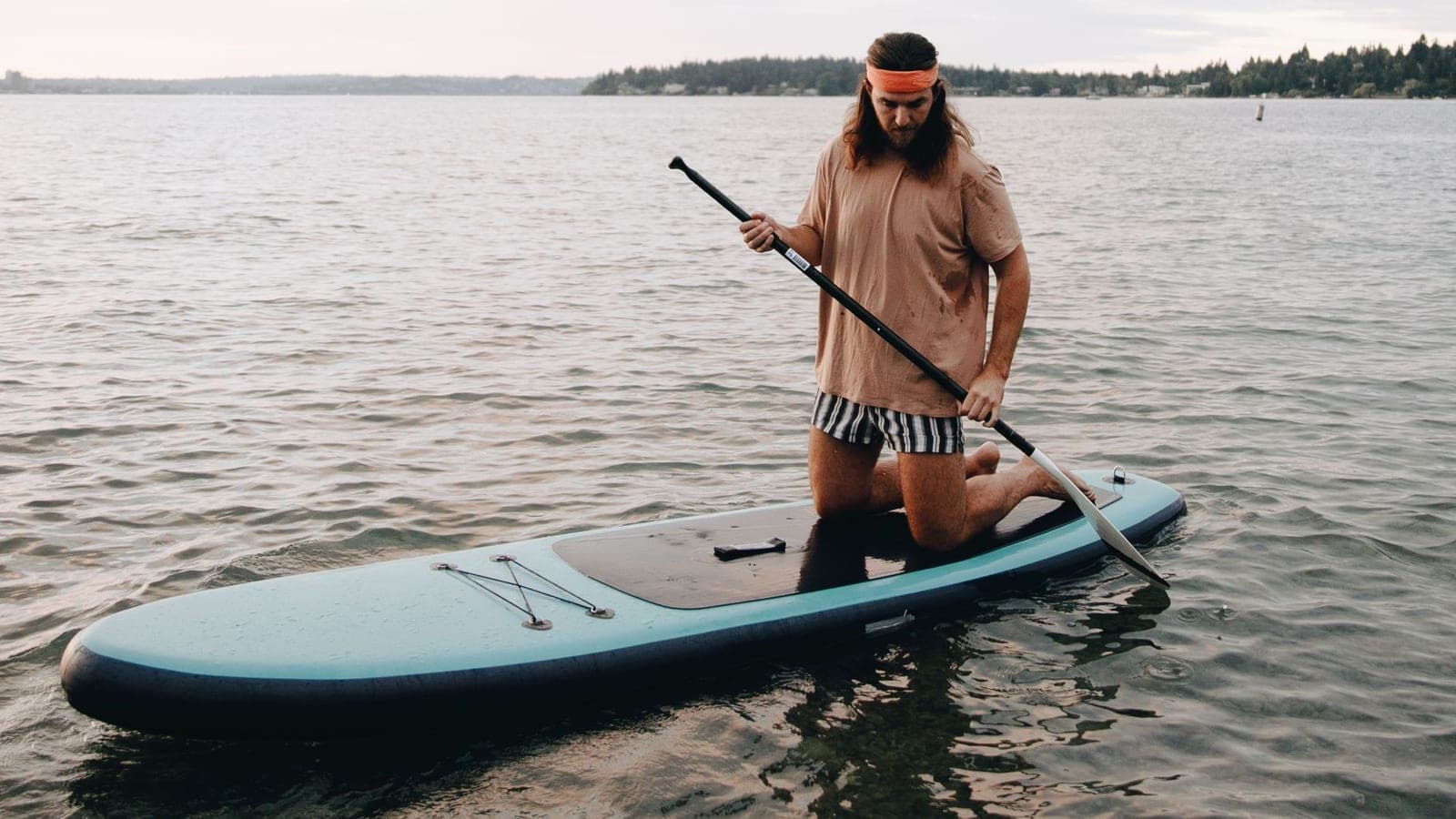
Can You Use a Paddle Board Like a Kayak?
A seat and a convertible paddle turn a board into a sit-down craft. The two parts, the boards they fit, and the three things you give up.
Top pick
Pelican Sit-on-Top Kayak or SUP Seat
A Pelican or Lifetime sit-on-top, or a paddle board
#ad · how this is funded · price as of October 18, 2026