Kayaks
The Best Budget Kayaks
Every cheap boat is cheap for a reason, and the reason is usually a number on the listing. Here are the boats where the compromise is one you can live with, and exactly what it is.

We have not paddled these, and we are not going to pretend we have. Here is what we did instead. Links to Amazon earn us a commission at no extra cost to you, and commission never decides a pick — how this site is funded.
| # | Product | Best for | The spec it turns on | Price |
|---|---|---|---|---|
| 1 | 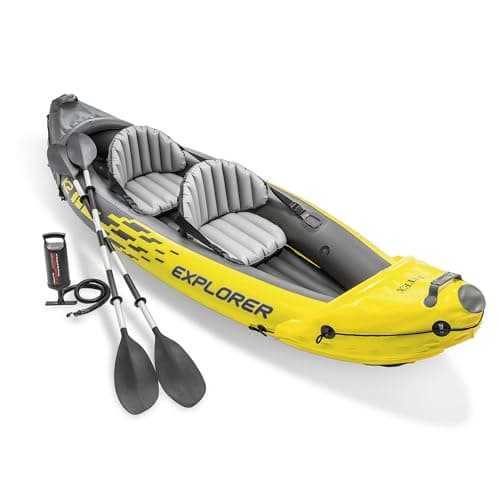 Intex Explorer K2 Inflatable Kayak, 2-person (oars and pump included)Top pickBought as a tandem it disappoints; bought as a very roomy solo boat with 400 lb of rating and no rack requirement, it is the most useful inflatable here. | Two people, no roof rack, small budget | 123 in long, 36 in beam, 35 lb packed, 400 lb rated capacity, two oars and a pump included | |
| 2 | 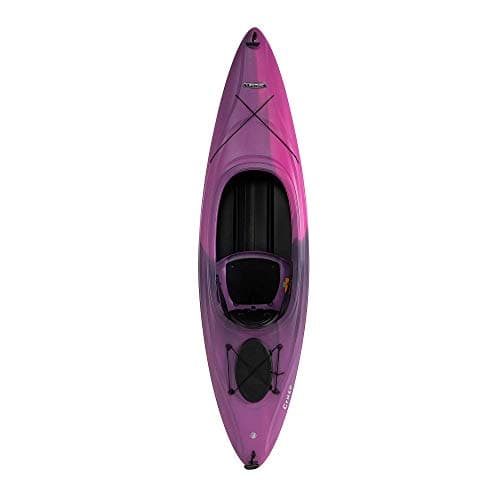 Lifetime Cruze 100 Sit-In Kayak, 10 ftA 30 in beam on a budget hull is the trade worth having: you give up ten pounds of carry weight against the Argo and get back the width that keeps a nervous paddler upright. | The cheapest hard-shell sit-inside worth owning | 120 in long, 30 in beam, 46 lb hull, 275 lb rated capacity | |
| 3 | 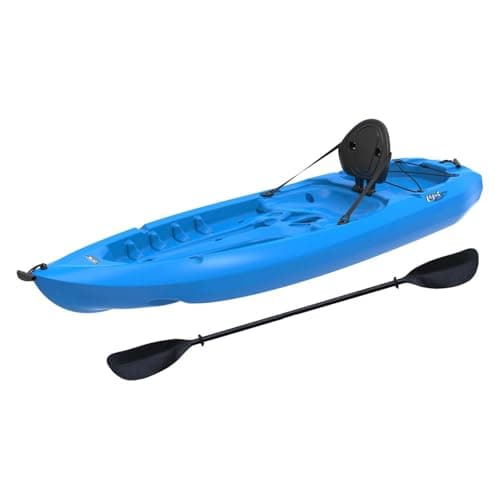 Lifetime Lotus Sit-on-Top Kayak, 8 ft (paddle included)Eight feet, thirty inches wide, a paddle in the box. It is not a good boat and it is an honest one -- this is a pond and a cabin dock, not a lake crossing. | The cheapest complete way onto flat water | 96 in long, 30 in beam, 39 lb hull, 250 lb rated capacity, paddle included | |
| 4 | 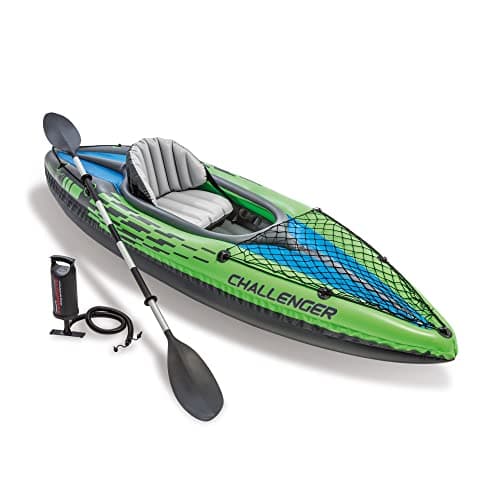 Intex Challenger K1 Inflatable Kayak (paddle and pump included)The honest answer to 'I have an apartment and a sedan'. It is a real boat on flat water and it is not a hard-shell substitute, and it is worth being clear about which of those you are buying. | No car rack, no garage, no storage | 108 in long, 30 in beam, 26 lb packed, 220 lb rated capacity, paddle and pump in the box |
Budget roundups usually pretend the compromise is not there. It always is, and the useful version of this page names it for each boat so you can decide whether it is one that affects you.
In this category the compromise is almost never build quality in the way people expect. Cheap rotomolded plastic is thick and durable — the boats will outlast their owners' interest. The compromise is nearly always **usable capacity**, and it is the specification that gets least attention on a budget listing.
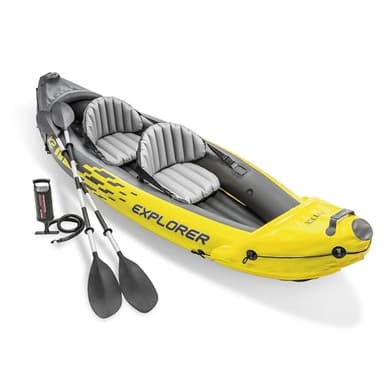
Top pick — Two people, no roof rack, small budget
Intex Explorer K2 Inflatable Kayak, 2-person (oars and pump included)
Bought as a tandem it disappoints; bought as a very roomy solo boat with 400 lb of rating and no rack requirement, it is the most useful inflatable here.
What the listing publishes
123 in long, 36 in beam, 35 lb packed, 400 lb rated capacity, two oars and a pump included
Usable at the 65 percent rule: 260 lb (range 240–280 lb), which leaves about 240 lb of paddler after a 20 lb day kit. Why 65 percent.
400 lb rated is about 260 lb usable at 65 percent. Two adults and gear will exceed that more often than not, which is why we recommend it as a spacious single rather than a genuine two-seater.
As a solo it is transformative: 260 lb of usable capacity against the Challenger K1's 143 lb, for nine extra pounds in the bag.
36 in of beam is wider than every hard-shell on this site. Inflatables are wide because air is what makes them stiff, and the side effect is a very forgiving platform.
What it does well
- 400 lb rated capacity -- 260 lb usable, which covers almost any solo adult with gear
- 36 in beam is the most stable platform on this site
- 35 lb in a bag: no rack, no straps, no garage
What it costs you
- Genuinely tight as a two-adult tandem once you apply the usable-capacity rule
- The included oars are oars, not proper kayak paddles -- budget to replace them
- Vinyl construction wallows in wind like every boat in this class
Skip this if you want a true two-adult tandem. Buy a hard-shell tandem with 500 lb or more of rating, or accept this as the roomiest solo inflatable in the price class.
#ad · how this is funded · price as of October 18, 2026
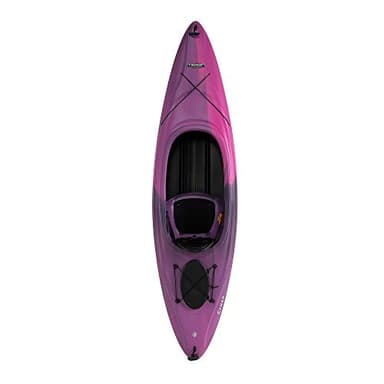
Pick 2 — The cheapest hard-shell sit-inside worth owning
Lifetime Cruze 100 Sit-In Kayak, 10 ft
A 30 in beam on a budget hull is the trade worth having: you give up ten pounds of carry weight against the Argo and get back the width that keeps a nervous paddler upright.
What the listing publishes
120 in long, 30 in beam, 46 lb hull, 275 lb rated capacity
Usable at the 65 percent rule: 179 lb (range 165–193 lb), which leaves about 159 lb of paddler after a 20 lb day kit. Why 65 percent.
275 lb rated is about 179 lb usable at 65 percent and roughly 159 lb of paddler after gear. That is the tightest headroom of the adult boats here and it is the honest reason this one is cheap.
46 lb in a budget rotomolded hull is normal. Cheap plastic is thick plastic, and thickness is weight -- there is no version of this boat that is both inexpensive and light.
The 30 in beam does the work a beginner actually needs. Width is stability, and it is the one spec on a first boat that is worth more than any brand name.
What it does well
- 30 in beam is genuinely stable, which is the spec that decides a first outing
- Reliably the least expensive hard-shell sit-inside on this list
- 10 ft stores and turns like the more expensive 10-footers
What it costs you
- 275 lb rating leaves the least headroom of the adult boats here
- 46 lb for a budget boat -- you pay the weight rather than the money
- Flat-bottom hull wanders more than the Pungo's keel line
Skip this if you weigh much over 160 lb once dressed and carrying gear. The usable-capacity arithmetic is against you and a 325 lb boat costs very little more.
#ad · how this is funded · price as of October 18, 2026
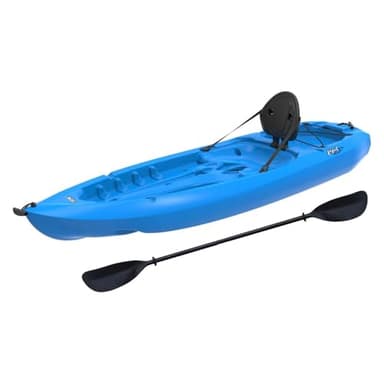
Pick 3 — The cheapest complete way onto flat water
Lifetime Lotus Sit-on-Top Kayak, 8 ft (paddle included)
Eight feet, thirty inches wide, a paddle in the box. It is not a good boat and it is an honest one -- this is a pond and a cabin dock, not a lake crossing.
What the listing publishes
96 in long, 30 in beam, 39 lb hull, 250 lb rated capacity, paddle included
Usable at the 65 percent rule: 163 lb (range 150–175 lb), which leaves about 143 lb of paddler after a 20 lb day kit. Why 65 percent.
250 lb rated is about 163 lb usable at 65 percent and 143 lb of paddler after gear. Read that number twice before you buy: a 180 lb adult is over it before they pick up the paddle.
The included paddle is the reason this is the cheapest genuine way onto the water, and it is also a paddle you will replace. Budget for that in year two, not year one.
Eight feet with a 30 in beam is very stable at rest and effectively unsteerable in wind. On a pond that is fine. On anything with fetch it is not.
What it does well
- Cheapest complete package here -- hull and paddle in one box
- 30 in beam on an 8 ft hull is extremely stable sitting still
- 39 lb and 8 ft: one person, one trip, fits in a lot of car interiors
What it costs you
- 250 lb rating means about 143 lb of paddler once gear is subtracted
- 8 ft is slow and blows around in any real wind
- The included paddle is a starter part, not a keeper
Skip this if you weigh more than about 145 lb dressed and carrying gear, or your water is anything larger than a small pond. Both are hard limits here, not preferences.
#ad · how this is funded · price as of October 18, 2026
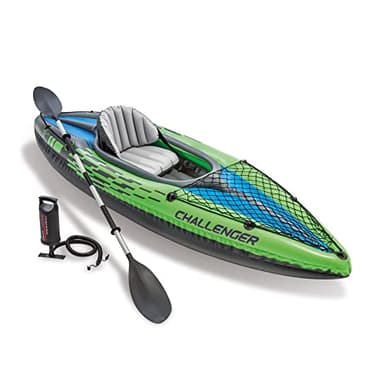
Pick 4 — No car rack, no garage, no storage
Intex Challenger K1 Inflatable Kayak (paddle and pump included)
The honest answer to 'I have an apartment and a sedan'. It is a real boat on flat water and it is not a hard-shell substitute, and it is worth being clear about which of those you are buying.
What the listing publishes
108 in long, 30 in beam, 26 lb packed, 220 lb rated capacity, paddle and pump in the box
Usable at the 65 percent rule: 143 lb (range 132–154 lb), which leaves about 123 lb of paddler after a 20 lb day kit. Why 65 percent.
220 lb rated is about 143 lb usable at 65 percent and roughly 123 lb of paddler once a PFD, paddle and water are subtracted. That is the single most important number on this listing and it rules out most adult men.
26 lb packed into a bag is what you are actually paying for. No roof bars, no straps, no cart, no garage wall -- the entire transport problem this site spends a page on simply does not exist.
Vinyl over a drop-stitch floor is not the same construction as a drop-stitch inflatable board. Expect fifteen minutes of setup, expect it to be soft, and do not expect it to hold a line in wind.
What it does well
- 26 lb in a bag removes the roof rack, the straps and the storage problem in one purchase
- Paddle and pump are included, so the number on the listing is close to the total
- 30 in beam and a wide flat floor is very stable at rest
What it costs you
- 220 lb rated is about 123 lb of paddler after gear -- read that before anything else
- Fifteen minutes of pumping at each end of every trip
- Soft hull, so it wallows in wind and tracks poorly
Skip this if you weigh over about 125 lb dressed and carrying gear. The capacity arithmetic is unambiguous and the Excursion Pro or the Explorer K2 are the honest upgrades.
#ad · how this is funded · price as of October 18, 2026
The compromise, named, boat by boat
| Boat | The compromise | Who it stops being right for |
|---|---|---|
| Intex Explorer K2 | Soft vinyl hull, wallows in wind; oars not paddles | Anyone paddling anywhere with fetch, or covering distance |
| Lifetime Cruze 100 | 275 lb rated — about 159 lb of paddler after gear | Most adult men, once dressed and carrying a day kit |
| Lifetime Lotus | 250 lb rated and 8 ft long; included paddle is a starter part | Anyone over about 145 lb, or on water bigger than a pond |
| Intex Challenger K1 | 220 lb rated — about 123 lb of paddler after gear | Most adults. This is the tightest number on the site |
Three of the four run out on capacity before they run out on anything else. That is the single most useful thing to know about the budget end of this market, and it is why the Explorer K2 — an inflatable tandem used as a spacious solo — ends up as the recommendation over two hard-shells that look more like 'real' kayaks.
Check your own number before you buy any of them
Does that kayak actually fit you?
Put in your weight and the rated capacity printed on the listing. This is the arithmetic the listing does not do for you.
The answer
No — you are 5 lb over
A 300 lb rating is the point at which the hull still floats, not the point at which it still behaves. Eddyline, a kayak manufacturer, publishes that the ideal load stops at about 60 to 70 percent of the maximum. At 65 percent that is 195 lb of everything aboard, and after a 20 lb day kit — paddle, PFD, water, dry bag — about 175 lb of paddler.
You are not going to sink. You will sit lower than the hull was designed to sit, which costs you stability and speed and makes the boat feel worse than it is. Look for a rating of at least 325 lb.
Where that came from
usable capacity = rated capacity x 0.60 to 0.70
300 x 0.65 = 195 lb of paddler, gear, clothing and PFD
If you are shopping to a hard number rather than to a value tier, the best kayaks under $500 sorts the same field by live price and shows where the rotomolded hulls actually start.
What cheap does not cost you
- **Durability.** Budget rotomolded polyethylene is thicker than premium polyethylene, because thickness is cheaper than engineering. These hulls are close to indestructible in normal use.
- **Safety.** A cheap boat with the correct capacity and a PFD is exactly as safe as an expensive one. Nothing in the safety chain is a price feature.
- **Basic function.** All four of these will float you on flat water on a calm day and be a pleasant afternoon.
What cheap does cost you
- **Capacity headroom**, nearly always. Look at the last column of the table above before anything else.
- **The seat.** This is the most-felt difference between a budget boat and a good one, and it shows up at ninety minutes rather than at ten.
- **Waterline shape.** Cheap hulls are flat and blunt, which is stable and slow and wanders. Fine on a pond; tiring on a lake.
- **Included paddles.** Where one is in the box it is a starter part. Budget to replace it in year two, not year one.
The inflatable question at this price
At the budget end, inflatables are unusually competitive, and for a specific structural reason: they are wide. An Intex Explorer K2 is 36 inches across, wider than every hard-shell on this site, because air pressure is what makes the hull rigid and pressure needs volume.
That gives a cheap inflatable stability a cheap hard-shell cannot match, alongside a capacity rating that is genuinely higher. What it gives up is stiffness — a soft hull pushes water rather than parting it, and it moves around in wind. On a sheltered lake that is an acceptable trade. The full inflatable comparison.
Questions people actually ask
Are cheap kayaks worth buying?
What is the cheapest way to get on the water?
Is an inflatable kayak better than a cheap hard shell?
How long do cheap kayaks last?
What should I not skimp on when buying a first kayak?
Where these numbers came from
Every figure on this page traces to one of these. Where a number could not be sourced, the page says so rather than estimating it.
- Eddyline Kayaks — Maximum weight capacity versus ideal capacity for various styles of kayaks (manufacturer, states the 60-70% ideal-capacity band)
- Intex Explorer K2 Inflatable Kayak — manufacturer specification as published on the Amazon listing, read 2026-09-02
- Lifetime Cruze 100 Sit-In Kayak — manufacturer specification as published on the Amazon listing, read 2026-09-02
- Lifetime Lotus Sit-On-Top Kayak — manufacturer specification as published on the Amazon listing, read 2026-09-02
- Intex Challenger K1 Inflatable Kayak — manufacturer specification as published on the Amazon listing, read 2026-09-02
Read next
Lifetime Lotus: The Cheapest Complete Way Onto the Water
Hull and paddle in one box at the lowest price we cover. 250 lb rated is the hard limit, and 8 ft is a pond boat — both stated plainly.
Top pick
Lifetime Lotus Sit-on-Top Kayak, 8 ft (paddle included)
The cheapest complete way onto flat water
#ad · how this is funded · price as of October 18, 2026
Lifetime Cruze 100: The Cheap Sit-Inside That Is Actually Wide Enough
30 in of beam at the budget end, which is the spec a nervous first-timer actually feels. You pay for it in 46 lb of hull and the tightest capacity here.
Top pick
Lifetime Cruze 100 Sit-In Kayak, 10 ft
The cheapest hard-shell sit-inside worth owning
#ad · how this is funded · price as of October 18, 2026
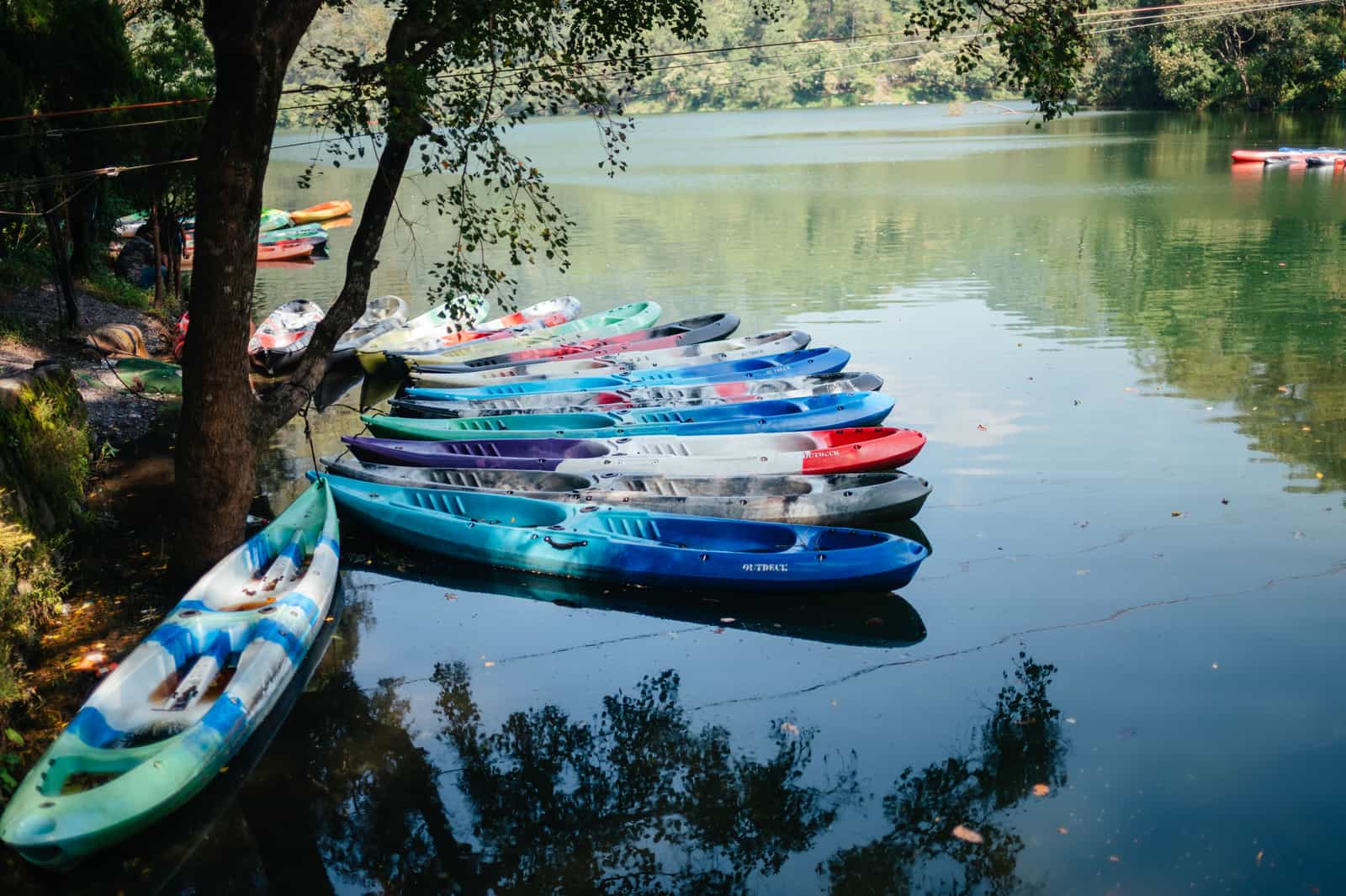
Best Under $500
The Best Kayaks Under $500
Under $500 is where a real hard-shell hull just becomes possible. What the bracket buys, which boats sit either side of the line, and the one to avoid.
Top pick
Pelican Seek 100X Sit-on-Top Kayak, 10 ft
A sit-on-top that still fits a small car
#ad · how this is funded · price as of October 18, 2026

Best Budget Board
The Best Budget Paddle Boards
The entry-tier boards where the compromise is one you can live with — a missing spec, a narrower deck, a starter paddle — named per board so you choose the right one.
Top pick
Roc Inflatable Stand Up Paddle Board, 10 ft 6 in x 33 in
The default first inflatable board
#ad · how this is funded · price as of October 18, 2026
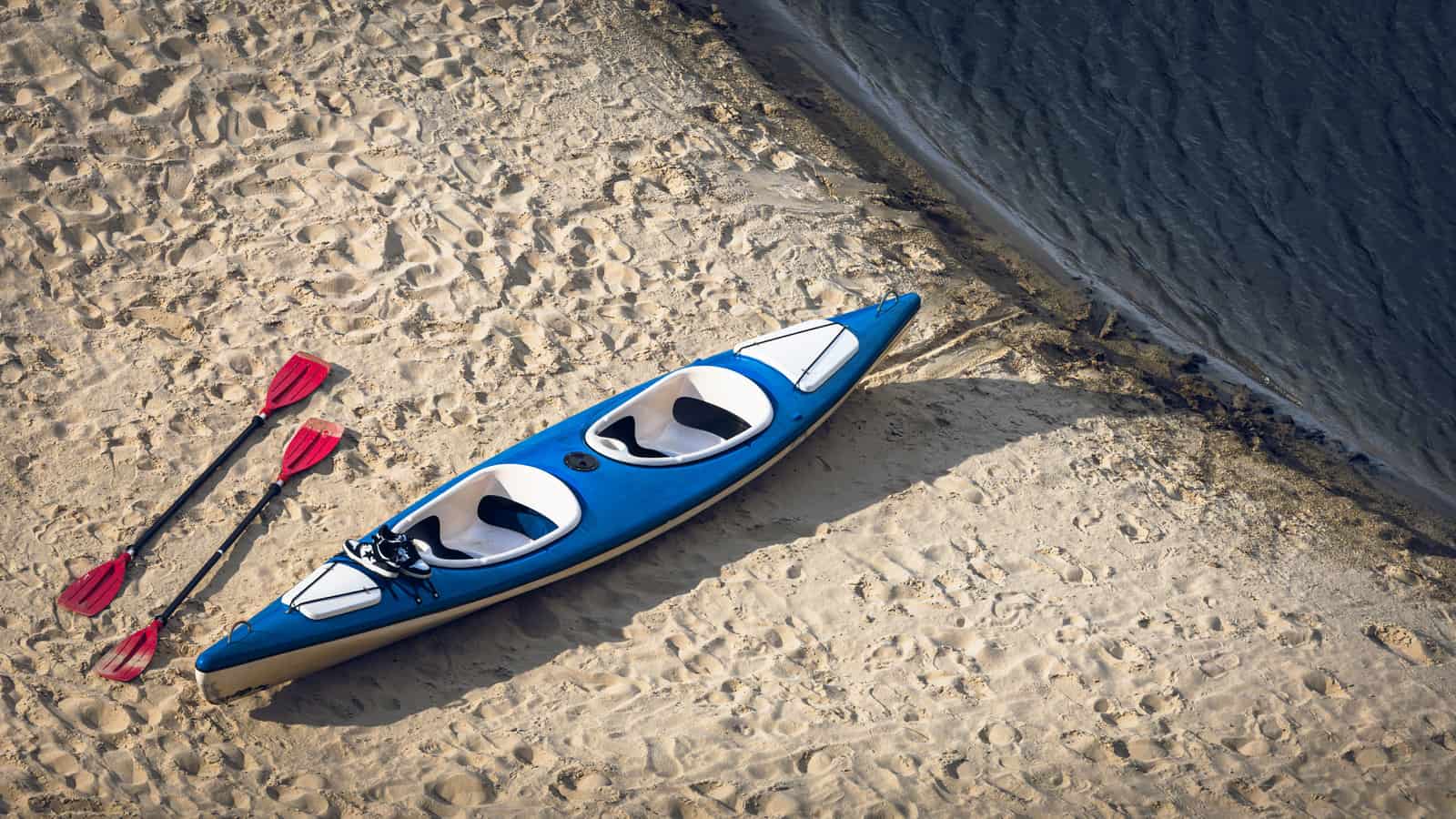
Pelican vs Lifetime Kayaks
The two big-box kayak brands, hull against hull on published weight, beam and capacity. Which wins for a light paddler, a heavy one, and someone who lifts alone.
Top pick
Pelican Argo 100X Sit-In Kayak, 10 ft
The lightest sit-inside to carry alone
#ad · how this is funded · price as of October 18, 2026
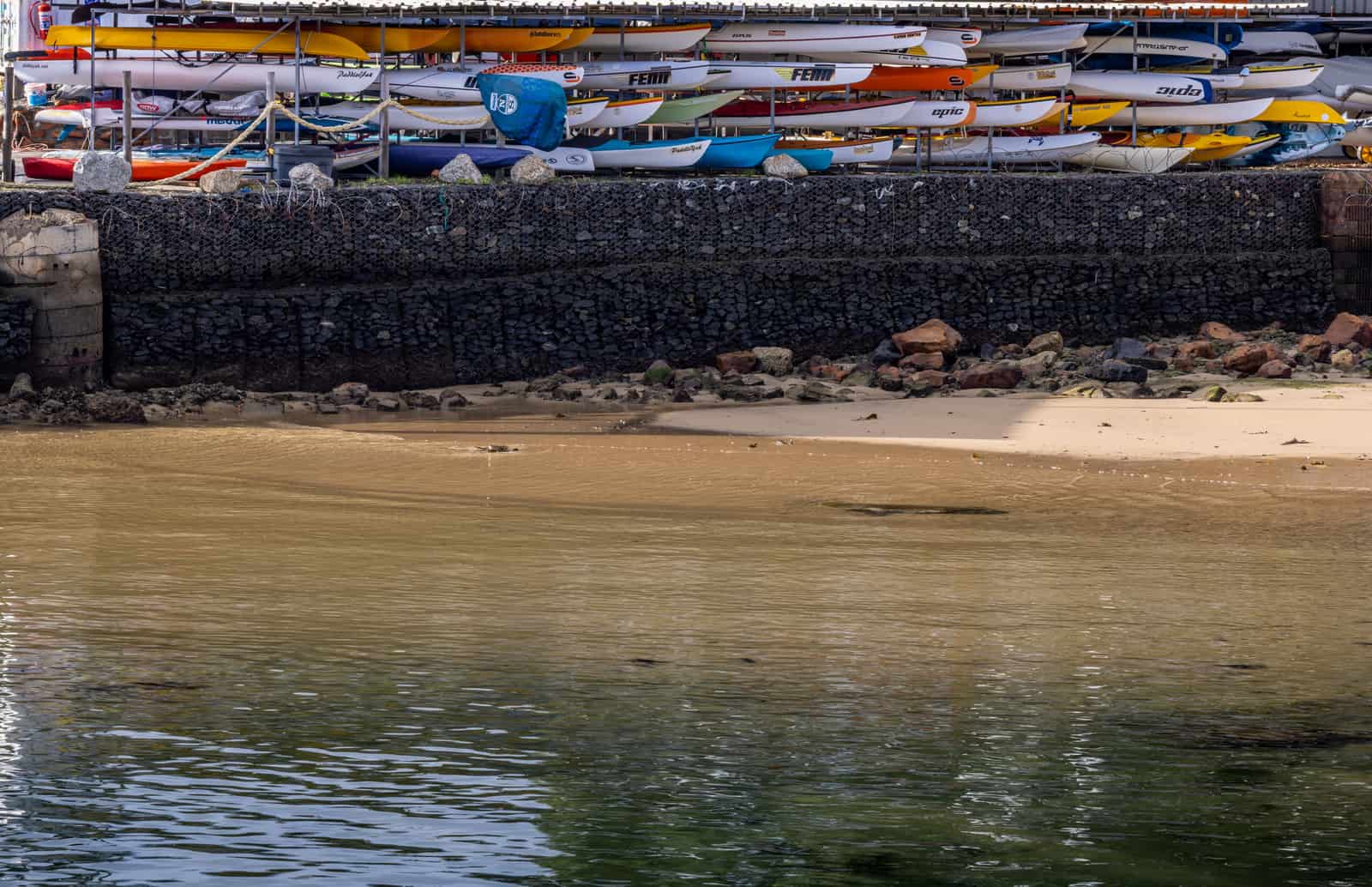
Should You Rent or Buy Your First Kayak?
Rental breaks even against a starter kayak in about four to six outings. The math, plus the three cases where renting is genuinely the better call.
Top pick
Lifetime Lotus Sit-on-Top Kayak, 8 ft (paddle included)
The cheapest complete way onto flat water
#ad · how this is funded · price as of October 18, 2026