Kayaks
Perception Tribe 11.5 vs Pelican Seek 100X
These are the two open-deck kayaks this site points people at most often, and they are within a quarter of an inch of each other on the spec everybody shops for. The decision is made somewhere else entirely.
We have not paddled these, and we are not going to pretend we have. Here is what we did instead. Links to Amazon earn us a commission at no extra cost to you, and commission never decides a pick — how this site is funded.
| # | Product | Best for | The spec it turns on | Price |
|---|---|---|---|---|
| 1 | 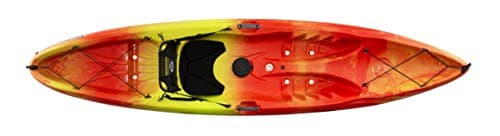 Perception Tribe 11.5 Sit-on-Top KayakTop pickThe combination almost nothing else manages: 350 lb of rating, a 30 in beam and enough waterline to hold a line, in a hull a first-timer can climb back onto from the water. | The all-round first sit-on-top | 137 in long, 30.25 in beam, 52 lb hull, 350 lb rated capacity | |
| 2 | 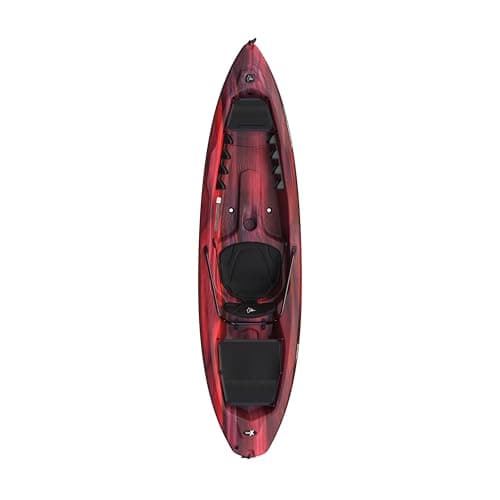 Pelican Seek 100X Sit-on-Top Kayak, 10 ftNine pounds lighter and seventeen inches shorter than the Tribe, for eight pounds less usable capacity. That trade is the whole reason to pick this one. | A sit-on-top that still fits a small car | 120 in long, 30 in beam, 43.1 lb hull, 300 lb rated capacity |
Between them these two boats appear in more of our roundups than anything else on the site: the Tribe 11.5 in sixteen, the Seek 100X in eight. They are the mainstream recommendation for someone who wants an open deck they can climb back onto, and they get cross-shopped constantly — usually on price, which is the least informative thing about them.
We have not paddled either boat. What follows is what the two published specifications mean when you put them side by side and run the same arithmetic we apply to everything here.
First, the spec that is not the difference
Width is the number a first-time buyer shops on, because width is stability and stability is the thing they are worried about. On these two boats it is a non-factor: the Tribe publishes 30.25 inches and the Seek publishes 30. A quarter of an inch is not a difference you can feel, and both sit squarely inside the 29 to 31 inch band we recommend for a first kayak.
So neither of these is the steadier boat when you are sitting still. Put that question down and the real decision becomes visible, and it is a three-way trade between how much you weigh, how far you paddle, and who lifts the boat onto the car.
| Spec | Tribe 11.5 | Seek 100X | Which wins |
|---|---|---|---|
| Length | 138 in (11 ft 5 in) | 120 in (10 ft) | Tribe — 18 in more waterline |
| Beam | 30.25 in | 30 in | Neither. This is a tie |
| Depth | 12.75 in | 14 in | Tribe — less side for the wind to push |
| Hull weight | 52 lb | 43.1 lb | Seek, by 8.9 lb |
| Rated capacity | 350 lb | 300 lb | Tribe, by 50 lb |
| Paddler after a 20 lb kit | 208 lb | 175 lb | Tribe, by 33 lb |
| Enclosed storage | Center hatch | None — fabric covers | Tribe |
| Entry and exit aids | Molded knee/thigh areas | Ergobar removable bar system | Seek |
| Seating | Adjustable framed seatback, padded pan | Adjustable Ergoform system | Tie — both adjustable |
| Origin | Made in the USA | Not stated on the listing | Tribe, if that matters to you |
Top pick — The all-round first sit-on-top
Perception Tribe 11.5 Sit-on-Top Kayak
The combination almost nothing else manages: 350 lb of rating, a 30 in beam and enough waterline to hold a line, in a hull a first-timer can climb back onto from the water.
What the listing publishes
137 in long, 30.25 in beam, 52 lb hull, 350 lb rated capacity
Usable at the 65 percent rule: 228 lb (range 210–245 lb), which leaves about 208 lb of paddler after a 20 lb day kit. Why 65 percent.
350 lb rated is about 228 lb usable at 65 percent and 208 lb of paddler after a day kit -- the most headroom of any single boat here, and enough that a 200 lb adult is inside the comfortable band rather than at the edge of it.
Sit-on-top means the deck is open and self-draining. The reason that matters to a beginner is not comfort, it is that remounting from deep water is a maneuver you can actually perform, where a flooded sit-inside cockpit is not.
52 lb is the price. This is at the top of what one person carries any distance, and the reason a cart appears in our cost totals for this boat and not for the Argo.
What it does well
- 350 lb rated capacity gives real headroom for larger adults or a child up front
- Open self-draining deck is the forgiving choice for a first summer
- 137 in of hull tracks far better than the 9 and 10 ft boats here
What it costs you
- 52 lb is a two-person lift onto a roof for most people
- You will get wet. Sit-on-tops always do, and that is a season decision not a design flaw
- 11 ft 5 in needs more storage length than the 10 ft boats
Skip this if you paddle in cold water or a cold shoulder season. An open deck in 55-degree water is a different and less pleasant sport, and a sit-inside is the right answer there.
#ad · how this is funded · price as of October 9, 2026
Pick 2 — A sit-on-top that still fits a small car
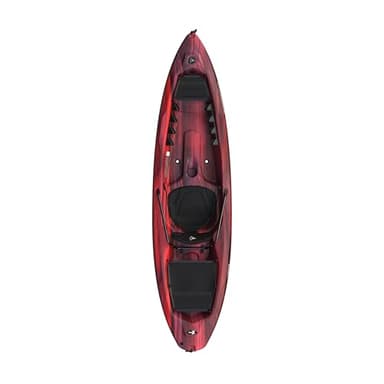
Pelican Seek 100X Sit-on-Top Kayak, 10 ft
Nine pounds lighter and seventeen inches shorter than the Tribe, for eight pounds less usable capacity. That trade is the whole reason to pick this one.
What the listing publishes
120 in long, 30 in beam, 43.1 lb hull, 300 lb rated capacity
Usable at the 65 percent rule: 195 lb (range 180–210 lb), which leaves about 175 lb of paddler after a 20 lb day kit. Why 65 percent.
300 lb rated is about 195 lb usable and 175 lb of paddler after gear -- enough for most adults, and 33 lb less headroom than the Tribe.
43 lb and 10 ft is the point where a sit-on-top becomes a one-person, one-trip job. Ten feet also fits inside a lot of vehicles that 11 ft 5 in does not.
The twin-arch hull section trades a little flat-water stillness for a hull that leans predictably rather than suddenly, which is a genuinely nicer feel once you are past the first hour.
What it does well
- 43 lb keeps this a one-person carry, unusual for a sit-on-top
- 30 in beam at only 10 ft means stability without the storage problem
- Self-draining deck with the same easy remount as any sit-on-top
What it costs you
- 300 lb rating is 50 lb short of the Tribe's
- 10 ft of hull wanders more than 11 ft 5 in on open water
- Same cold-water objection as every sit-on-top
Skip this if you and a child will regularly be on it together. The usable capacity does not cover two people once you subtract gear, and the Tribe or a tandem does.
#ad · how this is funded · price as of October 9, 2026
Capacity: 33 pounds of paddler
This is the single biggest functional gap between them, and it is the one that decides the purchase for a large share of buyers. Rated capacity is a load at which the hull sits where the designer intended rather than a strength limit, so we work at 65 percent of it and subtract what you carry.
If you are over about 175 lb, this comparison is already settled and the rest of the page is context. A boat loaded past its working figure sits low, drains slowly through its own scupper holes and feels sluggish from the first stroke — and none of the Seek's advantages compensate for that.
Eighteen inches of waterline
Length is what makes a kayak hold a course. A short hull turns willingly, which sounds like a virtue and means it also turns when a crosswind asks it to — and a crosswind asks constantly. The correcting strokes that follow are the most common reason a new paddler comes home tired and blames their fitness.
At 138 inches the Tribe has enough waterline to track properly on open water. At 120 inches the Seek does not, and no technique closes that gap. The Seek is a sheltered-water boat that happens to be easy to transport, not an open-water boat that happens to be light — and framing it that way makes the choice much easier.
There is a second, smaller point buried in the depth figures. The Seek is the deeper hull at 14 inches against the Tribe's 12.75, despite being shorter and lighter. More depth above the waterline is more side for the wind to push, which works against the shorter boat in exactly the conditions it already struggles in. What each hull shape does.
Nine pounds, at shoulder height
Here is the Seek's actual case, and it is a strong one. Open-deck kayaks are heavy — the deck that makes them easy to remount is a lot of extra plastic, and most 10 to 11 foot sit-on-tops land between 50 and 60 lb. At 43.1 lb the Seek sits below that band and the Tribe, at 52 lb, sits at the top of it.
Nine pounds reads as trivial on a spec sheet and is not trivial above your head next to a car. Fifty-two pounds is roughly the line where a hull stops being a confident one-person lift for an average adult, which is why our cost totals add a cart for the Tribe and not for the lighter boats. Getting it to the water.
This matters more than it looks, because carry weight predicts how often a boat actually gets used better than any other published number. A kayak that needs a second person and a plan goes out on arranged trips; one an adult can shoulder alone goes out on impulse. Carry weight across every boat we cover.
Storage, and what fits inside a car
Eighteen inches sounds like a detail until you measure a garage. Ten feet stores diagonally in a single garage, stands against a fence, and will go inside some larger vehicles with the tailgate down. Eleven foot five does none of those reliably and is a roof-rack boat, permanently.
If you are in an apartment, a shared driveway or a small garage already holding a car, that is not a minor consideration — it is frequently the whole decision, and it is worth measuring before you compare anything else. Where to keep it.
The fittings diverge more than the hulls do
The two hulls are closer than the two equipment lists. This is where the boats stop being similar.
- **The Tribe has a center storage hatch.** A genuine enclosed compartment, with a built-in drink holder alongside. The Seek's storage is a ripstop tankwell cover and a bow ripstop bag — fabric, not sealed, and a different class of thing. If you want somewhere to put a phone that is not strapped to the deck, that is the Tribe. Either way it goes in a dry bag first.
- **The Tribe has molded knee and thigh areas** plus integrated footrests, which is what lets you brace against the boat and paddle with your torso rather than just your arms. It is the difference between sitting in a kayak and being connected to one.
- **The Seek has the Ergobar system** — three removable bars positioned, in Pelican's words, to simplify entry and exit while staying clear of the paddle stroke. Nothing on the Tribe does this job.
- **The Seek publishes a slip-resistant standing area.** Treat that as a non-slip surface rather than an invitation: 30 inches at 10 feet is a marginal standing platform, and if fishing on your feet is the goal neither of these is the boat. What that actually needs.
- **Both are open, self-draining decks** with adjustable seating and toggle handles. The fundamentals are the same.
Where the money goes
The Tribe is the considerably more expensive boat, and we will not print figures in prose because they move — the live number sits on each buy button above. What is stable is what the gap buys: 50 lb of rating, 18 inches of waterline, an enclosed hatch, molded thigh braces and US manufacture.
Whether that is worth it is not a question about the boats, it is a question about you. For a 140 lb paddler on a sheltered reservoir with a long carry from the parking lot, almost none of what the Tribe adds is reachable, and the Seek is plainly the better buy. For a 190 lb paddler crossing a lake, the Tribe is not better value — it is the only one of the two that works.
Which one
- **Over about 175 lb of paddler: the Tribe.** The arithmetic decides it and nothing else on this page can overturn it.
- **Open lakes, or any real distance: the Tribe.** Eighteen inches of waterline is the difference between traveling and correcting.
- **You load the car alone: the Seek.** 43.1 lb against 52 lb is the gap between a one-person job and a planned one.
- **Tight storage, or a car you hoped to put the boat inside: the Seek.** Ten feet goes places 11 ft 5 in does not.
- **Difficulty getting in and out: the Seek.** The Ergobar system has no equivalent on the Tribe.
- **You want somewhere dry and enclosed for small items: the Tribe.** A hatch is not a fabric cover.
- **Still not sure: measure your storage, then weigh yourself with your gear.** Those two numbers settle this comparison more often than any preference does. What size kayak you actually need.
Questions people actually ask
Is the Perception Tribe 11.5 or the Pelican Seek 100X more stable?
What is the weight limit on the Tribe 11.5 and the Seek 100X?
Which is lighter, the Tribe 11.5 or the Seek 100X?
Which tracks better?
Can you stand up in either of these kayaks?
Is the Perception Tribe 11.5 worth the extra money?
Which is better for a beginner?
Where these numbers came from
Every figure on this page traces to one of these. Where a number could not be sourced, the page says so rather than estimating it.
- Eddyline Kayaks — Maximum weight capacity versus ideal capacity for various styles of kayaks (manufacturer, states the 60-70% ideal-capacity band)
- Perception Tribe 11.5 Sit-on-Top Kayak — manufacturer specification as published on the Amazon listing, read 2026-09-26
- Pelican Seek 100X Sit-on-Top Kayak, 10 ft — manufacturer specification as published on the Amazon listing, read 2026-09-26
Read next
Perception Tribe 11.5: More Capacity Than It Looks
350 lb rated, 30.25 in wide, 11 ft 5 in long — the most usable capacity of any solo boat here, at 52 lb.
Top pick
Perception Tribe 11.5 Sit-on-Top Kayak
The all-round first sit-on-top
#ad · how this is funded · price as of October 9, 2026
Pelican Seek 100X: The Sit-On-Top That Fits a Small Car
43.1 lb and 10 ft make it a one-person carry, rare for a sit-on-top. A 30 in beam lands in the beginner band. The 300 lb rating is the limit to check.
Top pick
Pelican Seek 100X Sit-on-Top Kayak, 10 ft
A sit-on-top that still fits a small car
#ad · how this is funded · price as of October 9, 2026

Best for Lakes
The Best Kayaks for Lakes
Lake paddling rewards waterline length. The boats that hold a line when the wind gets up, with the numbers.
Top pick
Perception Tribe 11.5 Sit-on-Top Kayak
The all-round first sit-on-top
#ad · how this is funded · price as of October 9, 2026
Best First Kayak
The Best Kayaks for Beginners
Beginner kayaks ranked on width, carry weight and usable capacity — with the 65 percent arithmetic run on every one.
Top pick
Perception Tribe 11.5 Sit-on-Top Kayak
The all-round first sit-on-top
#ad · how this is funded · price as of October 9, 2026

Sit-On-Top vs Sit-In Kayak
Water temperature and remounting decide this, not preference. The honest comparison, with picks for each.
Top pick
Perception Tribe 11.5 Sit-on-Top Kayak
The all-round first sit-on-top
#ad · how this is funded · price as of October 9, 2026
Kayak Weight Capacity, Explained
The 65 percent rule, where it comes from, what happens when you ignore it, and how to size around it.
Top pick
Perception Tribe 11.5 Sit-on-Top Kayak
The all-round first sit-on-top
#ad · how this is funded · price as of October 9, 2026