Choosing Your First
Where to Keep a Kayak or Paddle Board
Storage is a purchase decision disguised as a chore. It decides which craft you can own at all, and getting it wrong quietly damages the boat.
We have not paddled these, and we are not going to pretend we have. Here is what we did instead. Links to Amazon earn us a commission at no extra cost to you, and commission never decides a pick — how this site is funded.
| # | Product | Best for | The spec it turns on | Price |
|---|---|---|---|---|
| 1 | 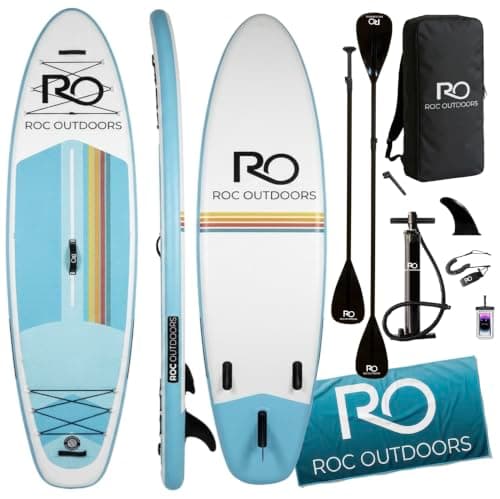 Roc Inflatable Stand Up Paddle Board, 10 ft 6 in x 33 inTop pick10 ft 6 in by 33 in is the shape the whole beginner category converged on, and this is the cheapest version of it that publishes a 350 lb rating. | The default first inflatable board | 126 x 33 x 6 in, 350 lb rated capacity, PVC drop-stitch, full accessory kit | |
| 2 | 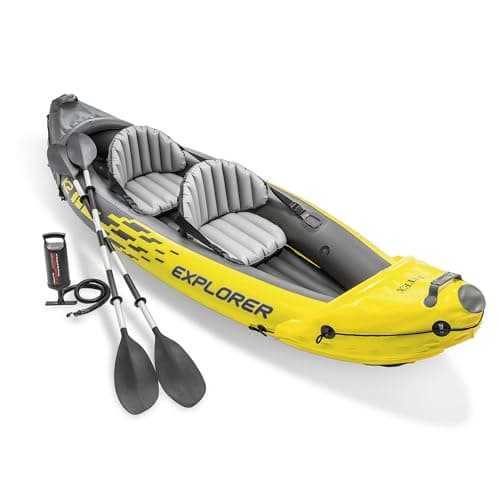 Intex Explorer K2 Inflatable Kayak, 2-person (oars and pump included)Bought as a tandem it disappoints; bought as a very roomy solo boat with 400 lb of rating and no rack requirement, it is the most useful inflatable here. | Two people, no roof rack, small budget | 123 in long, 36 in beam, 35 lb packed, 400 lb rated capacity, two oars and a pump included |
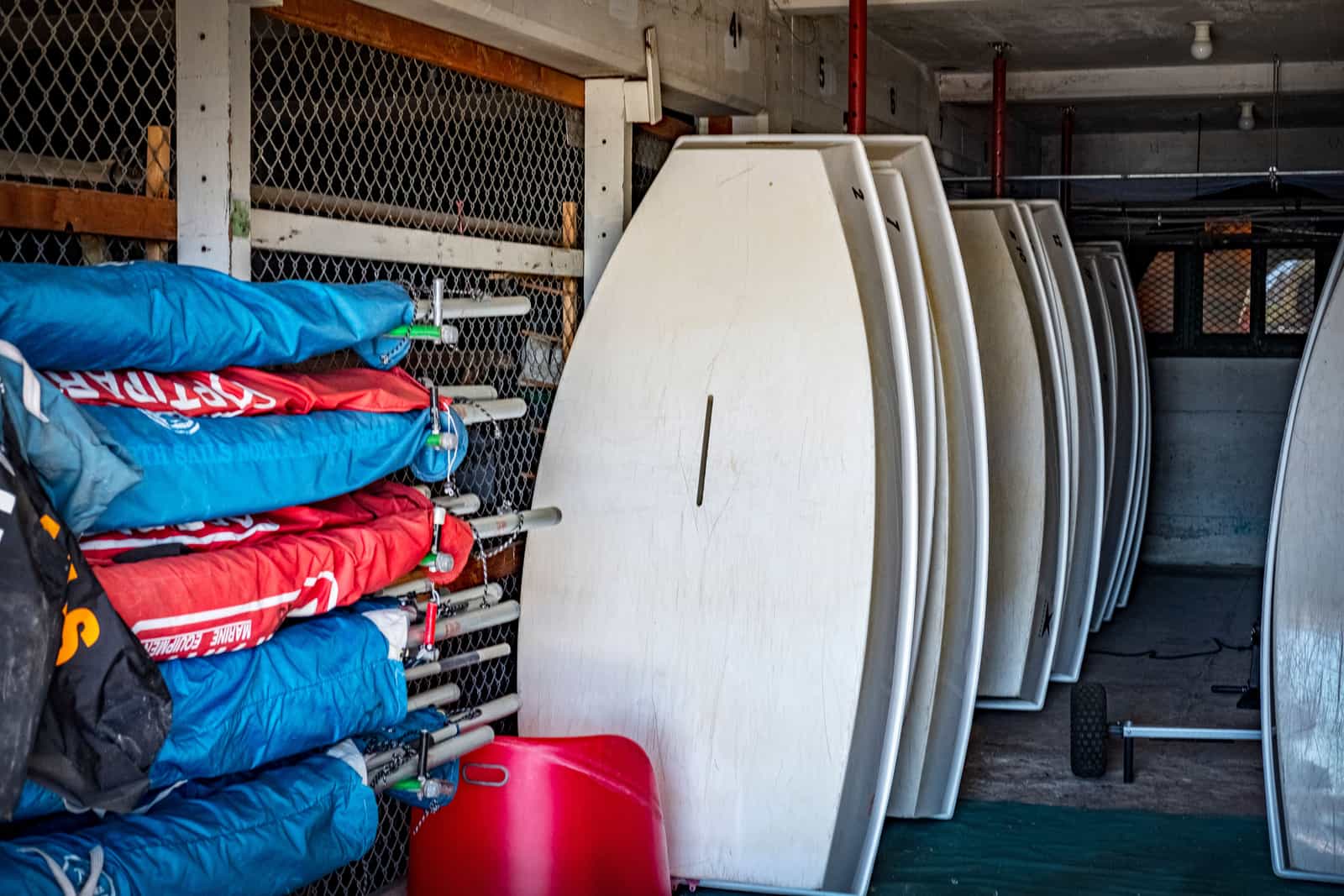
Storage gets treated as an afterthought and it is really a purchase constraint. A ten to twelve foot hard-shell needs somewhere permanent to live, and if that place does not exist the boat ends up in the way of something else and then does not get used.
Worth working out before you buy rather than after. It is one of the main arguments for an inflatable, and it is why the inflatable kayak is an underrated answer to a problem people usually solve by not buying a boat at all.
Hard-shell kayaks: support it properly
A rotomolded polyethylene hull will slowly take the shape of whatever it rests on, especially in heat. That is not a durability problem — the plastic does not fail — but a boat stored flat on its hull for a season develops a flat spot that changes how it sits in the water.
- **Store it on its side or upside down**, not flat on the hull. The deck and the sides are stiffer than the bottom.
- **Support it at two points, about a third of the way in from each end.** That is where the hull is strongest. Supporting it at the very ends lets the middle sag.
- **Use wide straps or padded cradles**, not narrow bars or hooks. A narrow support concentrates the load and creates a dent.
- **Keep it out of direct sun.** UV is what actually degrades polyethylene, and it does it slowly and permanently.
- **Do not store it under tension.** A boat cinched hard against a wall all winter takes a set.
The options, by the space you have
| Space | Approach | Watch out for |
|---|---|---|
| Garage wall | Padded wall brackets, boat on its side | Bracket spacing — a third in from each end |
| Garage ceiling | Pulley hoist, hull-up | Strap width. Two wide straps, not two ropes |
| Outdoors, under cover | Sawhorses or a rack, upside down, covered | UV. A cover that breathes, not a tarp that traps damp |
| Outdoors, uncovered | Not recommended | UV and standing water. This is how hulls age fastest |
| Flat or apartment | An inflatable, honestly | A 10 ft hard-shell in a flat is a permanent negotiation |
| Standing on end | Fine for short boats, on the stern with padding | Tipping. Secure it to a wall |
Inflatables: dry, loose, cool
Inflatable boards and kayaks are easier to store and easier to damage through neglect. Three rules cover nearly all of it.
- **Completely dry before it goes away.** Water trapped in a rolled board for a winter grows mold on the deck pad and inside the valve housing. This is the single most common way people damage an inflatable.
- **Rolled loosely, not tight.** Hard creases in the same place year after year stress the PVC. Roll from the nose, loosely, and do not compress it.
- **Somewhere cool.** Not a car trunk in summer, not an attic. Heat and UV are what age PVC, and a rolled board in a hot loft is the worst case.
The off-season
Less involved than people expect. Neither craft needs winterizing in the way an engine does.
- **Rinse the salt off** if you paddle salt water, and let it dry properly. Fresh water is not corrosive and needs nothing.
- **Leave hatches and drain plugs open**, so air moves through and condensation does not sit inside a sealed hull.
- **Take the seat off** if it is removable, and store it indoors. Foam and fabric age faster than plastic.
- **Loosen everything.** Bungees, straps and hatch straps left under tension for six months take a set and lose their elasticity.
- **Check the drain plug in spring** before you launch. This is the classic first-trip-of-the-season mistake.
If you genuinely have no space
Then that is the decision, and it is worth accepting rather than fighting. An inflatable board rolls into a rucksack-sized bag; an inflatable kayak into something similar. Both live in a cupboard, and both are real craft rather than compromises.
Top pick — The default first inflatable board
Roc Inflatable Stand Up Paddle Board, 10 ft 6 in x 33 in
10 ft 6 in by 33 in is the shape the whole beginner category converged on, and this is the cheapest version of it that publishes a 350 lb rating.
What the listing publishes
126 x 33 x 6 in, 350 lb rated capacity, PVC drop-stitch, full accessory kit
Usable at the 65 percent rule: 228 lb (range 210–245 lb), which leaves about 208 lb of paddler after a 20 lb day kit. Why 65 percent.
33 in of width is the number that decides whether you stand up on day one. Our width guidance puts 32 to 33 in as the beginner band for an adult between 150 and 200 lb, and this sits in it.
350 lb rated capacity means about 227 lb of loaded paddler at 65 percent. Applying the displacement arithmetic instead, a 195 lb loaded paddler wants roughly 195 L of volume -- this hull's 126 x 33 x 6 in envelope is comfortably past that.
Six inches of thickness is what makes a modern inflatable stiff. Four-inch boards flex under an adult in the middle and that flex is what people mistake for the board being unstable.
What it does well
- 33 in wide -- the width that gets a first-timer standing rather than kneeling
- 350 lb rating covers an adult with a child or a dog on board
- Ships with pump, paddle, leash and bag, so the listing price is close to the total
What it costs you
- The included paddle and pump are starter parts you will eventually replace
- 10 ft 6 in is a compromise length -- not fast, not especially maneuverable
- The listing does not publish a board weight
Skip this if you already know you want to cover distance. A 10 ft 6 in all-around board is a cruiser and an 11 ft 6 in touring shape is the honest answer for mileage.
#ad · how this is funded · price as of October 18, 2026
Pick 2 — Two people, no roof rack, small budget
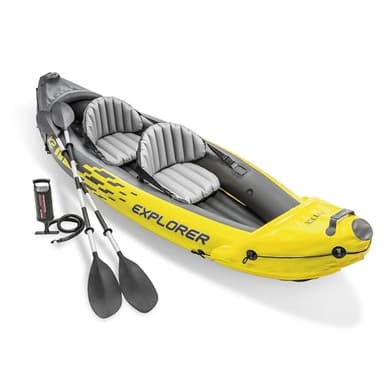
Intex Explorer K2 Inflatable Kayak, 2-person (oars and pump included)
Bought as a tandem it disappoints; bought as a very roomy solo boat with 400 lb of rating and no rack requirement, it is the most useful inflatable here.
What the listing publishes
123 in long, 36 in beam, 35 lb packed, 400 lb rated capacity, two oars and a pump included
Usable at the 65 percent rule: 260 lb (range 240–280 lb), which leaves about 240 lb of paddler after a 20 lb day kit. Why 65 percent.
400 lb rated is about 260 lb usable at 65 percent. Two adults and gear will exceed that more often than not, which is why we recommend it as a spacious single rather than a genuine two-seater.
As a solo it is transformative: 260 lb of usable capacity against the Challenger K1's 143 lb, for nine extra pounds in the bag.
36 in of beam is wider than every hard-shell on this site. Inflatables are wide because air is what makes them stiff, and the side effect is a very forgiving platform.
What it does well
- 400 lb rated capacity -- 260 lb usable, which covers almost any solo adult with gear
- 36 in beam is the most stable platform on this site
- 35 lb in a bag: no rack, no straps, no garage
What it costs you
- Genuinely tight as a two-adult tandem once you apply the usable-capacity rule
- The included oars are oars, not proper kayak paddles -- budget to replace them
- Vinyl construction wallows in wind like every boat in this class
Skip this if you want a true two-adult tandem. Buy a hard-shell tandem with 500 lb or more of rating, or accept this as the roomiest solo inflatable in the price class.
#ad · how this is funded · price as of October 18, 2026
Questions people actually ask
How should I store a kayak?
Can I store a kayak outside?
Can you leave an inflatable paddle board inflated?
How do you store an inflatable kayak over winter?
Does a kayak need to be winterized?
Where can I keep a kayak in an apartment?
Where these numbers came from
Every figure on this page traces to one of these. Where a number could not be sourced, the page says so rather than estimating it.
- Thurso Surf — What Size Paddle Board Is Right for You (manufacturer, states the weight-in-kg x 2 volume rule and the 32 in beginner width band)
- Roc Inflatable Stand Up Paddle Board 10'6" — manufacturer specification as published on the Amazon listing, read 2026-09-02
- Intex Explorer K2 Inflatable Kayak — manufacturer specification as published on the Amazon listing, read 2026-09-02
Read next

Inflatable vs Hard Paddle Board
Hard boards are better boards. Inflatables are better first boards. Here is exactly where each one wins.
Top pick
Roc Inflatable Stand Up Paddle Board, 10 ft 6 in x 33 in
The default first inflatable board
#ad · how this is funded · price as of October 18, 2026
Best Inflatable Kayak
The Best Inflatable Kayaks
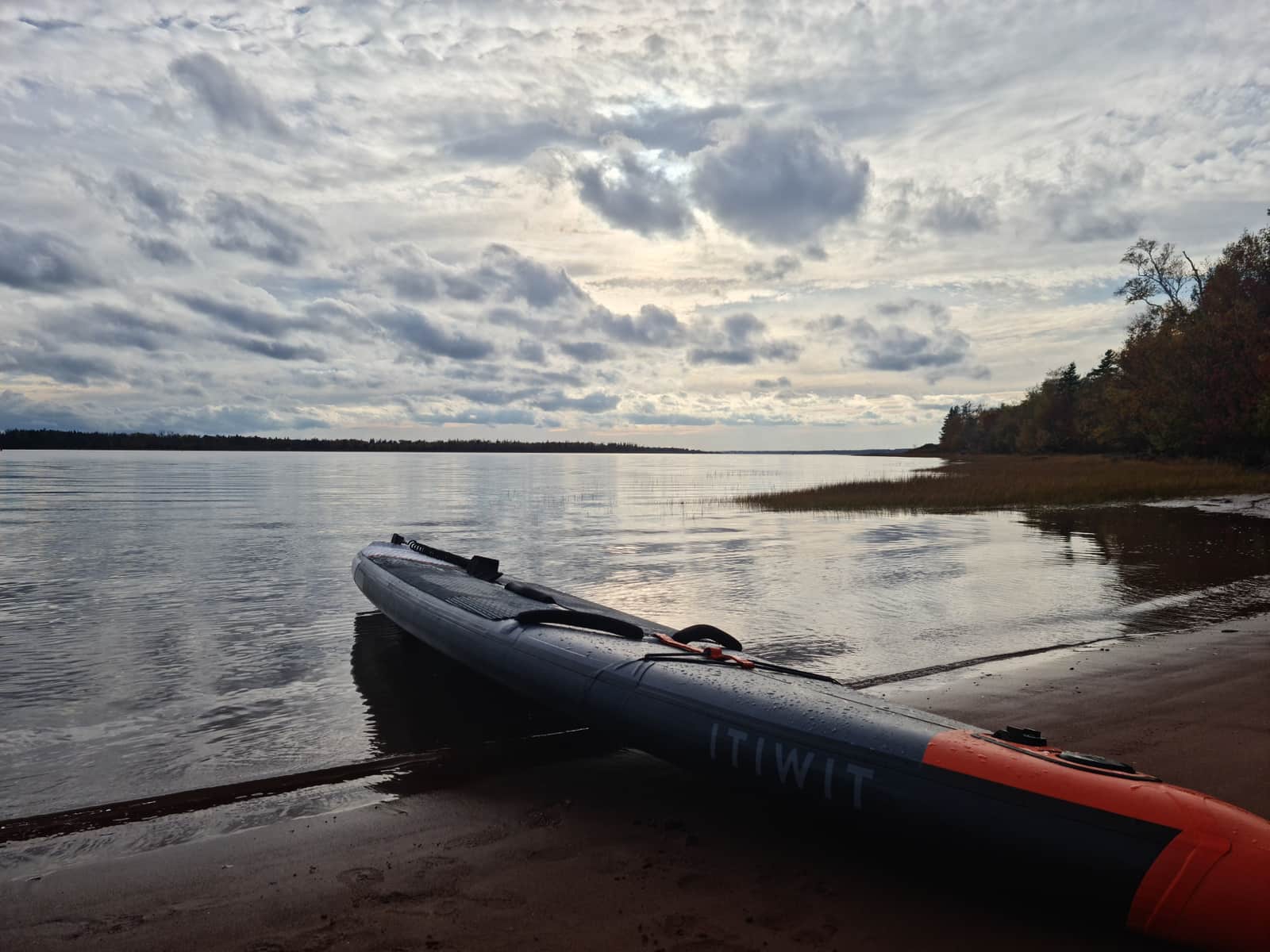
Inflatable kayaks ranked on capacity and hull stiffness — including the 220 lb rating that rules out most adults.
Top pick
Intex Explorer K2 Inflatable Kayak, 2-person (oars and pump included)
Two people, no roof rack, small budget
#ad · how this is funded · price as of October 18, 2026
Getting Your Kayak to the Water
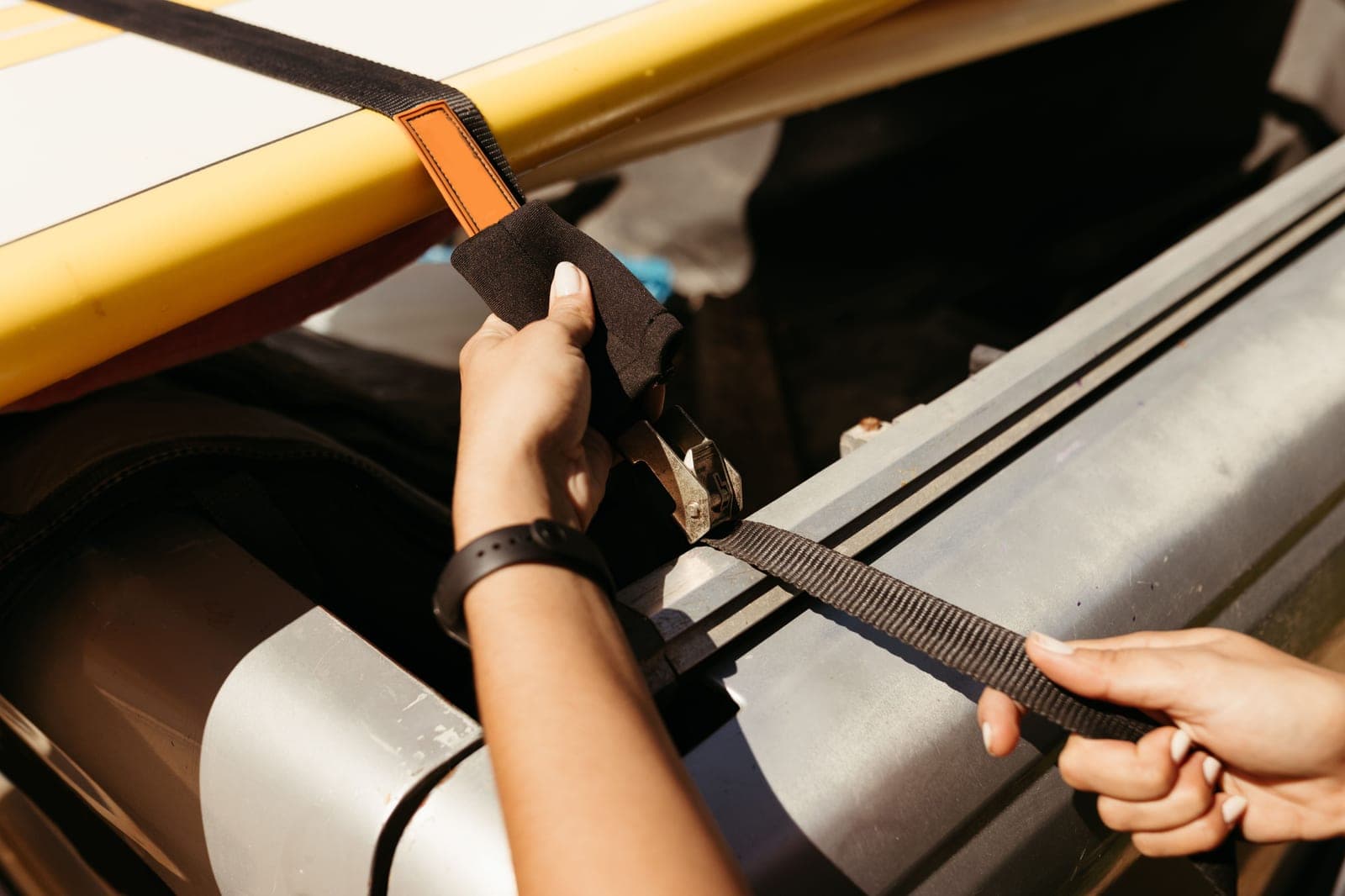
Four ways to move a kayak, including one that needs no roof bars and one that removes the problem entirely.
Top pick
Attwood Universal Rack-Free Car-Top Kayak Carrier Kit
A car with no roof bars at all
#ad · how this is funded · price as of October 18, 2026

Best Pump
Pumps, Pressure and Patches
Hand versus electric, and why the last three PSI are the ones that decide how the board feels.
Top pick
SereneLife Electric Paddle Board Pump, 20 PSI dual-stage
Anyone who launches more than twice a month
#ad · how this is funded · price as of October 18, 2026

What a First Setup Actually Costs
Every line item in a first setup, including the ones that surprise people — with live prices rather than stale numbers.
Top pick
Perception Tribe 11.5 Sit-on-Top Kayak
The all-round first sit-on-top
#ad · how this is funded · price as of October 18, 2026