Kayaks
The Best Kayaks for Lakes
A lake is open water with fetch, which means wind, which means the short wide boats sold as beginner kayaks are working against you. Length is the specification that matters here.

We have not paddled these, and we are not going to pretend we have. Here is what we did instead. Links to Amazon earn us a commission at no extra cost to you, and commission never decides a pick — how this site is funded.
| # | Product | Best for | The spec it turns on | Price |
|---|---|---|---|---|
| 1 | 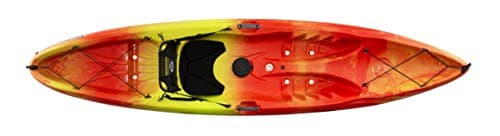 Perception Tribe 11.5 Sit-on-Top KayakTop pickThe combination almost nothing else manages: 350 lb of rating, a 30 in beam and enough waterline to hold a line, in a hull a first-timer can climb back onto from the water. | The all-round first sit-on-top | 137 in long, 30.25 in beam, 52 lb hull, 350 lb rated capacity | |
| 2 | 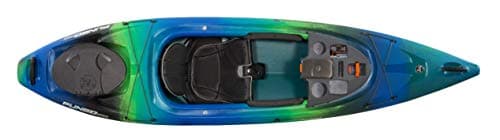 Wilderness Systems Pungo 105 Recreational Kayak, 10 ft 6 inThe only hull here that will still feel right in year three, because the seat and the waterline were designed for people who paddle for three hours rather than forty minutes. | The boat you keep after your first season | 126 in long, 30 in beam, 47 lb hull, 300 lb rated capacity | |
| 3 | 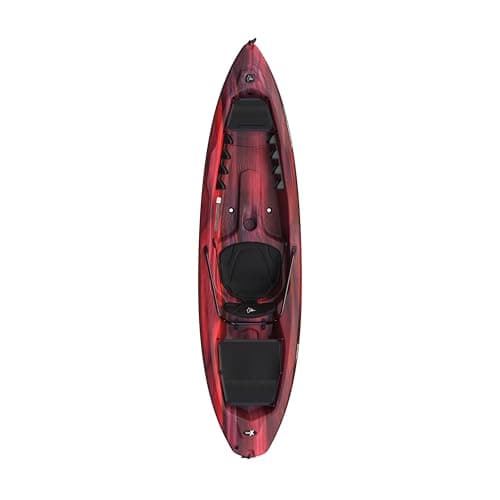 Pelican Seek 100X Sit-on-Top Kayak, 10 ftNine pounds lighter and seventeen inches shorter than the Tribe, for eight pounds less usable capacity. That trade is the whole reason to pick this one. | A sit-on-top that still fits a small car | 120 in long, 30 in beam, 43.1 lb hull, 300 lb rated capacity | |
| 4 | 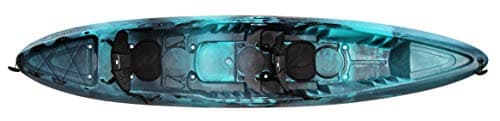 Perception Rambler 13.5 Tandem Sit-on-Top Kayak550 lb rated is the highest here, and it is the only figure on this page that genuinely covers two adults and a passenger once the 65 percent rule is applied. | Two adults plus a child or a dog | 162 in long, 34 in beam, 78 lb hull, 550 lb rated capacity |
Lake paddling looks like the easiest kind and it has one specific difficulty that ponds and sheltered creeks do not: fetch. Fetch is the distance wind travels unobstructed across water, and it is what turns a breeze into chop and a boat into something you are steering rather than paddling.
That single fact reorders the specifications. On a pond, width is king and length barely matters. On a lake, length is what determines whether an afternoon is pleasant.
Why length matters more here
A short hull sits in the water like a leaf. Wind pushes the bow around, you correct, the wind pushes it back, and across a mile you have made perhaps forty percent more paddle strokes than the distance required. It is not dangerous — it is just tiring, and it is the reason people describe lake paddling as harder work than they expected.
A longer waterline resists that. There is more hull in the water for the wind to have to rotate, and a defined keel line gives it something to bite against. Eleven feet is where this becomes noticeable and twelve is better.
| Length | Where it works | How it behaves | Who it is for |
|---|---|---|---|
| Under 10 ft | Ponds, small lakes, tight creeks | Turns easily, slow, wanders on open water | Kids, small ponds, tiny storage |
| 10 to 11 ft | Lakes, slow rivers, first boat | The recreational default. Easy to turn, easy to carry, easy to store | Almost every first-time buyer |
| 11 to 12 ft | Bigger lakes, light touring | Noticeably faster, still turns, heavier to lift | A first boat you expect to keep |
| 12 to 14 ft | Open water, day trips with gear | Fast and tracks straight, needs a rack and two people to load | Second boat, not a first one |
| Over 14 ft | Sea kayaking, multi-day touring | Fast, gear-hungry, unforgiving of a beginner's edge control | Not a first boat |
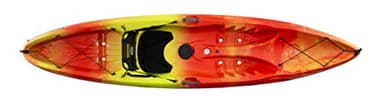
Top pick — The all-round first sit-on-top
Perception Tribe 11.5 Sit-on-Top Kayak
The combination almost nothing else manages: 350 lb of rating, a 30 in beam and enough waterline to hold a line, in a hull a first-timer can climb back onto from the water.
What the listing publishes
137 in long, 30.25 in beam, 52 lb hull, 350 lb rated capacity
Usable at the 65 percent rule: 228 lb (range 210–245 lb), which leaves about 208 lb of paddler after a 20 lb day kit. Why 65 percent.
350 lb rated is about 228 lb usable at 65 percent and 208 lb of paddler after a day kit -- the most headroom of any single boat here, and enough that a 200 lb adult is inside the comfortable band rather than at the edge of it.
Sit-on-top means the deck is open and self-draining. The reason that matters to a beginner is not comfort, it is that remounting from deep water is a maneuver you can actually perform, where a flooded sit-inside cockpit is not.
52 lb is the price. This is at the top of what one person carries any distance, and the reason a cart appears in our cost totals for this boat and not for the Argo.
What it does well
- 350 lb rated capacity gives real headroom for larger adults or a child up front
- Open self-draining deck is the forgiving choice for a first summer
- 137 in of hull tracks far better than the 9 and 10 ft boats here
What it costs you
- 52 lb is a two-person lift onto a roof for most people
- You will get wet. Sit-on-tops always do, and that is a season decision not a design flaw
- 11 ft 5 in needs more storage length than the 10 ft boats
Skip this if you paddle in cold water or a cold shoulder season. An open deck in 55-degree water is a different and less pleasant sport, and a sit-inside is the right answer there.
#ad · how this is funded · price as of October 18, 2026
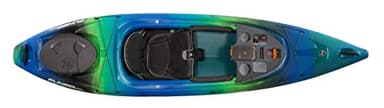
Pick 2 — The boat you keep after your first season
Wilderness Systems Pungo 105 Recreational Kayak, 10 ft 6 in
The only hull here that will still feel right in year three, because the seat and the waterline were designed for people who paddle for three hours rather than forty minutes.
What the listing publishes
126 in long, 30 in beam, 47 lb hull, 300 lb rated capacity
Usable at the 65 percent rule: 195 lb (range 180–210 lb), which leaves about 175 lb of paddler after a 20 lb day kit. Why 65 percent.
126 in of waterline with a defined keel line is why this tracks straight where a 9 ft 5 in flat-bottom does not. Distance stops being a fight, which is the difference between a boat you use twice and one you use twenty times.
300 lb rated is about 195 lb usable and 175 lb of paddler after a day kit. That is less headroom than the Flash despite being the better boat -- the rating is not the quality signal, and this is the clearest example of it on the site.
47 lb is the practical ceiling for a one-person carry from a driveway to a launch. Past this you are into cart territory, and a cart is a real cost that belongs in the total.
What it does well
- 126 in waterline plus a keel line means it holds a course without constant correction
- The seat is the reason people keep these boats -- it is a chair, not a molded dent
- 30 in beam is stable enough that a nervous first-timer relaxes inside ten minutes
What it costs you
- 47 lb is a real carry and gets old across a long parking lot
- 300 lb rating is mid-pack, so a heavier paddler runs out of room before the boat runs out of quality
- Costs more than every other sit-inside here, usually by a wide margin
Skip this if this is a once-or-twice-a-summer boat. Nothing about a better seat and a truer waterline is worth paying for if the hull spends eleven months against a garage wall.
#ad · how this is funded · price as of October 18, 2026
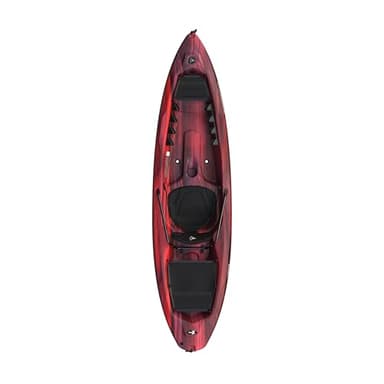
Pick 3 — A sit-on-top that still fits a small car
Pelican Seek 100X Sit-on-Top Kayak, 10 ft
Nine pounds lighter and seventeen inches shorter than the Tribe, for eight pounds less usable capacity. That trade is the whole reason to pick this one.
What the listing publishes
120 in long, 30 in beam, 43.1 lb hull, 300 lb rated capacity
Usable at the 65 percent rule: 195 lb (range 180–210 lb), which leaves about 175 lb of paddler after a 20 lb day kit. Why 65 percent.
300 lb rated is about 195 lb usable and 175 lb of paddler after gear -- enough for most adults, and 33 lb less headroom than the Tribe.
43 lb and 10 ft is the point where a sit-on-top becomes a one-person, one-trip job. Ten feet also fits inside a lot of vehicles that 11 ft 5 in does not.
The twin-arch hull section trades a little flat-water stillness for a hull that leans predictably rather than suddenly, which is a genuinely nicer feel once you are past the first hour.
What it does well
- 43 lb keeps this a one-person carry, unusual for a sit-on-top
- 30 in beam at only 10 ft means stability without the storage problem
- Self-draining deck with the same easy remount as any sit-on-top
What it costs you
- 300 lb rating is 50 lb short of the Tribe's
- 10 ft of hull wanders more than 11 ft 5 in on open water
- Same cold-water objection as every sit-on-top
Skip this if you and a child will regularly be on it together. The usable capacity does not cover two people once you subtract gear, and the Tribe or a tandem does.
#ad · how this is funded · price as of October 18, 2026
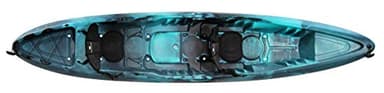
Pick 4 — Two adults plus a child or a dog
Perception Rambler 13.5 Tandem Sit-on-Top Kayak
550 lb rated is the highest here, and it is the only figure on this page that genuinely covers two adults and a passenger once the 65 percent rule is applied.
What the listing publishes
162 in long, 34 in beam, 78 lb hull, 550 lb rated capacity
Usable at the 65 percent rule: 358 lb (range 330–385 lb), which leaves about 338 lb of paddler after a 20 lb day kit. Why 65 percent.
550 lb rated is about 358 lb usable at 65 percent. Two 150 lb adults plus gear fits with room; two 200 lb adults plus gear does not, and no tandem's marketing copy will tell you that.
78 lb is a two-person carry, permanently. That is not a criticism, it is a planning fact: a tandem needs two people to move it and two people to paddle it well.
34 in of beam across 13 ft 6 in is why a dog can stand up on the back of this without it becoming an incident.
What it does well
- 550 lb rated capacity, the only figure here with room for three bodies
- 34 in beam is stable enough for a dog or a fidgeting child
- 13 ft 6 in tracks properly, so two paddlers out of sync still make progress
What it costs you
- 78 lb is a two-person lift every single time
- Needs roof bars and a real plan -- this does not go inside a car
- A tandem paddled solo from the back seat is genuinely awkward
Skip this if you will mostly paddle alone. A tandem solo is unbalanced and unpleasant, and two cheap solo boats often cost less than one good tandem.
#ad · how this is funded · price as of October 18, 2026
The other lake-specific specification: capacity
Lakes mean longer trips, and longer trips mean more gear — more water, a proper lunch, a dry bag with a change of clothes, sometimes a passenger. That all lands against the same rated capacity, and a boat that fits you for an hour on a pond can be over its ideal load for a day on a lake.
Does that kayak actually fit you?
Put in your weight and the rated capacity printed on the listing. This is the arithmetic the listing does not do for you.
The answer
No — you are 5 lb over
A 300 lb rating is the point at which the hull still floats, not the point at which it still behaves. Eddyline, a kayak manufacturer, publishes that the ideal load stops at about 60 to 70 percent of the maximum. At 65 percent that is 195 lb of everything aboard, and after a 20 lb day kit — paddle, PFD, water, dry bag — about 175 lb of paddler.
You are not going to sink. You will sit lower than the hull was designed to sit, which costs you stability and speed and makes the boat feel worse than it is. Look for a rating of at least 325 lb.
Where that came from
usable capacity = rated capacity x 0.60 to 0.70
300 x 0.65 = 195 lb of paddler, gear, clothing and PFD
Practical lake rules
- **Paddle out into the wind, back with it.** Wind almost always builds through the day, so the tired return leg should be the easy direction.
- **Stay within a swim of the shore until you are confident.** A lake looks small from the middle and is not.
- **Watch for boat wakes, not waves.** On most lakes the largest water you meet is from a passing boat, and it arrives from a direction the wind is not coming from.
- **Turn back at half your energy, not half your time.** The return leg is the one that goes wrong.
- **Check whether the lake requires registration.** Several states register non-motorized paddlecraft and some lakes have their own launch rules — this varies by state and is worth ten minutes before your first trip.
What to skip for a lake
- **Boats under 10 feet.** They wander badly in any breeze, and a lake supplies one on most days.
- **Soft-hulled inflatables**, unless portability is your binding constraint. A vinyl hull with no defined bow pushes water and blows around. The stiffer inflatables are a different proposition.
- **Pontoon fishing hulls**, unless you are fishing. The drag is real and a lake is where you feel it.
Questions people actually ask
What size kayak is best for a lake?
Are short kayaks bad on lakes?
How windy is too windy for kayaking on a lake?
Do I need to register a kayak on a lake?
Sit-on-top or sit-inside for lake paddling?
Where these numbers came from
Every figure on this page traces to one of these. Where a number could not be sourced, the page says so rather than estimating it.
- Eddyline Kayaks — Maximum weight capacity versus ideal capacity for various styles of kayaks (manufacturer, states the 60-70% ideal-capacity band)
- U.S. Coast Guard — Recreational Boaters (federal equipment requirements for vessels, paddlecraft included)
- Perception Tribe 11.5 Sit-on-Top Kayak — manufacturer specification as published on the Amazon listing, read 2026-09-02
- Wilderness Systems Pungo 105 Recreational Kayak — manufacturer specification as published on the Amazon listing, read 2026-09-02
- Perception Rambler 13.5 Tandem Sit-on-Top Kayak — manufacturer specification as published on the Amazon listing, read 2026-09-02
Read next
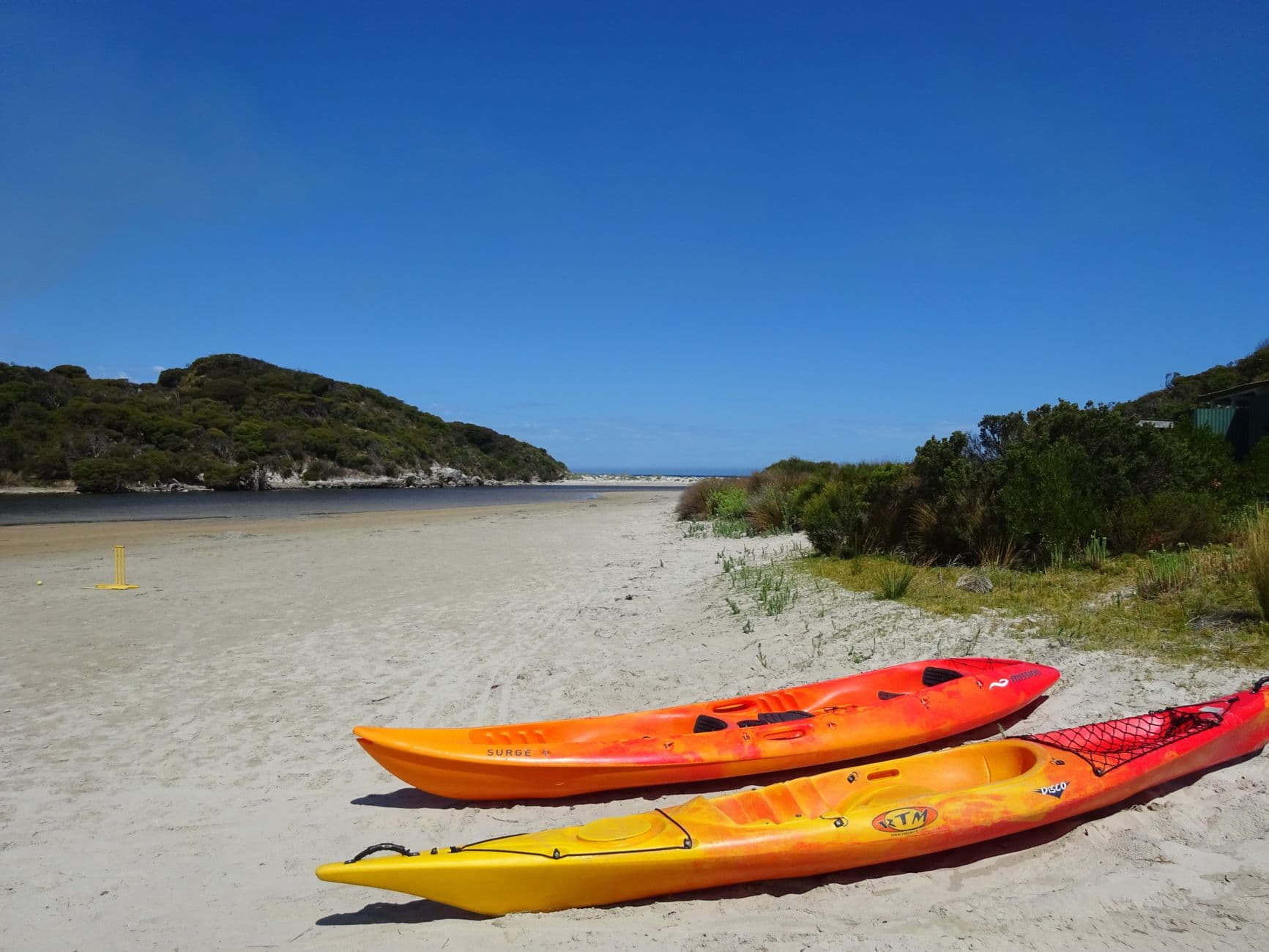
Perception Tribe 11.5 vs Pelican Seek 100X
Same beam, different everything else. 33 lb more paddler and 18 in more waterline against 8.9 lb less to lift — the trade, with the arithmetic.
Top pick
Perception Tribe 11.5 Sit-on-Top Kayak
The all-round first sit-on-top
#ad · how this is funded · price as of October 18, 2026
Pelican Seek 100X: The Sit-On-Top That Fits a Small Car
43.1 lb and 10 ft make it a one-person carry, rare for a sit-on-top. A 30 in beam lands in the beginner band. The 300 lb rating is the limit to check.
Top pick
Pelican Seek 100X Sit-on-Top Kayak, 10 ft
A sit-on-top that still fits a small car
#ad · how this is funded · price as of October 18, 2026
Perception Rambler 13.5: The Tandem That Actually Fits Three
550 lb rated — about 358 lb usable — is the only tandem figure here with room for two adults and a child or a dog. The 78 lb hull is a permanent two-person carry.
Top pick
Perception Rambler 13.5 Tandem Sit-on-Top Kayak
Two adults plus a child or a dog
#ad · how this is funded · price as of October 18, 2026
Best First Kayak
The Best Kayaks for Beginners
Beginner kayaks ranked on width, carry weight and usable capacity — with the 65 percent arithmetic run on every one.
Top pick
Perception Tribe 11.5 Sit-on-Top Kayak
The all-round first sit-on-top
#ad · how this is funded · price as of October 18, 2026
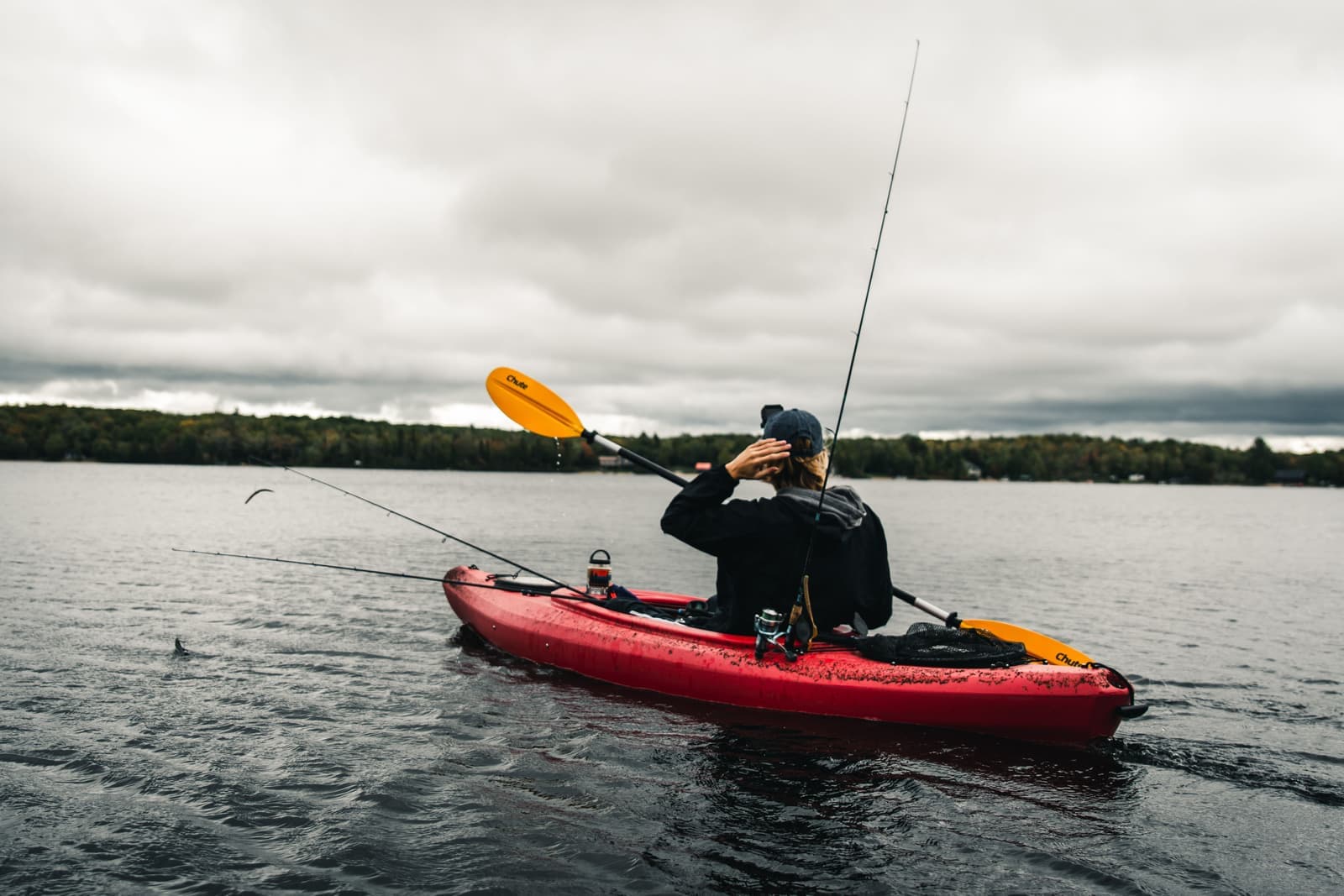
Best Fishing Kayak
The Best Kayaks for Fishing
Tackle is heavier than anyone plans for. The capacity, beam and deck specs that actually decide a first fishing kayak — and why the angler badge is not one of them.
Top pick
Perception Tribe 11.5 Sit-on-Top Kayak
The all-round first sit-on-top
#ad · how this is funded · price as of October 18, 2026
Wilderness Systems Pungo 105: What the Specs Say
126 in of waterline, a 30 in beam, 47 lb and 300 lb rated — the numbers behind the boat people keep after their first season.
Top pick
Wilderness Systems Pungo 105 Recreational Kayak, 10 ft 6 in
The boat you keep after your first season
#ad · how this is funded · price as of October 18, 2026