Gear & Getting There
The Best Kayak Storage Racks (November 2026)
A kayak spends perhaps thirty hours a year on the water and the rest of the year somewhere. Where that somewhere is, and what it is resting on, is what actually decides how long the hull lasts.

We have not paddled these, and we are not going to pretend we have. Here is what we did instead. Links to Amazon earn us a commission at no extra cost to you, and commission never decides a pick — how this site is funded.
| # | Product | Best for | The spec it turns on | Price |
|---|---|---|---|---|
| 1 | 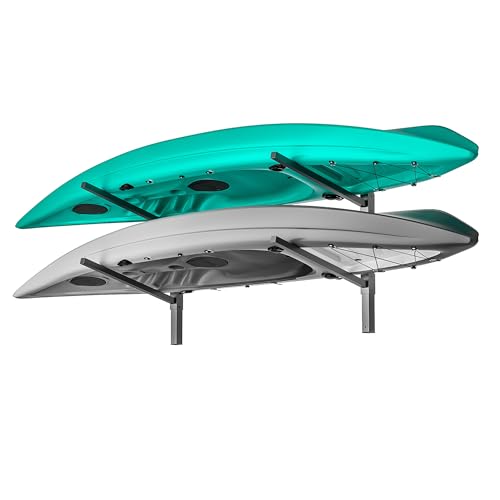 EVERHANGER Wall Mounted Kayak Storage Rack, adjustable, for 2 kayaksTop pickThe wall rack for an actual hard shell: 440 lb published against the hook sets' 50, with arms you can set to the width of your own hull. | A hard-shell hull that is too heavy to hang on hooks | 440 lb published weight capacity, adjustable wall-mounted arms for 2 kayaks, published for indoor and outdoor use | |
| 2 | 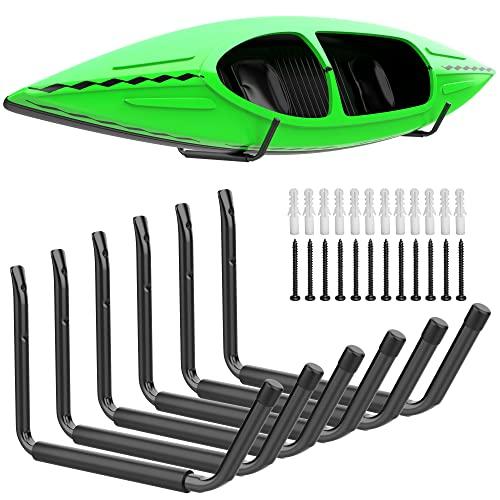 WALMANN Kayak Storage Rack, wall-mount hooks for 3 kayaksTwenty-odd dollars to get three hulls off the floor and onto a wall, and the one number that matters is published: 50 lb. | The cheapest way to get a hull off a garage floor | Wall-mounted hook set for up to 3 kayaks, published as holding up to 50 lb, also listed for canoes, surfboards, paddle boards, skis and ladders | |
| 3 | 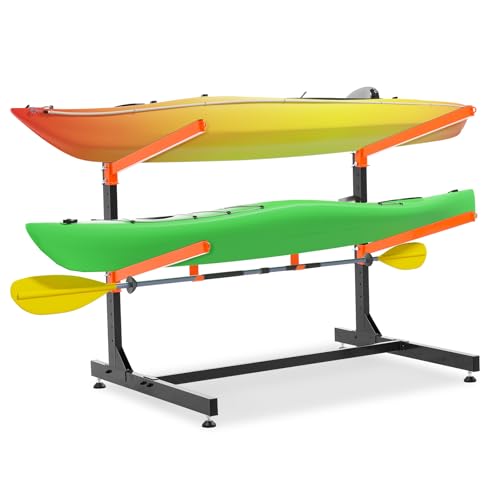 UOKRR 2-Level Kayak Stand, freestandingThe answer when drilling is not an option: it stands on the floor, holds two hulls, and goes with you when the lease ends. | A rented garage, or a wall you cannot drill | Freestanding two-level stand, adjustable, published for indoor and outdoor storage of kayaks, canoes, surfboards and paddleboards. No load capacity published on the listing | |
| 4 | 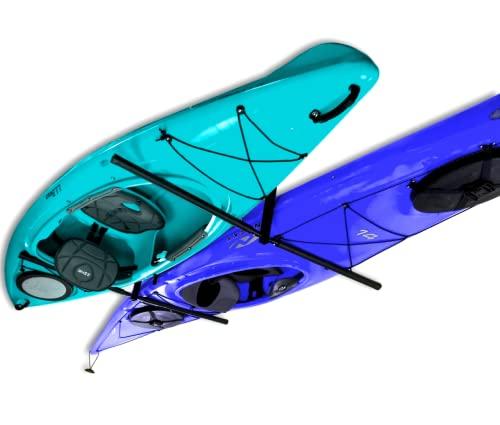 StoreYourBoard Kayak Ceiling Rack, Adjustable Hi Port, holds 2 kayaksThe only direction left in a full garage is up, and an adjustable-drop ceiling rack is how you use it without losing a parking space. | A garage with no spare wall but plenty of roof | Ceiling-mounted rack, adjustable drop, published as holding 2 kayaks and as fitting all garage heights | |
| 5 | 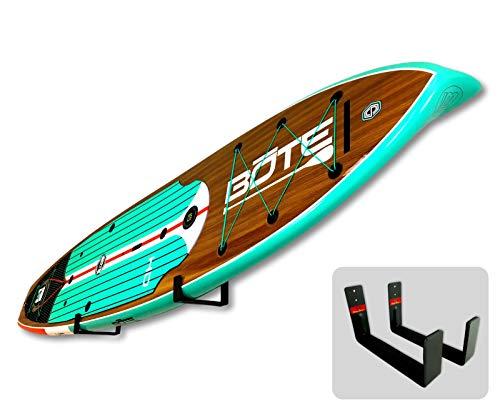 StoreYourBoard Paddle Board Wall Mount Rack, felt paddedFelt padding is the detail that matters on a board rack: a board rests on its rail for months, and the pad is what decides whether it leaves a mark. | A hard board, or an inflatable you keep inflated | Holds 50 lb, felt-padded aluminum arms, wall mount for a paddle board |
Our storing your board or boat page explains how to store a kayak properly: on its side or upside down, supported at two points about a third in from each end, out of direct sun. It is the right advice and it has been on this site since launch. What that page has never had is anything to buy, and that is a gap worth closing, because the two picks on it are a board and a kayak rather than anything you would actually mount on a wall.
So this page is the shopping half of that guide. It ranks five racks on two things: what their listings publish for weight capacity, and which of the three spaces in a garage they consume.
The support rule, before any product
A rotomolded polyethylene hull is stiff but not rigid, and over months it will slowly take the shape of whatever is holding it up. That process is called creep and it is accelerated by heat. A hull left all summer on two narrow hooks under a hot garage roof can develop a permanent flat spot or a visible dent at each contact point, and once it has one it keeps it.
Two rules prevent it, and both are free. Support the boat at roughly a third of its length in from each end rather than at the middle or the very tips, which is where the hull is naturally stiffest. And spread the load across as wide a pad as you can, because a 2 in strap and a 1 in hook under the same 45 lb hull are completely different pressures.
That is the entire reason the adjustable wall rack is ranked first and the hook set second rather than the other way round. The hooks are cheaper and perfectly adequate for a light inflatable or a board; for a hard shell left in place for a season, the arms you can position are worth the difference.
How we judged these
- **Published weight capacity first,** against the actual weight of your boat. The spread here is enormous -- 50 lb to 440 lb -- and a 50 lb rack cannot take most hard-shell kayaks. This is the one specification in the category that genuinely rules products in and out.
- **Then contact area,** per the support rule above. Wide padded arms beat narrow hooks for anything heavy left in place.
- **Then which space it uses.** Wall, floor or ceiling. In a single-car garage this is usually the binding constraint rather than price, and it is why there is one of each on this page.
- **Then whether it needs drilling,** because a rented or shared garage rules out four of these five.
- **Then adjustability,** because a fixed-spacing rack puts the supports wherever the holes went rather than where the hull wants them.
The five, side by side
| Rack | Space used | Published capacity | Holds | Needs drilling |
|---|---|---|---|---|
| EVERHANGER wall rack | Wall | 440 lb | 2 kayaks | Yes, into studs |
| WALMANN hook set | Wall | 50 lb | 3 kayaks | Yes, into studs |
| UOKRR 2-level stand | Floor | Not published | 2 hulls or boards | No |
| StoreYourBoard ceiling rack | Ceiling | Not published in lb | 2 kayaks | Yes, into joists |
| StoreYourBoard SUP wall rack | Wall | 50 lb | 1 board | Yes, into studs |
The capacity column is where the decision gets made, and it is worth being concrete about what 50 lb excludes. A Pelican Argo 100X is 36 lb and fine on hooks. A Perception Tribe 11.5 is 52 lb and over the line. A Perception Rambler 13.5 at 78 lb is not a candidate for either 50 lb product on this page. Check your own hull weight on the lightweight roundup, which lists every published figure we have, before you buy a rack.
Two cells read 'not published' and they stay that way. The freestanding stand publishes no load rating at all, which for a 36 lb boat is academic and for a 78 lb tandem on the upper level is a genuine unknown. The ceiling rack publishes a two-kayak claim rather than a figure in pounds. We would rather print the gap than fill it.
Which space to use, by the garage you actually have
Wall: the default, if you own the wall
A wall rack is the best answer for most people because it gets the hull off the floor, keeps it reachable without lifting overhead, and lets you position the supports properly. The adjustable-arm version is the one to want; the hook set is the budget version of the same idea with less contact area and a much lower rating.
Floor: the answer when you cannot drill
A freestanding stand needs no fixings at all, which makes it the only option in a rented garage, a shared bay or against a wall you are not allowed to touch. It also moves, which matters more than it sounds -- a rack you can shift when you need the space is a rack that does not become an argument. The cost is floor area, which is the exact thing a wall rack exists to save.
Ceiling: the last space in a full garage
In most garages the walls are already holding bikes, tools and shelving, and the ceiling above the car is empty. A kayak is light enough to live up there and an adjustable-drop rack is how you get it there without losing the parking space.
The honest catch is the lift. Getting a 50 lb hull above your head and onto a rack is harder than sliding it onto a wall arm, and it is the step at which people quietly stop using a ceiling rack and leave the boat on the floor again. If you paddle alone and your boat is over about 45 lb, buy the wall rack instead.
Inflatables and boards are a different problem
Everything above is about rigid hulls. If your boat is an inflatable kayak or your board gets deflated and rolled after every trip, you do not need a rack at all -- you need a dry shelf and the discipline to put the thing away completely dry. Our storage guide is blunt about it: heat and UV age an inflatable, water does not, and a damp rolled board is how you get mildew rather than how you get a damaged hull.
The case for a board rack is specifically the household that leaves an inflatable board inflated all season, or owns a hard board. There the contact surface is what matters rather than the rating: a board rests on its rail for months and a felt-padded arm spreads that over a wider strip than a bare bracket does. That is why the one board-specific rack on this page is here, and why its 50 lb rating is irrelevant -- an inflatable board that publishes a weight generally lands between 17 and 25 lb.
UV is what actually kills a hull
Worth stating plainly because it is the mistake a rack encourages. Mounting a rack on an outside wall solves a space problem and creates a worse one: polyethylene chalks and becomes brittle under sustained sunlight, and the color fading is the visible part of a change in the material itself.
Two of the racks here are published for outdoor use, and what that means is that the rack survives outdoors -- not the boat. If a boat has to live outside, it needs a cover or a shaded wall, and upside down rather than open to the sky so it does not become a water butt. The end-of-season checklist covers the winter version of this properly.
What you can ignore while you shop
- **Kayak-count claims.** 'Holds 3 kayaks' is a claim about how many arms there are, not about the total weight. The published capacity is the number that matters.
- **Powder-coat color and finish.** It is a garage bracket.
- **Included hardware.** Assume the supplied screws are for timber studs and buy proper fixings for anything else. This is a five-dollar decision on a fifty-dollar product holding a five-hundred-dollar boat.
- **'Heavy duty' as a phrase,** which appears on every listing in the category including the 50 lb one.
- **Hanging a boat by its grab handles or deck lines.** Not a product feature, a mistake -- those are for carrying and for holding a swamped hull, not for taking its weight for six months.
Questions people actually ask
How should I store a kayak?
What is the best kayak storage rack?
How much weight can a kayak wall rack hold?
Can I store a kayak outside?
Can I store a kayak vertically?
Do I need a rack for an inflatable kayak or paddle board?
How do I store a kayak in an apartment?
Is a ceiling rack or a wall rack better for a kayak?
Where these numbers came from
Every figure on this page traces to one of these. Where a number could not be sourced, the page says so rather than estimating it.
- EVERHANGER Wall Mounted Kayak Storage Rack, 440 lb capacity — manufacturer specification as published on the Amazon listing, read 2026-11-21
- WALMANN Kayak Storage Rack, wall-mount hooks for 3 kayaks — manufacturer specification as published on the Amazon listing, read 2026-11-21
- UOKRR 2-Level Freestanding Kayak Stand — manufacturer specification as published on the Amazon listing, read 2026-11-21
- StoreYourBoard Kayak Ceiling Rack, Adjustable Hi Port — manufacturer specification as published on the Amazon listing, read 2026-11-21
- StoreYourBoard Paddle Board Wall Mount Rack — manufacturer specification as published on the Amazon listing, read 2026-11-21
Read next
Where to Keep a Kayak or Paddle Board
Where to put it, how to avoid deforming the hull, and what the off-season actually requires.
Top pick
Roc Inflatable Stand Up Paddle Board, 10 ft 6 in x 33 in
The default first inflatable board
#ad · how this is funded · price as of November 24, 2026

The End-of-Season Checklist
Twenty minutes at the end of the season, aimed at the two things that actually cause damage over winter.
Top pick
Advanced Elements Double Action Hand Pump with Pressure Gauge
The backup that always works
#ad · how this is funded · price as of November 24, 2026

Lightest to Carry
The Best Lightweight Kayaks
Ranked on published hull weight, because the carry is what decides whether a kayak leaves the garage. What each pound saved costs in capacity.
Top pick
Pelican Argo 100X Sit-In Kayak, 10 ft
The lightest sit-inside to carry alone
#ad · how this is funded · price as of November 24, 2026

Best Roof Rack
The Best Kayak Roof Racks (November 2026)
Five ways to carry a kayak on a car, ranked on published load capacity and crossbar fit. J-cradles against saddles against foam blocks, and which your car can actually take.
Top pick
ERKUL WaveRack J-Style Kayak Roof Rack Kit
A J-cradle set that publishes which crossbars it fits
#ad · how this is funded · price as of November 24, 2026

Inflatable vs Hard Paddle Board
Hard boards are better boards. Inflatables are better first boards. Here is exactly where each one wins.
Top pick
Roc Inflatable Stand Up Paddle Board, 10 ft 6 in x 33 in
The default first inflatable board
#ad · how this is funded · price as of November 24, 2026

Will a Kayak Fit Inside Your Car?
The honest answer is no for hard-shells and yes for inflatables and folding boats. One measurement decides it, and here is what to buy either way.
Top pick
Intex Excursion Pro K1 Inflatable Kayak (paddle and pump included)
The stiffest inflatable in the entry price class
#ad · how this is funded · price as of November 24, 2026