Kayaks
Intex Excursion Pro K1: Stiffness You Can Feel, Capacity You Cannot Ignore
Three-ply laminate and a high-pressure floor are what separate an inflatable that holds a line from one that argues with you. Two hundred and twenty pounds is what separates this boat from the people who want it.
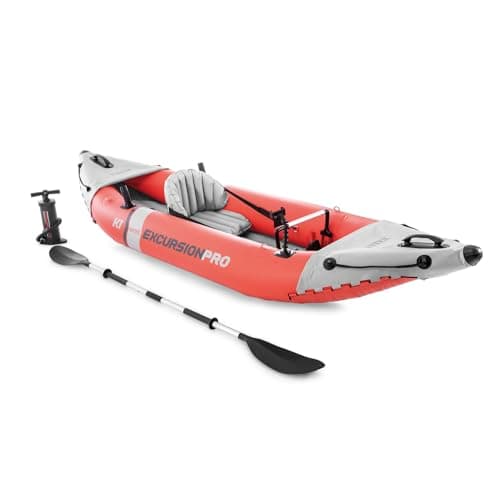
We have not paddled these, and we are not going to pretend we have. Here is what we did instead. Links to Amazon earn us a commission at no extra cost to you, and commission never decides a pick — how this site is funded.
| # | Product | Best for | The spec it turns on | Price |
|---|---|---|---|---|
| 1 | Intex Excursion Pro K1 Inflatable Kayak (paddle and pump included)Top pickA laminate hull and a high-pressure floor rather than plain vinyl, which is the difference between an inflatable that tracks and one that argues with you. | The stiffest inflatable in the entry price class | 120 in long, 36 in beam, 31.2 lb packed, 220 lb rated capacity |
We have not paddled this boat. What follows is what its published specification means, run through the same arithmetic we apply to everything on this site, plus a direct account of who it does not suit.
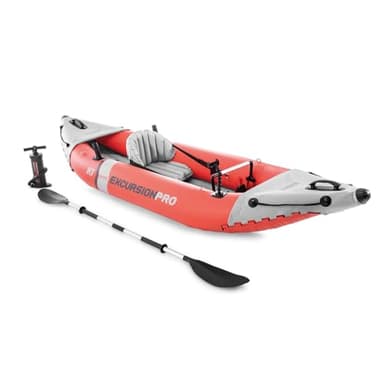
Top pick — The stiffest inflatable in the entry price class
Intex Excursion Pro K1 Inflatable Kayak (paddle and pump included)
A laminate hull and a high-pressure floor rather than plain vinyl, which is the difference between an inflatable that tracks and one that argues with you.
What the listing publishes
120 in long, 36 in beam, 31.2 lb packed, 220 lb rated capacity
Usable at the 65 percent rule: 143 lb (range 132–154 lb), which leaves about 123 lb of paddler after a 20 lb day kit. Why 65 percent.
220 lb rated is about 143 lb usable and 123 lb of paddler after gear -- the same limiting number as the Challenger K1, despite the better construction. Construction quality and capacity are separate specs and this is the clearest case of it on the site.
Stiffness is the whole story with inflatables. A high-pressure floor makes the hull behave like a shape instead of a bag, and it is the single upgrade that most changes how one paddles.
36 in of beam plus a stiff floor is an unusually settled platform for standing to fish or to take a photo.
What it does well
- Laminate hull and high-pressure floor track far better than plain vinyl
- 36 in beam plus a stiff floor is stable enough to stand on carefully
- 31 lb in a bag, still no rack required
What it costs you
- 220 lb rated -- roughly 123 lb of paddler after gear, same as the cheapest Intex
- Higher pressure means more pumping, and a gauge you should actually read
- Costs meaningfully more than the Challenger K1 for no extra capacity
Skip this if capacity is your constraint rather than feel. The Explorer K2 has 180 lb more rating for less money, and it is the better answer for a heavier paddler.
#ad · how this is funded · price as of October 9, 2026
Stiffness is the only thing that matters in an inflatable
A rigid kayak is a shape. An inflatable is a shape only while the air inside it is holding that shape against your weight, and how well it manages that is the difference between a boat and a pool toy. A soft hull flexes in the middle with every stroke, which bleeds away the energy you just put in and lets the ends wander.
Intex publish three-ply laminate construction with what they call SuperStrong PVC, explicitly to allow higher pressure for rigidity, plus a separate high-pressure floor. That combination is the whole argument for this boat over the cheaper Challenger K1, which is plain vinyl.
| Spec | Published | What it means |
|---|---|---|
| Inflated size | 10 ft × 3 ft × 1.6 ft | A full-length hull, not a shortened one |
| Beam | 36 in | The widest boat on this site. Very settled |
| Packed weight | 31.15 lb | Carried in a bag, so no roof rack needed |
| Rated capacity | 220 lb | About 143 lb usable, or 123 lb of paddler after a 20 lb kit |
| Construction | 3-ply laminate, SuperStrong PVC | Takes more pressure, so the hull stays a shape |
| Floor | High-pressure | The single biggest contributor to how it paddles |
| Tracking | Two removable skegs | Deep and shallow water options |
| Included | Two 86 in paddles, pump, two rod holders, device mount, patch | A complete kit, paddles included |
The 220 lb rating is the problem
This is worth dwelling on because it is genuinely counter-intuitive. You pay more for the Excursion Pro and get a better-built boat that carries no more weight. If you are a 180 lb adult, the better construction does not rescue the arithmetic — the Intex Explorer K2, a two-person boat rated 400 lb, is the Intex that actually fits you, paddled solo.
Two skegs, and why that is a real feature
Intex include two removable skegs — the small fins under the stern that stop a hull sliding sideways. Most inflatables at this price include one or none, and a skeg is the cheapest possible fix for the wandering that makes people give up on inflatable kayaks.
Two matters because the right skeg depends on the water. The deeper one bites harder and tracks better on open water; the shallow one clears a gravel bottom and shallow creek beds without catching. Being able to change that in thirty seconds is more useful than it sounds.
Thirty-six inches, and the standing question
This is the widest hull on this site, wider than most paddle boards. Combined with a rigid floor it makes an unusually settled platform — settled enough to turn and take a photograph, to fish sitting down without thinking about it, and for a nervous first-timer to stop gripping the sides within about ten minutes.
Width has a cost and it is speed. Thirty-six inches of beam pushes a lot of water and this is not a fast boat. On an inflatable at this price that is the correct priority: nobody buys their first kayak to go quickly, and plenty of people abandon one because it felt tippy.
What comes in the box
- **Two 86 inch paddles.** Aluminum starter paddles — the part of the kit you replace first, and 86 in is short for a 36 in beam. Why length matters more than material.
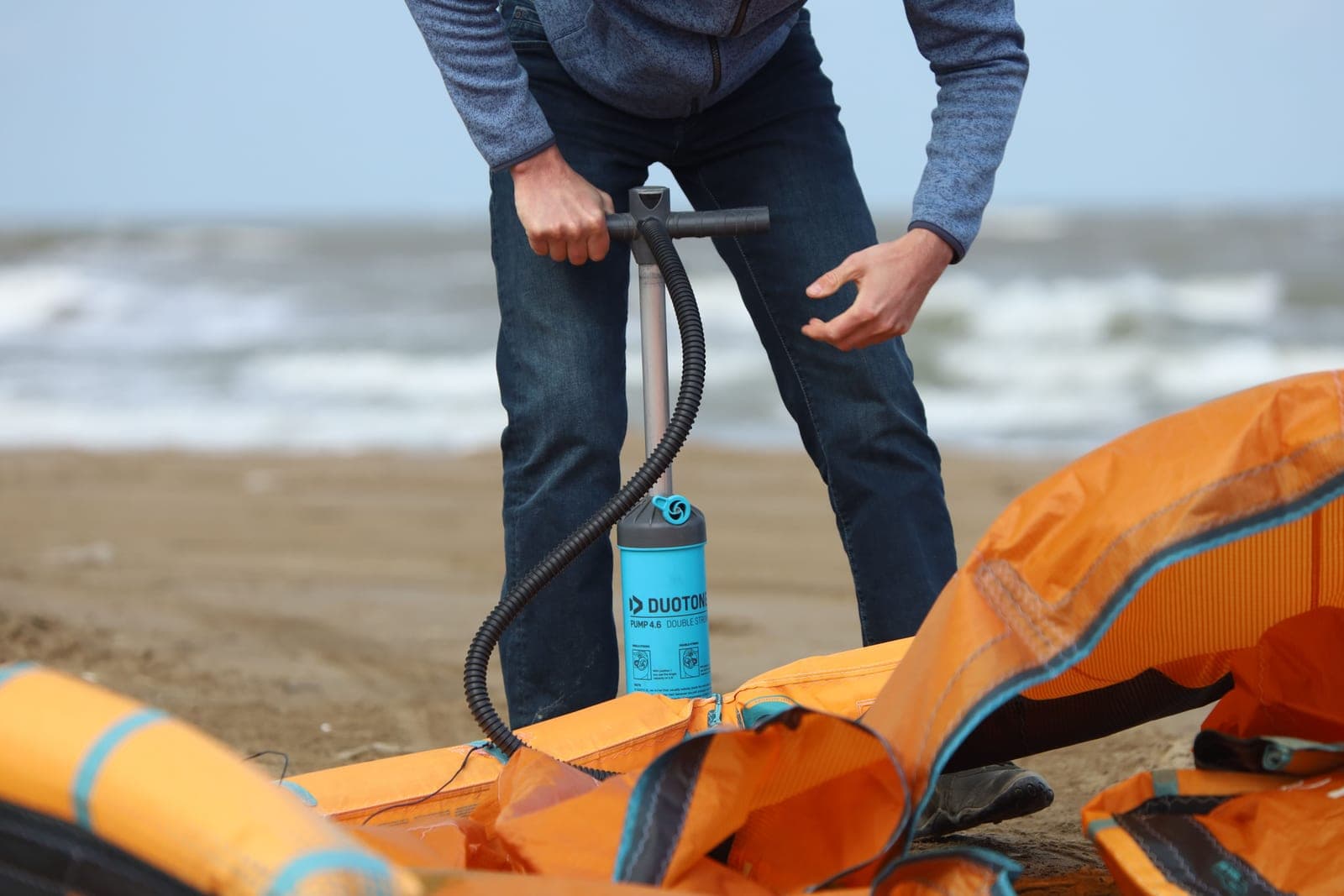
- **A high-output hand pump.** Adequate and slow. An electric pump is the upgrade that makes an inflatable get used. Pumps, honestly.
- **Two detachable rod holders**, which makes casual fishing plausible on a very stable hull.
- **A GoPro and phone mount**, and a repair patch. The patch is the one that matters — keep it in the bag.
Inflatable ownership, briefly
The reason to buy an inflatable is not price, it is storage and transport: 31 lb in a bag lives in a cupboard and travels in a car trunk, and it never needs a roof rack. The cost is a setup and pack-down routine at both ends of every trip, and a boat that must be dried before it goes away or it will mildew. Whether an inflatable is the right call at all.
Who should buy it
- **Paddlers under about 123 lb** who want the best-behaved inflatable at this end of the market.
- **Anyone with no storage and no roof rack.** A cupboard and a car trunk is the whole requirement.
- **Nervous beginners.** Thirty-six inches and a stiff floor is about as settled as a kayak gets.
- **Casual anglers** who want rod holders and a platform that does not react to leaning over the side.
Who should not
- **Anyone over about 123 lb of paddler.** Look at the Intex Explorer K2 and its 400 lb rating instead, paddled solo.
- **Anyone who wants speed.** Thirty-six inches is the opposite of speed.
- **Anyone who will resent the setup routine.** Twenty minutes each end, every trip, forever.
- **Anyone with a garage and a rack.** At this money a rotomolded hull is available and it needs no pump. What $500 actually buys.
Questions people actually ask
What is the weight limit of the Intex Excursion Pro K1?
Is the Intex Excursion Pro K1 better than the Challenger K1?
How long does the Intex Excursion Pro K1 take to inflate?
Can you fish from an Intex Excursion Pro K1?
What are the two skegs for on the Excursion Pro?
Is an inflatable kayak worth it over a hard-shell?
Where these numbers came from
Every figure on this page traces to one of these. Where a number could not be sourced, the page says so rather than estimating it.
Read next
Best Inflatable Kayak
The Best Inflatable Kayaks
Inflatable kayaks ranked on capacity and hull stiffness — including the 220 lb rating that rules out most adults.
Top pick
Intex Explorer K2 Inflatable Kayak, 2-person (oars and pump included)
Two people, no roof rack, small budget
#ad · how this is funded · price as of October 9, 2026
Are Inflatable Kayaks Worth It?
Worth it if storage or a roof rack is your problem. Not worth it if performance is. How to tell which buyer you are from the published capacity and your own garage.
Top pick
Intex Explorer K2 Inflatable Kayak, 2-person (oars and pump included)
Two people, no roof rack, small budget
#ad · how this is funded · price as of October 9, 2026
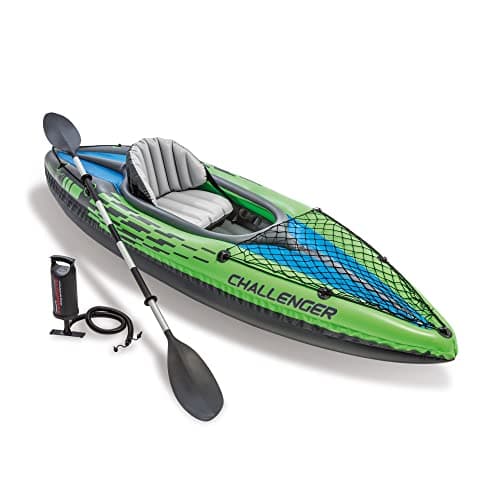
Intex Challenger K1: The Capacity Is the Catch
26 lb in a bag solves storage entirely. 220 lb rated is about 123 lb of paddler, which rules out most adults.
Top pick
Intex Challenger K1 Inflatable Kayak (paddle and pump included)
No car rack, no garage, no storage
#ad · how this is funded · price as of October 9, 2026
Intex Challenger K1 vs Explorer K2
The two cheapest inflatables, hull against hull. The counter-intuitive answer: the two-person K2 is the better solo boat for most adults, because 400 lb rated beats 220.
Top pick
Intex Explorer K2 Inflatable Kayak, 2-person (oars and pump included)
Two people, no roof rack, small budget
#ad · how this is funded · price as of October 9, 2026
Lightest to Carry
The Best Lightweight Kayaks
Ranked on published hull weight, because the carry is what decides whether a kayak leaves the garage. What each pound saved costs in capacity.
Top pick
Pelican Argo 100X Sit-In Kayak, 10 ft
The lightest sit-inside to carry alone
#ad · how this is funded · price as of October 9, 2026