Kayaks
Intex Challenger K1 vs Explorer K2
One is sold as a solo boat and one as a tandem, and that framing sends a lot of people to the wrong one. The rated capacity is what should decide it, and it points somewhere surprising.
We have not paddled these, and we are not going to pretend we have. Here is what we did instead. Links to Amazon earn us a commission at no extra cost to you, and commission never decides a pick — how this site is funded.
| # | Product | Best for | The spec it turns on | Price |
|---|---|---|---|---|
| 1 | 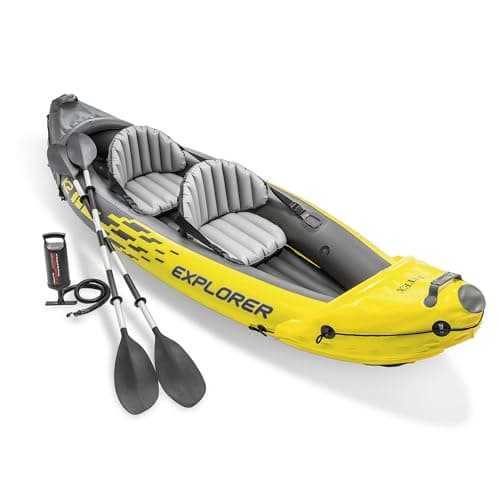 Intex Explorer K2 Inflatable Kayak, 2-person (oars and pump included)Top pickBought as a tandem it disappoints; bought as a very roomy solo boat with 400 lb of rating and no rack requirement, it is the most useful inflatable here. | Two people, no roof rack, small budget | 123 in long, 36 in beam, 35 lb packed, 400 lb rated capacity, two oars and a pump included | |
| 2 | 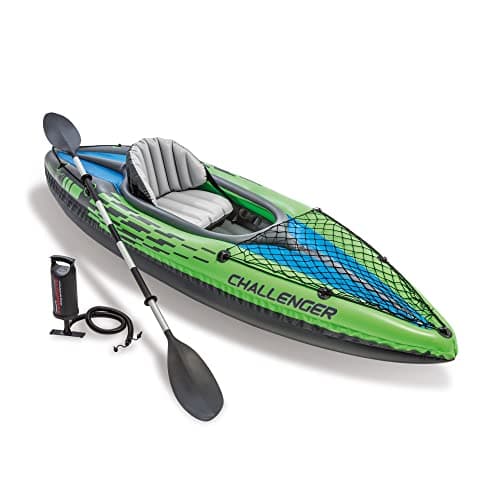 Intex Challenger K1 Inflatable Kayak (paddle and pump included)The honest answer to 'I have an apartment and a sedan'. It is a real boat on flat water and it is not a hard-shell substitute, and it is worth being clear about which of those you are buying. | No car rack, no garage, no storage | 108 in long, 30 in beam, 26 lb packed, 220 lb rated capacity, paddle and pump in the box | |
| 3 | 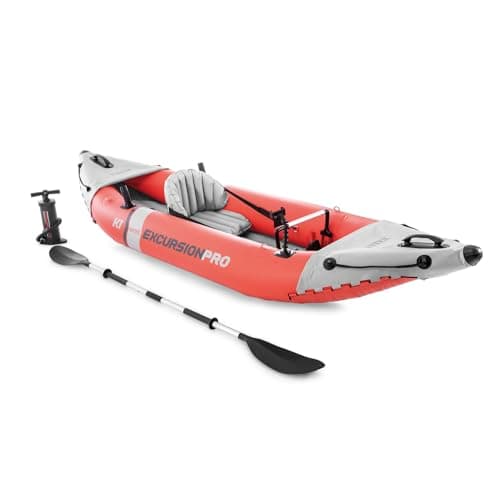 Intex Excursion Pro K1 Inflatable Kayak (paddle and pump included)A laminate hull and a high-pressure floor rather than plain vinyl, which is the difference between an inflatable that tracks and one that argues with you. | The stiffest inflatable in the entry price class | 120 in long, 36 in beam, 31.2 lb packed, 220 lb rated capacity |
These two boats are cross-shopped more than any other pair on this site, and the comparison is almost always run the wrong way round. People decide first whether they are buying a one-person or a two-person kayak, then pick the matching model. That sounds sensible and it produces the wrong answer surprisingly often, because on these two hulls the seat count and the capacity do not line up the way you would expect.
The published numbers, side by side
| Spec | Challenger K1 | Explorer K2 | Which is better |
|---|---|---|---|
| Sold as | 1 person | 2 people | Read the capacity, not the label |
| Length | 108 in (9 ft) | 123 in (10 ft 3 in) | K2 — more waterline holds a line |
| Beam | 30 in | 36 in | K2 — noticeably more settled |
| Packed weight | 26 lb | 35 lb | K1 — the lightest boat on this site |
| Rated capacity | 220 lb | 400 lb | K2, by a wide margin |
| Usable load at 65% | 143 lb | 260 lb | K2 |
| Paddler after a 20 lb kit | 123 lb | 240 lb | K2 — the decisive line |
| Included | Paddle and pump | Two oars and a pump | Tie — both are starter parts |
| Construction | Vinyl | Vinyl | Tie — neither is the laminate hull |
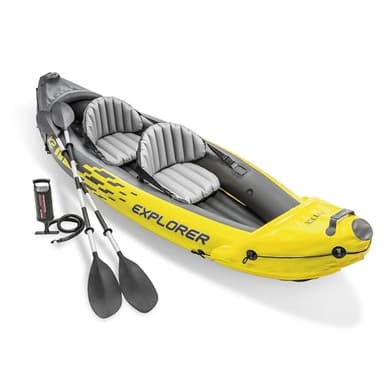
Top pick — Two people, no roof rack, small budget
Intex Explorer K2 Inflatable Kayak, 2-person (oars and pump included)
Bought as a tandem it disappoints; bought as a very roomy solo boat with 400 lb of rating and no rack requirement, it is the most useful inflatable here.
What the listing publishes
123 in long, 36 in beam, 35 lb packed, 400 lb rated capacity, two oars and a pump included
Usable at the 65 percent rule: 260 lb (range 240–280 lb), which leaves about 240 lb of paddler after a 20 lb day kit. Why 65 percent.
400 lb rated is about 260 lb usable at 65 percent. Two adults and gear will exceed that more often than not, which is why we recommend it as a spacious single rather than a genuine two-seater.
As a solo it is transformative: 260 lb of usable capacity against the Challenger K1's 143 lb, for nine extra pounds in the bag.
36 in of beam is wider than every hard-shell on this site. Inflatables are wide because air is what makes them stiff, and the side effect is a very forgiving platform.
What it does well
- 400 lb rated capacity -- 260 lb usable, which covers almost any solo adult with gear
- 36 in beam is the most stable platform on this site
- 35 lb in a bag: no rack, no straps, no garage
What it costs you
- Genuinely tight as a two-adult tandem once you apply the usable-capacity rule
- The included oars are oars, not proper kayak paddles -- budget to replace them
- Vinyl construction wallows in wind like every boat in this class
Skip this if you want a true two-adult tandem. Buy a hard-shell tandem with 500 lb or more of rating, or accept this as the roomiest solo inflatable in the price class.
#ad · how this is funded · price as of October 8, 2026
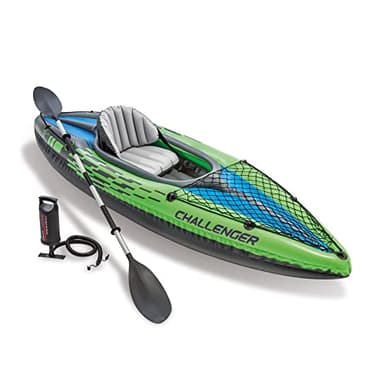
Pick 2 — No car rack, no garage, no storage
Intex Challenger K1 Inflatable Kayak (paddle and pump included)
The honest answer to 'I have an apartment and a sedan'. It is a real boat on flat water and it is not a hard-shell substitute, and it is worth being clear about which of those you are buying.
What the listing publishes
108 in long, 30 in beam, 26 lb packed, 220 lb rated capacity, paddle and pump in the box
Usable at the 65 percent rule: 143 lb (range 132–154 lb), which leaves about 123 lb of paddler after a 20 lb day kit. Why 65 percent.
220 lb rated is about 143 lb usable at 65 percent and roughly 123 lb of paddler once a PFD, paddle and water are subtracted. That is the single most important number on this listing and it rules out most adult men.
26 lb packed into a bag is what you are actually paying for. No roof bars, no straps, no cart, no garage wall -- the entire transport problem this site spends a page on simply does not exist.
Vinyl over a drop-stitch floor is not the same construction as a drop-stitch inflatable board. Expect fifteen minutes of setup, expect it to be soft, and do not expect it to hold a line in wind.
What it does well
- 26 lb in a bag removes the roof rack, the straps and the storage problem in one purchase
- Paddle and pump are included, so the number on the listing is close to the total
- 30 in beam and a wide flat floor is very stable at rest
What it costs you
- 220 lb rated is about 123 lb of paddler after gear -- read that before anything else
- Fifteen minutes of pumping at each end of every trip
- Soft hull, so it wallows in wind and tracks poorly
Skip this if you weigh over about 125 lb dressed and carrying gear. The capacity arithmetic is unambiguous and the Excursion Pro or the Explorer K2 are the honest upgrades.
#ad · how this is funded · price as of October 8, 2026
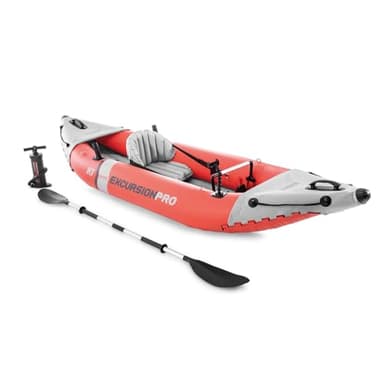
Pick 3 — The stiffest inflatable in the entry price class
Intex Excursion Pro K1 Inflatable Kayak (paddle and pump included)
A laminate hull and a high-pressure floor rather than plain vinyl, which is the difference between an inflatable that tracks and one that argues with you.
What the listing publishes
120 in long, 36 in beam, 31.2 lb packed, 220 lb rated capacity
Usable at the 65 percent rule: 143 lb (range 132–154 lb), which leaves about 123 lb of paddler after a 20 lb day kit. Why 65 percent.
220 lb rated is about 143 lb usable and 123 lb of paddler after gear -- the same limiting number as the Challenger K1, despite the better construction. Construction quality and capacity are separate specs and this is the clearest case of it on the site.
Stiffness is the whole story with inflatables. A high-pressure floor makes the hull behave like a shape instead of a bag, and it is the single upgrade that most changes how one paddles.
36 in of beam plus a stiff floor is an unusually settled platform for standing to fish or to take a photo.
What it does well
- Laminate hull and high-pressure floor track far better than plain vinyl
- 36 in beam plus a stiff floor is stable enough to stand on carefully
- 31 lb in a bag, still no rack required
What it costs you
- 220 lb rated -- roughly 123 lb of paddler after gear, same as the cheapest Intex
- Higher pressure means more pumping, and a gauge you should actually read
- Costs meaningfully more than the Challenger K1 for no extra capacity
Skip this if capacity is your constraint rather than feel. The Explorer K2 has 180 lb more rating for less money, and it is the better answer for a heavier paddler.
#ad · how this is funded · price as of October 8, 2026
Why the tandem is the better solo boat
Here is the whole argument in one pair of sums. Rated capacity is a load at which the hull sits where the designer intended, not a strength limit, so we work at 65 percent of it and then subtract what you carry.
A 180 lb adult is 57 lb over the Challenger's working figure and 60 lb under the Explorer's. That is not a marginal difference to be split; it is the difference between a boat that sits where it should and one that sits low, ships water over the sides and feels slow and wet from the first stroke.
What the Challenger K1 is genuinely better at
This is not a page arguing that one boat is bad. The Challenger has two real advantages and they matter to some people more than capacity does.
- **26 lb, packed.** It is the lightest boat we cover by nine pounds. If the kayak has to be carried any distance from the car, up stairs to a flat, or onto public transport, that is a decisive number.
- **A smaller package.** Nine feet of hull packs smaller than ten foot three. In a small cupboard or a hatchback already carrying camping gear, that is a real constraint and the K1 wins it.
- **It is the cheapest way onto the water that we are willing to recommend at all**, which matters to a buyer for whom the alternative is not paddling.
What it is not better at is paddling. Nine feet of soft vinyl with 30 inches of beam wanders in any breeze, and the shorter hull gives you less of the waterline that would fix it.
Oars or a paddle: a real difference
Intex list a paddle with the Challenger and two oars with the Explorer. That wording is not accidental and it catches people out. Oars are designed for rowing — facing backwards, pivoting against the boat — while a kayak paddle is held free in both hands and used facing forwards.
In practice the parts Intex ships with the K2 are used as kayak paddles and they work, but they are aluminum starter parts either way and they are short for a 36 inch beam. A wider boat needs a longer paddle, because the shaft has to clear the tube before the blade reaches water. This is the single cheapest upgrade available to either boat. Length first, everything else second.
The third Intex nobody compares
There is a version of this comparison that has a different answer, and it is worth knowing about before you buy. The Excursion Pro K1 is Intex's three-ply laminate boat with a high-pressure floor and two removable skegs, and it tracks in a way neither vinyl hull here does.
Its rated capacity is 220 lb — the same as the cheap Challenger. So the Excursion Pro is the answer to "which Intex is built best" and never the answer to "which Intex carries me". Those are two different questions and the listings encourage you to confuse them. The full review.
| Boat | Rated | Paddler after gear | Construction |
|---|---|---|---|
| Challenger K1 | 220 lb | 123 lb | Vinyl |
| Excursion Pro K1 | 220 lb | 123 lb | 3-ply laminate, high-pressure floor |
| Explorer K2 | 400 lb | 240 lb | Vinyl |
What both boats share, and what it costs
- **A setup routine at both ends of every trip.** Fifteen to twenty minutes each way. This is the real price of an inflatable and it is what decides whether the boat gets used.
- **They must be dried before storage.** A damp hull folded into a bag mildews, and that is how most cheap inflatables actually die.
- **A hand pump that is adequate and slow.** An electric pump with auto shut-off is the upgrade that most changes ownership. Pumps, honestly.
- **No roof rack, no garage, no trailer.** That is the reason to buy either of these over a rotomolded hull, and it is a good reason. Whether an inflatable is right at all.
So which one
- **Most adults paddling alone: the Explorer K2.** 240 lb of paddler versus 123 lb is not a close call, and the extra beam and waterline make it the better boat on the water too.
- **Two people, ever: the Explorer K2.** The Challenger seats one and the arithmetic does not stretch.
- **A light paddler who must carry the bag a long way: the Challenger K1.** Twenty-six pounds is its own argument.
- **Someone who wants an inflatable that actually tracks, and is light: the Excursion Pro K1** — with the 220 lb rating checked against yourself first.
- **Someone with a garage and a roof rack: neither.** At this money a rotomolded hull needs no pump and no drying. What $500 buys.
Questions people actually ask
Is the Intex Explorer K2 good for one person?
What is the weight limit on the Intex Challenger K1?
What is the difference between the Intex Challenger K1 and the Explorer K2?
Can two adults fit in an Intex Explorer K2?
Which Intex kayak is the best quality?
Do Intex kayaks come with paddles?
How long do Intex inflatable kayaks last?
Where these numbers came from
Every figure on this page traces to one of these. Where a number could not be sourced, the page says so rather than estimating it.
- Eddyline Kayaks — Maximum weight capacity versus ideal capacity for various styles of kayaks (manufacturer, states the 60-70% ideal-capacity band)
- Intex Challenger K1 Inflatable Kayak — manufacturer specification as published on the Amazon listing, read 2026-09-20
- Intex Explorer K2 Inflatable Kayak, 2-person — manufacturer specification as published on the Amazon listing, read 2026-09-20
- Intex Excursion Pro K1 Inflatable Kayak — manufacturer specification as published on the Amazon listing, read 2026-09-20
Read next
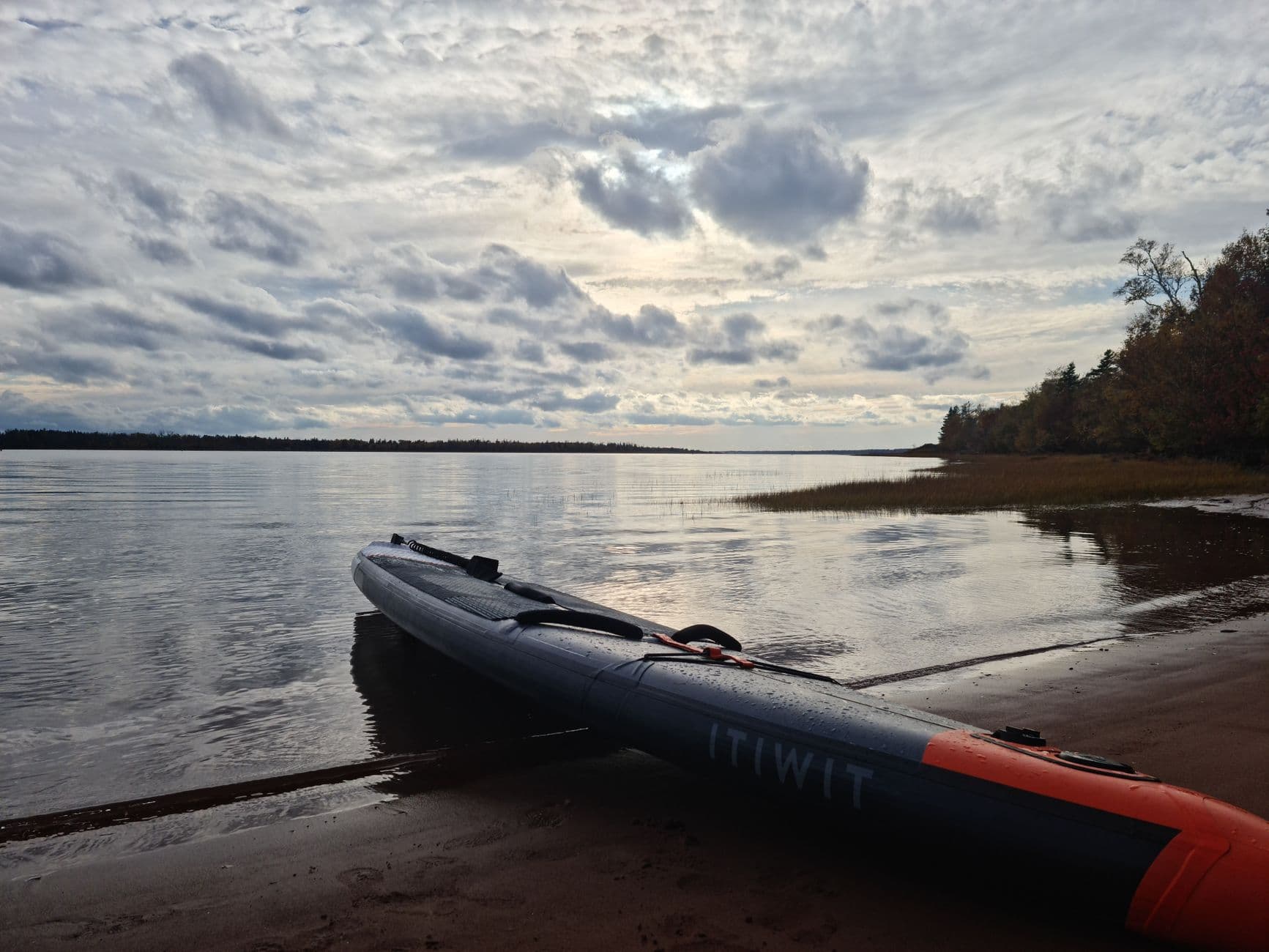
Best K2 Alternative
Intex Explorer K2 Alternatives
Alternatives to the K2 sorted by what you actually want fixed: tracking, packed weight, capacity, or the fact that it is an inflatable at all.
Top pick
Intex Explorer K2 Inflatable Kayak, 2-person (oars and pump included)
Two people, no roof rack, small budget
#ad · how this is funded · price as of October 8, 2026
Best Inflatable Kayak
The Best Inflatable Kayaks
Inflatable kayaks ranked on capacity and hull stiffness — including the 220 lb rating that rules out most adults.
Top pick
Intex Explorer K2 Inflatable Kayak, 2-person (oars and pump included)
Two people, no roof rack, small budget
#ad · how this is funded · price as of October 8, 2026
Intex Explorer K2: What the Specs Say
400 lb rated, 36 in wide, 35 lb in a bag — and a much better solo kayak than the two-person boat it is marketed as.
Top pick
Intex Explorer K2 Inflatable Kayak, 2-person (oars and pump included)
Two people, no roof rack, small budget
#ad · how this is funded · price as of October 8, 2026
Intex Challenger K1: The Capacity Is the Catch
26 lb in a bag solves storage entirely. 220 lb rated is about 123 lb of paddler, which rules out most adults.
Top pick
Intex Challenger K1 Inflatable Kayak (paddle and pump included)
No car rack, no garage, no storage
#ad · how this is funded · price as of October 8, 2026
Intex Excursion Pro K1: Stiffness You Can Feel, Capacity You Cannot Ignore
The best-constructed inflatable we cover — laminate hull, high-pressure floor, two removable skegs. Rated 220 lb, the same limit as boats built far worse.
Top pick
Intex Excursion Pro K1 Inflatable Kayak (paddle and pump included)
The stiffest inflatable in the entry price class
#ad · how this is funded · price as of October 8, 2026
Are Inflatable Kayaks Worth It?
Worth it if storage or a roof rack is your problem. Not worth it if performance is. How to tell which buyer you are from the published capacity and your own garage.
Top pick
Intex Explorer K2 Inflatable Kayak, 2-person (oars and pump included)
Two people, no roof rack, small budget
#ad · how this is funded · price as of October 8, 2026