Paddle Boards
Retrospec Weekender-Nano: The Board a Child Can Actually Carry
Twelve pounds is the whole point. A child who can lift, drag and inflate their own board is taking part in the trip; a child who cannot is cargo.
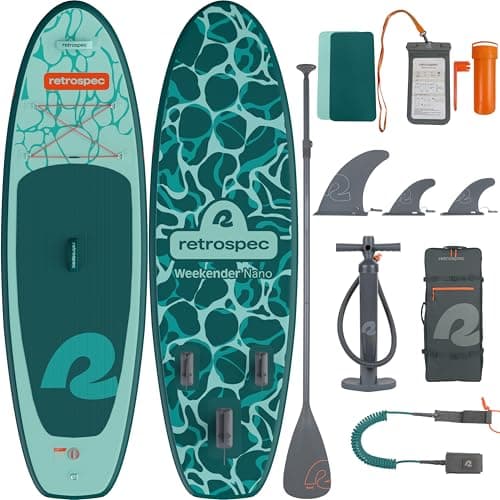
We have not paddled these, and we are not going to pretend we have. Here is what we did instead. Links to Amazon earn us a commission at no extra cost to you, and commission never decides a pick — how this site is funded.
| # | Product | Best for | The spec it turns on | Price |
|---|---|---|---|---|
| 1 | Retrospec Weekender-Nano Inflatable Paddle Board, 8 ftTop pickTwelve pounds and eight and a half feet: sized so a child can carry, inflate and drag their own board, which is the entire difference between their board and yours. | A child's own board | 102 x 28 x 5 in, 12.2 lb board weight, 140 lb rated capacity |
We have not paddled this board. What follows is what its published specification means, run through the same arithmetic we apply to everything on this site, plus a direct account of who it does not suit.
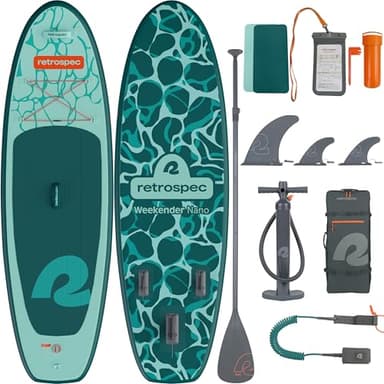
Top pick — A child's own board
Retrospec Weekender-Nano Inflatable Paddle Board, 8 ft
Twelve pounds and eight and a half feet: sized so a child can carry, inflate and drag their own board, which is the entire difference between their board and yours.
What the listing publishes
102 x 28 x 5 in, 12.2 lb board weight, 140 lb rated capacity
Usable at the 65 percent rule: 91 lb (range 84–98 lb), which leaves about 71 lb of paddler after a 20 lb day kit. Why 65 percent.
140 lb rated is about 91 lb of loaded child at 65 percent, so this covers most children up to roughly eleven or twelve.
28 in of width is narrow by our adult standard and correct here -- children weigh less, so they need less width for the same margin, and a narrower board is one they can actually reach past to paddle.
12.2 lb is the spec that makes it theirs. A child who cannot lift their own board is a passenger on a family outing rather than a participant in one.
What it does well
- 12.2 lb -- genuinely child-portable
- 28 in width is proportionate to a child's weight and reach
- 8 ft 6 in turns quickly, which is what children actually want to do
What it costs you
- 140 lb rated, so a teenager will outgrow it
- 5 in thickness is less stiff than a 6 in adult board
- Too small to be useful to an adult afterwards
Skip this if your child is already near 90 lb dressed. Buy a narrow adult board instead -- it will last them into their teens and this will not.
#ad · how this is funded · price as of October 8, 2026
Twelve pounds is the argument
Most boards sold for children are adult boards with a shorter length and a brighter graphic, and they weigh eighteen to twenty pounds like everything else in the category. That sounds fine until you watch a nine-year-old try to move one. A board a child cannot lift is a board an adult carries, inflates, launches and retrieves, and the child is a passenger in their own hobby.
At a published 12.2 lb this is the lightest board we cover by more than six pounds. That is the difference between a parent doing the work and a child doing it, and it is worth more to whether the board gets used than any other number on the listing.
| Spec | Published | What it means |
|---|---|---|
| Board weight | 12.2 lb | Light enough for a child to carry and launch alone |
| Length | 102 in (8 ft 6 in) | Short, so it turns quickly — which is what children want |
| Width | 28 in | Narrow by adult standards, proportionate for a child |
| Thickness | 5 in | One inch thinner than a standard adult board |
| Rated capacity | 140 lb | About 91 lb of loaded child at 65 percent |
| Construction | Puncture-resistant PVC, AerGlide-Lite | Retrospec's name for the lightweight layup |
| Packed size | 31 × 12 × 5 in | Fits a car trunk alongside the adult boards |
| Included | Adjustable paddle, pump, backpack | A complete kit, not a bare board |
| Model | 6631 | Useful when checking stock at a retailer |
140 lb is the spec that ends the relationship
This is the honest limit of the purchase and it is worth being clear-eyed about before you buy. You are not buying a board that grows with a child; you are buying one that fits them now and will be outgrown, probably within three or four seasons depending on when you start.
That is not a criticism — it is what a correctly sized child's board is. The alternative, buying a full-size board for a seven-year-old to grow into, produces a board they cannot carry, cannot turn and cannot reach around to paddle. The same mistake as buying a bike four sizes too big, with the same result.
28 inches is narrow, and that is correct here
We tell adults to look for 32 inches or more of width, so 28 inches reads as alarmingly narrow. Applied to a child it is not, for two reasons that both come down to scale.
- **Stability is relative to what you are floating.** Width provides a margin against the weight on top of it. A 70 lb child on a 28 in board has more margin than a 190 lb adult on a 32 in board, because there is far less mass up high trying to tip it.
- **A child has to reach past the rail to paddle.** On a board too wide for their arm length, the paddle enters the water at an angle that turns the board instead of driving it forward. Narrower is what lets a small paddler actually go somewhere.
- **Short boards turn, and children like turning.** Eight and a half feet spins easily. An adult would call that poor tracking; a child calls it the good part.
The name and the dimensions disagree
Retrospec's own listing calls this an 8 ft 6 in board in the title and an 8 ft board in the feature text, while the published length dimension is 102 inches — which is 8 ft 6 in. We have gone with the dimensions block, as we do across this site, because the measured figure is the one you can check and the product name is marketing.
It is a small thing and it is worth flagging because the same pattern turns up on adult boards, where a board named 10 ft 6 in measures 118 inches. We hit exactly that on the lightest adult board we cover. Read the dimensions, not the name.
Five inches thick, and what that costs
Standard adult inflatables are six inches thick. This is five, and thickness is what resists the board bending in the middle under load — a thinner board flexes more, and a flexing board drags because it is pushing water with a banana shape instead of gliding over it.
On a board carrying 70 lb rather than 200 lb, an inch of thickness matters far less, and the inch saved is a meaningful part of how the board got to 12.2 lb. It is the right trade for this application and a bad one on an adult board, which is exactly why a child's board should not simply be a small adult board.
What is in the box
- **An adjustable paddle.** Adjustable matters more for a child than an adult because they are still growing, and a paddle that extends is one that survives two growth spurts. How to set the length.
- **A pump.** A hand pump, which a child can genuinely operate on a 5 in board — there is far less air to move than in an adult board, so the job is not the ordeal it is on a 6 in 11-footer.
- **A backpack.** The reason the 12.2 lb figure translates into a child carrying their own kit rather than just their own board.
- **An EVA deck pad and front bungee**, plus deck and front carry handles. The front handle is the one that matters: it is how a child drags the board the last twenty yards when they have had enough.
- **No life jacket, and that is the one thing that is not optional.** A child under 13 must wear a US Coast Guard-approved vest on a vessel under way. Fitted by weight, never by age.
What the listing does not tell you
Two gaps worth naming. There is no published fin configuration, so whether the fin is removable — which decides how well it packs and whether it survives a gravel launch — is not something you can check before ordering. And there is no published pressure rating, which on an inflatable is the specification that determines how stiff the board actually gets.
Neither is a reason to avoid it. Both are reasons to treat the numbers that are published as the ones you can plan around, and we have not filled the gaps with estimates.
Who should buy it
- **Parents of a child under roughly 90 lb dressed** who want the child to participate rather than ride along.
- **Families who already paddle** and need a third board that fits in the same car trunk as the two adult ones.
- **Anyone whose child has tried a rental and liked it.** This is the right first board rather than the right only board.
- **Households short on storage.** At 31 × 12 × 5 in packed, it goes in a cupboard. Where to keep a board.
Who should not
- **Anyone whose child is near 90 lb now.** You will get a season. A narrow adult board gets you a decade.
- **Anyone hoping to use it themselves.** 140 lb rated and 28 in wide is not a board that works for an adult, even a light one.
- **Anyone wanting one board for two children of different ages.** The older one will be over the rating while the younger one is still growing into it.
- **Anyone buying for open or choppy water.** A short, thin, light board is a flat-water and sheltered-water object. What a beginner board needs.
Questions people actually ask
What is the weight limit of the Retrospec Weekender-Nano?
How much does the Retrospec Weekender-Nano weigh?
What age is the Weekender-Nano for?
Is 28 inches too narrow for a paddle board?
Does the Retrospec Weekender-Nano come with a paddle and pump?
Should I buy a kids paddle board or a full-size one they can grow into?
Where these numbers came from
Every figure on this page traces to one of these. Where a number could not be sourced, the page says so rather than estimating it.
Read next
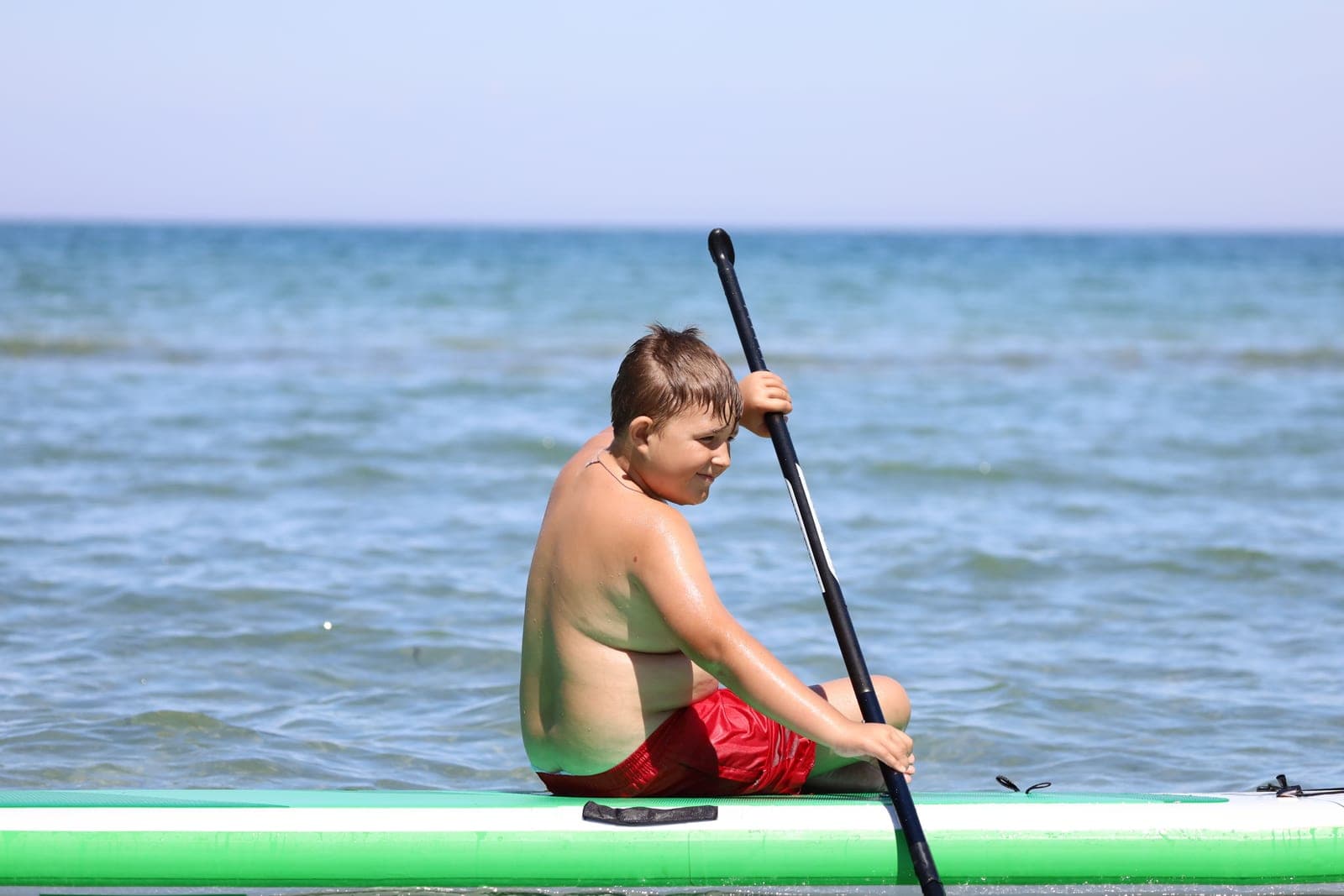
Best for Kids
The Best Paddle Boards for Kids
Kids' boards sized on weight and reach, plus the point at which a narrow adult board becomes the better buy.
Top pick
Retrospec Weekender-Nano Inflatable Paddle Board, 8 ft
A child's own board
#ad · how this is funded · price as of October 8, 2026
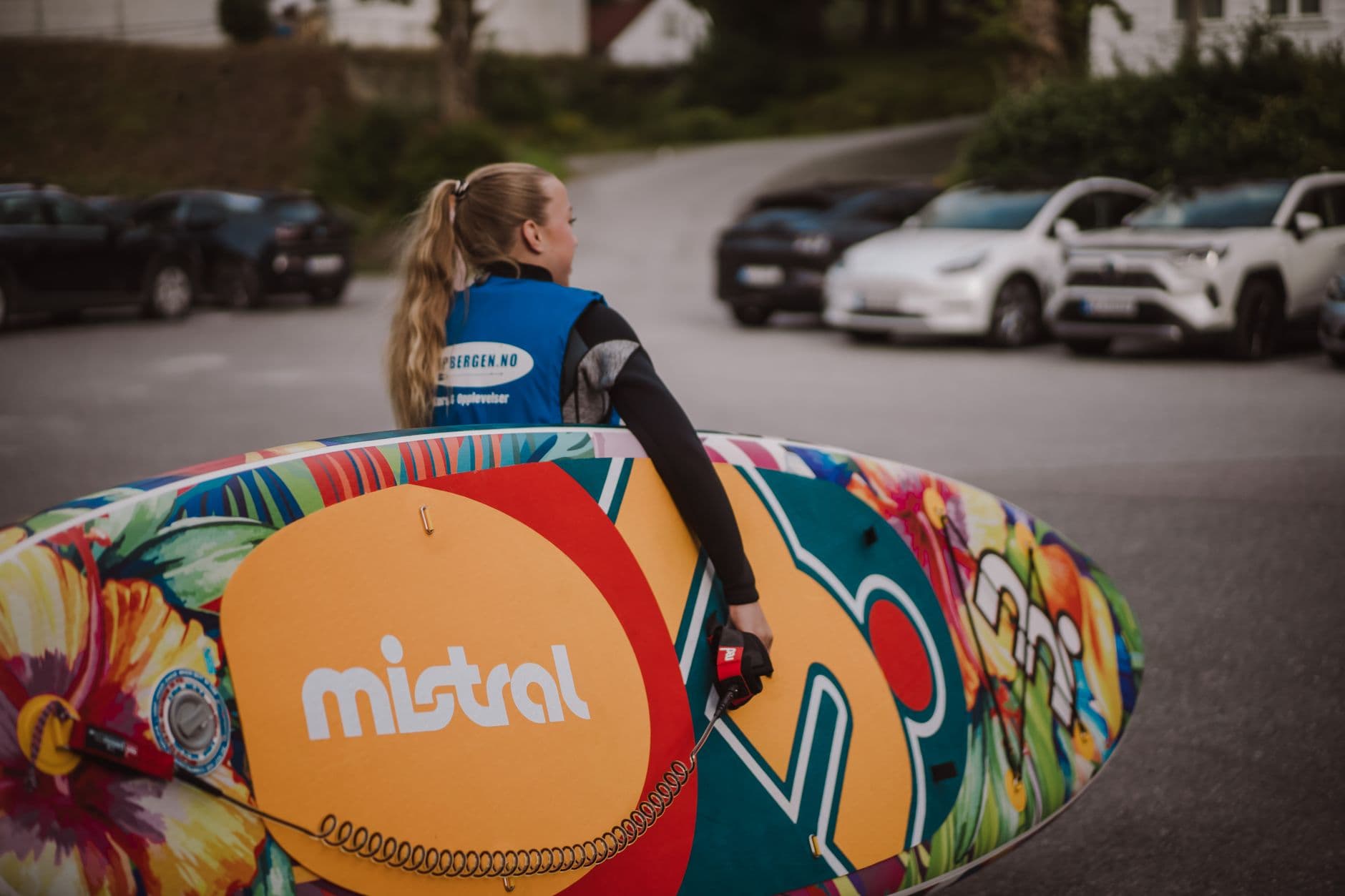
Lightest to Carry
The Lightest Paddle Boards, and What a Board Really Weighs
Published board weights run 12.2 to 24.5 lb across the boards we cover — and three of seven publish nothing at all. The lightest boards, and what light costs you.
Top pick
FEATH-R-LITE Inflatable Stand Up Paddle Board, 10 ft 6 in x 31.5 in
The lightest board to carry to the water
#ad · how this is funded · price as of October 8, 2026
Best Kids' Life Jacket
The Best Life Jackets for Kids Who Paddle
Fitted by weight on the label, never by age. The approved vest for each weight band, the features that matter at each size, and the mistakes that make a vest unsafe.
Top pick
Onyx Youth Life Jacket, 55-88 lb
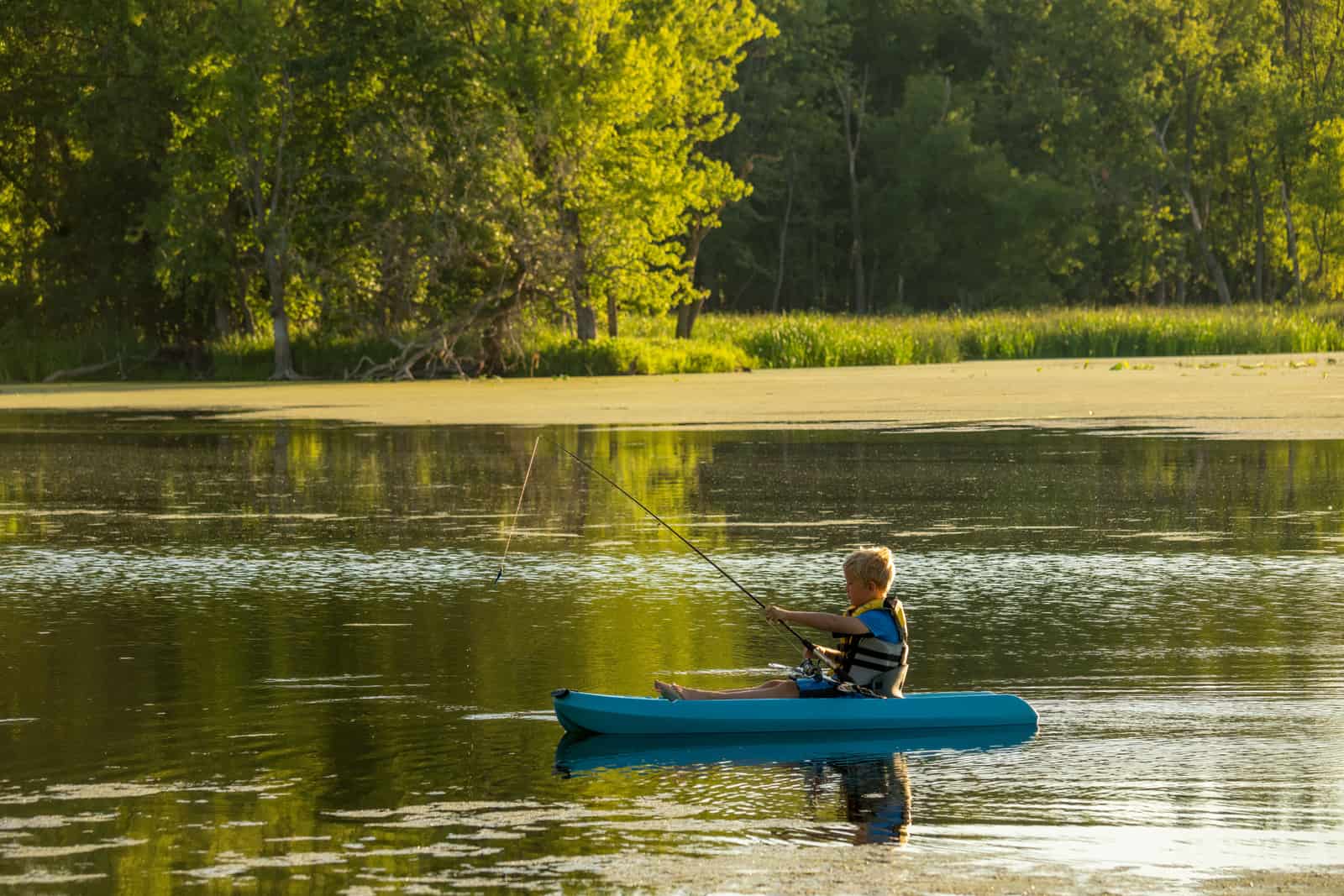
A child paddling their own kayak or board
#ad · how this is funded · price as of October 8, 2026

What Size Paddle Board Do I Need?
A volume and width calculator that shows its working, and ends in an actual board rather than a chart.
Top pick
Roc Inflatable Stand Up Paddle Board, 10 ft 6 in x 33 in
The default first inflatable board
#ad · how this is funded · price as of October 8, 2026

Paddle Board Weight Limits, Explained
Rated capacity is not usable capacity. The 65 percent rule, where it comes from, and what happens when you ignore it.
Top pick
SereneLife XL Extra-Wide Inflatable Paddle Board, 35 in
A heavier paddler, or a board that carries the family
#ad · how this is funded · price as of October 8, 2026

Best Kids' Kayak
The Best Kayaks for Kids
Hull weight decides whether it is their boat. Rated capacity decides how long it lasts. Both are on the listing — here is how to read them for a child.
Top pick
Lifetime Youth Wave Kayak, 6 ft (paddle included)
A first boat for a child aged five and up
#ad · how this is funded · price as of October 8, 2026