Choosing Your First
Are Costco Paddle Boards Worth It?
A site with affiliate links has an obvious incentive to say no. The honest answer is that the specifications decide it, and the specifications are usually fine.

We have not paddled these, and we are not going to pretend we have. Here is what we did instead. Links to Amazon earn us a commission at no extra cost to you, and commission never decides a pick — how this site is funded.
| # | Product | Best for | The spec it turns on | Price |
|---|---|---|---|---|
| 1 | 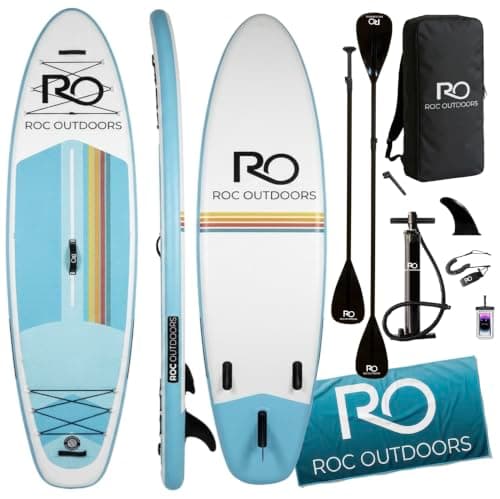 Roc Inflatable Stand Up Paddle Board, 10 ft 6 in x 33 inTop pick10 ft 6 in by 33 in is the shape the whole beginner category converged on, and this is the cheapest version of it that publishes a 350 lb rating. | The default first inflatable board | 126 x 33 x 6 in, 350 lb rated capacity, PVC drop-stitch, full accessory kit | |
| 2 | 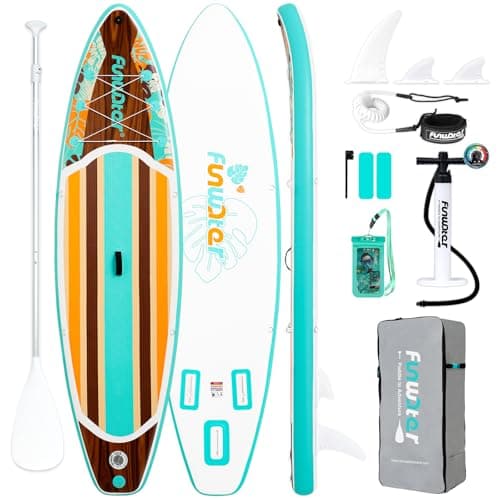 FunWater Inflatable Stand Up Paddle Board, 10 ft 6 in x 35 inThirty-five inches of width in a 10 ft 6 in board is the closest thing to a raft that still paddles like a board, and for a genuinely nervous beginner that is the right trade. | Maximum stability in a standard length | 126 x 35.1 x 6 in, 330 lb rated capacity, PVC drop-stitch |
It is worth naming the conflict of interest before answering this. We earn a commission when you buy through our links and nothing when you buy in a warehouse store. That gives us an obvious reason to be negative here, so treat the rest of this page with that in mind — and then check the specifications yourself, which is the whole recommendation anyway.
The honest answer
Warehouse-store inflatable boards are usually fine. The category is mature and commoditized: most consumer inflatable boards are PVC drop-stitch of broadly similar construction, made in a small number of factories, and a warehouse store buying in volume gets the same product as an online brand does.
In some respects the warehouse board is better. Accessory kits at that price point are often more generous, because the retailer is competing on perceived value in a physical aisle rather than on a listing page.
The two specs that decide it
Everything on this site comes back to these, and they are as true in an aisle as on a listing.
- **Thickness: 6 inches.** Four-inch boards flex under an adult standing in the middle, and that flex is what most people mistake for the board being unstable. This is a hard requirement and it is easy to check in person — look at the rail.
- **Width: 32 inches or more.** This is the number that decides whether you stand up on day one. Our width recommendation by weight.
If a warehouse board is 6 inches thick and 32 or more inches wide, it is very likely a perfectly good first board. If it is 4 inches thick or 30 inches wide, it is not, whatever it costs.
The one real disadvantage of buying in a store
You cannot do the arithmetic in the aisle. The whole method on this site is to take the published rated capacity, multiply by 0.65, and check the result against your own loaded weight — and warehouse packaging frequently does not state a rated capacity at all.
That is a genuine problem rather than a marketing one, because capacity is the specification most likely to be wrong for a given buyer.
What you give up
- **Choice of width.** A store carries one or two models. If neither is the width you need for your weight, there is nothing to be done about it in that aisle.
- **Published specifications.** Online listings publish capacity, thickness and dimensions in a table. Boxes often do not.
- **Model continuity.** Warehouse stock rotates seasonally, which makes replacement fins, pumps and repair parts harder to source in year three.
- **Reviews at volume.** A listing with thousands of reviews tells you about long-term durability in a way a box cannot.
What you gain
- **You can see and touch it.** Feeling the rail thickness and the deck pad quality is worth something real.
- **Return policy.** Warehouse club return policies are generally excellent, and that genuinely de-risks a first purchase.
- **Often a better accessory kit** at the same price point.
- **No shipping wait.** It is in the car.
So which should you buy?
If the warehouse board is 6 inches thick, at least 32 inches wide, and its rated capacity clears your loaded weight divided by 0.65 — buy it. It is a good board and the return policy is better than ours.
If any of those three is wrong, or you cannot find the capacity, the online route lets you filter on exactly the specifications that matter. The boards below are the ones we would compare against.
Top pick — The default first inflatable board
Roc Inflatable Stand Up Paddle Board, 10 ft 6 in x 33 in
10 ft 6 in by 33 in is the shape the whole beginner category converged on, and this is the cheapest version of it that publishes a 350 lb rating.
What the listing publishes
126 x 33 x 6 in, 350 lb rated capacity, PVC drop-stitch, full accessory kit
Usable at the 65 percent rule: 228 lb (range 210–245 lb), which leaves about 208 lb of paddler after a 20 lb day kit. Why 65 percent.
33 in of width is the number that decides whether you stand up on day one. Our width guidance puts 32 to 33 in as the beginner band for an adult between 150 and 200 lb, and this sits in it.
350 lb rated capacity means about 227 lb of loaded paddler at 65 percent. Applying the displacement arithmetic instead, a 195 lb loaded paddler wants roughly 195 L of volume -- this hull's 126 x 33 x 6 in envelope is comfortably past that.
Six inches of thickness is what makes a modern inflatable stiff. Four-inch boards flex under an adult in the middle and that flex is what people mistake for the board being unstable.
What it does well
- 33 in wide -- the width that gets a first-timer standing rather than kneeling
- 350 lb rating covers an adult with a child or a dog on board
- Ships with pump, paddle, leash and bag, so the listing price is close to the total
What it costs you
- The included paddle and pump are starter parts you will eventually replace
- 10 ft 6 in is a compromise length -- not fast, not especially maneuverable
- The listing does not publish a board weight
Skip this if you already know you want to cover distance. A 10 ft 6 in all-around board is a cruiser and an 11 ft 6 in touring shape is the honest answer for mileage.
#ad · how this is funded · price as of October 18, 2026
Pick 2 — Maximum stability in a standard length
FunWater Inflatable Stand Up Paddle Board, 10 ft 6 in x 35 in
Thirty-five inches of width in a 10 ft 6 in board is the closest thing to a raft that still paddles like a board, and for a genuinely nervous beginner that is the right trade.
What the listing publishes
126 x 35.1 x 6 in, 330 lb rated capacity, PVC drop-stitch
Usable at the 65 percent rule: 215 lb (range 198–231 lb), which leaves about 195 lb of paddler after a 20 lb day kit. Why 65 percent.
35.1 in is above our beginner recommendation for every weight band on the site. Extra width is slower and it is not a mistake -- speed is not the thing standing between a first-timer and a good afternoon.
330 lb rated is about 215 lb of loaded paddler at 65 percent, the same as the FEATH-R-LITE, in a board three and a half inches wider.
Wide boards are harder to reach past when you paddle, so a wide board pushes you toward a slightly longer paddle. Our formula puts a 5 ft 8 in paddler on a 77 in SUP paddle regardless of board, but the reach penalty is real and worth knowing about.
What it does well
- 35.1 in wide -- as stable as an inflatable board gets at this length
- 330 lb rating with room for a child or a dog on the nose
- Full accessory kit included
What it costs you
- Wide is slow, and you will notice against a 31 in board
- Harder to reach the water past the rail, which tires your shoulders
- The listing does not publish a board weight
Skip this if you are reasonably confident on your feet already. Width you do not need is drag you pay for on every stroke.
#ad · how this is funded · price as of October 18, 2026
Questions people actually ask
Are Costco paddle boards good quality?
What should I check on a warehouse store paddle board?
Is a cheap inflatable paddle board worth buying?
Are store-bought paddle boards better than online ones?
How can I tell if a paddle board is good quality in a shop?
Where these numbers came from
Every figure on this page traces to one of these. Where a number could not be sourced, the page says so rather than estimating it.
- Thurso Surf — What Size Paddle Board Is Right for You (manufacturer, states the weight-in-kg x 2 volume rule and the 32 in beginner width band)
- Eddyline Kayaks — Maximum weight capacity versus ideal capacity for various styles of kayaks (manufacturer, states the 60-70% ideal-capacity band)
- Roc Inflatable Stand Up Paddle Board 10'6" — manufacturer specification as published on the Amazon listing, read 2026-09-02
- FunWater Inflatable Stand Up Paddle Board — manufacturer specification as published on the Amazon listing, read 2026-09-02
Read next

Buying a Paddle Board on Amazon
How to read an Amazon board listing: the three specs that decide it, the two that are usually missing, and what the review count is not telling you.
Top pick
Roc Inflatable Stand Up Paddle Board, 10 ft 6 in x 33 in
The default first inflatable board
#ad · how this is funded · price as of October 18, 2026
Best Inflatable
The Best Inflatable Paddle Boards
Inflatable SUPs ranked on width, thickness, capacity and packed weight, with every figure read off the listing.
Top pick
Roc Inflatable Stand Up Paddle Board, 10 ft 6 in x 33 in
The default first inflatable board
#ad · how this is funded · price as of October 18, 2026

What Size Paddle Board Do I Need?
A volume and width calculator that shows its working, and ends in an actual board rather than a chart.
Top pick
Roc Inflatable Stand Up Paddle Board, 10 ft 6 in x 33 in
The default first inflatable board
#ad · how this is funded · price as of October 18, 2026

Are Walmart Kayaks Worth Buying?
Big-box kayaks are usually the same brands you find online. The capacity rating decides it, not the retailer.
Top pick
Lifetime Cruze 100 Sit-In Kayak, 10 ft
The cheapest hard-shell sit-inside worth owning
#ad · how this is funded · price as of October 18, 2026

Best First Board
The Best Paddle Boards for Beginners
Five beginner boards ranked on published width and usable capacity, with the displacement arithmetic run on each one.
Top pick
Roc Inflatable Stand Up Paddle Board, 10 ft 6 in x 33 in
The default first inflatable board
#ad · how this is funded · price as of October 18, 2026

Inflatable vs Hard Paddle Board
Hard boards are better boards. Inflatables are better first boards. Here is exactly where each one wins.
Top pick
Roc Inflatable Stand Up Paddle Board, 10 ft 6 in x 33 in
The default first inflatable board
#ad · how this is funded · price as of October 18, 2026