Choosing Your First
Buying a Paddle Board on Amazon
Almost every board a beginner buys comes from the same place, and almost every complaint traces back to three specifications the listing either buries or omits. Here is how to read one properly.
We have not paddled these, and we are not going to pretend we have. Here is what we did instead. Links to Amazon earn us a commission at no extra cost to you, and commission never decides a pick — how this site is funded.
| # | Product | Best for | The spec it turns on | Price |
|---|---|---|---|---|
| 1 | 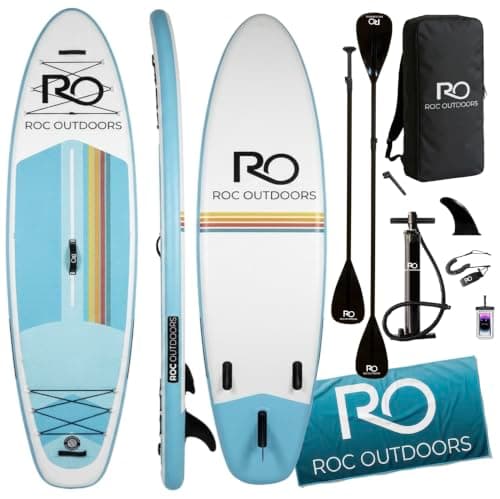 Roc Inflatable Stand Up Paddle Board, 10 ft 6 in x 33 inTop pick10 ft 6 in by 33 in is the shape the whole beginner category converged on, and this is the cheapest version of it that publishes a 350 lb rating. | The default first inflatable board | 126 x 33 x 6 in, 350 lb rated capacity, PVC drop-stitch, full accessory kit | |
| 2 | 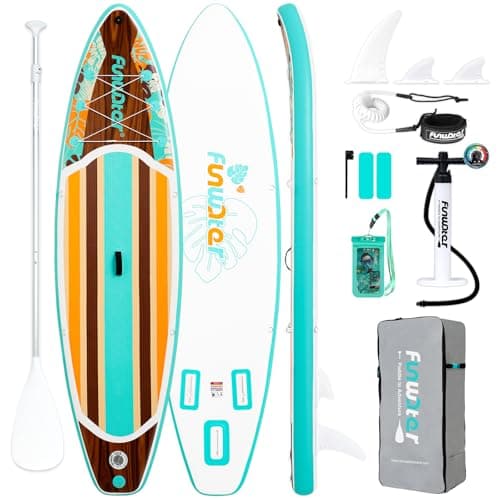 FunWater Inflatable Stand Up Paddle Board, 10 ft 6 in x 35 inThirty-five inches of width in a 10 ft 6 in board is the closest thing to a raft that still paddles like a board, and for a genuinely nervous beginner that is the right trade. | Maximum stability in a standard length | 126 x 35.1 x 6 in, 330 lb rated capacity, PVC drop-stitch | |
| 3 | 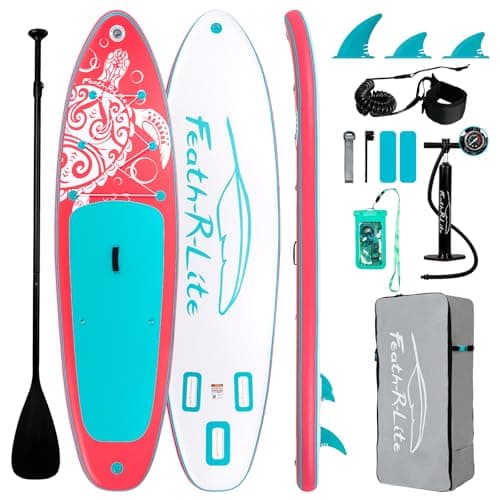 FEATH-R-LITE Inflatable Stand Up Paddle Board, 10 ft 6 in x 31.5 inEighteen and a half pounds is a genuinely low number for a drop-stitch board, and it is the spec that decides whether the board gets carried past the first parking lot. | The lightest board to carry to the water | 118.1 x 31.5 x 5.91 in, 18.9 lb board weight, 330 lb rated capacity | |
| 4 | 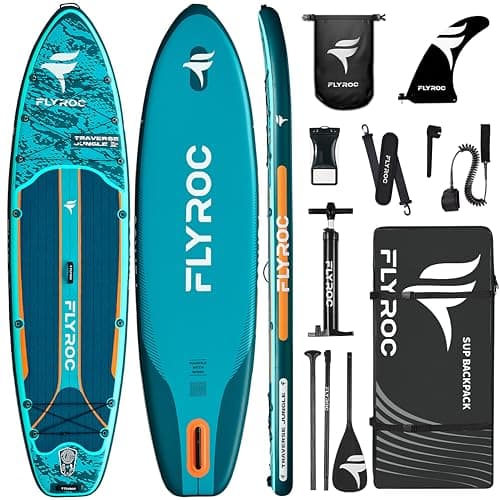 Flyroc 11 ft 6 in x 35 in Inflatable Paddle BoardA foot more waterline than the all-around boards with no narrowing to pay for it, and the highest rated capacity of any board here bar one. The published 18 lb is the figure to treat with some caution. | Distance without giving up width | 138 x 35 x 6 in, 18 lb board weight, 450 lb rated capacity, 15 D-rings |
This site is funded by Amazon links, so take the following as a description of the terrain rather than a sales pitch: the entry-level inflatable paddle board market is largely an Amazon market, most of the brands in it are not household names, and the listings vary enormously in how much they actually tell you.
That is not a reason to avoid it. The boards are genuinely serviceable and the prices are what make a first board affordable. It is a reason to read the listing like a spec sheet rather than an advertisement.
The three numbers that decide it
Everything else on a board listing is downstream of these. If you check only three fields, check these three.
| Spec | What to want | Why |
|---|---|---|
| Width | 32 to 34 in for a first board | This is what gets you standing. Under 32 in is a smaller-paddler board |
| Thickness | 6 in for any adult | 4 to 5 in boards sag underfoot at adult weight regardless of pressure |
| Rated capacity | your loaded weight / 0.65 | Rated is not usable. The 65 percent rule is the manufacturers' own guidance |
The two specs that are usually missing
An absent spec is a data point. Nobody omits a good number.
- **Board weight.** Frequently not published anywhere in the listing. It is the spec that decides how often the board actually gets carried to the water. The FEATH-R-LITE publishes 18.9 lb; a great many competitors publish nothing at all.
- **Real length.** Boards are routinely sold in the 10 ft 6 in category while their own dimension table says something shorter. Read the dimensions, not the product name — this is the single most common gap between what a buyer thinks they ordered and what arrives.
How to read the rest of a listing
- **The title is keyword soup.** Titles are written for search, not description, and often quote the largest capacity across several sizes. Use the size selector and the dimension table as the source of truth.
- **Photos are frequently generic.** The same stock renders appear across multiple brands in this category. Do not infer construction quality from a photo.
- **Accessory kits are close to standard.** Nearly every board in the class ships with a pump, a paddle, a leash, a fin and a bag. A kit is not a differentiator, and the included paddle is usually the first thing an owner replaces.
- **Check what is in the box against the price.** A cheaper board with a full kit can be better value than a pricier board without one, which is worth doing arithmetic on rather than eyeballing.
What the review count is not telling you
We do not publish ratings or review counts on this site, and this section is the reason why. In this category those numbers are the least reliable field on the page.
- **Listings get repurposed.** A product page can accumulate reviews under one item and later be edited to sell a different one, carrying the rating across.
- **Variations pool their reviews.** A rating shown on a 10 ft 6 in board can include reviews of a different size, and sometimes a different product entirely, sold under the same listing.
- **Most reviews are written in week one.** They tell you the box arrived and the board inflated. Almost none of them tell you what the seams look like after two seasons.
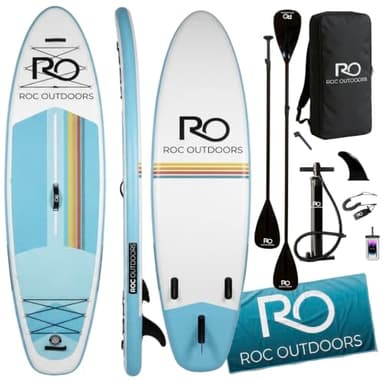
Top pick — The default first inflatable board
Roc Inflatable Stand Up Paddle Board, 10 ft 6 in x 33 in
10 ft 6 in by 33 in is the shape the whole beginner category converged on, and this is the cheapest version of it that publishes a 350 lb rating.
What the listing publishes
126 x 33 x 6 in, 350 lb rated capacity, PVC drop-stitch, full accessory kit
Usable at the 65 percent rule: 228 lb (range 210–245 lb), which leaves about 208 lb of paddler after a 20 lb day kit. Why 65 percent.
33 in of width is the number that decides whether you stand up on day one. Our width guidance puts 32 to 33 in as the beginner band for an adult between 150 and 200 lb, and this sits in it.
350 lb rated capacity means about 227 lb of loaded paddler at 65 percent. Applying the displacement arithmetic instead, a 195 lb loaded paddler wants roughly 195 L of volume -- this hull's 126 x 33 x 6 in envelope is comfortably past that.
Six inches of thickness is what makes a modern inflatable stiff. Four-inch boards flex under an adult in the middle and that flex is what people mistake for the board being unstable.
What it does well
- 33 in wide -- the width that gets a first-timer standing rather than kneeling
- 350 lb rating covers an adult with a child or a dog on board
- Ships with pump, paddle, leash and bag, so the listing price is close to the total
What it costs you
- The included paddle and pump are starter parts you will eventually replace
- 10 ft 6 in is a compromise length -- not fast, not especially maneuverable
- The listing does not publish a board weight
Skip this if you already know you want to cover distance. A 10 ft 6 in all-around board is a cruiser and an 11 ft 6 in touring shape is the honest answer for mileage.
#ad · how this is funded · price as of October 9, 2026
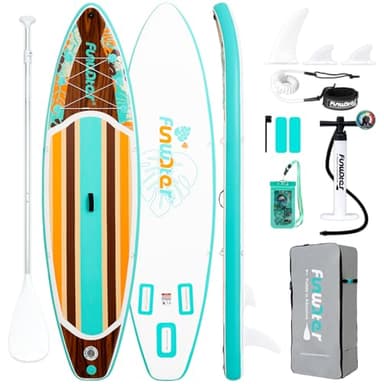
Pick 2 — Maximum stability in a standard length
FunWater Inflatable Stand Up Paddle Board, 10 ft 6 in x 35 in
Thirty-five inches of width in a 10 ft 6 in board is the closest thing to a raft that still paddles like a board, and for a genuinely nervous beginner that is the right trade.
What the listing publishes
126 x 35.1 x 6 in, 330 lb rated capacity, PVC drop-stitch
Usable at the 65 percent rule: 215 lb (range 198–231 lb), which leaves about 195 lb of paddler after a 20 lb day kit. Why 65 percent.
35.1 in is above our beginner recommendation for every weight band on the site. Extra width is slower and it is not a mistake -- speed is not the thing standing between a first-timer and a good afternoon.
330 lb rated is about 215 lb of loaded paddler at 65 percent, the same as the FEATH-R-LITE, in a board three and a half inches wider.
Wide boards are harder to reach past when you paddle, so a wide board pushes you toward a slightly longer paddle. Our formula puts a 5 ft 8 in paddler on a 77 in SUP paddle regardless of board, but the reach penalty is real and worth knowing about.
What it does well
- 35.1 in wide -- as stable as an inflatable board gets at this length
- 330 lb rating with room for a child or a dog on the nose
- Full accessory kit included
What it costs you
- Wide is slow, and you will notice against a 31 in board
- Harder to reach the water past the rail, which tires your shoulders
- The listing does not publish a board weight
Skip this if you are reasonably confident on your feet already. Width you do not need is drag you pay for on every stroke.
#ad · how this is funded · price as of October 9, 2026
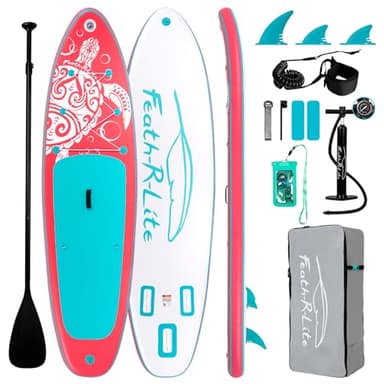
Pick 3 — The lightest board to carry to the water
FEATH-R-LITE Inflatable Stand Up Paddle Board, 10 ft 6 in x 31.5 in
Eighteen and a half pounds is a genuinely low number for a drop-stitch board, and it is the spec that decides whether the board gets carried past the first parking lot.
What the listing publishes
118.1 x 31.5 x 5.91 in, 18.9 lb board weight, 330 lb rated capacity
Usable at the 65 percent rule: 215 lb (range 198–231 lb), which leaves about 195 lb of paddler after a 20 lb day kit. Why 65 percent.
330 lb rated is about 215 lb of loaded paddler at 65 percent, which covers most adults with gear.
31.5 in of width is just under our 32 in beginner recommendation. For a paddler under about 150 lb that is fine; for a 200 lb paddler it is the reason to look at the 33 in boards instead.
At 118 in this is closer to a 9 ft 10 in board than a true 10 ft 6 in, despite how the category is marketed. Shorter is more maneuverable and less directionally stable, and the listing's own dimensions are the place to check that rather than the product name.
What it does well
- 18.9 lb published board weight is at the light end of the class
- Rated to 330 lb, so an adult with a day kit has real headroom
- Shorter hull is easier to turn and easier to pack
What it costs you
- 31.5 in is narrower than our 32 in beginner floor for an average adult
- 118 in is shorter than the 10 ft 6 in the category name implies
- Less glide per stroke than a longer board
Skip this if you are over about 180 lb. Half an inch of width sounds trivial and it is the difference between standing and kneeling for a heavier paddler.
#ad · how this is funded · price as of October 9, 2026
Pick 4 — Distance without giving up width
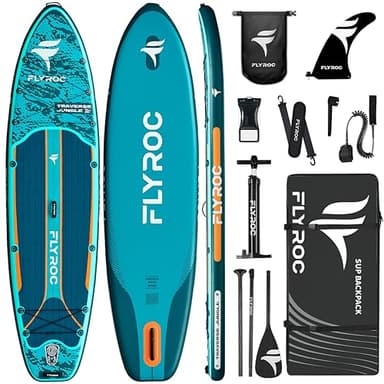
Flyroc 11 ft 6 in x 35 in Inflatable Paddle Board
A foot more waterline than the all-around boards with no narrowing to pay for it, and the highest rated capacity of any board here bar one. The published 18 lb is the figure to treat with some caution.
What the listing publishes
138 x 35 x 6 in, 18 lb board weight, 450 lb rated capacity, 15 D-rings
Usable at the 65 percent rule: 293 lb (range 270–315 lb), which leaves about 273 lb of paddler after a 20 lb day kit. Why 65 percent.
138 in of length is the reason this tracks. Every extra inch of waterline is distance covered per stroke, and the difference between a 10 ft 6 in and an 11 ft 6 in board over a mile is not subtle.
450 lb rated is about 292 lb of loaded paddler at 65 percent, which is genuine headroom rather than a marketing number. The listing's own 'up to 3 adults' framing is still optimistic — three adults is past 450 lb before anyone brings a bag.
18 lb for 138 x 35 in is light enough to be worth questioning. It is the figure the listing publishes and the only source for it, and the board's own feature text does not repeat it. Treat it as indicative rather than something to plan a long carry around.
Flyroc publish military-grade PVC with drop-stitch construction and a dual-layer sidewall, which is the right spec language for this class. What they do not publish is a maximum pressure, and pressure is what decides how stiff an inflatable actually gets.
What it does well
- 11 ft 6 in tracks straight and covers real distance
- 35 in of width means the extra length costs you no stability
- 450 lb rated, about 292 lb usable — real room for a passenger or gear
- 15 D-rings plus front and rear bungee, so a seat or a cooler both have somewhere to go
What it costs you
- 'Up to 3 adults' is not supported by 450 lb once you do the arithmetic
- The 18 lb board weight appears only in the listing's dimensions block
- No published maximum pressure, so stiffness is not a spec you can check
- 11 ft 6 in is a big object to turn on a small pond
Skip this if your water is a small pond or a tight creek. Length is only an advantage where there is room to use it, and a 10 ft 6 in board turns in half the space.
#ad · how this is funded · price as of October 9, 2026
The brands you have not heard of
This is the part that makes people hesitate, and it deserves a straight answer rather than reassurance. Most inflatable boards in the entry price class come out of a small number of factories, are sold under a large number of brand names, and differ mainly in specification, finish and how long the seller intends to stay in business.
- **An unfamiliar name is not a red flag by itself.** The category barely existed a decade ago and almost none of these brands have heritage to trade on.
- **A name that disappears is a warranty problem.** A five-year warranty from a brand that exits the market next season is not a five-year warranty. Weigh long warranties in this class accordingly.
- **Published specs are the real signal.** A seller who prints width, thickness, length, board weight and rated capacity is telling you they are comfortable being measured. A listing with a headline capacity and no dimension table is telling you something too.
What a complete kit should contain
Nearly every board in this class is sold as a package, and the packages are more similar than the marketing suggests. Knowing the standard contents makes it obvious when something is missing.
| Item | Standard? | Note |
|---|---|---|
| Board and center fin | Always | Check the fin is removable |
| Hand pump with gauge | Almost always | The gauge is the important part |
| Adjustable paddle | Almost always | Usually aluminum, usually the first upgrade |
| Ankle leash | Usually | Fine for flat water. Never on a river |
| Carry bag | Usually | Backpack straps if you are lucky |
| Repair kit | Usually | A patch and glue. Keep it with the board |
| Life jacket | Never | Legally required, and separately bought |
A life jacket is not in any of these packages and is required by federal rule for every person aboard. It is the most common omission from a first-board budget. What the rules actually say, and what a complete setup costs.
Returns, and what happens if it leaks
The genuine advantage of buying this category online is not price. It is that a large board is awkward to return anywhere, and the return process is unusually good on a platform built around it.
- **Inflate and test it early.** Pump it to its rated pressure in the yard and leave it for a few hours on the day it arrives, well inside any return window. A seam or valve fault shows up as pressure loss, and this is the only test that finds it before you are on the water.
- **Pressure drops in the cold are normal.** A board losing a little pressure overnight as temperature falls is physics, not a leak. Test at a stable temperature before concluding anything.
- **Keep the box for the window.** Boards are returnable and bulky, and having the packaging makes the first weeks straightforward.
- **Small punctures are genuinely repairable.** The patch kit in the box works, and a PVC board that gets a pinhole in year two is a twenty-minute repair rather than a replacement.
Where the other retailers fit
Amazon is not the only place a first board comes from, and the alternatives fail in different ways. Warehouse clubs sell a small number of boards very cheaply in a narrow seasonal window, with no ability to compare specs; big-box sporting goods stores let you see the board and carry a thinner range. We cover the two most-searched alternatives separately: the Costco paddle board question and Walmart kayaks.
The advantage of the Amazon market for a first board is not price, it is that the specification is written down. A board in a warehouse aisle has a price and a picture. That is a harder thing to check arithmetic against.
Which is the whole method on one line: decide your numbers before you open a single listing, then use the listings to find a board that meets them. Shopping the other way round — browsing until something looks appealing and then rationalizing the specs — is how people end up with a 4 in board or a capacity that does not cover them.
Questions people actually ask
Are Amazon paddle boards any good?
What should I check before buying a paddle board online?
Why do paddle board listings quote different capacities?
Can I trust the star ratings on paddle board listings?
Is the included paddle any good?
Should I worry about buying a paddle board from a brand I have never heard of?
What should I do when a new paddle board arrives?
Where these numbers came from
Every figure on this page traces to one of these. Where a number could not be sourced, the page says so rather than estimating it.
- Thurso Surf — What Size Paddle Board Is Right for You (manufacturer, states the weight-in-kg x 2 volume rule and the 32 in beginner width band)
- ISLE Paddle Boards — Paddle Board Size & Weight Chart (manufacturer, published per-model capacities)
- Eddyline Kayaks — Maximum weight capacity versus ideal capacity for various styles of kayaks (manufacturer, states the 60-70% ideal-capacity band)
- Roc Inflatable Stand Up Paddle Board 10 ft 6 in — manufacturer specification as published on the Amazon listing, read 2026-09-02
- FunWater Inflatable Stand Up Paddle Board — manufacturer specification as published on the Amazon listing, read 2026-09-02
- FEATH-R-LITE Inflatable Stand Up Paddle Board — manufacturer specification as published on the Amazon listing, read 2026-09-02
- Flyroc 11'6 x 35 in Inflatable Stand Up Paddle Board — manufacturer specification as published on the Amazon listing, read 2026-10-04
Read next
Best First Board
The Best Paddle Boards for Beginners
Five beginner boards ranked on published width and usable capacity, with the displacement arithmetic run on each one.
Top pick
Roc Inflatable Stand Up Paddle Board, 10 ft 6 in x 33 in
The default first inflatable board
#ad · how this is funded · price as of October 9, 2026

Are Costco Paddle Boards Worth It?
Warehouse-store boards are usually fine, and here are the two specs that tell you whether this one is.
Top pick
Roc Inflatable Stand Up Paddle Board, 10 ft 6 in x 33 in
The default first inflatable board
#ad · how this is funded · price as of October 9, 2026

What Size Paddle Board Do I Need?
A volume and width calculator that shows its working, and ends in an actual board rather than a chart.
Top pick
Roc Inflatable Stand Up Paddle Board, 10 ft 6 in x 33 in
The default first inflatable board
#ad · how this is funded · price as of October 9, 2026

Paddle Board Weight Limits, Explained
Rated capacity is not usable capacity. The 65 percent rule, where it comes from, and what happens when you ignore it.
Top pick
SereneLife XL Extra-Wide Inflatable Paddle Board, 35 in
A heavier paddler, or a board that carries the family
#ad · how this is funded · price as of October 9, 2026