Paddle Boards
FEATH-R-LITE 10 ft 6 in Paddle Board: What the Specs Say
One of very few boards in this class that publishes its own weight, and the number is genuinely low. Two other published figures decide whether that matters to you.
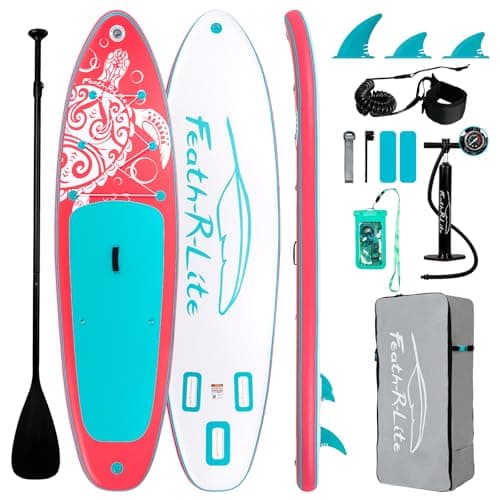
We have not paddled these, and we are not going to pretend we have. Here is what we did instead. Links to Amazon earn us a commission at no extra cost to you, and commission never decides a pick — how this site is funded.
| # | Product | Best for | The spec it turns on | Price |
|---|---|---|---|---|
| 1 | FEATH-R-LITE Inflatable Stand Up Paddle Board, 10 ft 6 in x 31.5 inTop pickEighteen and a half pounds is a genuinely low number for a drop-stitch board, and it is the spec that decides whether the board gets carried past the first parking lot. | The lightest board to carry to the water | 118.1 x 31.5 x 5.91 in, 18.9 lb board weight, 330 lb rated capacity |
We have not paddled this board. What follows is its published specification, run through the same arithmetic as everything else here, including one dimension that does not match the way the board is named.
Top pick — The lightest board to carry to the water
FEATH-R-LITE Inflatable Stand Up Paddle Board, 10 ft 6 in x 31.5 in
Eighteen and a half pounds is a genuinely low number for a drop-stitch board, and it is the spec that decides whether the board gets carried past the first parking lot.
What the listing publishes
118.1 x 31.5 x 5.91 in, 18.9 lb board weight, 330 lb rated capacity
Usable at the 65 percent rule: 215 lb (range 198–231 lb), which leaves about 195 lb of paddler after a 20 lb day kit. Why 65 percent.
330 lb rated is about 215 lb of loaded paddler at 65 percent, which covers most adults with gear.
31.5 in of width is just under our 32 in beginner recommendation. For a paddler under about 150 lb that is fine; for a 200 lb paddler it is the reason to look at the 33 in boards instead.
At 118 in this is closer to a 9 ft 10 in board than a true 10 ft 6 in, despite how the category is marketed. Shorter is more maneuverable and less directionally stable, and the listing's own dimensions are the place to check that rather than the product name.
What it does well
- 18.9 lb published board weight is at the light end of the class
- Rated to 330 lb, so an adult with a day kit has real headroom
- Shorter hull is easier to turn and easier to pack
What it costs you
- 31.5 in is narrower than our 32 in beginner floor for an average adult
- 118 in is shorter than the 10 ft 6 in the category name implies
- Less glide per stroke than a longer board
Skip this if you are over about 180 lb. Half an inch of width sounds trivial and it is the difference between standing and kneeling for a heavier paddler.
#ad · how this is funded · price as of October 9, 2026
The numbers, in order of how much they matter
| Spec | Published | What it means |
|---|---|---|
| Board weight | 18.9 lb | Light for a drop-stitch board, and the reason this one gets carried |
| Width | 31.5 in | Just under our 32 in beginner floor. This is the limiting spec |
| Length | 118.1 in (9 ft 10 in) | Shorter than the 10 ft 6 in the name implies. Turns well, glides less |
| Thickness | 5.91 in | Effectively the standard 6 in. No sag underfoot at pressure |
| Rated capacity | 330 lb | About 215 lb of loaded paddler at the 65 percent rule |
Why 18.9 lb is the headline
Board weight is the spec most listings in this category simply do not publish, and it is the one that quietly decides how often a board gets used. An inflatable lives in a bag; the bag has to get from a car to the water, usually more than once, often by one person who is also carrying a paddle and a pump.
Most 10 ft 6 in drop-stitch boards land somewhere in the low twenties once you include the fin and the pump, and several are heavier than that. Publishing 18.9 lb is both a good number and a signal — a maker that prints its board weight is usually not embarrassed by it.
The width question, which is the real decision
Our beginner width band is 32 to 34 inches, and this board is 31.5. Half an inch sounds like nothing and it sits exactly on the line where standing up stops being automatic.
Under about 150 lb, 31.5 inches is a perfectly stable first board and the extra half inch would only slow you down. Between 150 and 180 lb it is a fair trade for the weight saving. Above roughly 180 lb, the 33 in Roc or the 35 in FunWater are the boards that get you standing on day one, and standing on day one is most of whether someone continues.
How it compares to the boards it is cross-shopped against
Everything in this class looks identical in a photograph, so the published table is the only place they differ.
| Board | Length | Width | Board weight | Rated | Loaded paddler at 65% |
|---|---|---|---|---|---|
| FEATH-R-LITE | 118.1 in | 31.5 in | 18.9 lb | 330 lb | 215 lb |
| Roc 10 ft 6 in | 126 in | 33 in | not published | 350 lb | 227 lb |
| FunWater 10 ft 6 in | 126 in | 35.1 in | not published | 330 lb | 215 lb |
| Flyroc 11 ft 6 in | 138 in | 35 in | 18 lb | 450 lb | 292 lb |
Two things stand out. The FEATH-R-LITE is the only board here that is genuinely short, and it and the Flyroc are the only two that publish a weight at all. An unpublished board weight is not automatically a bad one, but across this category it correlates: makers print the number when the number is good.
What 5.91 inches of thickness means
Thickness is the spec beginners skip and it is the one that decides whether a board holds a person up properly. 5.91 in is effectively the standard 6 in — the number is a metric conversion rounded oddly, not a corner cut.
The reason it matters is stiffness. A drop-stitch board resists bending because thousands of internal threads hold the top and bottom skins apart under pressure, and thickness is the lever arm those threads work through. A 4 to 5 in board under an adult sags in the middle regardless of how hard you pump it, and a sagging board is slow, wet and unstable in a way that feels like a balance problem but is not.
The length the name does not mention
This is marketed in the 10 ft 6 in class and its own published dimension is 118.1 inches, which is 9 ft 10 in. That is not a small difference — it is eight inches of waterline.
- **Shorter turns more easily**, which is genuinely useful on a small lake or a narrow river.
- **Shorter tracks less well**, so you correct more often on an open crossing and cover less distance per stroke.
- **Shorter packs smaller**, which compounds the weight advantage if you are carrying it any distance.
Taken together those make this a good small-water board and a mediocre open-water one. On a pond, a slow river or a sheltered bay it turns readily and is easy to get to the launch. On a mile of open lake into a headwind, the shorter waterline and the narrower deck both work against you, and a longer, wider board covers the same distance for less effort.
Questions people actually ask
Is the FEATH-R-LITE good for beginners?
How much does the FEATH-R-LITE paddle board weigh?
Is the FEATH-R-LITE really 10 ft 6 in?
FEATH-R-LITE or Roc 10 ft 6 in?
What weight can the FEATH-R-LITE carry?
Is 5.91 inches thick enough for an adult?
Why does my inflatable board feel soft?
Where these numbers came from
Every figure on this page traces to one of these. Where a number could not be sourced, the page says so rather than estimating it.
- Thurso Surf — What Size Paddle Board Is Right for You (manufacturer, states the weight-in-kg x 2 volume rule and the 32 in beginner width band)
- Eddyline Kayaks — Maximum weight capacity versus ideal capacity for various styles of kayaks (manufacturer, states the 60-70% ideal-capacity band)
- FEATH-R-LITE Inflatable Stand Up Paddle Board 10 ft 6 in — manufacturer specification as published on the Amazon listing, read 2026-09-02
Read next

What Size Paddle Board Do I Need?
A volume and width calculator that shows its working, and ends in an actual board rather than a chart.
Top pick
Roc Inflatable Stand Up Paddle Board, 10 ft 6 in x 33 in
The default first inflatable board
#ad · how this is funded · price as of October 9, 2026
Best First Board
The Best Paddle Boards for Beginners
Five beginner boards ranked on published width and usable capacity, with the displacement arithmetic run on each one.
Top pick
Roc Inflatable Stand Up Paddle Board, 10 ft 6 in x 33 in
The default first inflatable board
#ad · how this is funded · price as of October 9, 2026
Best Inflatable
The Best Inflatable Paddle Boards
Inflatable SUPs ranked on width, thickness, capacity and packed weight, with every figure read off the listing.
Top pick
Roc Inflatable Stand Up Paddle Board, 10 ft 6 in x 33 in
The default first inflatable board
#ad · how this is funded · price as of October 9, 2026

Paddle Board Weight Limits, Explained
Rated capacity is not usable capacity. The 65 percent rule, where it comes from, and what happens when you ignore it.
Top pick
SereneLife XL Extra-Wide Inflatable Paddle Board, 35 in
A heavier paddler, or a board that carries the family
#ad · how this is funded · price as of October 9, 2026
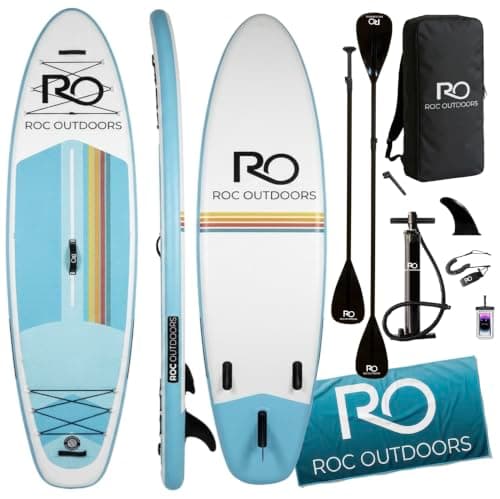
Roc 10'6" Inflatable Paddle Board: What the Specs Say
33 inches wide, 6 inches thick, rated to 350 lb — the numbers behind the most-recommended first board there is.
Top pick
Roc Inflatable Stand Up Paddle Board, 10 ft 6 in x 33 in
The default first inflatable board
#ad · how this is funded · price as of October 9, 2026