Paddle Boards
Retrospec June 11 ft 6 in Fishing Paddle Board: What the Specs Say
Sold as a fishing board, and the feature that matters most has nothing to do with fishing. Here is what its published specification means for someone buying their first board.
We have not paddled these, and we are not going to pretend we have. Here is what we did instead. Links to Amazon earn us a commission at no extra cost to you, and commission never decides a pick — how this site is funded.
| # | Product | Best for | The spec it turns on | Price |
|---|---|---|---|---|
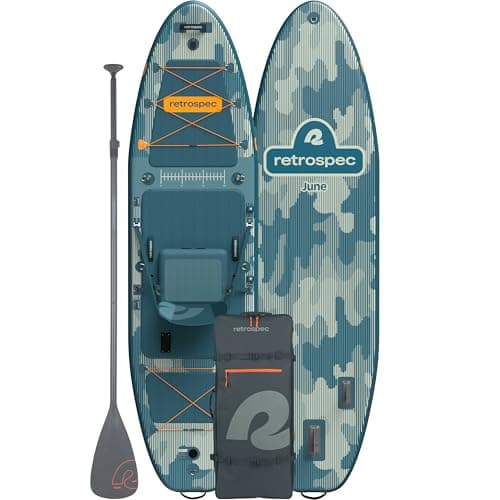
| 1 | Retrospec June Inflatable Fishing Paddle Board, 11 ft 6 inTop pickThe removable seat is what makes this useful to a beginner who is not a fisherman: a board you can sit on is a board you keep using when your legs give out or the wind gets up. | Fishing, or paddling seated | 138 x 35 x 6 in, 24.5 lb board weight, 320 lb rated capacity, removable seat and rod holders |
We have not paddled this board. What follows is what its published specification means, run through the same arithmetic we apply to every board on this site, plus an argument about who it is actually for that its own marketing does not make.
Top pick — Fishing, or paddling seated
Retrospec June Inflatable Fishing Paddle Board, 11 ft 6 in
The removable seat is what makes this useful to a beginner who is not a fisherman: a board you can sit on is a board you keep using when your legs give out or the wind gets up.
What the listing publishes
138 x 35 x 6 in, 24.5 lb board weight, 320 lb rated capacity, removable seat and rod holders
Usable at the 65 percent rule: 208 lb (range 192–224 lb), which leaves about 188 lb of paddler after a 20 lb day kit. Why 65 percent.
320 lb rated is about 208 lb of loaded paddler at 65 percent, which is enough for an adult plus tackle but not an adult plus a passenger.
Sitting down on a board converts it into a slow, very stable kayak. For a nervous first-timer that is a genuinely useful fallback rather than a gimmick, and most all-around boards do not offer it.
24.5 lb is heavy for an inflatable board and light for what it does. Rod holders, mounting points and a seat all cost weight.
What it does well
- Removable seat turns it into a stable sit-down craft when standing stops being fun
- 35 in wide and 11 ft 6 in long, so it is settled enough to fish from
- 320 lb rating covers an adult and a reasonable amount of tackle
What it costs you
- 24.5 lb is the heaviest board here
- Rod holders and mounts are clutter if you never fish
- Costs more than a plain all-around board of the same dimensions
Skip this if you only want to stand up and paddle. You are paying for hardware you will not use and carrying five extra pounds of it.
#ad · how this is funded · price as of October 9, 2026
The numbers, in order of how much they matter
| Spec | Published | What it means |
|---|---|---|
| Width | 35 in | Above our 32 to 34 in beginner band. Standing still is what this is built for |
| Length | 138 in (11 ft 6 in) | Long. Tracks well, holds position, turns reluctantly |
| Thickness | 6 in | Standard adult drop-stitch. No sag underfoot at pressure |
| Rated capacity | 320 lb | About 208 lb of loaded paddler at the 65 percent rule |
| Board weight | 24.5 lb | The heaviest board we cover. The hardware is where it goes |
| Fittings | Removable seat, rod holders, mounts | The seat is the feature. The rest is optional |
Who the 320 lb rating actually covers
Rated capacity is not usable capacity. A board loaded to its printed maximum floats low, pushes water instead of gliding, and gets unstable in exactly the conditions where you want it settled. The comfortable band manufacturers publish is around 65 percent, and that is the number to size against.
That is worth stating plainly because the width invites the wrong assumption. At 35 inches this looks like a family board, and it is not — the SereneLife XL publishes up to 485 lb and this publishes 320. Wide and high-capacity are different specs, and buying width expecting capacity is a common and expensive mistake.
The seat is the feature, and it is not a fishing feature
This is the argument the listing does not make, and it is the reason this board appears on a beginner site at all.
A removable seat converts a paddle board into a slow, extremely stable sit-down craft — effectively a very wide, very forgiving kayak. For someone who fishes, that is the normal way to use the board. For a nervous first-timer who has never stood on water, it is something better: an exit route that does not end the outing.
- **When your legs give out.** Standing on a board uses stabilizer muscles nobody trains. An hour in, a lot of first-timers are done — and on a normal board, done means going home.
- **When the wind gets up.** A standing paddler is a sail. Sitting drops your profile dramatically and turns an unpleasant fight back to the launch into an ordinary paddle.
- **When confidence runs out.** Being able to sit down is the difference between a bad first outing and a second one.
Length: what 11 ft 6 in buys and costs
At 138 inches this is at the long end of the consumer inflatable class, and length behaves differently depending on what you are doing on the board.
| Use | Effect | Verdict |
|---|---|---|
| Holding position to fish | Long waterline resists being pushed around | Good |
| Covering distance on flat water | More glide per stroke than a 10 ft 6 in board | Good |
| Turning in a tight spot | Pivots slowly. Needs real sweep strokes | Poor |
| Slow rivers and narrow creeks | Fights every bend | Poor |
| Packing and carrying | More material, more weight, bigger roll | Poor |
So this is an open-water board. On a lake or a wide slow river it is genuinely pleasant; on anything that requires turning it is the wrong shape, and the river roundup explains why we push people toward 10 ft 6 in there instead.
The 24.5 lb problem
This is the heaviest board we cover, and unlike most specs in this category it is published, which is worth crediting. The weight is not poor construction — it is the hardware. Rod holders, mounting points, extra D-rings and the seat attachments all add material, and a longer board has more of everything to begin with.
Compare it to the FEATH-R-LITE at a published 18.9 lb. Nearly six pounds is not a rounding error when the bag is on your back and the launch is a quarter mile from the car. Board weight is the spec that quietly decides how often a board actually gets used, and this one is on the wrong side of it.
If you fish, that is a fair trade — you are carrying tackle anyway and the hardware is the point. If you never fish, you are carrying five extra pounds of fittings you will not use, and there are lighter boards with the same width.
What you can ignore on this board
- **Rod holder count.** You cannot meaningfully fish more than one rod from a board. A second parks a spare; anything beyond that is decoration.
- **Camera and accessory mounts.** Fitted to nearly every fishing board and used by almost nobody in a first season.
- **The fishing branding itself.** The specification is a wide, long board with a seat. That is what you are buying, whether or not you own a rod.
What the listing does not tell you
- **A life jacket is not included** and is legally required for every person aboard. It is the most commonly missed line in a first-board budget — what the rules actually say.
- **Pump to the gauge, not to feel.** Every drop-stitch board has a rated psi and most people stop pumping early. An under-pressure board feels soft and slow, and it is almost never a construction fault.
- **Anchoring is a real hazard done wrong.** If you hold position, use a side D-ring with a quick-release. Never anchor from the nose or tail in current — a board held at one end in moving water can be pulled under.
- **The seat is an accessory, not a kayak seat.** It sits you low on the deck with no back support to speak of. It is a fallback and a fishing position, not a chair.
Questions people actually ask
Is the Retrospec June good for beginners?
How much weight can the Retrospec June hold?
Do you need to fish to want this board?
How heavy is the Retrospec June?
Can you stand and fish from the Retrospec June?
Retrospec June or a regular all-around board?
Where these numbers came from
Every figure on this page traces to one of these. Where a number could not be sourced, the page says so rather than estimating it.
- Thurso Surf — What Size Paddle Board Is Right for You (manufacturer, states the weight-in-kg x 2 volume rule and the 32 in beginner width band)
- Eddyline Kayaks — Maximum weight capacity versus ideal capacity for various styles of kayaks (manufacturer, states the 60-70% ideal-capacity band)
- U.S. Coast Guard — Life Jacket Wear / Wearing Your Life Jacket (federal carriage and under-13 wear requirements)
- Retrospec June Inflatable Fishing Paddle Board 11 ft 6 in — manufacturer specification as published on the Amazon listing, read 2026-09-02
Read next
Best for Fishing
The Best Paddle Boards for Fishing
Fishing boards need width, capacity for tackle, and a seat. Here is what actually changes versus a normal board.
Top pick
Retrospec June Inflatable Fishing Paddle Board, 11 ft 6 in
Fishing, or paddling seated
#ad · how this is funded · price as of October 9, 2026

Paddle Board Weight Limits, Explained
Rated capacity is not usable capacity. The 65 percent rule, where it comes from, and what happens when you ignore it.
Top pick
SereneLife XL Extra-Wide Inflatable Paddle Board, 35 in
A heavier paddler, or a board that carries the family
#ad · how this is funded · price as of October 9, 2026

What Size Paddle Board Do I Need?
A volume and width calculator that shows its working, and ends in an actual board rather than a chart.
Top pick
Roc Inflatable Stand Up Paddle Board, 10 ft 6 in x 33 in
The default first inflatable board
#ad · how this is funded · price as of October 9, 2026
Best First Board
The Best Paddle Boards for Beginners
Five beginner boards ranked on published width and usable capacity, with the displacement arithmetic run on each one.
Top pick
Roc Inflatable Stand Up Paddle Board, 10 ft 6 in x 33 in
The default first inflatable board
#ad · how this is funded · price as of October 9, 2026
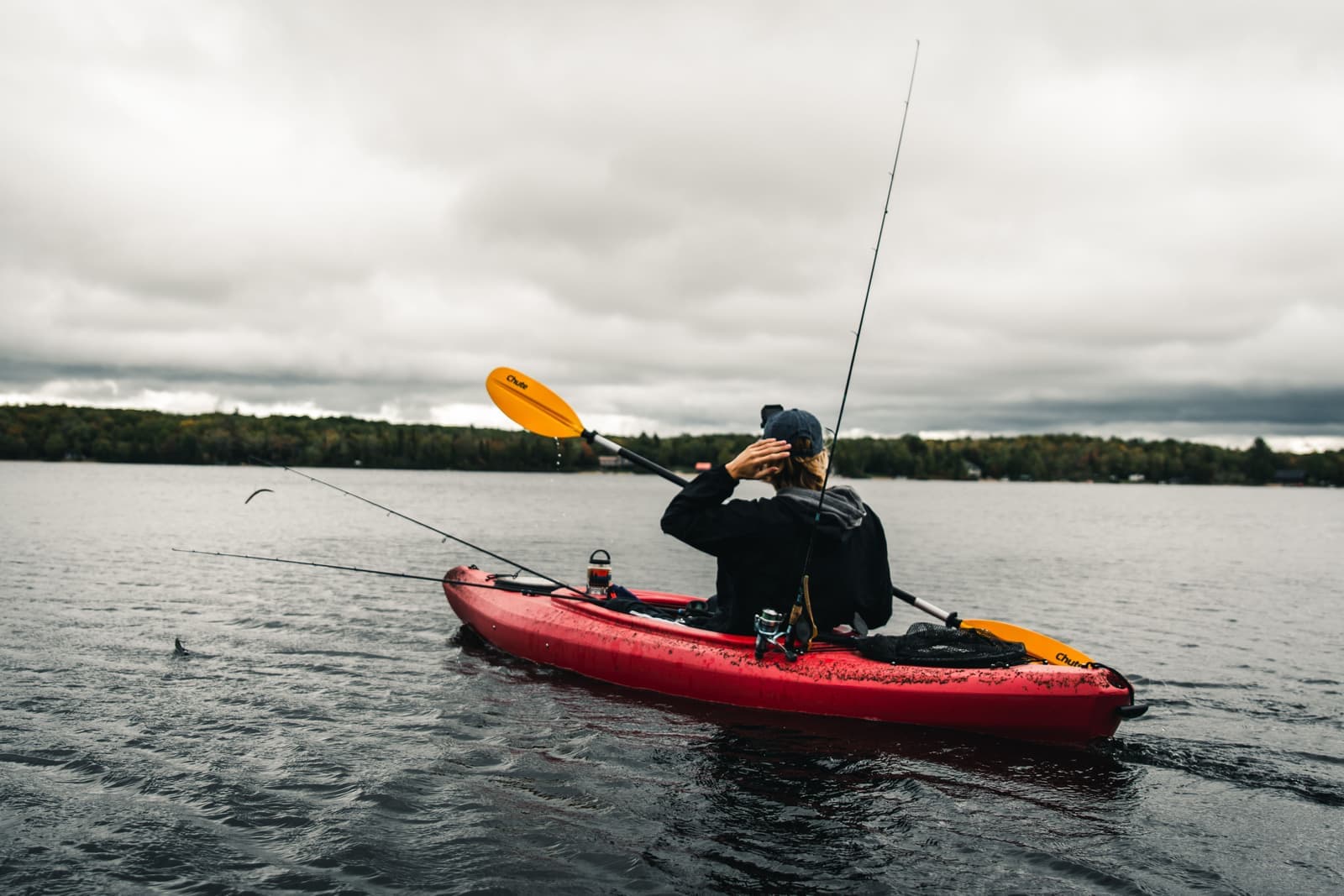
Best Fishing Kayak
The Best Kayaks for Fishing
Tackle is heavier than anyone plans for. The capacity, beam and deck specs that actually decide a first fishing kayak — and why the angler badge is not one of them.
Top pick
Perception Tribe 11.5 Sit-on-Top Kayak
The all-round first sit-on-top
#ad · how this is funded · price as of October 9, 2026