Paddle Boards
FunWater 10'6" Paddle Board: What 35 Inches Buys You
Two extra inches of width sounds like a rounding error and is the difference between kneeling and standing for a lot of first-time paddlers. Here is the trade, stated plainly.
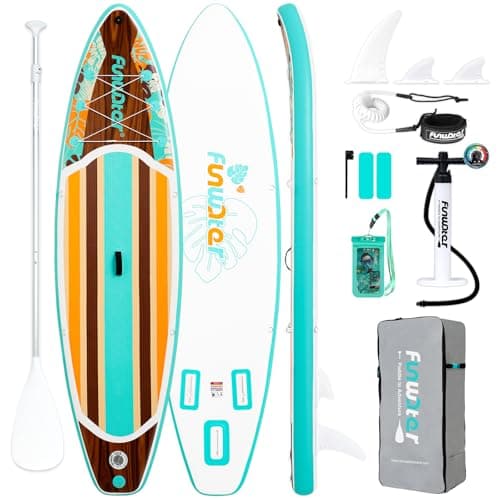
We have not paddled these, and we are not going to pretend we have. Here is what we did instead. Links to Amazon earn us a commission at no extra cost to you, and commission never decides a pick — how this site is funded.
| # | Product | Best for | The spec it turns on | Price |
|---|---|---|---|---|
| 1 | FunWater Inflatable Stand Up Paddle Board, 10 ft 6 in x 35 inTop pickThirty-five inches of width in a 10 ft 6 in board is the closest thing to a raft that still paddles like a board, and for a genuinely nervous beginner that is the right trade. | Maximum stability in a standard length | 126 x 35.1 x 6 in, 330 lb rated capacity, PVC drop-stitch |
We have not paddled this board. This is a reading of its published specification against the same arithmetic we apply to every other board on the site.
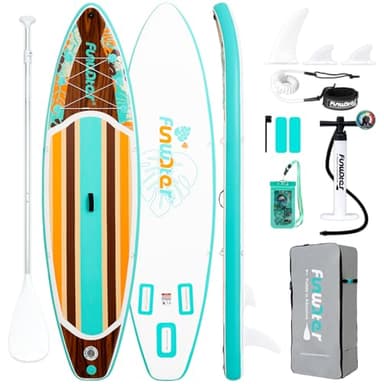
Top pick — Maximum stability in a standard length
FunWater Inflatable Stand Up Paddle Board, 10 ft 6 in x 35 in
Thirty-five inches of width in a 10 ft 6 in board is the closest thing to a raft that still paddles like a board, and for a genuinely nervous beginner that is the right trade.
What the listing publishes
126 x 35.1 x 6 in, 330 lb rated capacity, PVC drop-stitch
Usable at the 65 percent rule: 215 lb (range 198–231 lb), which leaves about 195 lb of paddler after a 20 lb day kit. Why 65 percent.
35.1 in is above our beginner recommendation for every weight band on the site. Extra width is slower and it is not a mistake -- speed is not the thing standing between a first-timer and a good afternoon.
330 lb rated is about 215 lb of loaded paddler at 65 percent, the same as the FEATH-R-LITE, in a board three and a half inches wider.
Wide boards are harder to reach past when you paddle, so a wide board pushes you toward a slightly longer paddle. Our formula puts a 5 ft 8 in paddler on a 77 in SUP paddle regardless of board, but the reach penalty is real and worth knowing about.
What it does well
- 35.1 in wide -- as stable as an inflatable board gets at this length
- 330 lb rating with room for a child or a dog on the nose
- Full accessory kit included
What it costs you
- Wide is slow, and you will notice against a 31 in board
- Harder to reach the water past the rail, which tires your shoulders
- The listing does not publish a board weight
Skip this if you are reasonably confident on your feet already. Width you do not need is drag you pay for on every stroke.
#ad · how this is funded · price as of October 18, 2026
The width is the whole story
At 35.1 inches this is wider than our recommendation for any paddler weight band. That is deliberate on the manufacturer's part and it is worth understanding as a design choice rather than as a specification error.
Width governs initial stability — how solid the board feels at rest, before you are moving. Every inch of it makes a first stand-up easier and makes the board slower and harder to reach past. For someone who has already decided they are nervous about falling in, that is the correct trade and it is not close.
| Spec | Published | What it means |
|---|---|---|
| Width | 35.1 in | Above our beginner band at every weight. Maximum forgiveness |
| Length | 126 in (10 ft 6 in) | Standard all-around length |
| Thickness | 6 in | Correct adult drop-stitch thickness |
| Rated capacity | 330 lb | About 215 lb usable at 65 percent, or 200 lb of paddler after gear |
| Material | PVC drop-stitch | Standard for the class |
| Board weight | not published | Cannot plan the carry from the listing |
The reach problem nobody warns you about
A wide board is harder to paddle properly, and the reason is geometry rather than effort. To get the paddle blade vertical in the water — which is what makes the board go straight instead of turning — you have to reach past the rail. Two extra inches of rail on each side is four extra inches of reach per stroke.
For an average adult that is manageable and it shows up as shoulder fatigue over an hour rather than as an immediate problem. For a shorter paddler it is more significant, and it is worth being honest that 35 inches is a lot of board for anyone under about 5 ft 4 in.
Who should buy it
- **Anyone who describes themselves as nervous about falling in.** This is the board that solves that, and the speed you give up is speed you were not going to use.
- **Paddlers between about 180 and 200 lb** who want stability without moving to a specialist high-capacity board.
- **Anyone taking a small child or a small dog aboard**, provided the combined load stays inside 215 lb of usable capacity.
- **Yoga and photography on the water**, where standing still and not falling in is the entire activity.
Who should not
- **Anyone already reasonably confident on their feet.** The Roc at 33 in is enough width and is faster for it.
- **Paddlers over about 200 lb.** The 330 lb rating runs out before the width does. Check your number.
- **Anyone under about 5 ft 4 in.** The reach across a 35 inch rail is a genuine ergonomic problem at that height.
- **Anyone who wants to cover distance.** Width is drag. An 11 ft 6 in board is the distance answer.
Questions people actually ask
Is a 35 inch wide paddle board too wide?
How much weight does the FunWater 10'6" hold?
Is the FunWater board good for yoga?
FunWater or Roc for a first board?
Where these numbers came from
Every figure on this page traces to one of these. Where a number could not be sourced, the page says so rather than estimating it.
- Thurso Surf — What Size Paddle Board Is Right for You (manufacturer, states the weight-in-kg x 2 volume rule and the 32 in beginner width band)
- Eddyline Kayaks — Maximum weight capacity versus ideal capacity for various styles of kayaks (manufacturer, states the 60-70% ideal-capacity band)
- FunWater Inflatable Stand Up Paddle Board — manufacturer specification as published on the Amazon listing, read 2026-09-02
Read next

Best for Yoga
The Best Paddle Boards for Yoga
Width for balance, length to lie down, and a deck with nothing on it. The three specs that make a board work for yoga, and which of ours have them.
Top pick
FunWater Inflatable Stand Up Paddle Board, 10 ft 6 in x 35 in
Maximum stability in a standard length
#ad · how this is funded · price as of October 18, 2026

Roc vs FunWater Paddle Board
The two entry boards everyone cross-shops, compared on the only two published specs that differ: width and rated capacity. Which to buy, by paddler.
Top pick
Roc Inflatable Stand Up Paddle Board, 10 ft 6 in x 33 in
The default first inflatable board
#ad · how this is funded · price as of October 18, 2026
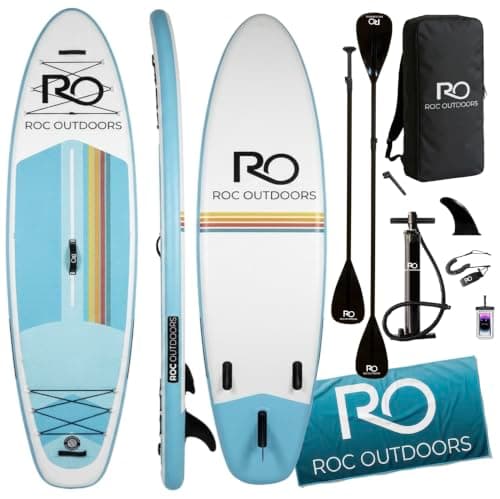
Roc 10'6" Inflatable Paddle Board: What the Specs Say
33 inches wide, 6 inches thick, rated to 350 lb — the numbers behind the most-recommended first board there is.
Top pick
Roc Inflatable Stand Up Paddle Board, 10 ft 6 in x 33 in
The default first inflatable board
#ad · how this is funded · price as of October 18, 2026

Best First Board
The Best Paddle Boards for Beginners
Five beginner boards ranked on published width and usable capacity, with the displacement arithmetic run on each one.
Top pick
Roc Inflatable Stand Up Paddle Board, 10 ft 6 in x 33 in
The default first inflatable board
#ad · how this is funded · price as of October 18, 2026

What Size Paddle Board Do I Need?
A volume and width calculator that shows its working, and ends in an actual board rather than a chart.
Top pick
Roc Inflatable Stand Up Paddle Board, 10 ft 6 in x 33 in
The default first inflatable board
#ad · how this is funded · price as of October 18, 2026

What Length Paddle Do You Need?
A paddle length calculator fitted to a manufacturer's published chart, with the derivation shown.
Top pick
Bending Branches Whisper Kayak Paddle, 230 cm
The first paddle worth keeping
#ad · how this is funded · price as of October 18, 2026