Gear & Getting There
Onyx MoveVent Dynamic: The Life Jacket You Will Actually Keep On
The best life jacket is the one still on your body when something goes wrong, which makes comfort a safety specification rather than a luxury. This one is cut for the way you actually sit in a kayak.
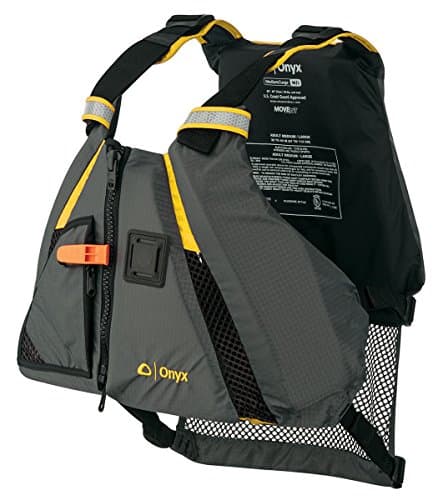
We have not paddled these, and we are not going to pretend we have. Here is what we did instead. Links to Amazon earn us a commission at no extra cost to you, and commission never decides a pick — how this site is funded.
| # | Product | Best for | The spec it turns on | Price |
|---|---|---|---|---|
| 1 | Onyx MoveVent Dynamic Paddle VestTop pickA paddling-cut vest with a mesh lower back, which is the design difference that stops a PFD from being pushed up your neck every time you sit against a seat back. | The PFD you will actually keep on | USCG and Transport Canada approved, 90 to 300 lb range, 1.7 lb, ventilated back panel |
We have not tested this vest in the water, and we would not claim to have. What follows is what its published specification means, what its approval does and does not cover, and a direct account of who it does not suit.
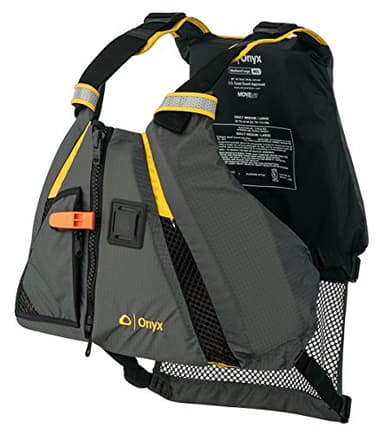
Top pick — The PFD you will actually keep on
Onyx MoveVent Dynamic Paddle Vest
A paddling-cut vest with a mesh lower back, which is the design difference that stops a PFD from being pushed up your neck every time you sit against a seat back.
What the listing publishes
USCG and Transport Canada approved, 90 to 300 lb range, 1.7 lb, ventilated back panel
The U.S. Coast Guard requires a wearable approved PFD for every person aboard a recreational vessel, and requires children under 13 to wear one while under way. Kayaks, canoes and paddle boards count as vessels. Carrying it satisfies the law for adults; wearing it is what actually works.
The 90 to 300 lb rating on the listing is a chest-size and buoyancy fit range, not a capacity. Get the size right -- a PFD that rides up when you lift your arms is one you will take off.
The ventilated back panel exists because kayak seats have backrests. A flat-backed general-purpose vest and a seat back fight each other for the same space, and the vest loses.
What it does well
- Cut for paddling, so the lower back clears a kayak seat
- Ventilated panel makes it bearable in real summer heat
- USCG and Transport Canada approved, which is the only certification that counts
What it costs you
- Costs several times a general-purpose orange vest
- Sized ranges mean you must check the fit chart, not just buy a Medium
- Mesh back panels snag on rough gear
Skip this if this is a once-a-year rental-style outing. A cheap approved vest is legally identical and the comfort argument only pays off with hours in it.
#ad · how this is funded · price as of October 9, 2026
Comfort is the safety specification
This sounds like marketing and it is the opposite. A life jacket in the bottom of the boat provides exactly no buoyancy, and the overwhelming reason adults take one off is that it is hot, it rides up, or it fights the seat. Every design decision on a paddling-cut vest is aimed at removing the excuse.
So when we say this is the vest you will keep on, that is the claim being made about it — not that it floats better than a cheaper one. Two approved vests of the same type provide comparable buoyancy. They do not provide comparable odds of being worn.
| Spec | Published | What it means |
|---|---|---|
| Approval | US Coast Guard and Transport Canada | The only certification that counts on the water |
| Back panel | Mesh, shaped for canoe and kayak seats | The reason it does not ride up against a seat back |
| Ventilation | Mesh panels front and back, open sides | The difference between wearing it and carrying it in July |
| Armholes | Large openings | Full stroke range without chafing the underarm |
| Adjustment | Side belts and shoulder straps | Six points to stop it lifting when you raise your arms |
| Foam | Sculpted soft foam | Conforms rather than sitting as a slab |
| Extras | Zippered pocket, whistle, lash tab | The whistle matters; see below |
| Visibility | SOLAS-grade reflective accents | The high-spec reflective standard, not a printed stripe |
| Weight | 1.7 lb | Light enough to forget you have it on |
The mesh lower back is the whole design
A general-purpose life jacket is a continuous slab of foam from shoulders to waist, front and back. That is fine standing on a boat deck. In a kayak you are sitting on the floor with a backrest pressed against your lumbar spine, and the vest's lower back foam has nowhere to go.
What happens next is predictable: the seat back pushes the foam up, the vest rides toward your ears, and within forty minutes you loosen it or take it off. A paddling cut replaces that lower back foam with mesh so the seat and the vest occupy different space. Onyx publish exactly this — a mesh panel in back that accommodates most canoe and kayak seats.
If you have owned a cheap orange vest and concluded that life jackets are unbearable, this is the specific thing that was wrong with it. How the rules actually read.
What the approval covers, and what it does not
Dual US Coast Guard and Transport Canada approval is the meaningful certification, and it is the line separating a life jacket from the large category of swim vests and flotation aids that look similar and are not approved for use on a vessel.
What approval does not tell you is whether it fits you. An approved vest that is too large rides up over your face in the water rather than holding you higher, which is the failure mode that makes sizing a safety issue rather than a comfort one. Approval applies inside the stated range and not outside it.
The armholes, and why paddlers care
A kayak stroke rotates your torso and lifts your arms across your body repeatedly. A vest with small armholes catches the underarm on every stroke, which is both chafing and a slight restriction you stop noticing and start compensating for.
Onyx publish large armhole openings and open sides, which is the paddling-specific detail alongside the mesh back. It is also part of why the vest is cooler than it looks: the open sides are ventilation as well as mobility.
The whistle is not a gimmick
A built-in whistle appears in the feature list between the pocket and the lash tab, which undersells it. A sound-signaling device is a genuinely useful piece of safety equipment on open water, it works when you are too cold or too winded to shout, and having it attached to the thing you are wearing means it is with you rather than in a hatch.
The SOLAS-grade reflective accents belong in the same category. SOLAS is the high-specification marine reflective standard rather than a decorative printed stripe, and it is what makes you findable in failing light.
What it costs you
- **It costs several times a basic orange vest**, and the basic vest is equally approved. You are buying the odds that it stays on, not extra flotation.
- **Sizing is by chart, not by instinct.** Buying your shirt size and hoping is how people end up with a vest that rides up.
- **Mesh panels snag.** On rough gear, a hatch rim or a stray hook, mesh is less forgiving than solid nylon.
- **It is not a rescue PFD.** There is no quick-release belt here, which matters if you ever want to clip a leash to it on moving water. Which leash needs what.
Who should buy it
- **Anyone who has taken a life jacket off because it was hot or rode up.** This is the vest that addresses exactly that.
- **Kayakers with a seat back**, which is nearly all of them. The mesh lower back is worth more here than any other feature.
- **Summer paddlers.** Ventilation is the difference between wearing it and carrying it.
- **Anyone buying their first proper PFD** after a rental or a bundled vest. The full roundup.
Who should not
- **Anyone buying for a child.** Children are sized by the weight printed on the label and need different features entirely. Kids' vests are here.
- **Anyone who needs a quick-release rescue belt** for a moving-water leash. This is not that vest.
- **Anyone who will not read the size chart.** An approved vest in the wrong size is the failure mode that matters.
- **Anyone on the tightest possible budget** who will genuinely wear a basic vest. A worn cheap vest beats an unworn good one, every time.
Questions people actually ask
Is the Onyx MoveVent Dynamic Coast Guard approved?
What makes a paddling life jacket different from a regular one?
How should a kayak life jacket fit?
Do you have to wear a life jacket in a kayak?
Is the Onyx MoveVent Dynamic worth the money over a cheap vest?
Does it have a pocket and a whistle?
Where these numbers came from
Every figure on this page traces to one of these. Where a number could not be sourced, the page says so rather than estimating it.
- U.S. Coast Guard — Life Jacket Wear / Wearing Your Life Jacket (federal carriage and under-13 wear requirements)
- U.S. Coast Guard — Recreational Boaters (federal equipment requirements for vessels, paddlecraft included)
- Onyx MoveVent Dynamic Paddle Vest, USCG/TC Approved — manufacturer specification as published on the Amazon listing, read 2026-09-27
Read next
Best Life Jacket
The Best Life Jackets for Paddling
Approved vests compared on cut and comfort — the variables that decide whether it stays on.
Top pick
Onyx MoveVent Dynamic Paddle Vest
The PFD you will actually keep on
#ad · how this is funded · price as of October 9, 2026
Life Jacket Rules for Paddlers
The federal PFD requirement, the under-13 wear rule, and why your state matters — sourced, not paraphrased.
Top pick
Onyx MoveVent Dynamic Paddle Vest
The PFD you will actually keep on
#ad · how this is funded · price as of October 9, 2026
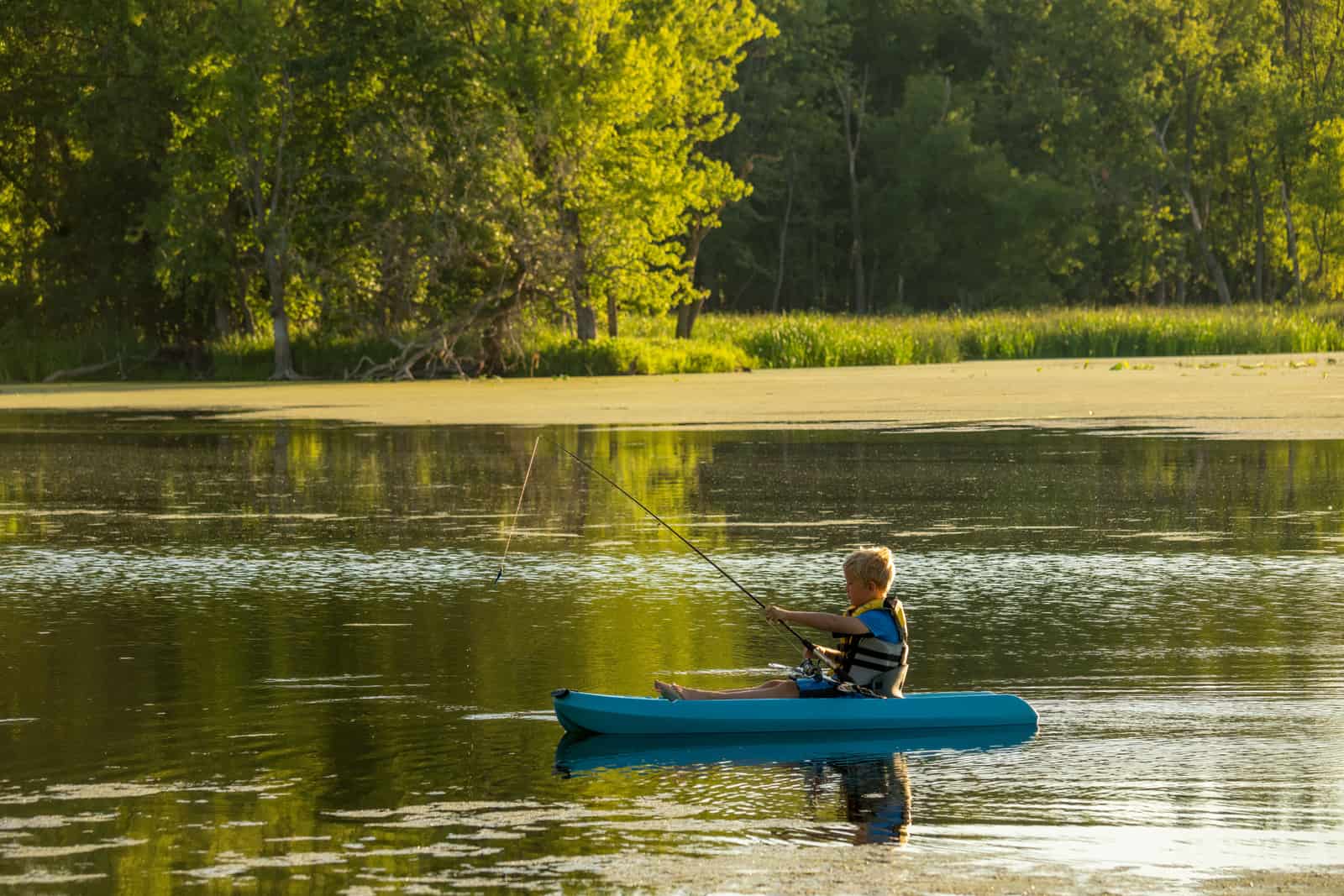
Best Kids' Life Jacket
The Best Life Jackets for Kids Who Paddle
Fitted by weight on the label, never by age. The approved vest for each weight band, the features that matter at each size, and the mistakes that make a vest unsafe.
Top pick
Onyx Youth Life Jacket, 55-88 lb
A child paddling their own kayak or board
#ad · how this is funded · price as of October 9, 2026

The First Trip Checklist
A deliberately short packing list for a first outing, plus the two-minute check before you launch.
Top pick
Onyx MoveVent Dynamic Paddle Vest
The PFD you will actually keep on
#ad · how this is funded · price as of October 9, 2026
Best First Accessory
Kayak Accessories: What Actually Earns a Place
Five accessories that change every outing, ranked by how much they improve it per dollar — and the ones you can safely skip for a season.
Top pick
Bending Branches Whisper Kayak Paddle, 230 cm
The first paddle worth keeping
#ad · how this is funded · price as of October 9, 2026