Kayaks
The Best Kayaks for Dogs
A dog needs somewhere to stand, somewhere to grip, and enough capacity spare that its weight does not sink the boat's waterline. That rules out more boats than people expect.
We have not paddled these, and we are not going to pretend we have. Here is what we did instead. Links to Amazon earn us a commission at no extra cost to you, and commission never decides a pick — how this site is funded.
| # | Product | Best for | The spec it turns on | Price |
|---|---|---|---|---|
| 1 | 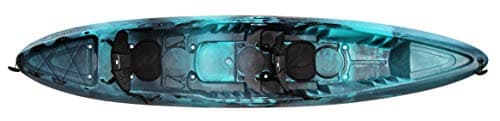 Perception Rambler 13.5 Tandem Sit-on-Top KayakTop pick550 lb rated is the highest here, and it is the only figure on this page that genuinely covers two adults and a passenger once the 65 percent rule is applied. | Two adults plus a child or a dog | 162 in long, 34 in beam, 78 lb hull, 550 lb rated capacity | |
| 2 | 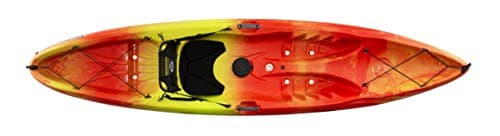 Perception Tribe 11.5 Sit-on-Top KayakThe combination almost nothing else manages: 350 lb of rating, a 30 in beam and enough waterline to hold a line, in a hull a first-timer can climb back onto from the water. | The all-round first sit-on-top | 137 in long, 30.25 in beam, 52 lb hull, 350 lb rated capacity | |
| 3 | 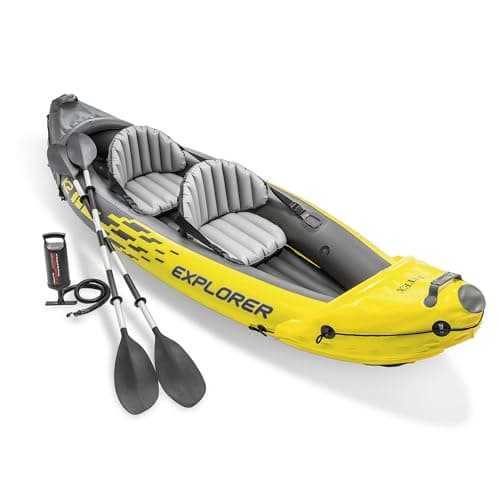 Intex Explorer K2 Inflatable Kayak, 2-person (oars and pump included)Bought as a tandem it disappoints; bought as a very roomy solo boat with 400 lb of rating and no rack requirement, it is the most useful inflatable here. | Two people, no roof rack, small budget | 123 in long, 36 in beam, 35 lb packed, 400 lb rated capacity, two oars and a pump included | |
| 4 | 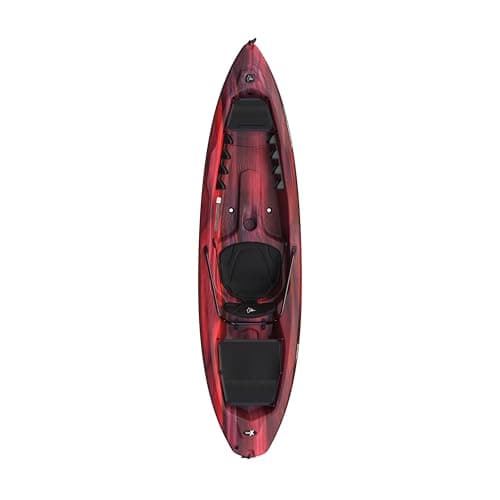 Pelican Seek 100X Sit-on-Top Kayak, 10 ftNine pounds lighter and seventeen inches shorter than the Tribe, for eight pounds less usable capacity. That trade is the whole reason to pick this one. | A sit-on-top that still fits a small car | 120 in long, 30 in beam, 43.1 lb hull, 300 lb rated capacity |
This is a deck-space problem before it is a stability problem, which is why it eliminates a whole design category immediately.
It has to be a sit-on-top
A sit-inside kayak has no deck to speak of. A dog cannot ride in the cockpit with you, cannot lie on the sealed foredeck, and — critically — cannot be lifted back aboard if it goes in, because there is nowhere to lift it onto.
A sit-on-top has an open, flat, self-draining deck. That is somewhere for the dog to lie, somewhere to fit a mat, and a surface you can haul a wet dog onto by the handle of its vest. The wider comparison.
Then the capacity arithmetic
That number is why so many single sit-on-tops do not work with a large dog. A 300 lb boat has about 175 lb of paddler capacity, and adding a 60 lb dog to a 150 lb paddler already exceeds it.
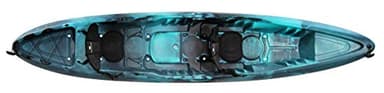
Top pick — Two adults plus a child or a dog
Perception Rambler 13.5 Tandem Sit-on-Top Kayak
550 lb rated is the highest here, and it is the only figure on this page that genuinely covers two adults and a passenger once the 65 percent rule is applied.
What the listing publishes
162 in long, 34 in beam, 78 lb hull, 550 lb rated capacity
Usable at the 65 percent rule: 358 lb (range 330–385 lb), which leaves about 338 lb of paddler after a 20 lb day kit. Why 65 percent.
550 lb rated is about 358 lb usable at 65 percent. Two 150 lb adults plus gear fits with room; two 200 lb adults plus gear does not, and no tandem's marketing copy will tell you that.
78 lb is a two-person carry, permanently. That is not a criticism, it is a planning fact: a tandem needs two people to move it and two people to paddle it well.
34 in of beam across 13 ft 6 in is why a dog can stand up on the back of this without it becoming an incident.
What it does well
- 550 lb rated capacity, the only figure here with room for three bodies
- 34 in beam is stable enough for a dog or a fidgeting child
- 13 ft 6 in tracks properly, so two paddlers out of sync still make progress
What it costs you
- 78 lb is a two-person lift every single time
- Needs roof bars and a real plan -- this does not go inside a car
- A tandem paddled solo from the back seat is genuinely awkward
Skip this if you will mostly paddle alone. A tandem solo is unbalanced and unpleasant, and two cheap solo boats often cost less than one good tandem.
#ad · how this is funded · price as of October 18, 2026
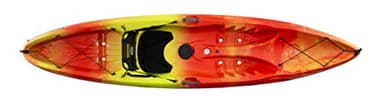
Pick 2 — The all-round first sit-on-top
Perception Tribe 11.5 Sit-on-Top Kayak
The combination almost nothing else manages: 350 lb of rating, a 30 in beam and enough waterline to hold a line, in a hull a first-timer can climb back onto from the water.
What the listing publishes
137 in long, 30.25 in beam, 52 lb hull, 350 lb rated capacity
Usable at the 65 percent rule: 228 lb (range 210–245 lb), which leaves about 208 lb of paddler after a 20 lb day kit. Why 65 percent.
350 lb rated is about 228 lb usable at 65 percent and 208 lb of paddler after a day kit -- the most headroom of any single boat here, and enough that a 200 lb adult is inside the comfortable band rather than at the edge of it.
Sit-on-top means the deck is open and self-draining. The reason that matters to a beginner is not comfort, it is that remounting from deep water is a maneuver you can actually perform, where a flooded sit-inside cockpit is not.
52 lb is the price. This is at the top of what one person carries any distance, and the reason a cart appears in our cost totals for this boat and not for the Argo.
What it does well
- 350 lb rated capacity gives real headroom for larger adults or a child up front
- Open self-draining deck is the forgiving choice for a first summer
- 137 in of hull tracks far better than the 9 and 10 ft boats here
What it costs you
- 52 lb is a two-person lift onto a roof for most people
- You will get wet. Sit-on-tops always do, and that is a season decision not a design flaw
- 11 ft 5 in needs more storage length than the 10 ft boats
Skip this if you paddle in cold water or a cold shoulder season. An open deck in 55-degree water is a different and less pleasant sport, and a sit-inside is the right answer there.
#ad · how this is funded · price as of October 18, 2026
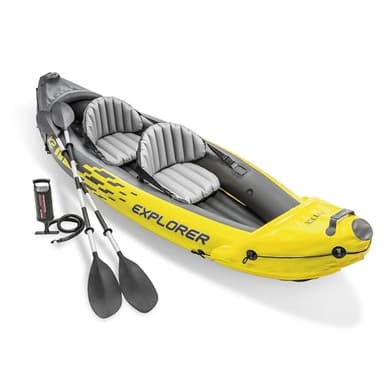
Pick 3 — Two people, no roof rack, small budget
Intex Explorer K2 Inflatable Kayak, 2-person (oars and pump included)
Bought as a tandem it disappoints; bought as a very roomy solo boat with 400 lb of rating and no rack requirement, it is the most useful inflatable here.
What the listing publishes
123 in long, 36 in beam, 35 lb packed, 400 lb rated capacity, two oars and a pump included
Usable at the 65 percent rule: 260 lb (range 240–280 lb), which leaves about 240 lb of paddler after a 20 lb day kit. Why 65 percent.
400 lb rated is about 260 lb usable at 65 percent. Two adults and gear will exceed that more often than not, which is why we recommend it as a spacious single rather than a genuine two-seater.
As a solo it is transformative: 260 lb of usable capacity against the Challenger K1's 143 lb, for nine extra pounds in the bag.
36 in of beam is wider than every hard-shell on this site. Inflatables are wide because air is what makes them stiff, and the side effect is a very forgiving platform.
What it does well
- 400 lb rated capacity -- 260 lb usable, which covers almost any solo adult with gear
- 36 in beam is the most stable platform on this site
- 35 lb in a bag: no rack, no straps, no garage
What it costs you
- Genuinely tight as a two-adult tandem once you apply the usable-capacity rule
- The included oars are oars, not proper kayak paddles -- budget to replace them
- Vinyl construction wallows in wind like every boat in this class
Skip this if you want a true two-adult tandem. Buy a hard-shell tandem with 500 lb or more of rating, or accept this as the roomiest solo inflatable in the price class.
#ad · how this is funded · price as of October 18, 2026
Pick 4 — A sit-on-top that still fits a small car
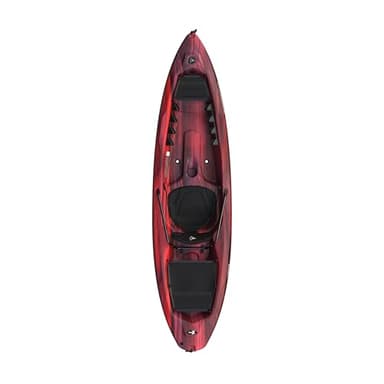
Pelican Seek 100X Sit-on-Top Kayak, 10 ft
Nine pounds lighter and seventeen inches shorter than the Tribe, for eight pounds less usable capacity. That trade is the whole reason to pick this one.
What the listing publishes
120 in long, 30 in beam, 43.1 lb hull, 300 lb rated capacity
Usable at the 65 percent rule: 195 lb (range 180–210 lb), which leaves about 175 lb of paddler after a 20 lb day kit. Why 65 percent.
300 lb rated is about 195 lb usable and 175 lb of paddler after gear -- enough for most adults, and 33 lb less headroom than the Tribe.
43 lb and 10 ft is the point where a sit-on-top becomes a one-person, one-trip job. Ten feet also fits inside a lot of vehicles that 11 ft 5 in does not.
The twin-arch hull section trades a little flat-water stillness for a hull that leans predictably rather than suddenly, which is a genuinely nicer feel once you are past the first hour.
What it does well
- 43 lb keeps this a one-person carry, unusual for a sit-on-top
- 30 in beam at only 10 ft means stability without the storage problem
- Self-draining deck with the same easy remount as any sit-on-top
What it costs you
- 300 lb rating is 50 lb short of the Tribe's
- 10 ft of hull wanders more than 11 ft 5 in on open water
- Same cold-water objection as every sit-on-top
Skip this if you and a child will regularly be on it together. The usable capacity does not cover two people once you subtract gear, and the Tribe or a tandem does.
#ad · how this is funded · price as of October 18, 2026
Deck grip is the detail that gets overlooked
A molded plastic deck is slippery when wet, and it is always wet on a sit-on-top. A dog scrabbling for grip is a dog shifting its weight suddenly, which is exactly what you do not want.
The fix is cheap and effective: a section of closed-cell foam mat, an offcut of EVA deck pad, or a rubber-backed bath mat cut to the deck, held down with the existing bungees. Nothing about it needs to be kayak-specific.
Getting the dog to accept the boat
- Put the boat on grass at home and feed the dog in it. Several short sessions across a week — this is most of the training.
- Sit in the boat on land with the dog aboard so it learns the shape of the space it has.
- Float in water shallow enough to stand in, dog aboard, you beside the boat. Let it get on and off itself.
- Paddle a short distance in shallow water. Ten minutes is a full first session.
- Fit the dog a buoyancy vest with a handle before any of this. It is the only practical way to lift a swimming dog back onto a deck.
The tandem case
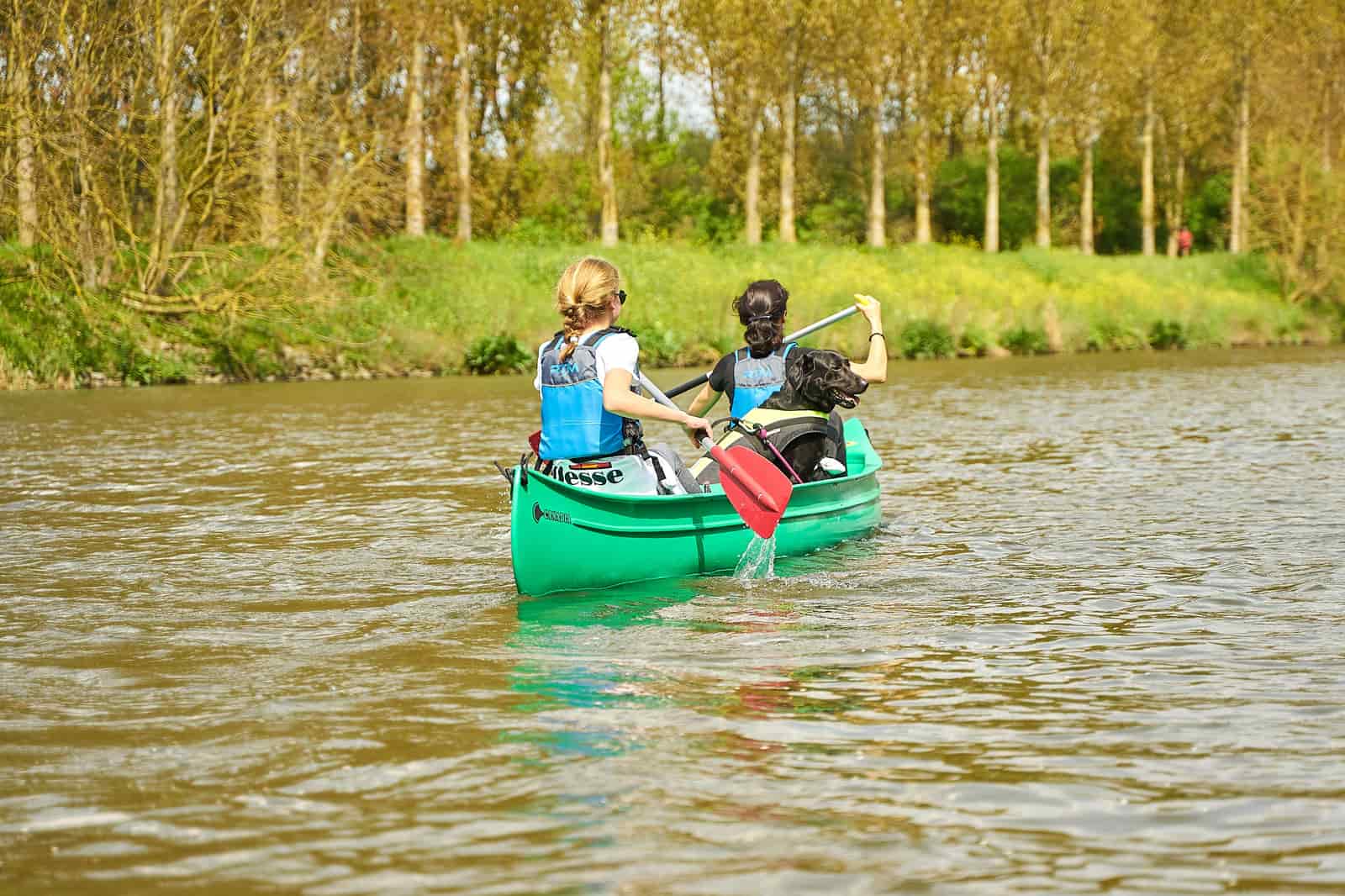
For a dog over about 50 lb, a tandem is usually the honest answer. The rear deck of a 13 ft 6 in tandem is genuinely dog-sized, the 550 lb rating absorbs the weight without argument, and 34 inches of beam means a dog standing up to look at something is not an event.
The cost is a 78 lb hull and a permanent two-person carry. That is a real cost and for a large dog it is usually worth paying. The tandem comparison.
Questions people actually ask
What kind of kayak is best for a dog?
How much capacity do I need for me and my dog?
Will my dog's claws damage a kayak?
Do dogs need life jackets in a kayak?
How do I train my dog to ride in a kayak?
Where these numbers came from
Every figure on this page traces to one of these. Where a number could not be sourced, the page says so rather than estimating it.
- Eddyline Kayaks — Maximum weight capacity versus ideal capacity for various styles of kayaks (manufacturer, states the 60-70% ideal-capacity band)
- Perception Rambler 13.5 Tandem Sit-on-Top Kayak — manufacturer specification as published on the Amazon listing, read 2026-09-02
- Perception Tribe 11.5 Sit-on-Top Kayak — manufacturer specification as published on the Amazon listing, read 2026-09-02
- Pelican Seek 100X Sit-on-Top Kayak — manufacturer specification as published on the Amazon listing, read 2026-09-02
Read next
Best Tandem
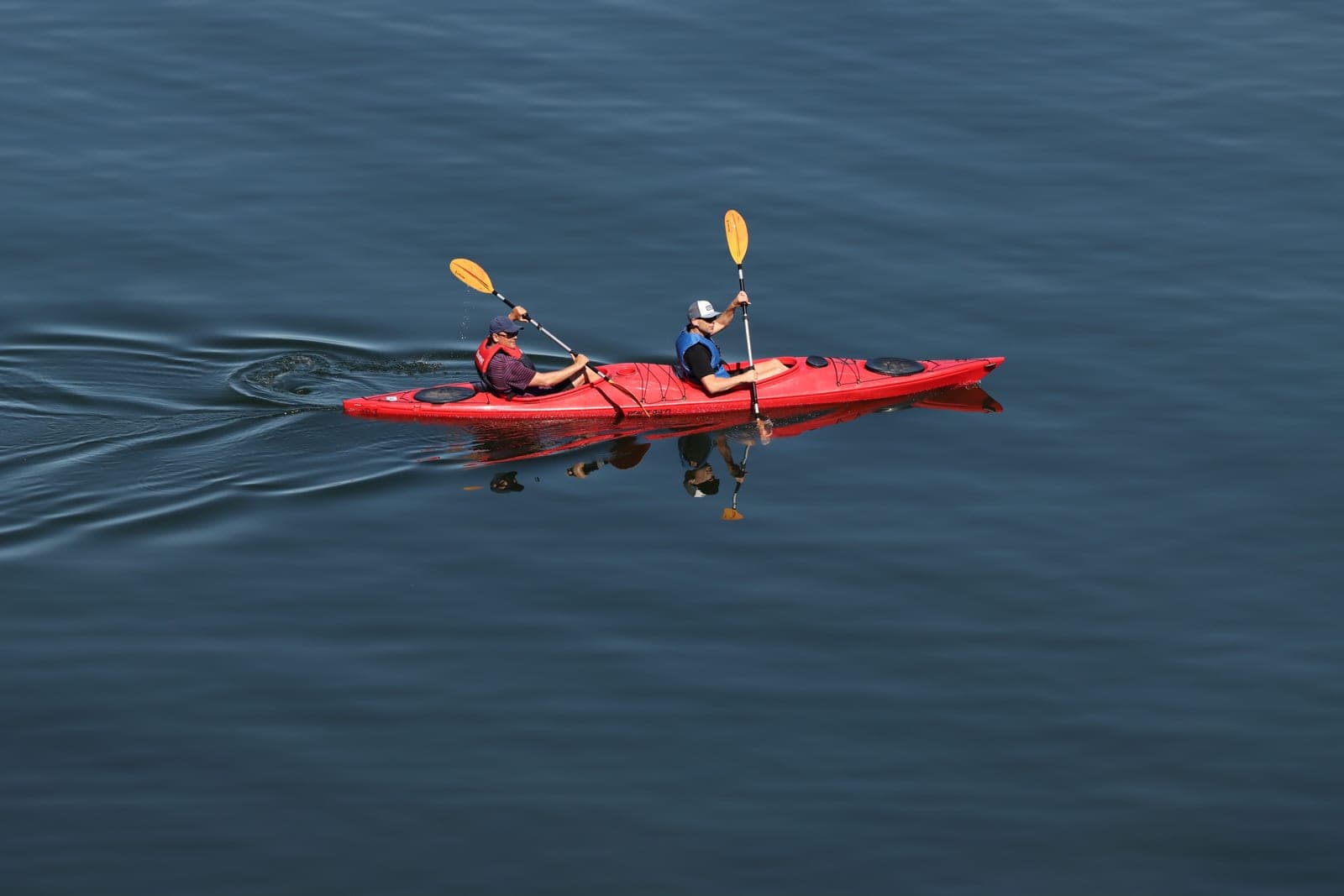
The Best Tandem Kayaks
Tandem kayaks with the usable-capacity arithmetic done — a 500 lb tandem covers less than most buyers assume.
Top pick
Perception Rambler 13.5 Tandem Sit-on-Top Kayak
Two adults plus a child or a dog
#ad · how this is funded · price as of October 18, 2026

Sit-On-Top vs Sit-In Kayak
Water temperature and remounting decide this, not preference. The honest comparison, with picks for each.
Top pick
Perception Tribe 11.5 Sit-on-Top Kayak
The all-round first sit-on-top
#ad · how this is funded · price as of October 18, 2026
Kayak Weight Capacity, Explained
The 65 percent rule, where it comes from, what happens when you ignore it, and how to size around it.
Top pick
Perception Tribe 11.5 Sit-on-Top Kayak
The all-round first sit-on-top
#ad · how this is funded · price as of October 18, 2026

Best with a Dog
The Best Paddle Boards for Dogs
A dog is 30 to 90 lb of load that moves. Boards with the width and usable capacity to take it.
Top pick
FunWater Inflatable Stand Up Paddle Board, 10 ft 6 in x 35 in
Maximum stability in a standard length
#ad · how this is funded · price as of October 18, 2026
Best First Kayak
The Best Kayaks for Beginners
Beginner kayaks ranked on width, carry weight and usable capacity — with the 65 percent arithmetic run on every one.
Top pick
Perception Tribe 11.5 Sit-on-Top Kayak
The all-round first sit-on-top
#ad · how this is funded · price as of October 18, 2026